– Row after row

There’s a kind of making that’s really just manufacturing. There are no choices or problems to confront. No risk. No surprise.
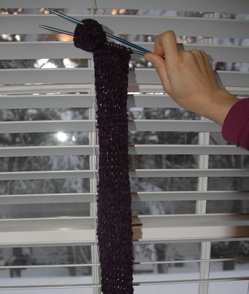
Purple skinny scarfI’m manufacturing a scarf as I sit on the sidelines and wait for Grace to finish her swim practice. Oh, early on I had to make one or two decisions — which of my surplus yarns should I use? how many stitches do I cast on? — but now all I have to do is pick up the needles and start moving my hands to operate the tools in a way I’ve done a thousand times before. As Lydia remarked a few weeks ago about this kind of knitting, it is calming, and it is productive. Row after row after row, the inches add up. I could almost knit this in my sleep. I want the scarf, which is intended for me, yet I feel no urgency about it.

On Monday afternoon, Grace interrupted her swimming of laps, hauled herself out of the pool, and walked over to where I was perched, knitting and waiting for her. Practice was only half done. She looked spent.

“I’m tired. I don’t want to keep swimming today,” she moaned as she leaned against my leg. A conversation determined that her complaint was nothing diagnosable.

“It’s a tough practice,” I replied. “They’re not always fun.” I tried, as I always do when her confidence wavers, to be an external ballast: “You’re halfway there. You look strong.” Inside, I asked myself, Why not just go home? She’s only seven.

“But, Mom!”

With my hand resting lightly on her wet back, I murmured with firmness, “Grace, I know you can do it. Plus, we’re here.” At an education conference in the fall, I learned that children become self-reliant in their interactions with trusted others. It’s our job to coax them, paradoxically, to become more independent. Is this what that speaker meant? I wondered.

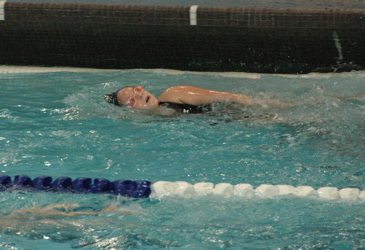
Unhappily, she walked back to her lane and slipped into the water. She looked to the coach for direction, and then she bent her knees, pressed her feet against the wall of the pool underwater, and pushed off. Stroke after stroke, Grace swam 25 meters, then 50, 75, and finally 100.

I looked down at the knitting in my lap and tried to compare my rows to hers. What’s different?

When I started teaching, my friend Lisette, a (former) serious college athlete who also became a teacher, asked me, “What are you going to do this semester to get out of your comfort zone?”

“Huh?” I responded.

“What are you going to do that’s hard for you, that you’re not sure you can do?” she elaborated.

I took her question seriously and thought about it for many days as I was planning the semester, and I built into my syllabus challenges not just for the students, but for me. With a silent nod across the miles to Lisette, I do that every semester.

When I do this kind of mindless knitting, however, there’s no risk for me and nothing of value at stake. Like eating ice cream, it’s soothing and filling in a pleasurable way. We all need those kinds of activities in our lives.

Grace’s rows in the pool, however, are different. She’s not always sure she’s up to it or that she can finish what she has signed on to do. There are tears sometimes, cold water, and nakedness in the locker room. There have been no measurable victories so far, although Grace keeps hoping for them, and hence no ribbons on a loop of thread to hang from her neck. And still, she must practice, practice, practice.
Grace swimming

—-

Picture of scarf in hand by Eli. Picture of Grace by Jimmy.
– Fall to pieces

In revising longer works, it’s easy to fall into the trap of endlessly polishing word choices and sentences, because they are small units that can be both held in the writer’s attention and worked on at once, and avoid dealing with the draft in its entirety.

That kind of fine labor, though, could be like running on a hamster wheel — it’s fun, it’s exercise, but you end up not too far from where you started.

For me, and I think for many writers, the hardest parts of revision are figuring out the big picture (“what’s my pressing question? theme? thesis?”); seeing how the pieces contribute to, or don’t contribute to, the whole; and sequencing the pieces in a scheme relevant to the big picture.

On and off, for months, I’ve been working on an unwieldy draft of an essay. It’s too long — 8600 words — for the journal I want to send it to, which has a word limit of 5000. When I read the draft from start to finish, it feels complete to me and every word precious.

So, the only smart thing to do is undo its completeness, which I did.

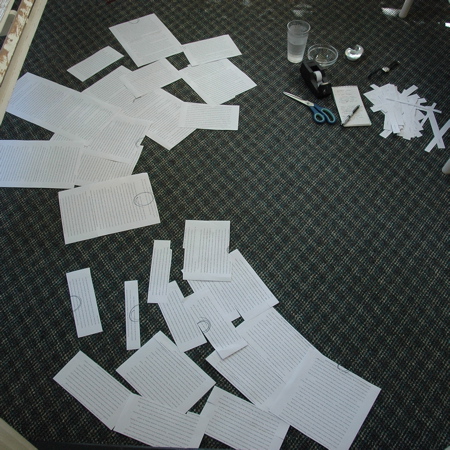
Draft in pieces

I cut it into pieces, based on a similar exercise I’ve done with students and on some remarks that journalist George Packer made to his audience at the Wesleyan University Writers Conference last June. About the structure of his own narratives, he has noticed that the “basic move is between scene and passage of analysis” and “sometimes both occur together.” In the image of my dismantled draft, the pieces in the grouping at the top are scene; the pieces that curve up from the bottom are passages of analysis and, for my purposes, reflection.

Yesterday I looked at each piece and sorted the pieces further: (1) ones relevant to my main idea, and (2) ones not relevant. This work went quickly.

Then I went back into the file for the draft, and I removed (and dumped into another document) all the irrelevant pieces. New word count: 5500.

I’m getting closer. Next step? I’ll lay those patches of paper out on the dining room table, and shuffle them around.

– Convergence

Last week we saw Ratatouille (Pixar 2007) for the first time. Remy is a French rat who loves fine food; his ambition to become a chef is stoked by imaginative visitations from the late Auguste Gusteau, a once-renowned restaurateur who wrote a book titled

Anyone Can Cook.

Yesterday I was sorting through a pile of non-urgent papers that I’ve been hiding, even from myself, in my top desk drawer at home. I came across a document, “NCTE Beliefs about the Teaching of Writing,” that a colleague asked me to read months ago. My eyes fell on the first belief, in bold type:

Everyone has the capacity to write.

These are beliefs. Like the jolly Gusteau, a person can choose to believe that each individual has the capacity to cook (not to become a great chef, but to cook). Like the Writing Study Group of the NCTE, a teacher can choose to believe that each student can write.

What if, however, a chef or a teacher held a similar belief, and yet also maintained an attitude inconsistent with that belief?

How many times have I heard someone grumble about students (especially incoming ones): “They can’t write”? I don’t think that a teacher, whose work is essentially optimistic, believes that college students do not have the capacity to write. What such a teacher is really saying is that her students’ writing does not meet her expectations, or college expectations, and she is daunted by that, and it brings her down. And yet, I wonder, what power does that attitude (“They can’t write”) have on one’s beliefs about one’s own students and, more so, one’s own teaching?

Once in a while I meet a new student in the Writing Center, and, as I read her writing for the first time, I see that it lacks so much in the way of clarity and sense that I do a quick, internal inventory for any teaching skills I might have to offer her as a writer and I come up almost empty. In such an instance, I do feel daunted — it’s like a stone in my chest — and I even set my sights low, not for the student but for the paper at hand. “Jane, just be an attentive audience. Give the student that.” So, I read and I get her to tell me about it. I don’t always understand her reply entirely, but I usually understand enough of it to have a conversation with her about her personal narrative, or reading of a novel, or thoughts about a historical event. I don’t correct or suggest. I listen, ask, nod, smile.

I have been tutoring S., who is such a writing-challenged student, for more than a year. She continues to make sentences that seem more spoken than written, and her grasp of American English idiom is based on what she hears, not what she reads. (For example, in a paper about a high school teacher, she described that person as being “inch arch” of a learning center. She and I figured out that the teacher was “in charge” of a learning center.) Encouragingly, I also see that her sentences are longer and more flowing and that her papers are more fully developed with detail and discussion. She sustains. And that’s a powerful sign of her growth as a writer, but it might be hard to recognize it if I were ticking off her many errors. And there are many; I do see them (and we are just beginning to work on some).

When another teacher, in genuine moments of fatigue or frustration, says to me, “My students can’t write,” I offer, gently, “They’ll get there.” I do not know what my tutee, S., will do in her writing, in school, and in her life beyond my time with her, but I do believe she will get there.

– Cabin fever

Restlessness — a lot of energy packed into a small container (you, your house) — requires an outlet. There are negative ones: complaining, watching reruns of American’s Most Smartest Model, picking at and eating dried-out candy off the gingerbread house. (Yeah, been there.) There are positive outlets, too: cleaning closets, walking around the neighborhood, making something. (Been there, too.)

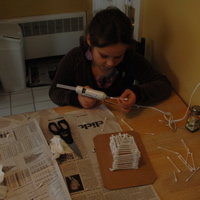
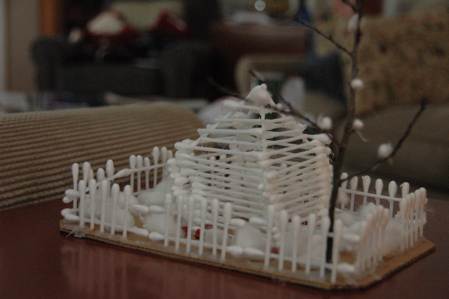
Grace with glue gunGrace channeled her cabin fever into industry today. Inspired by a spilled drum of off-brand cotton swabs, Grace started stacking them into a log-cabin-like structure, and then called for glue. I produced a lower-heat glue gun; I also handed her, unsolicited, a piece of cardboard from a discarded Amazon book box. The impulse evolved into a project, and she worked intently and inventively for a long time, even figuring out how to construct a hip roof by herself (she didn’t know she had made a hip roof until I walked back into the kitchen, saw it, and said, “Hey, a hip roof, just like on our house!”). She stripped a twig of bittersweet, in a bunch in a pitcher on the counter, of its berries and then made a tree in her little cabin’s yard. She used the red, shriveled berries as decorations around the house. I volunteered to help fashion a picket fence after she scalded herself a couple of times with hot glue.

Out of a drawer in the bathroom, Grace pulled a bag of cotton puffs, and she tore these up and put them in the little yard, for snow. “What do you call this?” I asked her. She answered, “Hmmm. Centerpiece of Winter.”

Cotton swab house

I put it on the table where the crumbling gingerbread house had been. A few of us took turns taking pictures of it. Jimmy even took a picture of Grace taking a picture. In her manner, she copied some of Eli’s photography tricks, moving both herself and her subject around, playing with angles and how she held the camera, sometimes close to her eye, sometimes an arm’s length away. I like this one — a bird’s eye view of her house, through the glass top of the living room coffee table.

House from above

And so go the days of our (winter) lives.

—-

Top picture by me; middle picture by Eli; and bottom picture, of her own creation, by Grace.

– Say “yes”

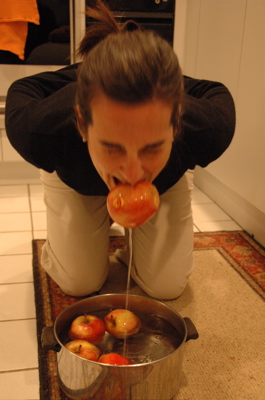
This was not my idea. When Grace set it up yesterday, and then asked, I almost said, “No” or “That’s for Halloween.” Fortunately, that switch clicked off before I fully activated the negative response.

I said, “Yes.”

Jane fishes apple, NY’s Eve ‘07

We all did.

In 2008, let’s all keep protesting the war, interrogating the candidates’ messages, and resisting sloth.

Don’t forget, though, to sometimes flick the “yes” switch. Ride the roller coaster or, at least, the waves. Ski again. Dance in public. Have a tea party. See your friends more. Smile wide enough to show your teeth. Leave the beds unmade. Write, sing, sew, draw, paint messily and off-key.

Repeat a few times.

– Power tool

A few weeks ago, Eli came across instructions online for making his own messenger bag out of fused plastic bags. He e-mailed it to me and asked if we could make one. In the past few days, we did.

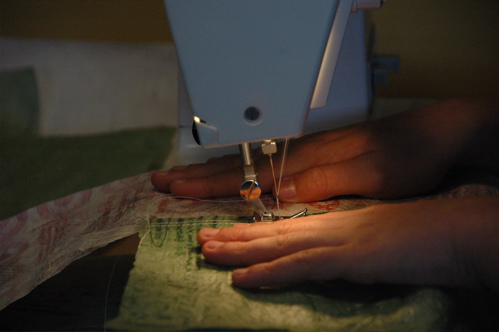
An absolute novice, he approached the sewing machine tentatively yet was open to advice and coaching. After his first few wandering seams, he got the hang of it. And eventually he got into it. From start to finish, we prepped, cut, sewed, and finished that bag together. I believe that Eli experienced the awe and sweetness of having one’s hands close to substantial mechanical power and guiding that force with purpose.

Eli guides fabric in the machine

If you know Eli and me, and you’d like to see highlights from our project, then click here for a slide show (and choose “Gallery View” for most pleasing size). If you’re a sewer, or if you enjoy reading accounts of do-it-yourself projects, then read beyond this paragraph for my description of how we adapted Bre Pettis’s directions to make Eli’s bag. At the very end, you’ll find a photo of the bag we made. Continue reading

– Why do it?

Lydia has been knitting like a fiend, aiming to finish some pieces before Christmas. Her knitting goes to school with her; she works on it during free time in the afterschool program. She reports that her friends, non-knitters, have asked her, “Is it fun?” Lydia says, “No, it’s not fun.”

So, as I sit on her bed one night and speedily cast on 45 stitches for her next item, I ask her why, then, does she knit?

She answers, “Because it’s calming, and…” (she hesitates, searching for the word) “productive.”

And, you know? That is what knitting is.

– Consider the sink

You spend a lot of time in front of it, so you think sometimes that the television or pc is the most important object in the house. And you wish it wasn’t.

Take comfort: You spend a lot of time, too, at the kitchen sink. It is more essential than the screen, and perhaps you even enjoy, like I do, your time in front of it.

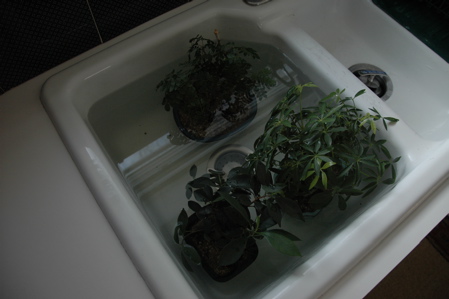
Beyond its usefulness as a trough in which to wash potatoes and dishes, the sink is a player in parts of your life that have nothing to do with food. If, for example, you are an indoor gardener like Jimmy, you give your bonsai their weekly soak in a sink.

Bonsai in sink on snowy day

Paintbrushes get clean there. Women bend themselves over the sink and wash their hair under the kitchen faucet; it’s something we start doing as teenagers and then keep returning to. During the morning rush, teeth get brushed and the last going-out-the-door glass of water gets drunk there.

Because you’re standing there so often, sometimes you kiss at the sink.

Babies have their first baths in stainless steel or white enamel tubs set into the waist-high countertop. Perhaps puppies do, too. When children are toddlers, and after they play in the backyard dirt with the hose, they get carried shoeless into the kitchen, plunked down at the sink, and have their feet and calves and shins washed of mud with the sprayer and by their mother’s soapy, slippery hands.

When children are older still and bring home head lice, they lay their long, sturdy bodies down on the counter and hang their head into the sink for what I call “the treatment.” Here’s an excerpt from an essay I wrote about the experience of nit-picking:

A prehistoric creature with a tough carapace and immense evolutionary stamina, the lice resist the drugstore poison that I massage through my son’s hair, and the next day through my daughters’ hair. Working in the kitchen, I bend their necks over the edge of the sink and rinse the white cream that smells like deodorant – both fresh and chemical – from their hair and their heads, holding the sprayer in one hand and supporting their skulls in the other. Trying to see, I lean over them and into them. My arm or breast through my t-shirt frequently brushes a shoulder, cheek, or, in the case of my son who is standing and not lying on the counter like the girls, a back. The gentle pressure makes us close and I wonder if they are aware of my body and the part that is touching them, as I am aware all the time when I am with them of their bodies and what their parts feel and smell like, how they have grown and lengthened. Their hair straightens and darkens in the stream from the faucet. The children are hypnotized. I wish the running water alone could rid them of parasites.

The window over the sink has, in many houses, the best view. If you’re tall enough to look out, you stand there often, for long periods of time, and stare at the steady trees and grass. You spot the neighbor’s gray cat, which is the exact color of a shadow but for its white feet and snout, and sometimes you see a rabbit shading itself under hosta leaves. And the squirrels, always the damn squirrels. In the winter, you watch a snowman’s creation, a snowball fight, the snow angel parade. There is no “world” out the kitchen window, and so the trance you find yourself in, standing in front of the sink, is local. At night, you try to look out and see only yourself reflected.

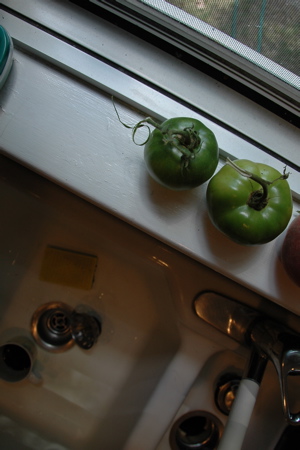
Tomatoes on window sillOn the sill, you keep the shampoo at hand. Someone emptied her pocket of a few rocks and pebbles, and now they belong. In late summer, the green tomatoes soak up the slant of sun. A wedding ring or watch visits occasionally. When the power goes out, you light a candle and place it on the ledge in front of the window and above the sink, for safety and a bit of illumination.

—-

Bonsai picture by me. Tomatoes on sill by Eli.

– Prompted by snow

The view of snow out of a second floor window into our backyard reminds me of other times, in other winters, I’ve stood at the same window and looked out on the same view. These linked memories seem to collapse time and heighten the present moment.

Snow out window, December 14

Yesterday I was the first adult home, and I dug out the driveway. This morning, I dug out a 600-word essay I wrote in mid-winter 2003 and tried to publish, in a local newspaper, in winter 2004. It seems fitting to publish it here today. Yes, it’s about snow, and something more.

—–

Snow Hunger

February 2003

This morning, snow again. The branches of the bare and mature Japanese maple outside the girls’ window is furred with snow, as if the snow had grown there. The lower-growing junipers in the back, planted like fence posts in a line by the neighbors on the border of their yard and ours, are top-heavy with snow, their heads bowed in awe of the maple.

I say out loud to Grace, “Oh, look at the beautiful snow!” Almost three and unstoppable, Grace jumps off the low bed she is dancing on, steps onto the blue stool at the window, and blurts, “Oh, I hungry for it.” Her instant desire, I know, may have more to do with getting the snow into her mouth than appreciating its beauty, but I am instantly touched by her word choice, so more deeply true than “I want to eat it.”

I love the snow and the cold. Especially the snow. Last winter there was none that accumulated, and in this house we wished daily for it, watching the sky out our kitchen window as if we could discern the signs of weather. We wished for freezing temperatures, too, a long string of sub-freezing days and nights.

In December last I bought a backyard skating rink kit, and Eli, Lydia, and I assembled it in the backyard on an afternoon cold enough for coats and gloves but not too cold that it would have been unwise to run the hose for several hours. The water started running into the 17 x 21 foot form in mid-afternoon, and even at 9 p.m. Jimmy and I were still checking the progress of the fill. Moon glow and a backyard light shimmered on the water, yet we could not see well and so had to put a finger in to check how far to the top edge of the frame the water had reached. By our bedtime it was full. We turned off the hose, disconnected and drained it, and coiled it away in the garage for the winter, its last watering task done.

A day here and a day there, temperatures dropped below freezing. Through January, February, and March 2002, however, there was no trio of days cold enough to freeze such a large quantity of water. Nevertheless I loved looking out at that still, shallow pool every morning as I filled the pot to make coffee. I noticed the stray leaf or two that had fluttered down and settled to the bottom, a dark rotting brown against the slippery vinyl white. Some mornings there was a crust of ice; leaves and broken twigs rested lightly on it. Those days gave us hope for even colder weather, for a giant puddle to blossom into a skating surface, for a frosted patch to fill with bright, whirling parkas and a flash of skate blade and the shrieks of the neighborhood children convening in our yard.

The hope for cold and ice — for extreme weather — was the only hope last winter. I also remember sitting on the wooden steps leading from our porch into the backyard a few months earlier, on September 11, 2001. It was a stunning and clear afternoon, and I remember peering at the blue sky, the Japanese maple leaves not yet ready to turn from dark green into their autumn flame, and these words bursting into my thoughts: “I will never be happy again.”

One season later my daily wish for a certain kind of atmospheric condition, and the ice it could bring, lifted me. Better it was, I think now, that a sustained freeze never arrived. There was so much potential in that silent, inexpertly made pool of water.
—–

Picture above, of the view from the window at 8 a.m. today, is by me. Picture below, of the tangle of tree branches seen through the same window, is by Lydia.

Snow on branches, December 14