Dead turkey inspires poem

6721770717_518cc40136_mGrace had the idea we would brine the Thanksgiving turkey, which sounded simple: put turkey in giant ziploc bag, add water to cover, and put in one cup of kosher salt for every gallon of water. The task was arduous, considering that the turkey weighed 20 pounds and the water an additional 25 pounds (three gallons x 8.34 lb. per). Getting it into the refrigerator was handled by Jimmy, aided by a sturdy dishpan.

I interacted with that turkey a lot in the 24 hours leading up to the time that cooking began. By 8am Thursday it was in the oven. Throughout NaNoWriMo , I’ve been doing my prose poem writing at night. But after my encounter with the turkey, I couldn’t wait all day. Inspiration was right there. I sat down. I went with it.

Headless Bird

The neck, broken, is inserted into the place its beating heart once went. That’s there
too, packaged in plastic, a gift from the slaughterer to the cook. The cold skin like
an old person’s, loose on the bone, yet like a baby’s, inviting touch. Empty and patted
dry, the body gets filled with white onion, branches of thyme and rosemary, and two
rubbery carrots. A long loose flap of skin I stretch over the spinal stem and under
the back, which rests on a rack. The pliant flap, like a bandage, hides a cross-section of
connectors that once signaled a head — no longer here — to turn, to look, to peck.

—–
Image credit: Turkey (2009), wattpublishing on Flickr via a Creative Commons license.

NaNoWriMo: Progress Report 1

The first 10 days of my first-ever participation in NaNoWriMo are done! What have I learned from my daily attempts to write a prose poem? (I am following the spirit of the month-long event by writing more, although not following it to the letter, by writing poems instead of novel pages.)
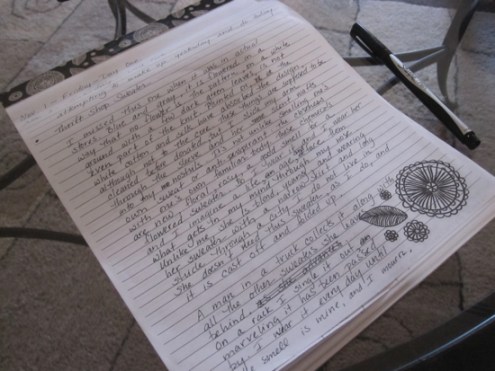
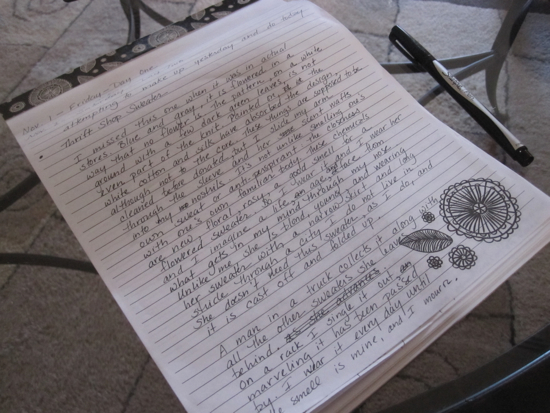
draft of prose poem, “Thrift Shop Sweater,” from Day One

1. I can write creatively even on days when I have lots to write analytically. Constant analytical demands do not ‘kill’ the occasional creative ones.

2. Paper is a nice change of pace. On Day One, sick of my laptop, I grabbed a new pad of paper and a pen and wrote my lines on lines. It worked. I’ve stayed with the handwritten medium for the whole 10 days so far, and I find the blank notebook page to be more inviting and the whole experience to be more pleasingly tactile.

3. A new ritual heightens the experience. At around 9pm, I stop the chores or take a break from paper-grading and set my paper and pen on the kitchen table. Jimmy, who is writing short stories during NaNoWriMo, joins me with his laptop. I take out a juice glass and pour some wine for myself. (If you know me, you know this is typically not me.) I do not fret; I write.

4. I’m using this as an opportunity to discover what is prose, and what is prose poetry. I like introductions and I like context, and I have found that this is my customary gesture: to begin by situating the reader. A few sentences in, I realize I am explaining too much, setting a scene too much, and I pull back and try to turn off that part of my brain. (A teaching part, maybe.) Poems may not have story logic, I remind myself. I try to follow images that may not make sense. I leave gaps.

5. The constraints of a page remind me that a poem has to conclude. When I’m within about three inches of the bottom, I start to wonder how I’m going to see it through. That awareness causes what feels like a downshift or upshift, as though my imagination were a motor. The poem turns.

6. Knowing that writing is on the evening agenda, during the day I keep my eyes and ears open for inspiration. One day, driving to the rink for a skating lessons, I heard an ad for No Doz. The tag line, unbelievably, is “a trusted leader in mental alertness.” At the next stop light, I wrote down what I planned to make as a first line: “He is a trusted leader in mental alertness.” At 9pm that night, I wrote a poem about him.

7. I cannot start after 10pm at night. My brain cannot generate anything new. (Funny, I can grade papers after 10pm at night.) I thought that fatigue would help strike down mental barriers to creativity, but it only strikes down enthusiasm and vocabulary.

8. Only a percentage of my output delights me and may lead to something. I see that this exercise might yield only a couple of poems, and those will need revision. So far, my favorite thing is a title I came up with for a poem: “The Dead-Cold Peace of Saying No.” The poem is so-so, but that’s okay. The daily writing is bringing something to life.
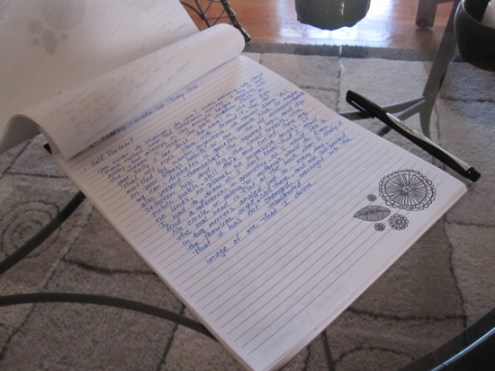
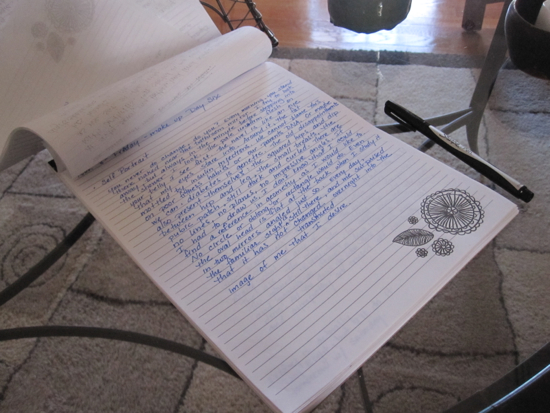
draft prose poem, "Self Portrait," for Day Six

draft prose poem, “Self Portrait,” for Day Six

That’s why they pay us

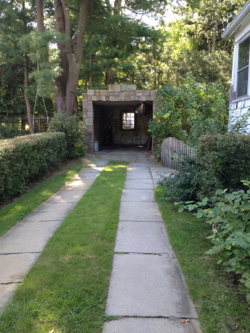
photoLast year I bought the materials needed to repair the concrete around our bulkhead that is crumbling in a few places. I suspect this is a back-door entrance for mice into our house. I then threw a blue tarp over the bulkhead, weighed it down with a few old bricks, and procrastinated the task for several months. Yesterday, I re-started.

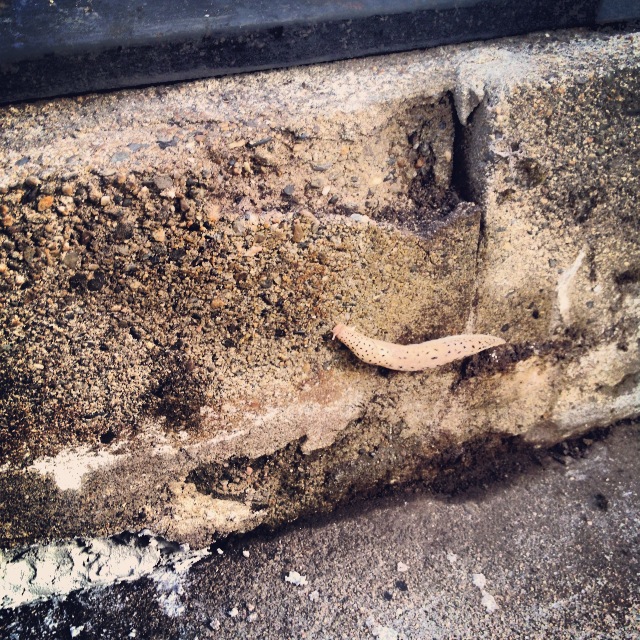
This morning I went into the backyard to inspect if the first layer of Quikrete® had dried. I kneeled and touched it. My peripheral vision noticed the immobile, five-inch long slug, and I jumped up, disgusted. I stood back; I stared at and then photographed it. (Note: you can click on the image and see the full-sized beauty.)

I was both fascinated and repelled. I remembered some work I did the summer before college, when I took on lots of odd jobs to make money: child care, house painting, and landscaping. Neighbors hired me to clean out and mulch under their deck, which was built only about three feet off the ground, so I had to crawl on my hands and knees in that dark wet space for hours. Enough light seeped through the spaces between floorboards and lattice on the sides that I could spot broken cement blocks that had been discarded there, and I spread around huge double handfuls, one after another, of the spruce mulch. Occasionally under my dungareed knees I felt a pop. Only when I got out to the light did I see the mucus-y smear and realize how many slugs I was sharing the space with. I forced myself to finish the job, shuddering when I felt the pop and pressing on. I liked the smell of mulch — still do — and had my pride to consider.

This is what work is sometimes, isn’t it? We accept the big task with enthusiasm or at least willingness, and then the hours and days present us with the actual nature of the work: the dirt, bent back, slug slime, and belief that we were made for better things or at least great praise and compensation for our dedicated labor. All work has some of this, even art. I don’t love everything I do, and I don’t believe that old lie: Do what you love, the money will follow it. But I am satisfied when the mulch has been laid down and the broken bricks thrown out. I can at least say, “Someone had to do it, and that person was me.”

Writer’s 15-minute confession

Sometimes I feel as though I am dying by not writing.

By “I,” I mean my creative self, not my physical body.

By “dying,” I mean losing force, vitality, hope.

By “writing,” I mean the right words on a matter of personal or artistic urgency.

I went to the bookshelf to find a poem to work on with my adult ESL student today. We are studying modifiers, and those grammar workbooks will kill your interest in words. They are so earnestly done. They seem to have nothing to do with any language that people actually speak or write.

Charles Simic, Philip Levine, Robert Frost. Mark Strand’s “I Was an Arctic Explorer” was on my mind, but I couldn’t put my hand on the book. Mary Oliver’s What Do We Know: Poems and Prose Poems will do.

“Black Snake,” first line:

The flat rock in the center of the garden heats up every morning in the sun.

Instantly, you are somewhere else. You see it in your mind as you’ve seen it before. You feel it; you are the rock.

This poem was in front of me like a piece of cake I could not eat. I know I am exaggerating. But I am close to the cake — so close I could put a fork into it, put the fork into my mouth — but I cannot. Not because I am unable, and not because I am afraid, but because I should be doing something else. I am preventing myself. I am in my own way.

And time will pass, life will happen, I will notice things like flat rocks, bare toes on concrete, and the uptwist of my daughter’s hair, and someone else will be writing about them.

I will be grading your paper, attending your meeting, revising a lecture, listening to your complaints, fielding a question, cooking a meal, signing a school form, getting some sleep.

This may not be factual. This though is what it is like for me to not write.

Lost and found writing

garageI’ve been on Google Docs, which is now part of Google Drive, since the beta version became available. (Was that 2007?) I do most of my writing in that environment, whether collaborative and individual. I’ve lost track of what I’ve stored there.

Recently, I was searching for a document I knew was in there, and I came across one with an unfamiliar title, “toc: Jane’s World.” While I don’t recall the moment of this file’s creation, I recognized the contents immediately. It’s an annotated table of contents of a book of essays I imagined writing and publishing. There is a list of 11 titles with short descriptions of them after.

The table of contents was aspirational, I could see. The titles of essays were mere drafts; I’ve thought of better ones since. What really made me happy was to realize that 5 of the 11 essays were since completed and published, and one is well underway.

I worry a lot that, with time being fragmented by work and personal responsibilities and activities, no writing gets done. This lost and found table of contents makes me realize that writing is getting done.

Though many of my professional hours are spent as a teacher, I am still a writer. The list is akin to a letter written by the self years ago. I’m sending her a thank you note.

You say editor; I say writer

Health Axioms, cover image, as poster

Health Axioms, cover image, as poster

With my MIT friend and colleague Juhan Sonin (a founder of Involution Studio Boston and, like me, an instructor on MIT’s 2.009 product design capstone course), I have been working on the text for Health Axioms, a beautifully illustrated set of cards that conveys health knowledge and preaches action. After almost a year, the project is coming to a finish. I’m so excited! The art, text, and package are smart.

Two weeks ago, I went to Invo’s fourth-floor studio in Arlington Center for a review meeting with the team, which includes artist Sarah Kaiser and Juhan’s colleague Harry Sleeper.  Propped on the final stair landing was a full-size poster of the package cover (see image). Around the studio hung more poster-sized images of individual cards. I suddenly pictured these in doctor’s offices and clinic waiting rooms. I imagined people inspired to move more, eat better, meditate, seek comfort, find happiness, and track data as a result of sifting through the cards.

It’s great to be on an effective team and produce a high-quality product. At the end of the meeting, Juhan wondered aloud if it really takes about a year to design and develop something good or, if we all had concentrated on it full time, could we have pulled it together in a month?  Knowing myself, I’d say the year was necessary. But high-energy quick thinkers might be as effective under a tighter time constraint. This much is true for all of us: quality work takes REVISION. Designers, you might call this iteration. No matter the time frame, a good product evolves over many versions. (And the first one sucks.) Continue reading

That’s not me, or is it?

clinic comfort station

clinic comfort station

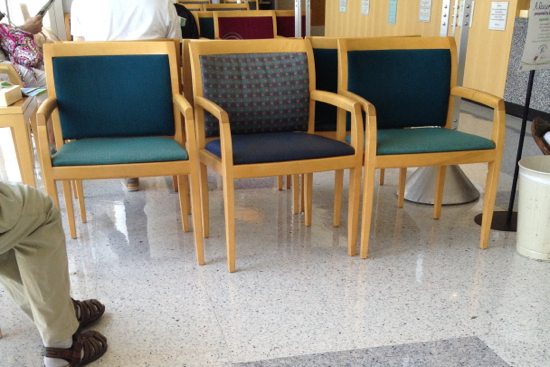
For several years, I have periodically visited a hospital clinic to see a specialist about my anemia. The clinic — Hematology/Oncology — mainly treats very sick people. As I have waited in the waiting room, mentally I have set myself apart. “That’s not me,” I have thought with willed conviction, seeing a person in a wheel chair across from me or hearing another person’s muffled crying in the alcove where they take our vital signs. (An essay I wrote on a moment in this waiting room, where I witnessed a doctor ask his patient to dance, is published here: link.)

I was there again in this clinic a few weeks ago, on a Wednesday after lunch. Typically, the mood is subdued. It’s a very serious place. This time, though, the emotional container seemed to have burst. As I stood at the check-in desk, a woman ran into the waiting room from the adjacent treatment area, sobbing and calling for a doctor by name.  Couples came in holding hands tenderly. I saw a woman, about my age and very thin, shuffle in. As she leaned on the check-in desk to state her name, her white tshirt clung to her trunk and I could see that her abdomen was the site of large tumors. She and her husband sat near me. They murmured together, about the tumors. He was a very good helper: he listened, he placed his hand on her back for a little while and then removed it (so as not to tire her out being helped, I thought), and he did not take over.

I tried, as usual, to stay detached, to think of myself as not that sick and therefore not of them. But I couldn’t hold the pose. What was it about this day? The chemistry of it, perhaps. My thoughts went in a different direction than usual, more stark. I ruminated on sickness and health not as a binary but as a continuum. We are all on it, and our position on the continuum changes as we go through life. And maybe we can find ourselves occupying two points at a time on this continuum. For example, although I have diabetes as a diagnosis (and it is a disease), I take care of myself and identify myself as a healthy person.

Maybe it would be better to give in, I sometimes wonder. On this day, I did for some reason feel vulnerable as I sat in chairs, waiting. “We are all sick, or will be someday,” I mused. It turns out, although I could not have predicted it, that my body is not quite as I thought: link. I do belong, not to the cancer club, but to the human one.

waiting for patients

waiting for patients