– Needles and activism

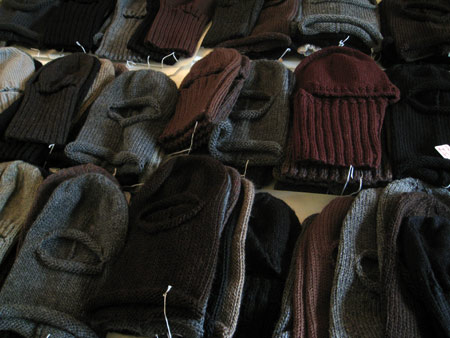
The knitters at Stitch for Senate are making helmet liners for every member of the U.S. senate in order to engage “with public officials about the war in Iraq.”

Helmets, stacked, by Stitch for Senate

"Helmets, stacked," by Stitch for Senate

This puts me in mind of Eyes Wide Open, an exhibit of boots and shoes, representing military men and women killed in the Iraq War, that we stumbled across once when we were visiting my in-laws in New Jersey.  We drove past a library and on its front lawn were rows of boots.  Plain, magnetic.

When artists and activists use the everyday, intimate, and individual to make a statement about the enormous — war, power, death — that brings the enormous in close.  I can imagine my head in the knit helmet, and my feet in the boots.  And perhaps by imagining myself inside, I can start to imagine the other.

– Crow season

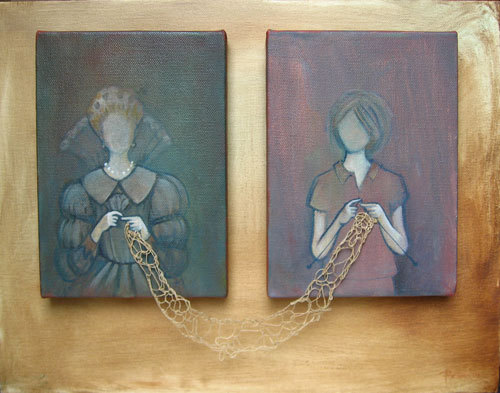
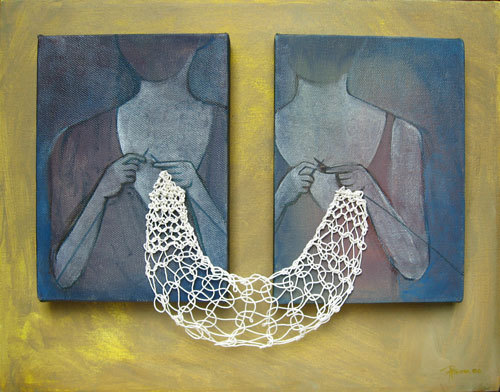
Jan sent me a link announcing new work by Vermont artist Carol MacDonald, in which she “examines the tradition of knitting through a variety of print-making techniques.”  I love it, especially that the featured image is “Red Skein I.”  (What is it about red yarn?)

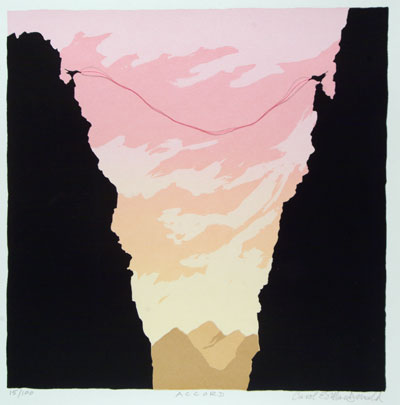
I looked deeper into MacDonald’s portfolio and found even more that I liked, especially her paintings and prints with crows as their subjects.  Her works have titles like “Convergence,” “Bearing Arms,” and “Resolve,” and they are more than portraits of crows.  There occasionally seems to be a bit of string in them, too:

"Accord," Carol MacDonald, silkscreen/thread

"Accord," Carol MacDonald, silkscreen/thread

It’s crow season again.  Yesterday and today, in the mild, fall weather, the crows are landing and taking off in the yard, again and again.  Continue reading

– Best brief bio

Yes, I do read the “Contributors” section of magazines and journals and study the array of author and artist credentials, which are always publications, prizes, occupations, affiliations, and educations. Here’s one that stands out from all that:

FELIX SOCKWELL is a designer and illustrator living in Maplewood, New Jersey. The illustration on the cover of this magazine, “Truth Seeker,” is a piece that he has been developing, redeveloping, and agonizing over for fourteen years.

From Poetry, September 2008.

– Retreat day two

The draft of “The Work Hands Do” grew by 1,716 words today. I feel like I’m coming to the end of it, like maybe tomorrow I could verify some facts and finish this version, of which this section is part:

There’s a stigma to lice, and I’m not sure what’s at the root of it. After all, the head lice epidemic largely affects school age children, six to twelve million a year, according to a recent report by the Centers for Disease Control. We’re not, as a culture, afraid to discuss other school age illnesses, like asthma and food allergies, so why head lice? Head lice are not sexually transmitted, although pubic lice are, and perhaps the two conflate in the public’s imagination. Body lice are prevalent among the homeless, so head lice, too, may be associated with poverty and poor hygiene.

Maybe that’s it: lice are dirty, whether you’re talking about grime or sleaziness. If contagions are preventable – haven’t we all increased our attention to hand-washing in the last several years? – then a head full of lice is an outward sign of poor fastidiousness and moral failure.

I had lice at least once, during one of the several times my children seemed to be farming them on their heads. At first, the itching seemed sympathetic. I’d comb squirming lice from hair for hours, absorbed in my task and mesmerized by scurrying creatures, and later as I lay in bed and tried to go to sleep, my head felt as though its surface was crawling with microscopic feet.

One day, though, after I finished spitting out toothpaste water into the bathroom sink, I raised my head, glanced at myself in the mirror, and caught a glimpse of a louse skating along one of the hair strands that brush across my forehead. I leaned closer and saw it dip down into the hair, out of sight. Visual confirmation of what I had suspected made me relieved and squeamish at once.

It was late, so I went to work, where I did not tell my officemate about the louse sighting. I decided, simply and inconsiderately, that I did not want to deal with unanticipated consequences. Are omissions lies? Not always, but, in this case, yes.

During a break, I went into Metaphor Yarns in nearby Shelburne Falls, because I had to. I met the proprietor, Meta (pronounced Meetah) Nisbet, who told me about a wonderful series of books by Sally Melville and then realized she was out of the very one I wanted. I mentioned that I had stumbled across Shelburne Falls years ago, when we were driving back from MASS MoCA with the kids and simply had to stop somewhere, and we discovered her town and the magical Bridge of Flowers. She asked if we had caught The Knitting Machine when it was at the museum, and I said no, so she told me about cranes, giant knitting needles, and a giant flag.

What could I do, but go to YouTube and look for it? “The Knitting Machine,” by artist David Cole, is straightforward yet weirdly phallic, and I think it’s meant to be. See what you think:

– Sentence love

Every night Dusty and Honey lie in their twin beds and talk before they fall asleep.

I didn’t write that sentence.  I heard it today, in the middle of a broadcast essay by Hillary Frank on This American Life.  The story is about two sisters in their 70’s who are not twins but who have lived their entire lives together, buying matching clothes, eating matching foods and snacks, and making a matching life.  It’s called “Matching Outfits Not Included,” and you should listen to it.  The author/producer gently raises with the sisters the urgent questions of selfhood that gnaw at many of us, and the sisters gently push back.  Love, not the self, is their currency.

And I love the sentence.  Hearing it, I instantly pictured the sisters, like old girls, in their beds on their backs with blankets up to their chins.  I superimposed on their faces the faces of my grandmother and her older sister, Mae, who lived together in later life: bickering, sharing, knitting.  As I wrote down the sentence on a pink Post-it note, a beat after it was spoken, I admired the author for saving it until the middle of the piece.  It would have been easy to use it as a first sentence — what great names! — like a good pick-up line.  But Frank holds onto it, until the moment after she establishes the sisters’ genuine intimacy.  And then the sentence brings us, the audience, in closer.

– After coffee

Cal Newport at Study Hacks pored over interviews with 10 major nonfiction writers (Ted Conover, Susan Orlean, and others) to extract information about their habits. He’s mainly interested in how they schedule their work days. Most get up early and start no later than 8:30 a.m. A ritual, involving the New York Times, precedes writing for several of them. So does coffee, “lots of coffee.”

His data illuminate more than his cohort’s coffee drinking. Check out his graphs and commentary, and perhaps you’ll “Schedule Your Writing Like a Professional Writer.”

The coffee, at least, I can manage.

—-

Thanks to Jimmy for the link.

– Before coffee

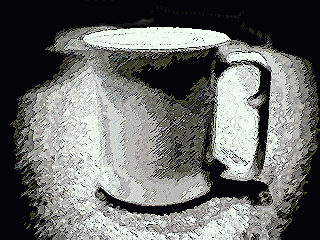
Coffee cup drawing

I like talking to Leslie Sills, my daughter Grace’s art teacher, about process. She’s a sculptor and a writer, so inevitably we get to how making objects and making prose are alike, and unlike.

Once, in a discussion on finding time to do self-generated work, amidst teaching and other commitments, Leslie said, “Before coffee.”

“What?”

She elaborated: “I heard Katherine Patterson speak at the Brookline Library about her work. She said, “Write before coffee.”” Leslie has tried, and keeps returning to, this simple advice.

Intrigued, I tried, too. Many times in the last fews months I’ve gotten up about an hour before I normally would (time varies depending on weekday or weekend) and done some writing while I waited for the coffee to drip.

Here’s a long hand-written piece from early Sunday, October 28, presented to you as is:

So, then a hundred, then 50 more black birds, so black there was a bluish oily tinge to tail and head feathers swooped and circled into our backyard this morning, into Isaac’s, into Gail’s, and pecked for a few minutes in the grass. All the while, they were cackling together almost screaming. But not crows, not big enough to be crows. They must see well, to be able to see between grass blades the insects they peck at. They look purposeful: taking steps, peering down as if seeking, zeroing in, pecking.

When they first arrived, I saw them (I was looking out kitchen window) swoop in an arc from beyond Isaac’s house, in the air around his garage, some made stops in our Norway maple that’s on the property line, before hopping as solid as a stone or fleet as a bullet down onto our grass.

Bird squad. Bird squadron. Bird squads.

As if sensing a signal, the ones scouting the east end of our backyard lifted off and circled away. Hastily. As if being pulled by threads or by a signal that they senses second after, others took off a flew, too. In the crowd, there was a kind of order, even though I felt a kind of compressed hysteria in watching them.

Why did they arrive so swiftly, and from where? Were they hopping from yard to yard, satisfied to get one or two bugs per bird in each yard? Incessant moving, incessant feeding to fuel the movement, a cycle that cannot stop.

This must happen every fall and around this time. I remember in the fall of 2001 — only six years ago? — being home with Eli, and noticing the same pattern with the black birds. They swooped in, blanketed the front lawn, chattering and hunting, and then swooping away. It was ominous, marring, on a beautiful October afternoon. Eli said, “The birds know something. Because they’re in the air, they know what’s coming before we do.”

The terrorist attacks of 9-11 were on all our minds. Eli, only nine years, imagined the birds, like planes, in the air, sensing a familiar pattern (planes fly up there, “we” (birds) fly down here) altered, and knowing that something had changed and was changing, yet not being able to predict what.

And when it happened? Was it another fire for them — treetops burning, cracking, popping and falling — acre after acre — or was their familiarity with buildings and glass enough to tell them that this event was remarkable, something that doesn’t happen.

I couldn’t have written this at night, when there often is more free time to write, because the birds would not have presented themselves to me.

I doubt I could have written this before coffee, because the having of coffee makes me sharper, more thoughtful, deliberate. With coffee, would my mind have wandered to where it ended up?

—–

The image is from Grillboy’s Coffee Cup Project.
– Dead skin dress

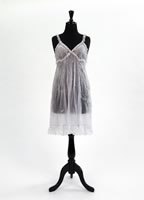
Artist’s “peeled” dressHow floating this is, yet how shaped and shapely. The fabric appears to be gauze or some sort of soft netting. So fine, it’s translucent; any woman wearing it would find her skin visible through it. It appears so lightweight it may even lack weight. On, I imagine it might feel like someone’s breath or a second skin.

In fact, it is a second skin: This dress, made from huge pieces of “hide” created by lavishing her body with a skin-peel facial mask and then gently stripping it off, is embedded with artist Laura Splan’s dead skin cells. The fabric is herself, in a way, which she then trims, sews, and embellishes as she would any delicate cloth.

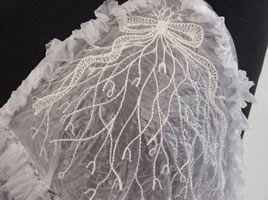
Splan must have a light hand and lots of patience. Embroidered bodice cupLook at the machine-sewn detail on the bodice. She calls this sexy, ghostly work Trousseau (Negligee #1). Inspired equally by the body and artifacts of medicine, Splan also paints in her own blood on watercolor paper, tracing the patterns of neuroanatomical forms. She sews lace doilies based on the structures of viruses. She has knit a blood-filled scarf from vinyl i.v. tubing and photographed it. See for yourself — more of Laura Splan’s fascinating work is here.