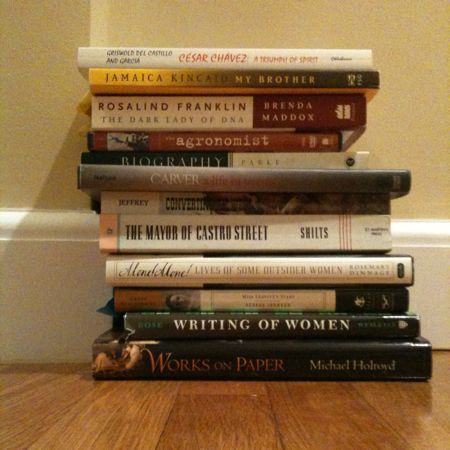
I am instantly in love with this project

This notice from The New Yorker caught my eye and rang the wonder bell.

Patrick Shea, an elementary-school teacher and musician who lives in Brooklyn, has spent the past three years setting “Moby-Dick” to music, writing one song per chapter. He’s performing them with his band, Call Me Ishmael, during a weekly residence at Pianos, a club on the Lower East Side.

I found Patrick Shea’s blog and song list. I found the song for possibly my favorite chapter, 89: Fast-Fish and Loose-Fish. My one-word review: peppy.

Not sure these songs will climb any charts, but no doubt Melville would have related to this display of obsessiveness.

Deep reading, restored


I feared I had lost my attention span as a reader.

Over the winter, with so many work and family responsibilities, I maintained my daily commitment to reading (Jimmy calls it the “Jane Ten” — the 10 minutes I must read every night, no matter what, before I turn in — of which I’ve never missed a day) but only in fragments.

Here and there I read reviews in the New Yorker, articles in the New York Times or Onion online, magazine headlines at the grocery store check out, an essay or two from an anthology, and attachments sent my way by friends and colleagues: “Check this out.” I checked.

I wasn’t really reading, though. I was surfing the printed word. For me, real reading is a sustained, complete experience.

Honestly, I thought I had changed with the times. We multi-task. We browse. We lose interest. In April, I was worried it was over between me and books. They’re long! I don’t have the time! That was the inner dialogue of the new (fragmented, distracted) me.

The semester ended. Finally there was time to walk down the street to the branch library and wander its aisles and read jacket covers and first pages. I found the recent and umpteenth volume in my favorite series, the Inspector Banks mysteries by Peter Robinson. It was my transition back into whole books.

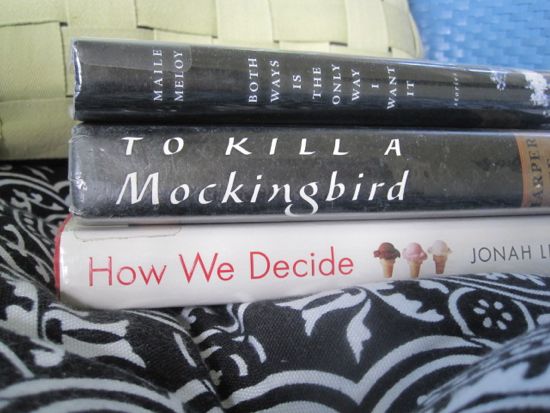
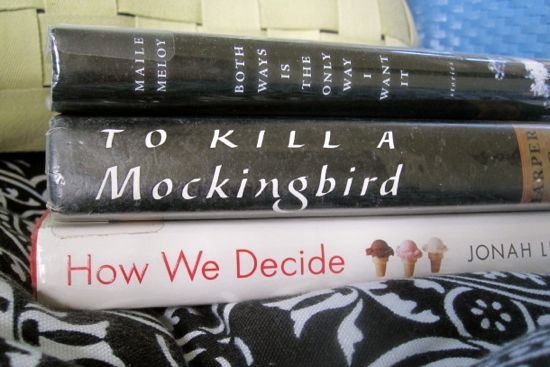
And the next three, one after the other, were Both Ways Is the Only Way I Want It (stories), by Maile Meloy; To Kill A Mockingbird, by Harper Lee (because I had never read it); and How We Decide, by Jonah Lehrer. Yes, yes, and yes.

I’m relieved that I am still a reader. That I wasn’t much of a reader (of longer works) during the academic year, however, tells me that having too much to do, in too many fragments, is an obstacle to sustained inquiry.

What other kinds of experience do our chopped-up days get in the way of?

Telltale art

In July, I got lucky and went to TEDx Boston. My favorite talk was not the expert one by presentation superstar Larry Lessig, but the surprising one by artist Eric Mongeon, on his persistent obsession with what he calls the “dark and thrilling work” of Edgar Allen Poe and his struggle to illustrate and publish Poe’s stories.

What Mongeon says, in part one, about Poe’s work makes me want to return to the stories: “He was writing about fear in uniquely modern terms. All of Poe’s characters experience fear when their fundamental beliefs about their social, personal, or practical situation are somehow invalidated. The world becomes uncertain, because the picture of reality falls out of sync with the experience of reality. And at the root of fear is uncertainty.”

In part two, Mongeon describes a situation he found himself caught in. After years of generating material for his secret Poe project, he realized he was in The Vortex: “A viscious circle of research, rejection, and refinement. It is unrelenting, and it is self-perpetuating because you feel like you’re actually making something.” He soberly adds, “Doing isn’t the same thing as making.”

And finally he knits it all together — Poe’s stories, his own story, fear — deftly.

Original ideas, and a really original presentation. Everything fits: the script, the images, the timing, his clockwork pacing of the stage, and some strategic pauses. Simmering is how I’d characterize this, and worth studying.

Friend of the author

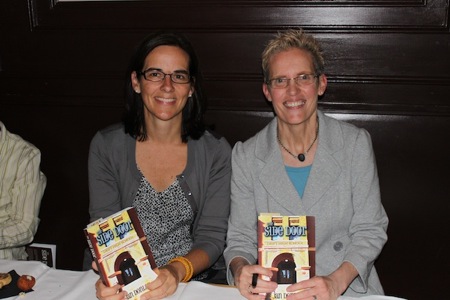
On Monday night, September 13, I was a guest and volunteer at my friend Jan Donley‘s book-signing event at Lineage.

Weeks ago on Facebook I posted this status message: “[Jane Kokernak] is not an event ‘mingler.’ Give her a job to do — coat check, for example — and she’ll knock your socks off.” The message captured my feeling after I attended an MIT event at which I had a job to do. I wasn’t hanging out, self-consciously chatting people up and trying to penetrate small-group conversations. Instead, I was there, by request, to examine student work and ask questions. At other events, I have distributed name badges, guarded doors, and cleared the dinner detritus. In each case, the assigned role made me comfortable enough to do well and have a great time.

Back to my status message. On it, Jan commented, “Hmmm… we might have a job for you at the book launch.” She and her spouse, Diane Felicio, invited me to handle proceeds at the book-signing table. “Of course!,” I practically bleated.

On Monday night, I showed up. I talked to my mysterious friend T. and others, drank wine, ate little crab cakes and figs with bleu cheese, listened to Jan read, saw Diane in her far out dress, clapped for Greater Boston PFLAG (the event’s beneficiary), and played cashier as the author signed books. Of course, I enjoyed it.

And a couple of weeks before, when I read The Side Door, Jan’s first novel, I thoroughly enjoyed that, too.

—–
Event photograph by Diane Hammer.

Be still, my research heart.

At least twice a week, I walk down the long hallway that is glassed on one side with giant windows that look out on the courtyard outside Hayden Library. I look, and I imagine sitting out at one of the tables and reading in the roofless room, enclosed on four sides and open to the sky. Sheltered/exposed. I look, but I don’t go through the door. And no one else seems to. We’re busy.
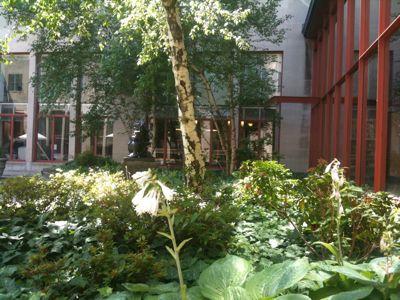
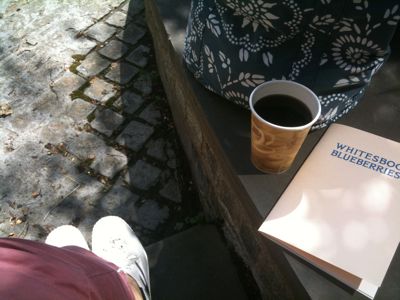
Finally, though, it’s a beautiful day, and I have an errand taking me to Hayden. Through Google Scholar I have found citations to three published articles relevant to my Elizabeth White project. I get coffee at the Clover truck. I head to the library and go through the door. Others have the same idea: there are two young women, with an open laptop, sitting at one table and talking, and there is another young woman at a smaller table, reading. I choose the steps, sit half in sun and half in shade, read a reprint of a pamphlet written by White, and drink the coffee. Already I am happy, like a bee among daisies.
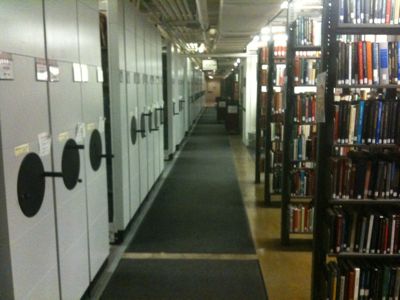
Coffee done, pamphlet read, I head down to the library basement, where the old bound journals cohabitate on those movable shelves. Down there I whiff the minerals of concrete and dust. The air seems to hum, but only because it’s so quiet, and I know that fluorescent lights are supposed to hum. The semester is over; I am alone.
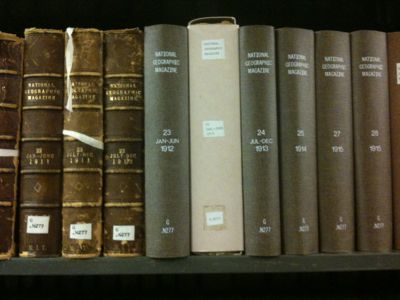
I find the call number for the citations in National Geographic Magazine. Frederick Coville, the USDA botanist to whom Elizabeth White offered her family farm, Whitesbog, as an experimental agricultural station in the 1910s, published three articles in that decade that will help me with my project. Two are on blueberries: one published before White discovered Coville, and one after White and Coville bred a cultivated blueberry that could be farmed. Another article is on the first World War and the U.S. government’s concerns with the food supply in Europe.

Old books have a sour smell, not unlike the tang of expired milk or the acid of bile. When I was a girl and I would open a book with this particular smell in the library and breathe it in, I would consider it mildly vomit-y. I love this smell, and as I open each heavy book I drink it.

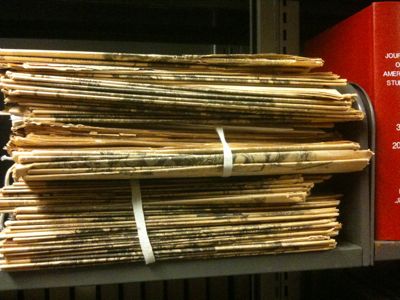
Facing the National Geos are a stack of skinny newspapers. I slide one off the top; it’s Harper’s from 1869. Amazing, I think, that this treasure is out on the shelf and I am trusted to put my human hand on it. It flakes along the fold when I open it wide. Carefully, as though it’s a sheet of glass, I close and arrange it back into place.
My friend Rosemary, doing her own research this summer, offhandedly described her surroundings as “musty old archives,” and reported that our mutual friend, Susan, herself an archivist, first took umbrage at the characterization and then softened: “Perhaps we [archivists] should embrace it.”
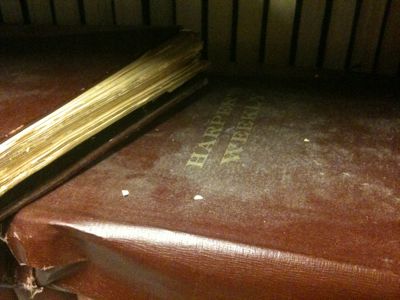
Ah, friends, yes. For those of us whose pulse quickens as our steps shuffle down to the library basement, hands open leather-covered and cool pages, eyes delight in the accumulated dust, and noses inhale the sour cloud of old ink while eardrums vibrate with the hum of what is surely our own heart: embrace it all.
– I’ll take reality.

I have always preferred reality.

I was the child who read the Little House series, Nancy Drew, Tree Grows in Brooklyn, Jane Eyre, Secret Garden, Pig Man, and Anne of Green Gables.

And like my daughter Lydia, I have always liked facts. One spring, when I was about 16 years old, I took a stack of books out of the library’s nonfiction section on farming, gardening, and vegetables. (That summer I also attempted a 10 x 15′ garden on a clayey waste plot in my family’s back yard. What I recall is that lettuce grows quickly, and slugs like to make a home among lettuce leaves, which a person finds out when she holds that salad lettuce up to her mouth and sees a baby crawler on a leaf.) Another time I took out a less goal-oriented selection of books on the human body — a bunch of owner’s manuals. (I remember a set of photographs from a dermatology book on effects of aging, and how an older person could pinch skin on the back of her hand and it would stay in a little teepee shape for a second or two. I tried this on my own hand then and could not imagine a little skin teepee as a possibility.)

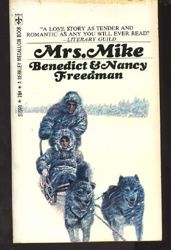
In my fiction reading, as much as I followed plot I liked learning how people did things with their hands: laundry in big tubs, food over an open fire, sleeping 3 or 4 to a bed, toys from sticks and rags, and treatments from poultices (ah, Kaiser Pease’s onion bath in Where the Lilies Bloom). When I picked up Mrs. Mike again, at least 30 years after I first read it, it was to find the description of an emergency amputation that has stayed with me:

I filled a kettle. I lifted it to the stove. The cries drew me back. His nails dug long furrows in the wood of the table. His dark eyes rolled back under his lids, leaving white, unseeing holes. The smooth muscles moved in Sarah’s arms. Back and forth, back and forth. The trap bumped and clanged against the table. Sarah’s strong man’s hand pressed the saw’s teeth deeper into the wound. It quivered, it quivered like jelly. A strange laughter stirred me. Mother and child, I thought. Mother and child. Then Sarah begin hacking. The bone chipped and splintered. I looked at her face, at the clamped lips! I looked at her hands. I thought, how can she do it! I looked again at her face, relentless and calm… His body lay under her hands, twisting, screaming, while she hacked at him calmly with a saw. I stared at a flap of hanging flesh.

Continue reading

– Bulbs and boxes

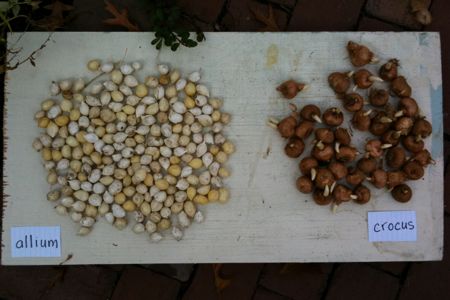
What I like about bulbs, which I planted on Sunday, is their utter forgetability. I dig a hole, drop them in, leave their spot unmarked, and forget. The cold and short days of winter will pass — some sparkling days swiftly, most days grindingly — and then one day I’ll be walking up to the house, with my head down and hands in my bag searching for keys, and I’ll see them. The cocked, belled heads of the crocii will be first.

We moved into this house in the summer of 1999, not sure what was planted but for the big, gumdrop shaped old shrubs. Much of the planted parts of the yard seemed taken over by leaf mold or invasive ground vines. That first summer, the most we did was cut back the overgrown parts and mow the neglected grass. In late February 2000, though, stomping through the yard with Eli and Lydia who were still small and close to the ground themselves, we spotted tell-tale little blue heads poking up just inches from patches of cold, bare ground still circled by snow. Planted by someone else before us, they were like a gift from the past to the future. And there we were.

I had a feeling like that recently when I went up into the attic to rummage through my boxes of books and papers I had packed up in June 2006, when my job at Simmons College ended due to budget cuts. (That was a sad, sad time.) I’m currently getting ready to teach a course next semester on expository writing at the Harvard Extension School, and I’m basing it on the first year writing course I taught at Simmons, in which we read and wrote about biographical texts of my choosing. (At MIT, I don’t choose the texts for the WAC courses I’m involved in; the lead professor does.) I opened box after box and found treasure after treasure: books, DVDs, notes, and handouts I had forgotten. If I were in a movie, I would have had to toss those papers into the air to communicate my glee. Instead, I leafed intently through them, my interest in my dearest interests rekindling; I made a pile of keepers. While I did not speak aloud to the empty attic, I felt like whooping, “Yippee!”

Sometimes pieces of ourselves get shut up and put away, underground or in attic boxes. The putting away can seem as though an interment: Oh, that part of myself, or my talents? It is dead to me. Never again. And then, months or years later, the boxes get reopened, the green leaves and colorful heads push up from the ground, and we realize that the book, the bulbs, those little packets of life, have only been waiting for us, keeping themselves alive, shut away in darkness.

– Getting too much done?

In high school, I had a clerk’s job at the Leicester Pharmacy in the center of our town. It was about three miles away from our house. To get there, often I drove or got driven. Once in a while, I walked and took the lovely meandering way: up our street, down the dirt road that connected our circle to the newer Cricklewood development, out onto Pine Street, a detour through the old cemetery, and then back up Pine Street to where it met Main. If it was autumn, I’d kick the fallen leaves as I walked, in no hurry at all. As I strolled, I thought my thoughts. I hummed to myself, bothering no one.

Last Thursday night, one of my office mates Karen and I were talking about our teenager children as we tidied up the piles on our desks. Their lives, to us, seem to be like full-time jobs, plus moonlighting. Busy, rushing from task to task, sleepless. No time to think their thoughts. Like the present-day us.

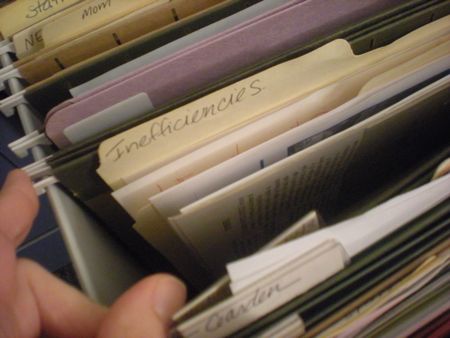
About 12 years ago, when my oldest child (now 17), was a little boy, my friend Martha Mulligan and I were feeling the pressure from our culture to get stuff done, gracefully and in multiples. (This was before the GTD system was even a gleam in David Allen’s eye.) We felt ourselves to be failing more than meeting expectations. Mirthful over our own daily inefficiencies, together (and probably with Eric and Jimmy, too) we came up with an idea for a humor book, with illustrations, called Maximize Your Inefficiencies. Martha billed it as “the Dilbert for your home life.”

I still have the file. I dug it out.

FolderLabel

Martha and I planned for 101 inefficient items, perhaps one per page. It would be like a coupon or flip book, the kind you can purchase on impulse at the counter of a book or gift store. Continue reading

– I would read a book about pencils.

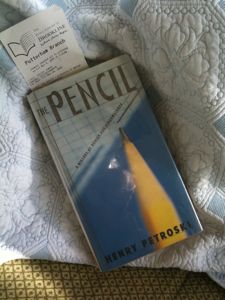
Pencils_Pillow300For some reason, Grace, Jimmy, and I were talking about single-noun-subject books. What concrete thing interests you enough that you would read or write an entire book about it? Salt, for example.

Grace raised potatoes as a possibility.

“Pencils,” I said. “I love pencils. I would read an entire book about pencils.”

Yesterday, my library helpers found and brought this home for me. I saw the title, and my heart started to beat a little faster in anticipation. I opened to chapter one. First words: “Henry David Thoreau seemed to think of everything…” Ah, book heaven.