There are many things that could be done in a day.
There are many things that will not get done.
Choose one of each; others will follow.
—
Thank you to my shower, which gave me this thought.
There are many things that could be done in a day.
There are many things that will not get done.
Choose one of each; others will follow.
—
Thank you to my shower, which gave me this thought.
First of all, this is just to say that the following poem is one by William Carlos Williams that I’ve never really liked. I knew in high school I was supposed to like it, for its straightforwardness maybe, its use of the word “delicious,” but I don’t think I ever did. I do like the sound of “icebox,” yet I don’t like the sound of the word “breakfast” (a stack of consonants and blends!), even though I do like to eat it.
Yet, the title, This Is Just to Say, has been speaking itself to weary me as I stand in front of the sink and look out on ladders in the back yard and see paint splashes in the sink or sit at the kitchen table and hear the builders thumping and singing upstairs, as if our house is their house. This is also just to say I want my house back.
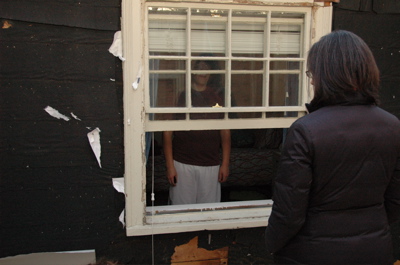
You can read the WCW poem and see if you like it. Then you can read my words crammed into his structure. I know white space is important in his work, but there is no space in my life right now and so no extra space between the lines of my attempt.
I have eaten
the plums
that were in
the icebox
*
and which
you were probably
saving
for breakfast
*
Forgive me
they were delicious
so sweet
and so cold
*
–William Carlos Williams
We have endured
the guys
who are in
our bedrooms
and whom
you were possibly
going
to hire
Pity us
they are industrious
yet such bulls
and so loud
–Jane Elizabeth Kokernak
—-
Picture taken by Jimmy on March 11, 2008.
This week I played hooky from life — our ongoing construction project, my piles of paper, an empty fridge, gray pants and wool sweaters — and went to the Cape for a few days with Lydia and Grace to visit my parents. We biked, ate ice cream, and, on glorious Wednesday (temperature 74° F. at the coast), lounged at the beach and walked on the jetty. With my mother and sister Sally, I went to a restaurant and enjoyed a meal that (a) I didn’t cook or clean up from and (b) lasted, over drinks and four courses, way more than 10 minutes.
One can only play hooky for so long, however.
We drove home in sunshine. Back home, even warmer, and a surprise.
The magnolia in the front yard, planted and staked seven years ago by Colleen (gardener/artist) and coaxed, watered, fertilized, and generally clucked over by me, had finally — finally! — burst into yellow bloom. I’ve been waiting.
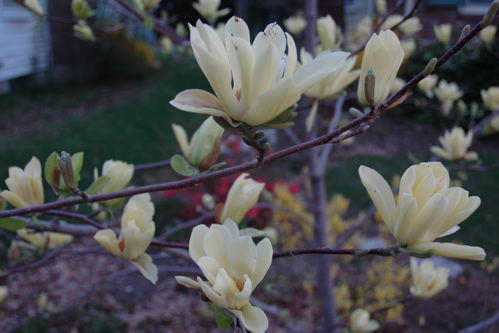
Last year there was one bud on the entire tree: the pioneer, the advance guard, a canary. This year there are multiple buds on every branch.
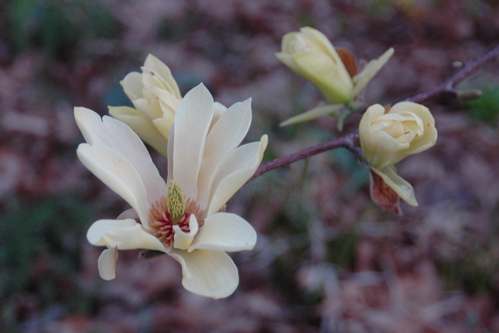
The buds open at their own pace. This one begins.
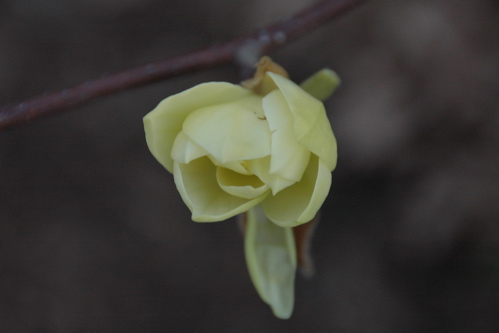
This one is either next, or perhaps proudly insisting on holding out for the last moment of the tree’s spring glory.
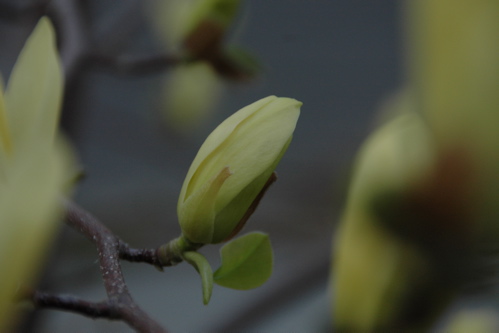
Some flowers show signs of later life; petals wither and curl and droop. Green leaves unfurl.
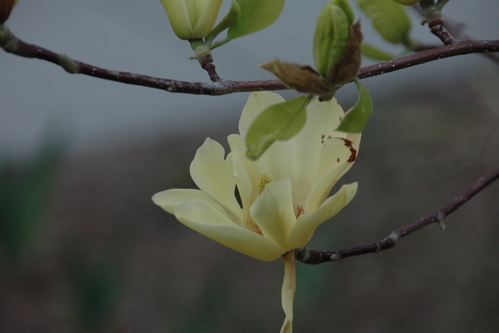
One doesn’t want to have to wait too long for labor and attention to bear fruit; waiting can be wearying. However, in this instance, my thrill with these profuse blooms, which arrived at their own pace, is a match for the weight of waiting, which has suddenly lifted.
—-
Thanks to Jimmy for the camera work while staff photographer Eli is occupied with other spring concerns, most notably, rowing on the Charles River and “erging” at Simmons College with his high school crew team. (Go, Eli!)
Our house, which is currently undergoing dramatic structural changes, was built in 1938, according to our town’s property records. Nine years ago we bought and moved into it. We have learned much about it and previous owners since then.
At the closing, the lawyer for the bank remarked, as he studied the paperwork probably for the first time, “Oh, I know this house. It’s the bad luck house.” And he told us about financial reversals, domestics woes, and crimes committed in the house.
We learned more about the crimes, especially, a few months after we moved in, at a party that our new neighbors (and now friends), Rich and Julie Ross, threw. A woman was there who had, in high school, dated a boy in the family; she got caught up in an investigation as the local police and the FBI prepared to nab various family members for drug trafficking. They nabbed them.
When I dig in the yard and the shovel hits metal or unearths a buried strip of plastic, my first, impulsive thought is that I’ve come across a stash of money or a bundle of bones.
I haven’t, yet.
The garage walls are punctuated with covered cavities, and I wonder if little bags of cocaine were stored there.
I have found no supporting evidence.
Interior walls of the house were mirrored — beautifully and expensively, like a hotel lobby — when we moved in, and I wondered what was behind the mirrors.
It turns out (we’ve had them all removed, over time), nothing.
Once, as workers took out the old dishwasher and installed the new, we found a lost snapshot of a little girl and a fatherly man, standing together by a little swimming pool in the backyard. They looked happy. Carved into the paneled walls of the finished part of the basement are traces of people who have moved away: “Steve + Joan 70-71.”
Over the years of our ownership, there have been lots of repairs and cosmetic projects in our house on Puddingstone Road, but nothing major until now. Builders are ripping down walls and reframing them into other room configurations. A bathroom floor and tub have made their way into the dumpster; I see grayed, creaky boards where they once sat. Old ceiling plaster has been pried and brushed loose. Shreds of insulation drift down, like ghosts released.
Here’s a picture of the insulation in the ceiling over what used to be Jimmy and my closet:
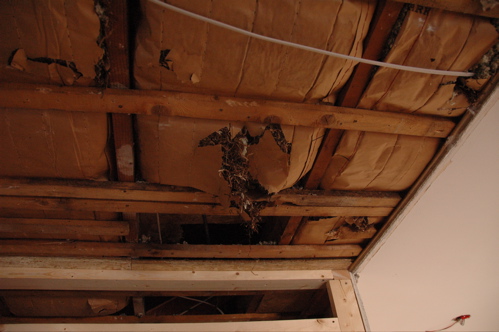
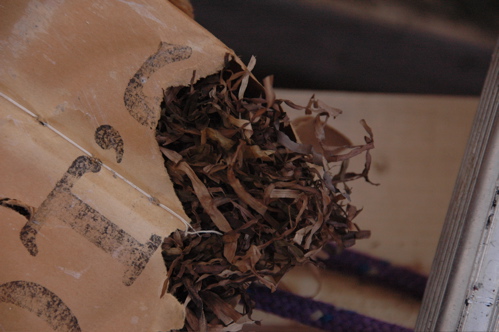
The stuffing, it turns out, is eelgrass, that profuse plant that washes up on ocean beaches all over the world. In 1893, Samuel Cabot, a chemist who graduated from MIT and Switzerland’s Zurich Polytechnicum, having learned that “early settlers had used eelgrass as a crude home insulation,” invented Cabot’s Quilt, clumps of the dried ocean plant stitched between brown paper. A six-inch layer of it is as effective as fiberglass, according to one source. There is a one-inch layer of it in our walls. Brrrr.
On the brown paper is stamped words: Samuel Cabot. Boston. One yard. Cabot’s. Those were the clues that helped me find the story (thank you, Google!) of this curious insulation, which went out of production in the 1940’s, although Samuel Cabot Inc. still exists.
When the foolish, unfiltered banker told us in 1999, at the signing of documents that made this house ours, that “bad luck” was associated with it, I retorted (politely), that it was up to us to “make it the good luck house.”
Although I think it is unfortunate that much of our house remains poorly and archaicly insulated, I am also pleased to discover that the walls around us are stuffed with a kind of leaf, stitched between paper that’s faintly printed with words.
Is that karma or what?
Are you curious about how people live when they’re undergoing renovations? Jimmy posts a picture today (March 28) of our living room doing double-duty as a dormitory for four people. Eli, whose bedroom is still intact, wistfully calls it “cozy.” He’s feeling left out of our nightly pajama party, and I have a feeling that pretty soon we’ll be making room for his bed among the other three. Hey, why not?
It’s not merry, but it’s manageable. We do get to wake up every morning to Junior Senior’s “Can I Get Get Get,” played by DJ Jimmy on his iPod speakers, also in the living, er, bunk room. Songs can make you happy.
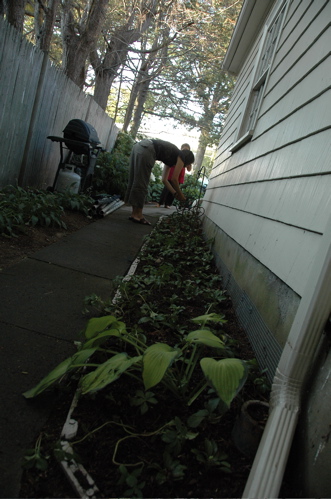 In September, I wrote (pridefully) of how I propagated and planted 100 pachysandra cuttings from my parents’ yard into mine. Within a couple of weeks, the cuttings had taken root and appeared sturdy. Over the winter, I checked on them from time to time, when they weren’t blanketed by snow. They drooped, yet remained green and leafy. I anticipated their spring return to robustness.
Flash forward to today: Now they’re trampled, knocked over, torn, dug up, and gone missing in places. Our house is undergoing what, for us, is a dramatic transformation — we’re adding a bedroom over the garage and redoing the rest of the second floor — and the builders and their staging are taking over the pachysandra’s territory.
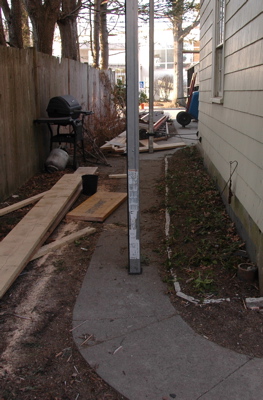
There’s also a pile of lumber on top of a more established hydrangea given to me by Leah B., a favorite former student and one I tutored frequently when I worked at Simmons. There are ruts in the lawn and broken branches on a holly. Around the foundation, where hostas and plumbago are soon to emerge, are scattered old nails and splinters of wood.
Do I feel sad? No, not that. Do I feel hopeful, that the return of a growing season will restore the trampled green things? Uh, no, because it’s also possible that the fragile pachysandra were too tender to survive boots, tools, and ladders. Yet I don’t exactly feel unhopeful.
I feel… like an accomplice. I set something into motion that’s directly competing with and possibly destroying some other process I set into motion. And all I can do is see it through, and do what I can to repair what’s been broken asunder.
The hydrangea will bounce back. The broken holly will fill out again in a season or two. Hostas are unstoppable and will find a way. It’s the viability of the pachysandra I’m not sure about.
Years ago I learned the phrase “transition time” from one of the kids’ preschool teachers. A bridge from one kind of activity to another, it’s something that all children need and something that some have trouble with. For example, if a child is engrossed in building with Legos, he might be unable or unwilling to follow directions to put away the toy and put on his coat if he has not first been given a warning as well as some time to transition from his play into the practical.
Transitions help us cope with change by easing us forward. Routines help, too.
Two days before Thanksgiving, on November 20th, it snowed lightly. There were still plenty of leaves on the ground, and the Japanese maple in our backyard, which bursts every fall from green to crimson and then drops its leaves within a few days, still wore half its foliage. I stood in the backyard, trying to gauge when the leaf guys would come to finish their work for the year and, after that, when I would have an hour or two to break open the bales of hay and mulch around new shrubs and divided plants.
I stood in my neighbor Gail’s yard and looked into my own. There was a soccer ball left behind from some game that did not involve me; there were the patient hay bales against Bob & Mary’s fence, the carpet of crimson leaves, and a toddler picnic table under the maple.
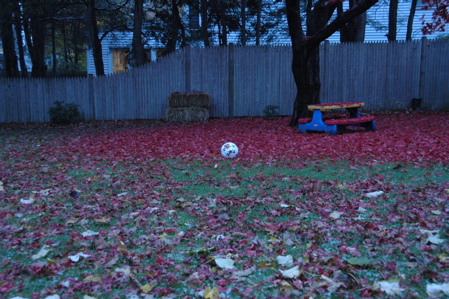
I have no toddlers in my house, and won’t again. The sight of that leaf-covered picnic table, too small for any of our children, reminds me of its redundancy. At best, it’s an artifact. I stood there for a long time and looked at it.
What happens to knowledge when it is not applied to daily use? I have this expertise in caring for the newborn and very young: feeding, washing, handling, soothing, delighting, lugging. I no longer need to mash up anyone’s food, wash a boy’s hair while protecting his eyes, or grab a girl up and out of a sandbox. Now that there are better music makers in this house than me, I haven’t sung anyone an invented lullaby in ages. (One of my lulling hits: “You’re A Baby.”)
Does such knowledge disappear? Is it transformed and applied to other uses? Does it go underground, and hibernate?
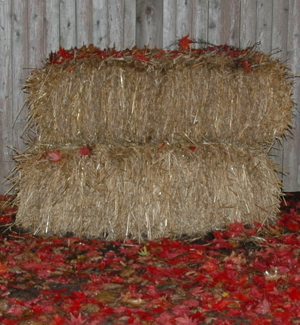 The leaf guys came on a clear day and vacuumed up the red leaves. Soon after, it got cold – bitterly – and we got busy here. It has since snowed again; the stray leaves that fell after the final cleanup are clumps under snow. The brilliance of the fall is a memory. I wonder if I missed my chance to lay down the hay. Like a child sometimes, I don’t like to be rushed, and I waited too long. It’s December 9th and gardening is over for the year.
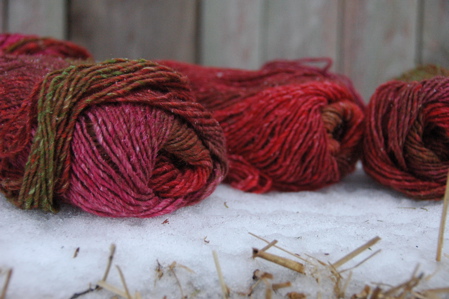
I’m not a person to spend the winter months dreaming of what I’ll plant in the spring. I put those thoughts aside until signs of thaw, and then I feel, too, as if I’m thawing out. My interest in the yard reawakens. In the meantime, I keep my hands busy in other ways. Knitting is one of them.
Remember that Miss Clairol ad, from a time when stylists were still called hairdressers?
This is about my hair, and how I don’t color it, and how, in response to pressures from various factions, I’m considering it. Yeah, it’s a digression from my usual blog topics, but it’s also about making a decision.
The first faction is myself as observer. Here’s what I see in the mirror every day, when my hair is dry. When it’s wet, it looks perfectly black and smooth.

I actually kind of like it, except for the fly-aways (oh, what happened to the sleek, textureless hair of my 20s?), but I notice it. There’s no hiding it, even from myself.
The second faction is the woman who cuts my hair. The last time I got my haircut, she even… grimaced. “It’s time,” she said. I replied, trying to buy time: “Mmm, maybe next time.”
The third faction is made up of many people who, over the last few years, have said, every time they see me after a break of several weeks, “Wow, Jane, I’m just noticing that you’re getting a lot of grays.” Some have said, demurely, “silver.” Some, more truthfully, “white.”
A resistant faction, the practical me, doesn’t really want to start down that long, un-turn-backable path of coloring or foiling. If you have dark hair, that means maintenance visits every six to eight weeks to deal with the roots. Add the time for a haircut and blowdry, and that’s three hours at the salon! Not much of a self-pamperer, that makes me agitated just imagining it. There’s money on top of that.
Still, there is another faction — perhaps the über-faction — which is vanity, or audience internalized. Is my vanity in my hair remaining natural, or is my vanity in my person looking brighter or younger? I’m torn.
How do I proceed?
Step one, of a decision-making process, is, obviously, defining the problem or question, which I have done.
Step two is gathering information. Most of that information is in the hair photo, and what I know about the procedure and its costs.
Step three is seeking advice. I have turned directly to my reliable and thoughtful friends. Marcia appreciates the aesthetics of graying hair, but recommends her strategy, which is color now, and go gray at 50. Jan says she’s always liked dark hair with gray, but points out the annoying part of gray hair — the dry texture, its uncontrollability — and informs me that coloring takes care of that. Eli, although he is in the faction of people who have brought my gray hair to my attention — “Mom, your hair has a lot of white in it” — says, “Be your color.” From my friend James, with whom I talk about style of all kinds (writing, clothes, music, etc.), I received a measured response, full of examples, in which he recommends resisting pressure and doing what feels right, whatever that is: keep my gray hair if I like it or color it if that would be fun.
Those four answers contain factual and emotional information, but not a decision, which I guess is up to me. Damn.
Step four is taking more time to think about it. This isn’t surgery, so there’s no rush.
I could even put this one off forever.
—-
Digital hair closeup in daylight conditions — you can’t run, you can’t hide — by Eli.
For anyone who is interested in the results of my propagating 100 pachysandra cuttings from my parents’ yard into mine, this post gives an update on the health of the transplants and, at the end, shows how I did it.
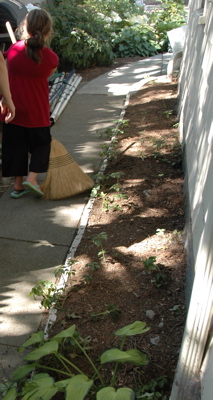 This is also a before-and-after story and an occasion for me to remark on my uneasiness with sudden and dramatic transformations, which this is not. I recognize that, as a culture, we want big and positive change: the new fabulous job that will turn those daily doldrums and interpersonal irritations into personal zest and suitable comrades; the surgery or exercise that will turn my everyday outer self into a “10” (oh, yes, I’ve had those fantasies of ten-ness); the design and construction project that will help a house be all it can be (bigger, better, beautiful). This is prevalent — just type “before and after” into the Google search box and see what you come up with.
A couple of summers ago, driving to Crane’s Beach with my friend Betsy, she asked me what I would do if I won a million dollars. I asked her permission to reframe the question, setting $50,ooo as the limit, because I couldn’t wrap my mind around so much possibility — such an immensity seemed a pressure, an obligation, a weight. She laughed; she agreed; and we played the game. On my list, I put a beautiful coat, well-made shoes, a charitable gift, and a personal chef for a year. Later, I played the game with the kids, and they put items on their lists like “couch for my room,” “video game console,” and “elevator in our house.”
As Jimmy pointed out, as the kids and I were itemizing, any one or two or three of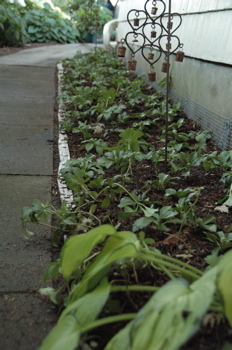 those wishes are ones we could actually afford now. He was right, and I realized — from Betsy’s laughter, from his comment — that the kind of changes that are either most interesting or tolerable to me are incremental ones. Indeed, I’ve become happier with my living room after getting a chair reupholstered from a busy, whimsical print to a green, textured chenille. Work is better on the day I tidy up my office and have a conversation with an eager student. My old clothes look snappier when I’m wearing a new sweater. This kind of change, which is probably most common in most of our lives, isn’t the stuff of dreams or the stuff that sells. Who would pay the initiation and monthly fees to a gym that promised only that working out would help you feel moderately better? Does anyone lie in bed at night fantasizing about updating the sleeve lengths on all their jackets and sweaters? More significantly, are any of such changes representable?
I confess: even though I am capable of ho-hum-to-fabulous fantasies, it’s the small changes in my life, wardrobe, house, hairstyle, garden, career, cafeteria that sustain me.
If you would like to follow how I made this incremental change in my side yard, as illustrated in the above Before and After images, please… Continue reading
 leaf stitch word