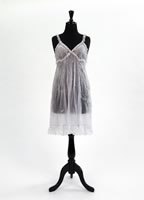
 How floating this is, yet how shaped and shapely. The fabric appears to be gauze or some sort of soft netting. So fine, it’s translucent; any woman wearing it would find her skin visible through it. It appears so lightweight it may even lack weight. On, I imagine it might feel like someone’s breath or a second skin.
In fact, it is a second skin: This dress, made from huge pieces of “hide” created by lavishing her body with a skin-peel facial mask and then gently stripping it off, is embedded with artist Laura Splan’s dead skin cells. The fabric is herself, in a way, which she then trims, sews, and embellishes as she would any delicate cloth.
Splan must have a light hand and lots of patience. 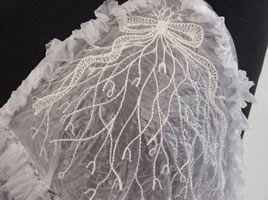 Look at the machine-sewn detail on the bodice. She calls this sexy, ghostly work Trousseau (Negligee #1). Inspired equally by the body and artifacts of medicine, Splan also paints in her own blood on watercolor paper, tracing the patterns of neuroanatomical forms. She sews lace doilies based on the structures of viruses. She has knit a blood-filled scarf from vinyl i.v. tubing and photographed it. See for yourself — more of Laura Splan’s fascinating work is here.
 leaf stitch word