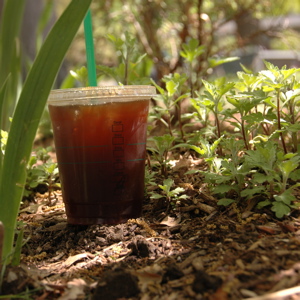
 It’s sunny. Summer’s on its way. I’m digging, and energy flags. The time is right, I sense, to switch from hot to iced for the season.
(Tall, black, no sugar.)
It’s sunny. Summer’s on its way. I’m digging, and energy flags. The time is right, I sense, to switch from hot to iced for the season.
(Tall, black, no sugar.)
Cal Newport at Study Hacks pored over interviews with 10 major nonfiction writers (Ted Conover, Susan Orlean, and others) to extract information about their habits. He’s mainly interested in how they schedule their work days. Most get up early and start no later than 8:30 a.m. A ritual, involving the New York Times, precedes writing for several of them. So does coffee, “lots of coffee.”
His data illuminate more than his cohort’s coffee drinking. Check out his graphs and commentary, and perhaps you’ll “Schedule Your Writing Like a Professional Writer.”
The coffee, at least, I can manage.
—-
Thanks to Jimmy for the link.
I like talking to Leslie Sills, my daughter Grace’s art teacher, about process. She’s a sculptor and a writer, so inevitably we get to how making objects and making prose are alike, and unlike.
Once, in a discussion on finding time to do self-generated work, amidst teaching and other commitments, Leslie said, “Before coffee.”
“What?”
She elaborated: “I heard Katherine Patterson speak at the Brookline Library about her work. She said, “Write before coffee.”” Leslie has tried, and keeps returning to, this simple advice.
Intrigued, I tried, too. Many times in the last fews months I’ve gotten up about an hour before I normally would (time varies depending on weekday or weekend) and done some writing while I waited for the coffee to drip.
Here’s a long hand-written piece from early Sunday, October 28, presented to you as is:
So, then a hundred, then 50 more black birds, so black there was a bluish oily tinge to tail and head feathers swooped and circled into our backyard this morning, into Isaac’s, into Gail’s, and pecked for a few minutes in the grass. All the while, they were cackling together almost screaming. But not crows, not big enough to be crows. They must see well, to be able to see between grass blades the insects they peck at. They look purposeful: taking steps, peering down as if seeking, zeroing in, pecking.
When they first arrived, I saw them (I was looking out kitchen window) swoop in an arc from beyond Isaac’s house, in the air around his garage, some made stops in our Norway maple that’s on the property line, before hopping as solid as a stone or fleet as a bullet down onto our grass.
Bird squad. Bird squadron. Bird squads.
As if sensing a signal, the ones scouting the east end of our backyard lifted off and circled away. Hastily. As if being pulled by threads or by a signal that they senses second after, others took off a flew, too. In the crowd, there was a kind of order, even though I felt a kind of compressed hysteria in watching them.
Why did they arrive so swiftly, and from where? Were they hopping from yard to yard, satisfied to get one or two bugs per bird in each yard? Incessant moving, incessant feeding to fuel the movement, a cycle that cannot stop.
This must happen every fall and around this time. I remember in the fall of 2001 — only six years ago? — being home with Eli, and noticing the same pattern with the black birds. They swooped in, blanketed the front lawn, chattering and hunting, and then swooping away. It was ominous, marring, on a beautiful October afternoon. Eli said, “The birds know something. Because they’re in the air, they know what’s coming before we do.”
The terrorist attacks of 9-11 were on all our minds. Eli, only nine years, imagined the birds, like planes, in the air, sensing a familiar pattern (planes fly up there, “we” (birds) fly down here) altered, and knowing that something had changed and was changing, yet not being able to predict what.
And when it happened? Was it another fire for them — treetops burning, cracking, popping and falling — acre after acre — or was their familiarity with buildings and glass enough to tell them that this event was remarkable, something that doesn’t happen.
I couldn’t have written this at night, when there often is more free time to write, because the birds would not have presented themselves to me.
I doubt I could have written this before coffee, because the having of coffee makes me sharper, more thoughtful, deliberate. With coffee, would my mind have wandered to where it ended up?
—–
The image is from Grillboy’s Coffee Cup Project.

What would you do to get some? Walk 500 miles? Pass up tickets to the World Series? Give up your spring break?
If not those, then could the promise of pizza get you to show up at a meeting?
Not me. I’ve noticed, however, that this is a lure for students. A huge one. Right now I’m dividing my time between two different colleges, which are so different that I’d think the students at them would be motivated by different rewards, yet I notice a striking prevalence of the words FREE PIZZA on posters and chalkboards announcing club meetings, grammar workshops, and support groups.
Does it work? If you offer a snack to someone to get them to ingest, oh, comma rules, will he stick around long enough to learn how to fix his comma splices?
I’m skeptical.
Around the time I turned 40, I said to my children, as they waited impatiently for the usual Friday night delivery: “I’m so done with pizza.” Really, I’ve had enough. Because I’m not into pizza, if I offered it to students, there would be something condescending in that. I like comma rules, but I doubt that they do, so the pizza would be a cheap trick. A manipulation.
So what if I tempted them with something that tempts me too? Good olives. A roasted potato. Grilled flank steak from a recipe my friend Marcia gave me years ago. Walnuts. Almonds.
(Picture that poster. FREE ALMONDS.)
I’m interested in these questions of motivation. It takes empathy and creativity to persuade people to do what they don’t actually want to do. Yet, we keep relying on the same tired old tricks.
The blog Motivation Matters at Education Week has been covering the cash incentives that schools offer K-12 students to apply themselves to various tasks: reading, enrolling in AP courses, completing homework. Recently, Ken Bushwiller reported that panelists at the American Economic Association’s annual meeting demonstrated that “giving students incentives was not very effective.”
Alex Kjerjulf, a self-identified Chief Happiness Officer, considers the contemporary workplace and claims, “Many people don’t feel motivated at work, and there’s a very simple explanation for this: The motivational techniques used by most managers don’t work.” His blog post, which includes a vivid illustration, is titled, “Why Motivation by Pizza Doesn’t Work.”
Kjerjulf discusses extrinsic and intrinsic rewards and comes down firmly on the side of helping people find their own internal motivation. What is it that employees deeply want to do? (Hint:”eat pizza” is not the answer.)
What is it, I wonder, that students deeply want to do at school? More specifically, what is it that they want to do in my writing class?
Steven Reiss, a professor of psychology at Ohio State University, argues that there are more than the two kinds of motivation: “It’s all a matter of individual differences. Different people are motivated in different ways.” His research has theorized 16 basic desires.
This is news to me. Reiss’s findings seem sound. When I think about motivating students to undertake the assignments in my course, however, I could become overwhelmed trying to design incentives for all their human differences. This one might be motivated by pizza, that one by cash, he by the stuff itself, and she by acclaim.
Just as one person cannot be all things to all people, one teacher cannot design all rewards for all students.
Does that leave me back at square one? Hmm, maybe. How about this, though? I’ll offer them free almonds. Well, not really almonds. What if I offered them the promise of the same rewards that motivate me? A chance to talk about writing with other smart people. Good questions. Stuff worth reading. Moments of writing together. A little time, here and there, to get to know something about each other. Mutual support for the long haul and the steps we take alone.
Not everyone will bite, but some will. And there will be plenty for me.
—–
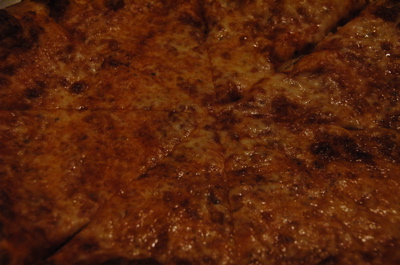
Thank you, Eli Guterman, for putting aside your dinner for five minutes to take the pizza picture. And thanks to a YouTube member for the clip of The Proclaimers doing an acoustic version of “I’m Gonna Be,” which includes the unforgettable line: “I would walk 500 miles and I would walk 500 more.” I love it.
 This week Eli was sick with a cold. On Thursday, one of my tutors apologized for bringing her sickness to work. On Friday, one of my colleagues brought along her obviously sick child to a staff meeting.
Such occurrences don’t bother me. I figure that my persistent exposure to germs are an occupational hazard of both parenting and teaching. I don’t use hand sanitizer. I abide by the five-second rule and sometimes eat things that have fallen on the floor. I do not fear touching doorknobs. I’ll drink out of another person’s water glass, if offered. You can drink out of mine, if you like.
This morning I woke with a cough, a deep chest one. Right now I have two part-time jobs that together add up to more than one, and fatigue is my new tag-along. My guard is down. The palace has been invaded.
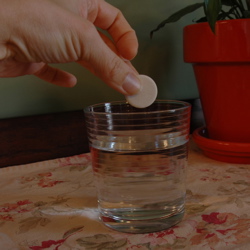
It might be too late, but I’ll try anything. Eli and my mother are recommending AirBorne, a packet of so-called immunity boosters in a fizzing tablet. Normally I eschew such remedies, preferring chemicals and a nap.
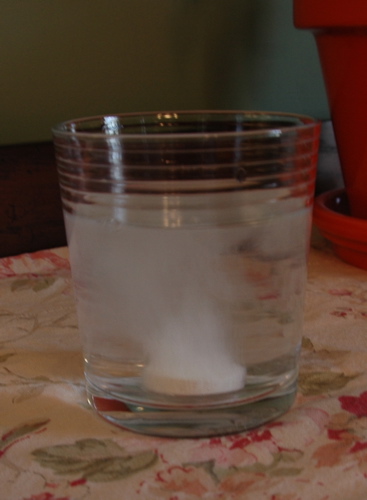 This item has a homey list of ingredients, however, which sound as though they were grown in someone’s yard: lonicera, forsythia, ginger, schizonepeta (what’s this?), echinacea, and other herbal names. It looks and tastes like Alka-Seltzer. L’chaim, everybody.
 If I owned a café (an idea I’ve flirted with), I’d put this on the fall menu.
Peel and slice a one-inch knob of fresh ginger, and pour over it a quart of boiling water. Steep for 10 minutes, then strain. Combine this ginger tea, which has a bite to it, with an equal amount of apple cider. Serve hot or cold.
That’s it, folks, one of my favorite kinds of recipes: common ingredients + no work = alchemy. It was told to me in the waiting room of the Boston Children’s Chorus by Cynthia, the mother of one of Lydia’s fellow singers. Drink up. The mixed flavour might give you, too, a curious feeling.
—-
Fictional Alice stamp created by web designer and writer Amber Simmons.
Normally, I am content to leave the food enthusiams and food blogging to my friend, Marcia, who introduced me to the essays and novels of Laurie Colwin and gave me, more than 15 years ago, a flank steak marinade recipe that has never failed to get oohs and ahhs from my guests.
Once in a while, though, I come across a revolutionary way to do something in the kitchen and I have to step up and spread the word. Years ago, for example, lying on the couch and watching cooking shows on PBS with preschooler Eli, who found them relaxing, I saw Nathalie Dupree cut an onion in such an elegant, straightforward, SENSIBLE way that, not only did I adopt her technique, I converted others, too.
This week, in the kitchen assembling cheese enchiladas from a recipe, I let out an “oh, my god” when I got to the step for heating the corn tortillas.
Jimmy: What?
Jane: Oh, my god. Here’s the most brilliant way to heat tortillas.
Jimmy: How?
Jane: Get this — you heat the first one in the fry pan for a few seconds. Then, you lift up that tortilla with the spatula, and put the next one underneath, and heat it for a few seconds. And then you lift the two tortillas, slide another one underneath with the spatula, and cook for a few seconds. You keep doing that, until you have a stack of 12.
Jimmy: That seems like a Jane thing.
Jane: Yeah, it does.
Not only did it seem like a good idea on paper, it was a good idea upon execution. It worked, beautifully. My old habit (heating them one at a time and then trying to keep the bunch warm in foil or a low oven) now seems clunky.
Life with tortillas? Changed.
—-
Thanks to stranger Elise Bauer, at Simply Recipes, for the tortilla tip included in her pretty delicious “Enchiladas” recipe.
Backyard farmers have been harvesting ripe, yielding-to-the-touch tomatoes for a few weeks now. There are still plenty of greenish ones on the vine or a kitchen windowsill, hanging out there, awaiting more sun and their own readiness. Some will ripen; some will not.
The gardener, and the eater too, seek the ideal — a ripe, tart and sweet, dripping tomato that matches the memory of a tomato enjoyed, sliced and salted on a plate, in the shady backyard of youth. Waiting for it, they miss today’s chance to eat something very delicious indeed.
Last year, after school started and summer segued into fall, my neighbor Susan gave up on the last of her tomato plants and handed a cache of the stubborn green ones to me. In August, I had eaten a tastebud-altering fried green tomato BLT at a cafe in Oak Bluffs, Martha’s Vineyard. Wanting to replicate the meal, I leafed through cookbooks in the house. In the index of Mark Bittman’s How to Cook Everything, under “Tomato(es),” I discovered two for “green”: pan-fried, and salsa.
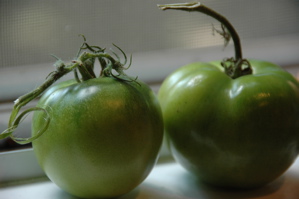 About the green tomato salsa, Jimmy said, “This is one of the ten best things I have eaten in my life.” The kids and my friend Julie and I sat around the kitchen table in the afternoon with tortilla chips and, when they were gone, spoons, and ate it all. Last week, after fruitlessly searching for unripe tomatoes at the Newton Farmers’ Market, my friend Pam gave me the only one she had. Later, I called Susan, who was such a reliable supplier last summer, and cadged another one. From that tiny yield, I fried enough for two BLTs, and a little extra taste for the cook.
Resist perfectionism: Stop thinking of those green tomatoes on overgrown, leggy vines as works in progress. Pick them; prepare and eat them. Recipes are here. The experience might make you wonder, as Jimmy did as we cleaned up the sandwich mess, “What does ‘done’ mean?”
[Photo credit: Eli Guterman.]
 leaf stitch word