A complaint may simply be a boast in disguise

Years ago, I was having dinner at Brasserie Jo with a friend, her husband, and her out-of-town colleague. The colleague, a professor from somewhere in the Midwest, asked me about our experience of the public schools in our town. I described the school system’s exceptional quality, and I paradoxically whined at length about the excessive homework, competition, and parental (over) involvement.

Listening to myself, I didn’t like what I was hearing. I broke off and said to him, “I’m so sorry. I have a lot to be happy about, and I’m only complaining.”

He replied, “You’re boasting. I hear you. That’s okay.”

His remark was illuminating to me, and I have thought about that often. Whenever I hear someone else complaining, or even myself, I wonder if it really is a boast in disguise. I wish I had the guts that he did, though, and could say to someone else what he, so cheerfully, said to me.

And now I have a complaint that’s really a boast. Read on.

For six months, our old Kenmore washing machine has been dying a slow death. Repaired many times over its 12 years of life, it finally started to rust out over the winter, and Jimmy and I propped up the crumpled base with wooden toy blocks. It kept going and washing until a couple of weeks ago, when water started to leak out the bottom, and we realized we could no longer put off the errand. So we went to the store and ordered a new washer and dryer.

The plumber came Friday morning to disconnect the two (we have a gas dryer, and a plumber is needed) before the arrival of the appliances, scheduled for Saturday. With the appliances pulled away from the basement wall, we could see that the drywall was damp and crumbling up about 24″ off the floor. It would have to be fixed before the plumber came back Monday morning to connect the new appliances. No time to call a handyman — we’d have to do it.

My handy brother-in-law Kenlie came by, demolished part of both the wall and the frame supporting it (sections of the sole plate were rotted too), and told us what to do.  That “us” became “me” — poor me, that’s my overt complaint — and I spent a few hours on Sunday repairing the wall when what I had really wanted to do was not much of anything.

Watch this slideshow, and you’ll see the process. I wish I had a “before” picture, but the moment the appliances were pulled away from the wall was so disgusting — dirty and wet plaster everywhere — that I didn’t think to photograph it. The show begins after I’ve put in the pieces to replace the rotted sole plate, which I painted red: paint to make them a bit moisture resistant and red because it’s what I had nearby.

This slideshow requires JavaScript.

And what’s the underlying boast? This was my first experience with drywall and plaster, and it came out very nicely, neat and clean.

I’m wicked proud of myself. There, I said it.

—–
Thanks to Grace and Jimmy Guterman for the photography.
Same route, different thoughts

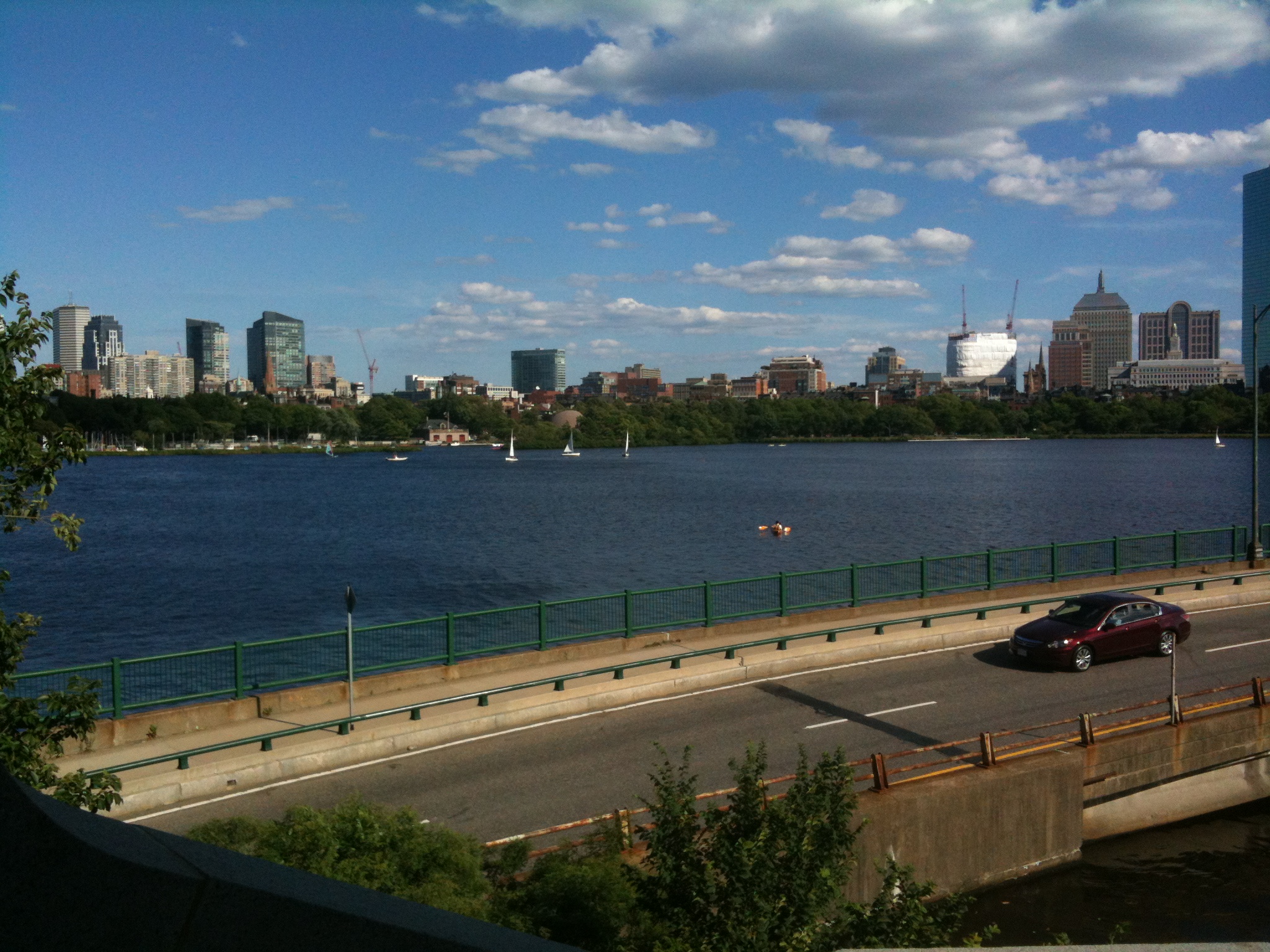
I took the same route back to my parked car today as I did last Monday afternoon: through the Common, down Charles Street, and across the Longfellow Bridge back to Kendall Square from Park Street.

This time, I took my own photo.

on Longfellow Bridge, nearing Cambridge, today at 4:45pm

I met no strangers on the bridge, but I did walk by many of them. One smiled.

On my walk, I thought for almost the whole time about the power of the words, “I’m sorry.” My shift on the GLAD Legal InfoLine was busy today. Lots of calls. So many of the calls I get have to do with gay marriage or immigration issues. Once in a while there is one that has to do with crime, and the caller as victim of one. Today there were two.

To one fellow, after he had told me a long yet coherent story about being beaten, I said, “I’m so sorry that happened to you. It sounds very upsetting.” Until that moment, his voice had been measured and regular, sort of like the tone of voice a friend would use as you sat together at a coffee shop and discussed an incident that had happened to a third friend.

His voice broke. “It was.” That was all he said. I could hear the loosening inside him. I felt loosened myself, not crying but as though I could.

I got practical again and made some suggestions. He rallied. I’d like to think we both felt as though we were moving forward in solving a problem and that it seemed, for the moment, better.

A magical place where coffee grows on trees

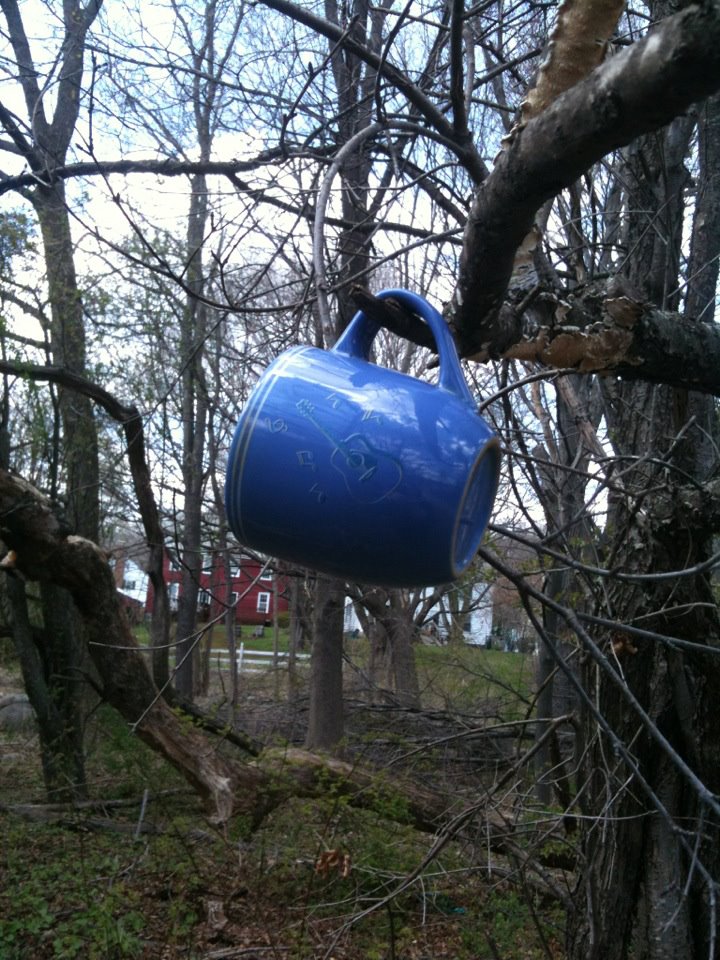
This magical place exists not too far away, in Milton, MA, where my sister Sally lives and where she spotted this perfect blue cup hanging from a tree. Sally sent a picture my way. The next day, walking the same route, the cup was still there. Later it disappeared.

There is a place in my brain activated by the word “coffee,” by the implements of coffee, and by the thing itself. If you’re my friend and you like coffee (James or Marcia, for example), then I like you extra. Siblings, you too.

Every coffee story or image reminds me of another one. Recently in one of my early classes, I got to the lab  right on time, 9 a.m.  It’s a big enough class that several other instructors are involved, and one of them is in the habit of stopping at Dunkin Donuts on the way in and buying munchkins to share and a coffee for himself. On this particular morning, I hadn’t had time to get my own coffee, and I felt forlorn, although I did fake a good coffee alertness face. And yet my eyes kept tracking the movement of Phil’s giant iced coffee around the room. I was like a dog who perks up when people food is about to be served: ears pointed, nose twitching, eyes wide.

The coffee-bearer offered the box of doughnut holes around, one instructor at a time. He reached me. “Do you want one?” he asked.

“Actually, I’ve been eying your coffee,” I admitted, perhaps panting a little.

“Oh, by all means have some!” he said enthusiastically.

I got a cup from near the wash-up sink. I held it out to him; he took the top off his plastic cup and poured. I was happy — it had not been hard to get what I wanted. I drank.

An hour passed as student teams worked on their projects, and instructors hovered around helping and prompting. I kept my eye on Phil’s iced coffee and noticed that half remained, with ice still bobbing in it. Want more? he signaled by pointing at the cup.

I nodded. He walked over and refilled my cup. “You’re like my dealer,” I said and smiled. He laughed.

—–
Image by Sally Kokernak Millwood, found April 10, 2012 in Milton, MA. Thanks, sis!

Scratching an itch

Recent travels in the neighborhood, either on foot or in car, have taken me past Allandale Farm, still closed for the winter. Curiously, there are two bulls regularly lounging in the shade near the algae-filled pond. I say curiously because this is a new sight at the farm, and I have no idea why they are there.

Driving past, I point them out to Grace. She has the same question as mine. “Why?”

“My guess is that the farm has rented them to sire the cows,” I say.

Then I recall that there are no cows there.

“Another thought,” I add, “is that the farm owns them, and they are renting out the bulls to impregnate cows on other farms.”

“I don’t really get it,” says Grace. For once, I decide not to explain everything. Beyond mentioning that cows are female and bulls male, I avoid the topic of animal husbandry.

But the desire to get up close and inspect the bulls remained. Today I walked over to the farm, cutting through the cemetery — yeah, I know, growth and death, circle of life — and made my way over to the pond. There is a shed and pen for the bulls, and as I approached, one of the bulls stuck his massive head over the wire fence. I was kind of flattered, as though the bull had pegged me as a friendly person who might give an apple or a pat. I was also intimidated: the bull was bigger than a VW Beetle, his head alone bigger than a 30 pound supermarket turkey.

Turns out, he didn’t want me, an apple, or a pat. He wanted to scratch. First he rhythmically scratched behind his right ear by rubbing it on the chain link fence post. His eyes rolled back in the sockets. Next he rhythmically scratched behind his left ear after deliberately adjusting the position of his head. This I videoed.

He was smart enough to get what he needed from his environment.

I walked home in the other direction, through a neighborhood of once-starter homes that have been lived in for ages. I noticed that, in most of the yards, a number of idiosyncratic gardening purchases and decisions have mostly led to clutter, either actual or visual. I made a mental note to go through my own yard carrying a big plastic garbage bag and to throw out the old plastic pots I’ve left here and there as well as the ugly or surplus ornaments. The season for gardening is beginning.

My last stop before home was the local Starbucks for iced coffee. Some itches are easy to scratch. I might as well this one, I thought.
—–
UPDATE (June 1, 2012): I was at Allandale today buying some mulch and a few dahlias. A young woman who worked for the farm loaded the mulch into the car. I asked her about the bulls: “Are you folks going to breed them?” She answered that the original intention was to farm them for meat, but that the longer they hang around, the more attached the farmers and the patrons are becoming to them. (And they are steer, not bulls, which I was politely told are castrated bulls.)

I also learned that they are a friendly species, Scottish Highland, “which are used in rehabilitative setting,” this young farmer explained. “They’re good with people.”

“So, like, they’re therapy bulls, er, steer?” I asked.

“Yes, like that,” she answered.

Banana tattoo

Eli was home from college for a week. Even when he was quiet he made his presence felt by the traces he left here and there: a skateboard in the mudroom, canvas shoes near the door, and water glasses near the couch and his bed.

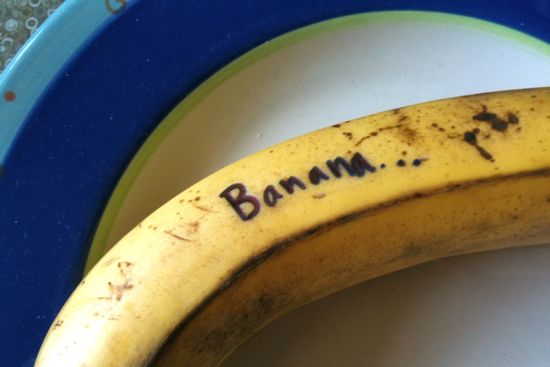
This morning I grabbed the last banana to caramelize for the waffles, and I saw that Eli may have picked up my tendency (and taken it to the next level) to see writeable surfaces in every scrap.

How do I know he wrote “Banana…” on the banana? That’s his handwriting and his sense of humor.

Give me your tired, your poor, your huddled masses

This is the line that goes through my head every time I enter a Registry of Motor Vehicles, as I did yesterday with Lydia to get her learner’s permit.

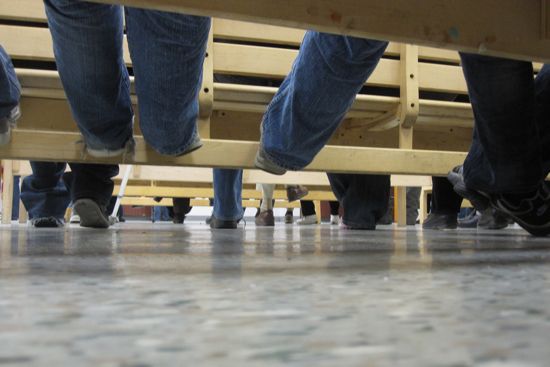
view from the floor, Watertown RMV waiting room, Feb 27 @ 4:23pm

While I don’t think my parents ever embarrassed me*, I do cross that line occasionally with my children. Usually they let me know and stop me from whatever I’m doing.

At the Registry, Lydia wasn’t too happy with me taking pictures of people in the waiting room. (Who knows when I’ll need a portrait of human abjection?) So I moved the camera to the floor.

Missions accomplished: learner’s permit gotten and pictures taken.

*Well, Mom, once there was a weird hairdo.

Wrapped, unwrapped, and wrapped again

1. Not the Martha Stewart way

My life is always about a day behind my plans. When I die, I’ll have a To Do list of 24 hours’ worth of outstanding tasks that someone else will have to tackle.

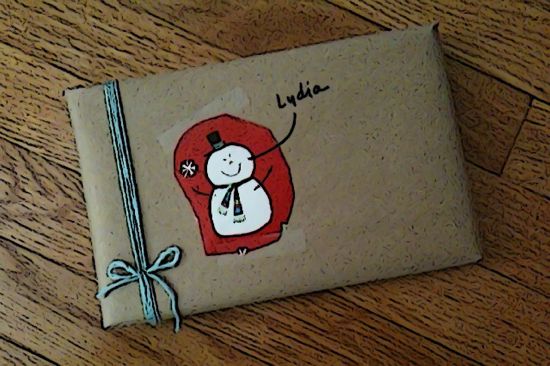
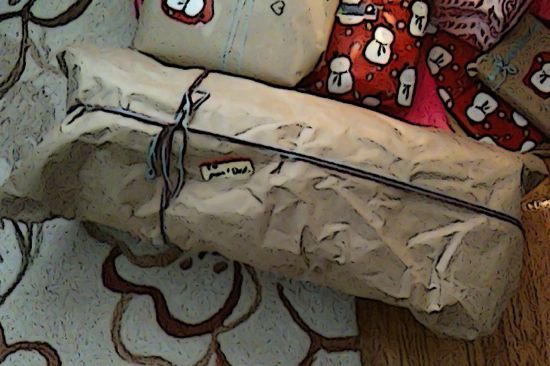
Even though I intended to have all my gifts wrapped by Friday night, on Saturday at midnight I was still sitting on the floor with brown paper — some unfurled from an Amazon box, some repurposed from shopping bags — and tape and a black Sharpie and gifts around me. I did follow through on my plan to wrap with used paper and yarn remnants. I hadn’t thought to buy gift tags, though, and so I had to improvise those at the last minute, using some snowman paper that Jimmy and Grace had on hand.

Beyonce DVD

snowshoes

Continue reading

Old paper, new uses

Every September, when the kids bring home a stack of textbooks from school and a teacher’s order to put covers on them, I take out the brown paper grocery bags and get to work. An hour later, there is a stack of books all tightly and cleanly covered on the dining room table. I recall Eli once saying, with a touch of wonder in his voice, “Mom, this is your secret talent.”

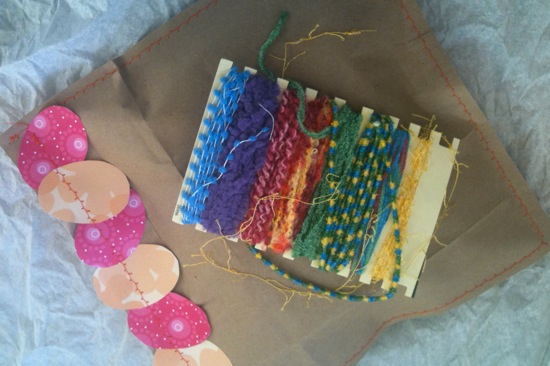
Grocery bags, and other sources of discarded paper, make mighty nice gift wrap too. Last year, I wrapped some small gifts by turning the printed side in on two squares of paper from bags and sewing up three sides. Then I inserted the gift and sewed up the fourth side, with scrap paper appliqués. I tied them up with fancy string. This year, I might go totally green, and use bits of twigs instead of the colored paper scraps for embellishment.

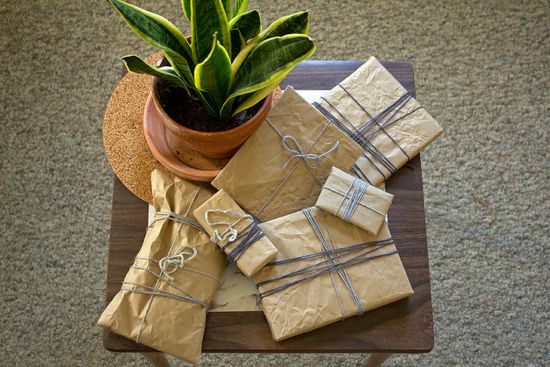
Jodi Anderson, who keeps the blog Daybook, wrapped gifts this year with the brown packing paper she found in the box her husband’s new saw came in. She used long lengths of yarn in place of ribbon.

credit: Jodi Anderson, 2011

And if I had a lot of outdated sewing patterns, I might steal Lisa Brainerd’s method for wrapping the items she sells and ships through her Etsy store. In January, I received a plain brown box in the mail from her.  Opening my purchase was as satisfying as the item (a pin) itself.

first surprise: pattern paper

second surprise: a purchase, wrapped like a gift, and bonus acorn

third surprise: more pattern paper!

final surprise: the thing itself (alongside the bonus felt acorn with a real cap)

Once, this girl could do anything

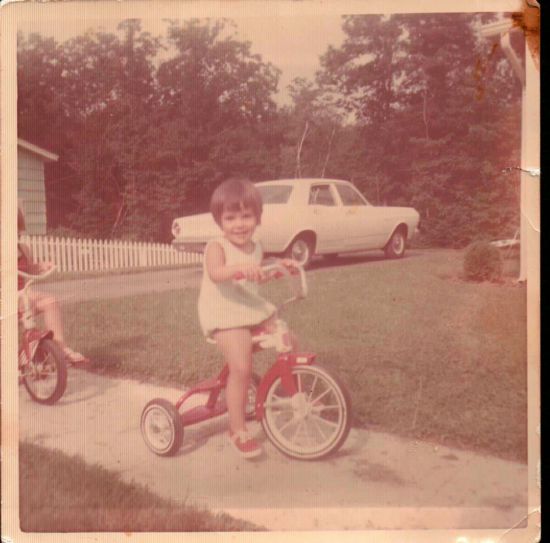
My brother Michael has appointed himself the family archivist. He has been scanning old snapshots, giving them titles, and posting them on Facebook. I look at the images of myself, siblings, and parents from the 60s and 70s with wonder, and a pang.

My impulse is to say, “This is everything we were before [fill in the blank] happened.”

As I first stared at this image of me on my tricycle, I actually felt myself to be on the tricycle. I looked down at my chubby legs; I felt my rump on the curved seat. I remembered the time I rode the bike without sneakers and imagined that I felt my own innocent curiosity: I am going to do this because my mother said not to. My toes got stuck in one of the pedals, and my mother had to call Mr. Galaski from two houses away, because my father wasn’t home, to bring his tools to undo the pedal and get me out.

I stared at the image, too, from the perspective of today and had a feeling of looking at a picture of my own baby. The equation is as simple as this: I = my own baby. I even wanted to nibble on myself in the picture, as I wanted to nibble on my own children when they were infants and delicious.

I teared up, too. “This is everything I was before [fill in the blank] happened.”

Bountiful possibility. An almost-blank slate. Continue reading

Accidentally brought back from the dead

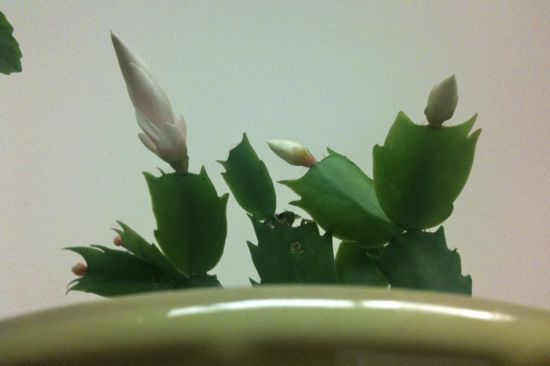
Last spring a Christmas cactus died slowly from neglect in one of our bathrooms. In late May, in a flurry of post-semester cleaning and organizing, I moved the pot with the petrified soil and dessicated leaves out to the back steps. I wondered if the roots of the plant, soaked by whatever rain should fall, would sprout a new plant. And, if not, I could toss it into the nearby compost.

The pot hid among some other more viable planters all summer. It was only two weeks ago, when I brought in the plants in advance of the Halloween snow, that I noticed it was alive again. Not a new sprout — the old thing, alive.

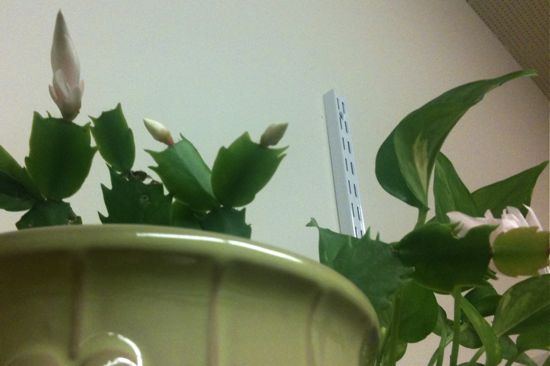
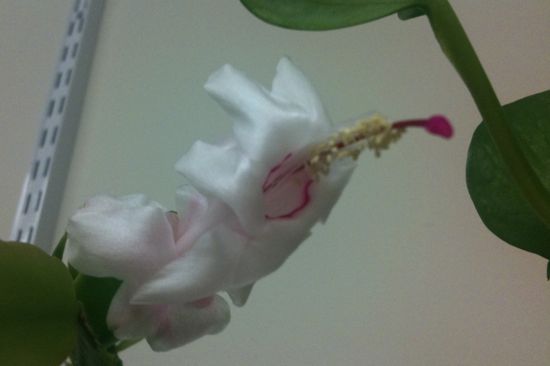
I brought it to work and proceeded to lose track of it again. (Why do I do this?) Thursday night, on the way out the door for the three-day weekend, I reached up to water the Kalanchoe and Pothos and noticed that the cactus, hiding again behind the two bigger plants, had… blossomed.

Perhaps all the time I had believed myself to be making mistakes with the cactus I had been doing exactly what it needed, and what it didn’t.

Are those... could they be... buds?

Buds indeed.

One show stopper.