Weeding and thinking

The crabgrass is an invader. Not only has it staked its claim on various islands of the lawn, it has mingled with the flowers in the front yard too. What we call “weeds” is socially constructed, you know. Crabgrass is simply one kind of grass, equal to others, but we don’t like it, we can’t control it, so we think of it as a weed: undesirable and to be eradicated.

I’ll live with it on the lawn — and it only grows out front, where there’s sun — but I dislike crabgrass among the flowers I planted intentionally.
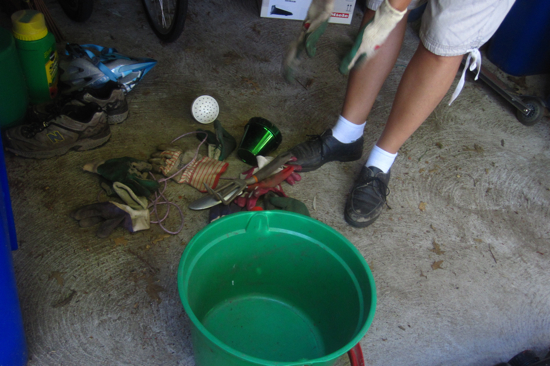

Weeding is good to do early in the day. It focuses the mind and then clears it. Was I procrastinating the semester prep I need to do when I put on my work shoes and gathered the bucket and tools? Yes. If one is putting off something else, though, it is good to at least accomplish another task. Recently I read that the highest-achieving people always do their most difficult work first. Ah, not me. I like a little puttering first, sort of like walking around the block before a run. The warm up, the loosening.

It is satisfying to grab the head of a clump of weeks, pry the dirt a bit from below, and then pull, feeling the roots of the weed pull back and my own gentle force eventually overcome their tenaciousness. Is this similar to the satisfaction dentists, doctors, and even aestheticians feel in their work with the human body? The organism resists; the professional — wilier, and with tools — overcomes. This may also lead to the despair that is sometimes felt in working with the human body, with nature in general: ultimately, its own force or fragility asserts itself and the counter force we apply fails. The river overflows the bank; the freckles proliferate; illness has its way; children grow and become themselves; we age.
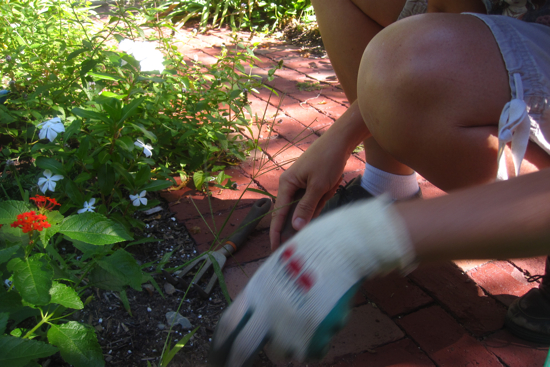

Working with one’s hands — and typing does not feel like work with one’s hands, although hand writing does — focuses the mind on the task. There are a set of small decisions to make as well as continual adjustments. To any passerby, I probably look quite still as I weed, just my hands and fingers busy, but I inch my way down the front walk and my mind, meanwhile, buzzes with thought: about the flowers and which ones to plant again next year, about the fall tasks around the corner, about water and my access to an abundant amount of it, and about the burden and pleasure in owning a piece of the earth.

Eli once said it’s so weird that people can own property, a piece of the planet, and when you stop to think about it, he’s right. Surely, we have to live somewhere, but strange that only Jimmy and I have a claim on these particular 7,000 square feet of dirt in Brookline, Massachusetts. And how far down do our rights go? A foot? Down to the sewer and gas pipes? All the way to the center of the earth? I picture a cutaway view of my house on the earth’s crust and the massive sliver of geological layers on which we rest. And if I do own the sliver all the way to the planet’s core, do I also have responsibility for it?

The parts of life that touch me have this awesome responsibility: if I know about it, or am associated with it, I am implicated in its maintenance or outcome. To not take responsibility (and I don’t, always) is to make an active decision to *not* concern myself, to shut off that part of my brain or body that could act. I won’t help (though I could); I won’t care (though I do); I will leave this to someone else.

I’m not borrowing the rhetoric of the self-help movement to assert my need for “me time” (I hate that expression). Occasionally I have this dialog with myself because I am lazy or tired or even because I lose faith in myself.
Continue reading

Summer chores: pleasure and pain

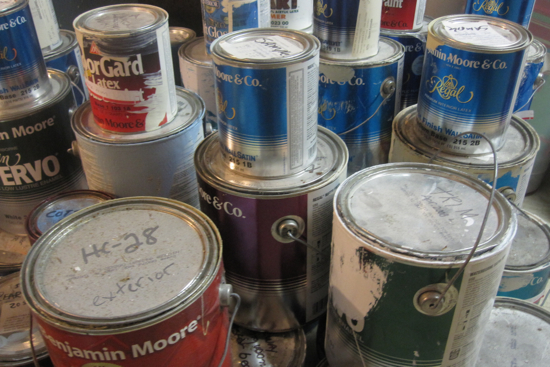
a fraction of my paint can hoard

In his essay, “Good-Bye to Forty-Eighth Street,” E. B. White describes a move from the six-room Manhattan apartment he then shared with his wife. Even in 1957 people accumulated lots of stuff; it’s not just our epoch that is so acquisitive.  Contemplating my own home, which is fairly tidy, I feel about it the same way that White felt about his apartment:

A home is like a reservoir equipped with a check valve: the valve permits influx but prevents outflow. Acquisition goes on night and day — smooth, subtly, imperceptibly. I have no sharp taste for acquiring things, but it is not necessary to desire things in order to acquire them. Goods and chattels seek a man out; they find him even though his guard is up. […] This steady influx is not counterbalanced by any comparable outgo. Under ordinary circumstances, the only stuff that leaves a home is paper trash and garbage; everything else stays on and digs in.

In the passage above where I’ve used a “[…]” as a placeholder for many sentences I’ve omitted, White lists the various things that have made their way into his life without his beckoning or actively acquiring them: books, oddities, gifts, memo books, a chip of wood sent to him by a reader, and “indestructible keepsakes” left behind by someone who has died. Later in the essay he writes about the special problem of trophies. (Note: While my post is not at all about teaching, I think it could be a fruitful assignment in a creative writing class to have students make a long list of items that could fill that “[…]” spot. Perhaps an idea for a poem would emerge.)

White and his wife had only six rooms in this apartment. In our house, we have seven rooms, plus more closets, and an attic and basement. Ah, therein lies the problem. A former grad school professor of mine once said to me, as she and her husband packed up a house to move in with a daughter upon their retirement: “People should not be allowed to know that they have attics and basements.” Continue reading

A complaint may simply be a boast in disguise

Years ago, I was having dinner at Brasserie Jo with a friend, her husband, and her out-of-town colleague. The colleague, a professor from somewhere in the Midwest, asked me about our experience of the public schools in our town. I described the school system’s exceptional quality, and I paradoxically whined at length about the excessive homework, competition, and parental (over) involvement.

Listening to myself, I didn’t like what I was hearing. I broke off and said to him, “I’m so sorry. I have a lot to be happy about, and I’m only complaining.”

He replied, “You’re boasting. I hear you. That’s okay.”

His remark was illuminating to me, and I have thought about that often. Whenever I hear someone else complaining, or even myself, I wonder if it really is a boast in disguise. I wish I had the guts that he did, though, and could say to someone else what he, so cheerfully, said to me.

And now I have a complaint that’s really a boast. Read on.

For six months, our old Kenmore washing machine has been dying a slow death. Repaired many times over its 12 years of life, it finally started to rust out over the winter, and Jimmy and I propped up the crumpled base with wooden toy blocks. It kept going and washing until a couple of weeks ago, when water started to leak out the bottom, and we realized we could no longer put off the errand. So we went to the store and ordered a new washer and dryer.

The plumber came Friday morning to disconnect the two (we have a gas dryer, and a plumber is needed) before the arrival of the appliances, scheduled for Saturday. With the appliances pulled away from the basement wall, we could see that the drywall was damp and crumbling up about 24″ off the floor. It would have to be fixed before the plumber came back Monday morning to connect the new appliances. No time to call a handyman — we’d have to do it.

My handy brother-in-law Kenlie came by, demolished part of both the wall and the frame supporting it (sections of the sole plate were rotted too), and told us what to do.  That “us” became “me” — poor me, that’s my overt complaint — and I spent a few hours on Sunday repairing the wall when what I had really wanted to do was not much of anything.

Watch this slideshow, and you’ll see the process. I wish I had a “before” picture, but the moment the appliances were pulled away from the wall was so disgusting — dirty and wet plaster everywhere — that I didn’t think to photograph it. The show begins after I’ve put in the pieces to replace the rotted sole plate, which I painted red: paint to make them a bit moisture resistant and red because it’s what I had nearby.

This slideshow requires JavaScript.

And what’s the underlying boast? This was my first experience with drywall and plaster, and it came out very nicely, neat and clean.

I’m wicked proud of myself. There, I said it.

—–
Thanks to Grace and Jimmy Guterman for the photography.

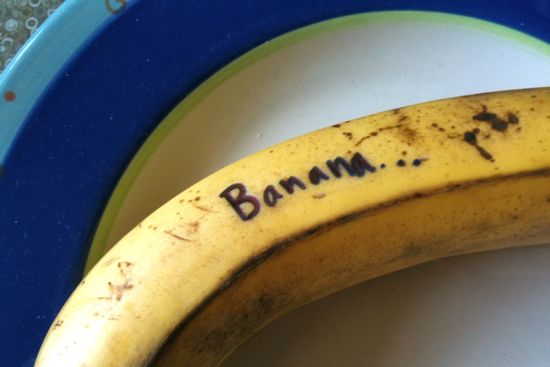
Banana tattoo

Eli was home from college for a week. Even when he was quiet he made his presence felt by the traces he left here and there: a skateboard in the mudroom, canvas shoes near the door, and water glasses near the couch and his bed.

This morning I grabbed the last banana to caramelize for the waffles, and I saw that Eli may have picked up my tendency (and taken it to the next level) to see writeable surfaces in every scrap.

How do I know he wrote “Banana…” on the banana? That’s his handwriting and his sense of humor.

It’s always good to leave a note

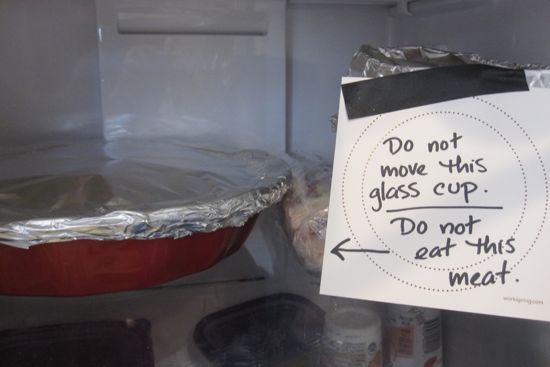
We’re having friends over for dinner tonight. Because I’m working until 5pm today, I cooked the main dish (the filling for Korean beef tacos) overnight in the crockpot. This morning I shredded the meat, strained the broth, and packed the meat and liquid into the refrigerator. Eli is home from school for a week, and I can imagine him rummaging through the fridge in my absence, finding cooked shredded beef, and sampling. And there would go dinner.

He’s still asleep. Soon I’m off for the day, so I’m left him a communiqué, taped to the Pyrex measure containing the broth to be boiled down later.

About me Lydia once said to Jimmy, “It’s so cute how mom leaves these little scrap notes everywhere.”  Any paper bag, junk mail envelope, promotional note pad, newspaper or magazine page margin, notice from school, a stray and linty post-it note, or an old greeting or business card: these are writable surfaces and a good place for me to leave a list, note to self, or note to you.

It’s the Jane Show

I’ve often thought of this blog as my own school newspaper or ‘zine, with the editor and writer in one. And now it’s about to become my own local access cable television show in a way.

Even though I know some video and audio editing software — thanks to excellent training by friend/colleague Lisa Dush — and even though I’ve had a Mac forever, I hadn’t yet learned iMovie. That changed today. I took some video I’ve been shooting over the last couple of weeks on my adventures (read: follies) in mouse proofing, and I used the iMovie platform to make a little home improvement show, starring me.

In this 12-minute movie, I

  • laugh at myself,
  • praise plumbers,
  • use one French word and two expletives,
  • mention whipped cream with delight,
  • deploy “so” and “okay” as pause fillers,
  • have weird intermittent eye contact with the camera (which disqualifies me from any real work as a tv announcer or host),
  • lie on the floor for a few seconds to think,
  • express love for my new LED head lamp,
  • show what a basin wrench can do, and
  • thank my parents for one cool thing.

I’m not sure if, in the video, I succeed at teaching or explaining much about mouse proofing that an amateur wouldn’t already know. The Jane Show below, therefore, might be of most interest to friends I don’t see often. Video is the next best thing, or perhaps even better because edited.

—–
Thanks to Jimmy Guterman for shooting the outdoor video and Eli Guterman for having a really nice tripod.