Imagine the luck of her future second graders

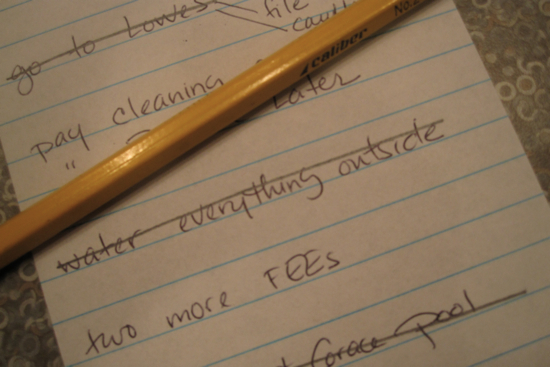
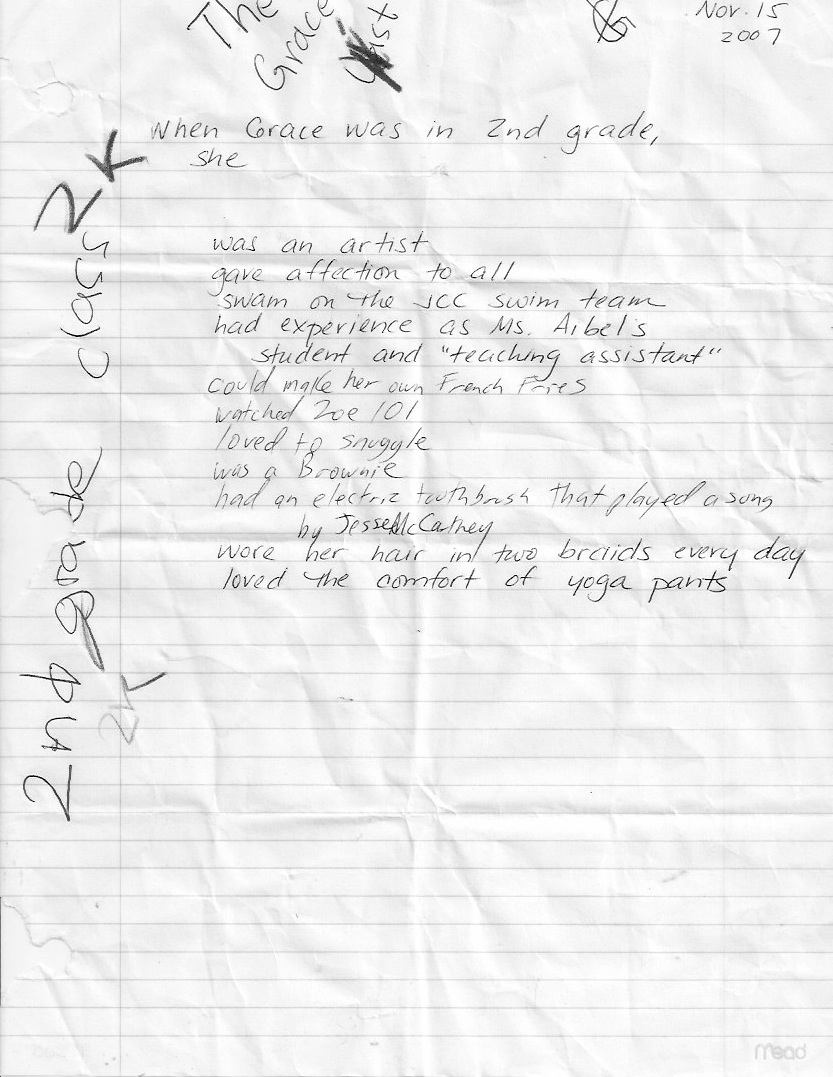
Grace and I have been bitten by the organizing bug, and we are culling our collections. I took four boxes marked “Jane’s Junk” and got them down to one, and Grace has stripped her closet down to the essentials and tackled her desk drawers. Last night she came across a list made five years ago when she was in the second grade. Knowing I like to save the textual artifacts of childhood, Grace handed it to me. You can click on the thumbnail to see the scanned version in full size or read the transcript below.

From the handwriting, it looks like Jimmy and I took turns at dictation. I asked Grace, “What was this list for?”

She replied, “When I was in second grade and thinking about becoming a teacher, I thought it would be neat to be able to tell my second graders some day what I was like when I was their age.”

This is what she was like, as reported on November 15, 2007:

When Grace was in 2nd grade, she

  • was an artist
  • gave affection to all
  • swam on the JCC swim team
  • had experience as Ms. Aibel’s student and “teaching assistant”
  • could make her own French fries
  • watched Zoe 101
  • loved to snuggle
  • was a Brownie
  • had an electric toothbrush that played a song by Jesse McCartney
  • wore her hair in two braids every day
  • loved the comfort of yoga pants

Wouldn’t it be wonderful if Grace, or Eli or Lydia, became a teacher? Then there would be three generations of us: my father, my mother-in-law, I, and one of the kids. Now that would be a family legacy.

Summer chores: pleasure and pain

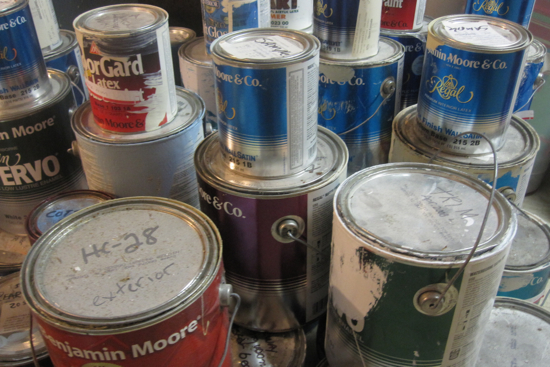
a fraction of my paint can hoard

In his essay, “Good-Bye to Forty-Eighth Street,” E. B. White describes a move from the six-room Manhattan apartment he then shared with his wife. Even in 1957 people accumulated lots of stuff; it’s not just our epoch that is so acquisitive.  Contemplating my own home, which is fairly tidy, I feel about it the same way that White felt about his apartment:

A home is like a reservoir equipped with a check valve: the valve permits influx but prevents outflow. Acquisition goes on night and day — smooth, subtly, imperceptibly. I have no sharp taste for acquiring things, but it is not necessary to desire things in order to acquire them. Goods and chattels seek a man out; they find him even though his guard is up. […] This steady influx is not counterbalanced by any comparable outgo. Under ordinary circumstances, the only stuff that leaves a home is paper trash and garbage; everything else stays on and digs in.

In the passage above where I’ve used a “[…]” as a placeholder for many sentences I’ve omitted, White lists the various things that have made their way into his life without his beckoning or actively acquiring them: books, oddities, gifts, memo books, a chip of wood sent to him by a reader, and “indestructible keepsakes” left behind by someone who has died. Later in the essay he writes about the special problem of trophies. (Note: While my post is not at all about teaching, I think it could be a fruitful assignment in a creative writing class to have students make a long list of items that could fill that “[…]” spot. Perhaps an idea for a poem would emerge.)

White and his wife had only six rooms in this apartment. In our house, we have seven rooms, plus more closets, and an attic and basement. Ah, therein lies the problem. A former grad school professor of mine once said to me, as she and her husband packed up a house to move in with a daughter upon their retirement: “People should not be allowed to know that they have attics and basements.” Continue reading

A complaint may simply be a boast in disguise

Years ago, I was having dinner at Brasserie Jo with a friend, her husband, and her out-of-town colleague. The colleague, a professor from somewhere in the Midwest, asked me about our experience of the public schools in our town. I described the school system’s exceptional quality, and I paradoxically whined at length about the excessive homework, competition, and parental (over) involvement.

Listening to myself, I didn’t like what I was hearing. I broke off and said to him, “I’m so sorry. I have a lot to be happy about, and I’m only complaining.”

He replied, “You’re boasting. I hear you. That’s okay.”

His remark was illuminating to me, and I have thought about that often. Whenever I hear someone else complaining, or even myself, I wonder if it really is a boast in disguise. I wish I had the guts that he did, though, and could say to someone else what he, so cheerfully, said to me.

And now I have a complaint that’s really a boast. Read on.

For six months, our old Kenmore washing machine has been dying a slow death. Repaired many times over its 12 years of life, it finally started to rust out over the winter, and Jimmy and I propped up the crumpled base with wooden toy blocks. It kept going and washing until a couple of weeks ago, when water started to leak out the bottom, and we realized we could no longer put off the errand. So we went to the store and ordered a new washer and dryer.

The plumber came Friday morning to disconnect the two (we have a gas dryer, and a plumber is needed) before the arrival of the appliances, scheduled for Saturday. With the appliances pulled away from the basement wall, we could see that the drywall was damp and crumbling up about 24″ off the floor. It would have to be fixed before the plumber came back Monday morning to connect the new appliances. No time to call a handyman — we’d have to do it.

My handy brother-in-law Kenlie came by, demolished part of both the wall and the frame supporting it (sections of the sole plate were rotted too), and told us what to do.  That “us” became “me” — poor me, that’s my overt complaint — and I spent a few hours on Sunday repairing the wall when what I had really wanted to do was not much of anything.

Watch this slideshow, and you’ll see the process. I wish I had a “before” picture, but the moment the appliances were pulled away from the wall was so disgusting — dirty and wet plaster everywhere — that I didn’t think to photograph it. The show begins after I’ve put in the pieces to replace the rotted sole plate, which I painted red: paint to make them a bit moisture resistant and red because it’s what I had nearby.

This slideshow requires JavaScript.

And what’s the underlying boast? This was my first experience with drywall and plaster, and it came out very nicely, neat and clean.

I’m wicked proud of myself. There, I said it.

—–
Thanks to Grace and Jimmy Guterman for the photography.

It’s the Jane Show

I’ve often thought of this blog as my own school newspaper or ‘zine, with the editor and writer in one. And now it’s about to become my own local access cable television show in a way.

Even though I know some video and audio editing software — thanks to excellent training by friend/colleague Lisa Dush — and even though I’ve had a Mac forever, I hadn’t yet learned iMovie. That changed today. I took some video I’ve been shooting over the last couple of weeks on my adventures (read: follies) in mouse proofing, and I used the iMovie platform to make a little home improvement show, starring me.

In this 12-minute movie, I

  • laugh at myself,
  • praise plumbers,
  • use one French word and two expletives,
  • mention whipped cream with delight,
  • deploy “so” and “okay” as pause fillers,
  • have weird intermittent eye contact with the camera (which disqualifies me from any real work as a tv announcer or host),
  • lie on the floor for a few seconds to think,
  • express love for my new LED head lamp,
  • show what a basin wrench can do, and
  • thank my parents for one cool thing.

I’m not sure if, in the video, I succeed at teaching or explaining much about mouse proofing that an amateur wouldn’t already know. The Jane Show below, therefore, might be of most interest to friends I don’t see often. Video is the next best thing, or perhaps even better because edited.

—–
Thanks to Jimmy Guterman for shooting the outdoor video and Eli Guterman for having a really nice tripod.

Guess who’s back, back again?

Shady’s back, tell a friend.

Shady is what I’m calling my mouse. He’s back. I actually haven’t seen him, but I do see the droppings under the sink again, and, as I study them, a line from an Eminem song goes through my mind: “Guess who’s back, guess who’s back, guess who’s back, guess who’s back.” Answer: Shady the Mouse. There are enough droppings that I think Shady might be bringing along his trailer park girl in a search of some crumbs.

This afternoon I vacuumed the tell-tale turds. Jimmy walked into the kitchen, and I showed him the evidence. “I have a Plan B, and this week I’m going to implement it,” I promised.

“This means war!” he said rather vigorously.

“Oh, no,” I said. “This means counter-intelligence.”

“We’re going to outsmart mice?” He seemed willing to humor me.

I am going to outsmart mice.” The last word was mine.

I do have a Plan B, and I have two new tools (nonviolent) provided by my parents. I also have been scouting the perimeter of my house, and I have an idea as to how Shady and his girl might be getting in.

I’ll report back.

She was nice to mice

I’ve confronted squirrels (outdoors) and rats (indoors), and, compared to them, mice are cute… almost.

Children love mice — cartoon ones and real ones — and the first time I discovered one in the house, the children, then ages 4, 8, and 11 and home on a summer day, begged me to catch it and drive it to the nearby farm to let it go. I did. Picture me, in jeans, t-shirt, and Black Dog baseball cap, in the family minivan with two little girls and a mouse in a metal waste basket with a piece of cardboard on top, driving to Allandale Farm and down one of the dirt roads marked with a No Trespassing sign, pulling over, getting out with a metal waste basket with a mouse in it, and gently sending that mouse on its way.

a mouse in an overturned glass, not wastebasket, but same concept

We had mice in the living room one Thanksgiving weekend when we also had guests. I waited until they were upstairs asleep before enlisting Jimmy’s help to catch the mice with my upside-down-metal-waste-basket-and-a-piece-of-cardboard trick. Stealthily I caught two, walked across the street with them in the basket in the middle of the night, and released them near the bushes around the temple, where I suspect they originated because of all the intense catering activity for events at the temple. (The regular appearance of a truck marked Waltham Chemical in the temple driveway was another clue.) I stuffed the holes around the radiator pipes with steel wool, and the incursion at the time was addressed.

For the past few months, we’ve had signs that the mice have returned and this time to the kitchen, most notably under the sink and in the silverware drawer. Their droppings, which resemble flax or black sesame seeds, are the evidence. To deal with the problem, we’ve ignored it. All that we keep under the sink is dishwasher detergent and our plastic recyclables. We moved the silverware in its caddy to the counter.

Weekly, I have been vacuuming the turds and hoping the problem would disappear. Apparently, the mice were not getting the mental messages I was sending them because the turds would inevitably blossom again. “Oh, well, so we have mice,” I would think.

I can tolerate mice more than I can clutter, however, and last week the constant presence of the silverware and all the knives on the kitchen counter pushed me to the limit. Visually and mentally I needed space: a long, horizontal, counter-length stretch of it. I had to confront the mice and take back a sliver of my domestic equilibrium. Continue reading

How to steal your own clothing

Yesterday, Eli was treated to some new pants on sale at the Gap and J. Crew. I predict that new pants are also in Lydia and Grace’s near future. If one gets, they all want.

This morning, 20 minutes before he had to leave for work, Eli presented me with a post-retail frustration: the security tag still attached to the seam of his Gap jeans.

Why drive back to the store when you can remove these tags yourself? I’ve done it before. I got a flat head screwdriver, hammer, and hacksaw from the toolbox, although in the end I only needed the screwdriver and saw and a few minutes.

This slideshow requires JavaScript.

It is just so typically me to come up with a moderately hard way to do something and only later find the simpler way. Go here and here to see how to do this in seconds with two sets of pliers. The second video even shows the mechanism inside these hard tags and why the two-pliers method works.

—–
Credit for images 4, 5, 6, and 7 goes to Eli Guterman.

Tattered no more

Many readers or watchers of The English Patient (I preferred the novel) were swept away by the romantic story line: the Count and Katharine, their illicit liaisons, the plane crash, desert cave, fire. And I? In both the film and the book, I was drawn to the nurse’s story: Hana, her makeshift hospital, and her care of the burned and disfigured English patient.

Real love, in my view, is seldom epic. It’s steady and practical, and it accumulates in small gestures.

One of the to-do items on a long list of preparations and purchases for Eli’s move to college was mending. Months ago he left three pairs of jeans on the window seat in my room and asked me to make them wearable again. I don’t feel like mending during the school term — I’m too busy mending drafts, I guess — so I put off the task. Last week, a few days before my first child’s departure, I set up the sewing machine, looked at the pants with their three sets of problems, and sat down with scissors and sewing box.

Only one pair was ripped on a seam line, an easy problem to solve, although a rivet through three layers of denim created an obstacle for my non-industrial machine. Solution: remove the rivet, using a hammer and small chisel, and sew along the existing seam lines. Done.

Two pairs weren’t ripped so much as tattered. Eli, through use, had worn the fabric down in the seat and around his wallet pocket. “Couldn’t I just buy you two new pairs of jeans?” I asked him. “I love these,” he said. “Couldn’t you just try to sew them?” Then he flattered me: “Mom, you can do it.”

Anticipating that more fabric would be needed, Eli had given me an unloved pair of denim shorts to cannibalize. I cut patches from these shorts and pinned them to the tattered places. I tacked them in place using a zigzag stitch.

Then I dialed the stitch setting on the machine back to the straight stitch, and I randomly and repeatedly sewed back and forth across the patches. This was true patching, building up a new fabric, in a way.

I kept my foot on the power pedal, periodically pressed the directional switch to reverse (the “back” of the back and forth stitching), and watched the stitches gather and blur into each other. I switched thread color, from gray to light blue for the denim ones and khaki to stone for the corduroys, to increase the blurring effect.

I thought about leaving my signature somehow, writing a word in stitches that would be like a secret message — one so secret only I would know about it — for the mended pants to carry around as Eli wore them. Mom, Jane, love all seemed too corny. (Plus, how twisted would that be, to write your own name in your son’s pants?) I considered hieroglyphs, which would fit invisibly into the random stitching, or tattoos or Japanese characters.

No symbolic language, in the end, made it into the mended pants. After I finished sewing, I snipped all the loose threads and admired my own work. We threw them into the wash, and Eli folded and packed them into his suitcase* for college. The pants and Eli live in Vermont now.

_____

*Wait, there’s more! In trying to lift Eli’s overstuffed suitcase into the back of the car, I hurt my toe. Of course, I had to find a way to write about that. I called it “Toe Story” and posted it on my other blog. Link. There were sequels: “Toe Story 2” and “Toe Story 3.” Link 2 and Link 3.
Making a place

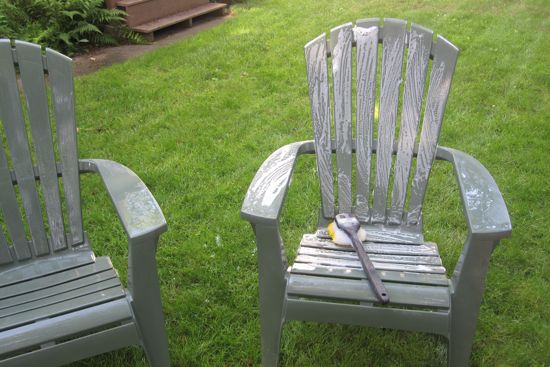
I mowed the grass and bagged all the clippings. I hesitated a moment — hadn’t enough labor been done for a day? — and then filled a bucket with water and dish soap, uncoiled the hose, and scrubbed the winter mildew and spring birdshit from the plastic Adirondack chairs.

Yes, I sat for a while and surveyed my handiwork. I wish now I had taken it one comfort further and had a beer.

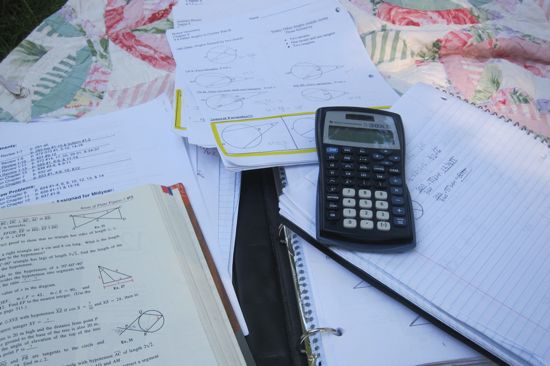
Eventually, I went inside. At some point I looked out the kitchen window to visually touch base with the order I had restored, and I saw Lydia had spread a quilt out in the middle of the chair circle. There were books all around her.

She yelled, “Please bring me a camera!” I did.

I discovered her photos later: the math textbook and worksheets on the quilt, another with her feet against a backdrop of trees, and an oblique view of her arm and a bracelet.

Nothing lasts intact. The birds and mildew will find the chairs again; the grass will grow shaggy. Already, Lydia’s math final is over and done with. Still, I feel as though something has been accomplished.