A hard and bitter seed

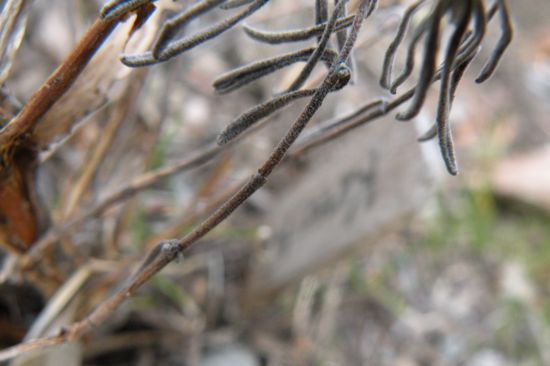
heather, brought down by winter

The first few fragments here have been knocking at the door of my attention. So I wrote them down, and then I followed one sentence with the next, the next, the next, and so on. At some point it became what we call free writing, and it ended where it did.

I hate writing.
I hate skating.
Yard work.
Teaching.
Parenting sometimes, and reading.
All of these things I supposedly love: I hate them.

That’s how I feel on the verge of doing them.

A couple of weeks ago and with enthusiasm I bought some supplies for my yard clean up. I took the afternoon off. The next day I went out there and faced what I intended to do. Tear out two old bushes and bundle them up for the town’s compost pickup. Dig up the weed patch and lay down rolled sod, heavy and awkward.  Move an azalea, in too much sun, to a shady spot, and an American cranberry bush from shade to sun.

I sat in a dirty plastic lawn chair for a while and thought how it didn’t matter, how fruitless my effort would be. Who cares, really, who will ever notice, if the azalea gets more comfort in the shade and the cranberry more berries in light? Okay, I will notice. But I won’t always live here. Some future owner will look at my non-artistic, non-modernist attempts at gardening, rip them out, and install beautifully identical boxwoods with space in between. And the old screened porch (with original and much-repaired screens), buttressed by the elderly hydrangea, will get torn down to make room for a family room. And the ferns and hostas might seem like garbage plants to a fancier owner and end up in a brown paper bag on the curb.

Still, it’s possible to begin even with a fog of pragmatic despair hanging over me, so I did.

I feel this way, too, the more and more I skate. I must be improving, right? I can look back on five years ago, and even five months ago, and say to myself, “I can do this now. I can do that.” An hour before I gather my things and car keys to leave the house for the rink, though, I say to myself, “There is no forseeable outcome to this: no contest, no show, probably no mastery.”

But then I go, because it’s on my calendar and I promised myself that I would.

And I smell the dirt, or I smell the ice, and the shovel makes a sandy, muffled sound as it connects and the hockey player over there digs in until the ice groans its particular protest which is so satisfying to the human ear, and I feel as though maybe I can begin. (Beginning is a kind of restarting.)

At first I am hating it still, but I am also giving it a chance. I say, “Jane, try ten minutes, or thirty. If nothing happens, you can stop.” I am without grace, as though I really am a beginner, yet of course I lack the utter, naive enthusiasm of the absolute beginner. I am between beginner and master, that no man’s land. Continue reading
Tightening my gardener’s belt

This year, I’m putting my yard on an austerity program. There have been a few purchases to take care of a barren spot in the backyard, which was a weed patch inherited from the previous owners that I’ve left empty while I’ve ruminated on what to plant there, but otherwise I will mostly shop for plants among what’s already growing out back.

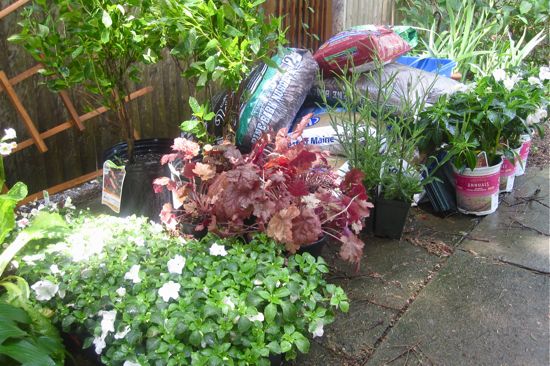
Here is the extent of what I’ve purchased, to the tune of about $150:

  • 2 clethra “Ruby Spice”
  • 3 New Guinea impatiens (white)
  • 3 verbena (blue)
  • 1 Japanese primrose (white) — my only purchase off list
  • 3 heuchera “Encore”
  • 3 trays of impatiens (assorted whites) — four plants for $1.39 at Christmas Tree Shop
  • 4 bags mulch
  • 1 flimsy trellis

ready and waiting for duty

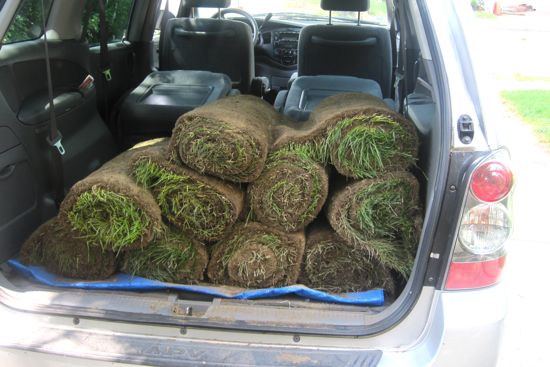
rolled sod: heavier than it looks

From the yard, I have more than 30 irises I dug up in the fall, separated, and dumped in a bin with some dirt. These are the most forgiving perennials, and they survived winter above ground and are now starting to bloom in that bin, clamoring to be planted.

The excessive winter snow and spring rain have given a boost to the green perennials, like hostas, ferns, and Solomon’s seal, and I’ll dig some of those up, divide them, and move offspring around the yard to fill in.

my own shade plant thrift store

At my mother’s house, I noticed some ferns growing up happily among the stones in a wall, and I think I’ll browse my rock pile (doesn’t every gardener have one?) and distribute some rocks around transplanted ferns.

In the next few days, the weather looks perfect for outside labor. My goal is to get it all done in one sprint and then enjoy the yard. I have other projects to nurture without undertaking one of my intensive yard projects. To do all this, as well as scrub down the outdoor furniture, will have to be enough this summer.

Stay tuned, though: I’ve always wanted to plant some quick-growing fall crops, like lettuces, and there may be a late season experiment later on.

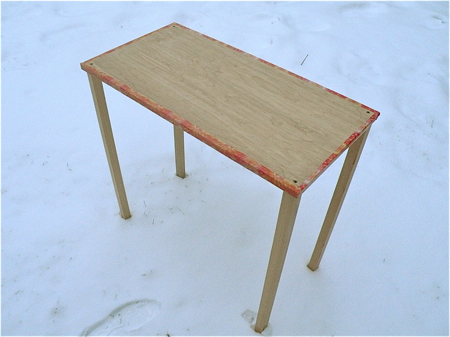
Origins of my $8 table

I like order. While I am no perfectionist, and I recognize that we live in a chaotic universe, I feel more at peace when t-shirts are folded and put away neatly and tasks are on lists.

my January laundry table

Where there is no order, I enjoy imposing it. I see a mess, and my imagination starts selecting, categorizing, and straightening. When I am in a colleague’s unruly office, I must resist the temptation to say, “I could help you with this.” (What a time suck that would be.)

I like the revision part of writing as much as I like the generation part. The mental activity is not unlike cleaning out a closet. Creativity is not all right brain. Could anything ever get made without the desire to bring coherence to a wash of ideas, experience, sensations, stuff? The left brain brings shape to raw material and finds what my friend Jan calls the spine of a piece.

I often think about one creative activity when doing another: writing when gardening, for example.  Recently, I organized the laundry corner of the basement, quickly made a rudimentary table, and thought about teaching while doing both. And I didn’t just think about teaching while my hands were busy; I thought about my wonderful junior high shop teacher, Richard Bayrouty, who died in December, and the benefits of real hands-on learning.

In 1977, when I entered 7th grade, there was a policy shift in my hometown’s school system that girls could take industrial arts, or “shop,” as an elective. If I remember correctly, before 1977 all girls took home economics (cooking, sewing, laundry) and all boys took shop. That year, the policy loosened, and suddenly there was cross-registration. Boys who wanted to make and eat cookies took “home ec” with Ms. T. Girls who knew how to sew, cook, wash, and iron, as I did, took shop. My friend Lynn-Marie, who recently wrote to me that she never “caught on to home ec” and “never really liked to cook,” and I were the only two girls that year in Mr. Bayrouty’s class.

He had the best classroom. Continue reading

The world is strange again.

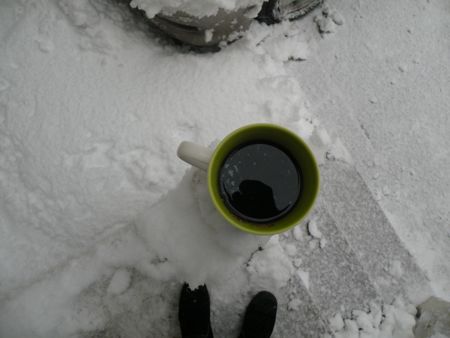
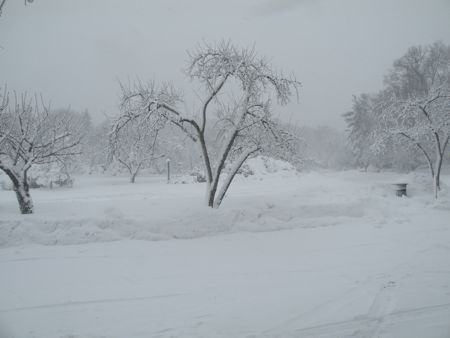
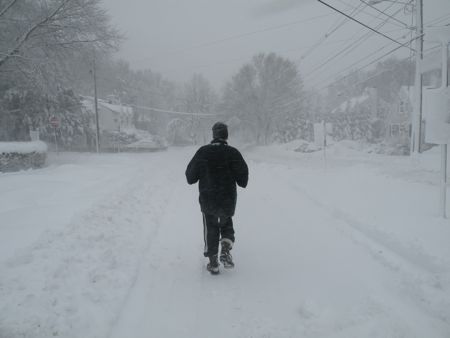
On the morning of the snowstorm, I am awake at the usual time. There’s no rush to get going. Still, I turn on the coffee and check “what happened overnight on the Internets,” as Jimmy would joke.

From my father, I read a gang email to all five of his children, exhorting us to clean off our cars before the temperature drops below freezing. His message may affect each of my siblings differently, but me, I feel watched over in a good way.

I put on my gear and go outside. Jimmy shovels; I clear the cars properly, even their roofs, and then I shovel around them.

Any mug can be a travel mug, depending on where you're going.

Snow removal from the cars, driveway, and sidewalk takes about 90 minutes. We jam the shovels in a snowbank — it’s great snow for igloo-making, why don’t we make one? — and walk over to the shops at Putterham Circle. Only two are open: the convenience store and Starbucks. While there are no cars in the rotary that feeds the shopping center, inside Starbucks it is steamy with people.

For once, no cars in Putterham Circle.

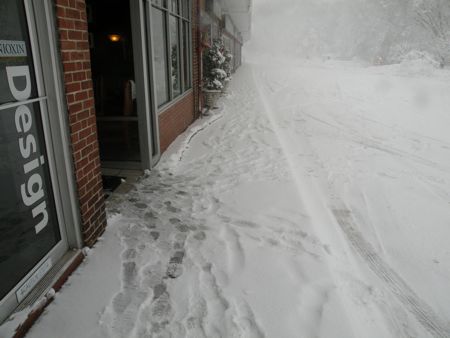
All footprints lead to the coffee source.

Then we walk, lattes in hand. It’s easy to shuffle across the intersection and down South Street. We walk and walk and pass only a few neighbors, here and there, out shoveling or snow-blowing. Ogden Street has not yet been plowed, and on the snow’s surface are chestnuts, still in their pods, that have just fallen.

Jimmy walks blithely down the middle of South.

Now, this is still life.

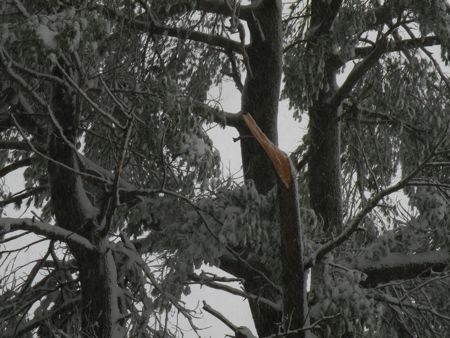
We see these fresh wounds everywhere.

Near Bournewood, we throw our empty cups into a dumpster in a driveway.

As we walk through the hospital grounds, I say, “I think Anne Sexton stayed here. And perhaps Robert Lowell.” Jimmy asks, “And Sylvia Plath?” McLean, in Belmont. Continue reading

Attractions of ordinary life

bed to make

Two nights before Christmas, Betsy and I sat at the bar at Legal’s in Chestnut Hill, having a quick drink and bowl of chowder before we went to see The Fighter. That now seems ages ago. For a while she and I talked about our attraction to cinematic portrayals of ordinary life: the food, routines, chores, and even squabbles of the everyday. B. also mentioned the fiction of Alice Munro; I thought of Charlotte Bronte, Jane Austen, Charles Dickens. And yet to say those works are only about the quotidian is to reduce them.

Because we never travel farther than New Jersey during the Christmas week — I’ve never spent my holiday in the Virgin Islands, Costa Rican rainforest, or Hawaii as some families do — and this time we haven’t traveled at all, the last week has been lush with the quotidian. Laundry. Tidying. Mail sorting. Reading. And cooking, especially cooking.

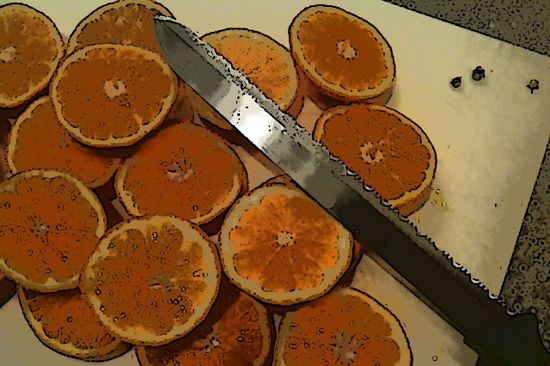
clementines to simmer and preserve

When the hands are busy, the mind is free. As I’ve chopped or made beds or run errands or wrapped gifts that I have since returned, sometimes with a clenched jaw, I’ve been thinking of the pressure on some of us to turn one’s own everyday life into an art form: concentrated, heightened, shareable. I both succumb to and participate in that.

As a child, my favorite bag lunch consisted of two hard-boiled eggs with salt, bread and butter, an apple, and cookies if possible. My own children want “something good” for lunch — and this may be a result of our having occasionally provided the show-stopping lunch — and it’s not enough, for example, to have an apple in a bag. The apple must be cored, peeled, and packed with sliced lemon. (Yes, I initiated that.)

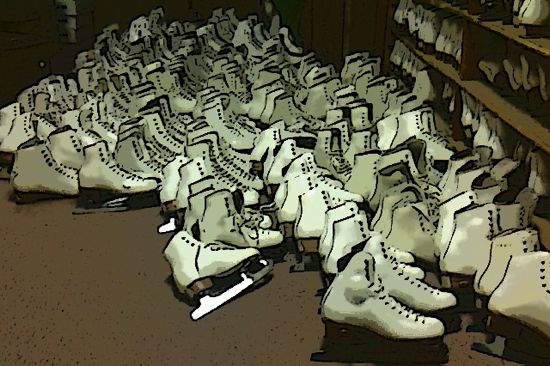
last year's skates to sell, in the back room at the Ice House

Incrementally over time, the bar has been raised for all of us with a stable income. We are surrounded with labor-saving devices — vacuum, dishwasher, clothes dryer, car — and we use them to make more labor possible.  This week, Grace and I drove out to the Ice House to upgrade her skates and get hers and mine sharpened, and then we drove miles back to the rink for skating. Sometimes I long for (or perhaps romanticize) the hours spent on the frozen swamp ice deep in the woods that surrounded my childhood neighborhood. In its surface were embalmed sticks and leaves and air bubbles, which made for a pebbled glide, and here and there boulders and rotted trunks made interesting obstacles that we could do nothing about but skate around or over. Dulled blades were not a concern.

a fine girl to skate with

Once, seeing me crouching in the dirt in the front, my neighbor Gail, who never gardens but knows more the names of plants than I do, said to me, “You’re Martha Stewart.” I think this was a compliment, but I felt it as a stab. To convert everyday life to something that can be packaged, photographed, and sold is not my intention. If this is life, I want to make it into something, for me, yes, but also to share with others.

What causes the clenched jaw is when there is a collision between what I want to make and what others want me to make. Many nights, not very hungry, I’d be happy with a potato and fried egg for dinner. I am even often tempted to make a dish my father invented when we were kids and my mother went to night classes and he had to feed us, normally her job. It is the briefest recipe, not even deserving of a list or adjectives for that matter. Take a package of hot dogs, slice them into coins, saute them until crisp, stir in a jar of Prince or Ragu tomato sauce, and heat through. Boil water and cook a pound of spaghetti. Voila, dinner. My brothers and sisters could attest to how delicious this is, although not much to look at. Would my kids eat it? Maybe once, as a novelty.

Meanwhile, too, you know, much of the human population is malnourished, 40% of the world’s children do not go to secondary school, and the planet’s fossil fuel reserves are boiling down. And still here I am worrying about what I’ll plant in my backyard come spring, and also the expectations that both drive and thwart self-actualization.

to read, to drink

—–

Photographs taken on the iPhone using ToonCamera. Only $0.99.

Unpretty potatoes and their lessons

There are beautiful ideas, and there is reality.

I learned this from a tutor I was training, several years ago, when I worked in the Simmons College writing program. Her name was Kristin, and she told our group about a time she absolutely could not write a paper, although she had “written it in her head,” and it was perfect. So she went to her professor, and she told him about this perfect, imagined paper and how she was unable to write it. He said to her, “All you have now is a beautiful idea. And beautiful ideas are not writing.” He handed her a lined, yellow pad of paper and looked at the clock. “I’ll be back in two hours. Write,” he said. Kristin sat at a desk in the hallway and wrote. And what she produced was less perfect than what she imagined producing, and yet it was real. The words existed in the world and did not merely float in her head. “There,” the professor said. And the paper turned out to be neither good nor bad, Kristin told us.

If a creative person has high hopes for her work, she must learn to tolerate the gap between the idea and its manifestation.

Harvest done. Things arranged.

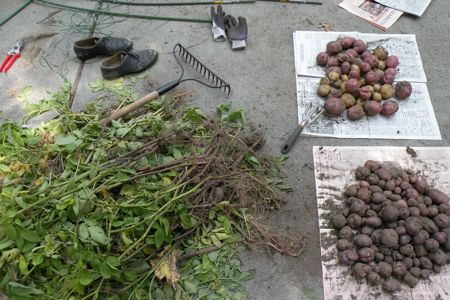
Yesterday I completely harvested my first crop of potatoes. I waited for the soil to dry from a previous rain, and then I clawed around each plant, exposing the stalks to the first potato. One at a time I grasped the plant down near the exposed soil line and pulled gently and with a little vibration, as though wiggling a tooth out. I piled up the stalks on the driveway. I piled up the potatoes — gold, red, and purple — on dry newspaper. My dark shirt absorbed the sun and my scapula were like hot wings. Continue reading

You will be mine; you will be mine, all mine.

Those lyrics from this song went through my head as I put this little guy in his place. And then I remembered how much we loved this song in 1980, perhaps because it’s so mimickable. We sang it to each other a lot. I watch the video now, and the song seems to draaaaaaag along. Well, we were 15 that year and had all the time in the world, and we minded not the draggy songs.

I turned on the hose in the back and went to the front yard, where the potatoes are thriving. In only 4 weeks, some of the plants are already 12″ tall, so I hilled them. The UPS guy, in brown shorts that show off the fascinating tattoo running up the meat of his calf, stopped to ask, “What are you growing?” He seemed astonished when I told him, and had been walking toward me but took a step back, and then he said, “Hey, any fruits and vegetables are good, right? Well, except asparagus.” (I happen to agree that asparagus, which I will eat, is over-rated unless garlicked, roasted, and salted.) I confessed my worry that so far the results of my farming experiment are exceeding my hopes: “I might end up with one hundred pounds of potatoes, even more. How will we eat so many potatoes?” He responded by rattling off a list of all the ways potatoes can be prepared, ending with “leftover potatoes, hash browned.”

Even though we Americans normally plant our vegetables in a back garden, the good thing about gardening in the front is that people stop to talk. A woman in a nice black car parked along the curb to go to the temple across the street. I don’t know her, but I recognized her as my friend/neighbor Julie’s friend. She was as interested in my experiment as the UPS guy was, and remarked how satisfying it is when something grows. I said, “It’s amazing,” and then I checked myself: “Well, perhaps it is not amazing.” Lovely and well-groomed, she surprised me when she forcefully replied, “It is amazing. I mean, I’ve grown things myself. Tomatoes, cantaloupes…” In the air and with her hands she held the shape and weight of a cantaloupe, as if she was remembering the growing and picking of it.

While it is wonderful to grow anything ornamental — daisies, hydrangea, impatiens, and sunflowers — there really is something different, and I can’t quite yet put my finger on it, about growing food.

Potato farmer’s progress

new potato plant, June 11

I have been wanting to report on the progress of my first attempt at potato growing, and I have been wanting to try Vuvox, a multi-media slide and collage making tool on the web. Two-for-one: I composed a story, with pictures and video, of the first weeks with my potato patch.

Note: My potatoes and Vuvox are still in beta. If you go to the Vuvox potato show, click on the play arrow and let it run through. (If you hold the cursor arrow in the collage field, you can control the speed and direction of the show, but the slide bar is clunky and to be avoided.) When you see the arrow for the video of rototilling, you can click on that, too. It all won’t take very long: 1 minute or so.

Where did I get the instructions for how to grow potatoes? The Maine Potato Lady, of course. Go to her site, and click on “Growing Potatoes Successfully” for a one-page PDF. And because she was out of seed potatoes by the time I was ready to order them, I got them instead from the Gerritsens of Wood Prairie Farm in Maine.

– Bought back my own time

In the last couple of months, for various projects, I’ve been interviewing people and recording those interviews for later transcription. Some transcription I’ve done on my own. For every minute of audio, it takes me four to eight minutes to transcribe the dialogue. An hour-long recording could take as many as eight hours to turn a conversation into material for an article or data for a qualitative study. I had a handful of those.

Recently, I wrote about a digital recorder that has been a handy tool in those interviews and a play-back app that makes transcribing more efficient. Now I’d like to give a shout-out to CastingWords, a web-based transcription service. I uploaded .WMA files to their site, chose the 6-day, $1.50 per minute option, and crossed my fingers. In two days, my first transcription arrived in my mailbox. Within six days, the whole order was complete.

I’ve been going through the transcripts. Hooray! They are high quality and accurately capture the text of what was said, as well as the little touches in timing and fillers (“um, yeah”) that turned each digital file into the record of a conversation.

If, like me, you’re ever in a situation where you want to buy back some of your own time (I paid about $340 to conserve about 30 hours of my own time) and subcontract tape transcription to specialists, I highly recommend the staff (really, Mechanical Turk Workers) at CastingWords. The output is excellent, and the manner of doing business with them — entirely via the web — was efficient.

—-

Parking meter image by Lance McCord via Flickr and creativecommons.org.

– Bleach kills bacteria.

“bleach kills bacteria”: that’s what I Googled before taking Boston.com’s advice on sanitizing our clean dishes during the MWRA/Boston area water emergency that began Saturday, May 1 at 6:40pm. I found out that, indeed, bleach kills bacteria quite reliably. And seeing that we’re bathing and washing our dishes too in pond water right now (from back up supplied by the Chesnut Hill Reservoir, a kind of local goose haven), it’s possible there are some robust organisms hanging around the kitchen sink that wouldn’t mind finding a human host.

Here I am, demonstrating the dish sanitizing procedure. Take that, E. coli. You’re not welcome here no more.

Will the bleach solution also clobber the water-born parasite Giardia? I hope so, yet I am not as sure. <gulp>

—-

Update (May 3 afternoon): Since making and posting this video, I have discovered, or been pointed to, various advice for sanitizing dishes after washing them. I’ll summarize:

  • Boston.com recommends using 1/8 t. per gallon H2O and specifies no length of time for the dishes’ submersion in the bleach solution.
  • The MWRA “Consumer Fact Sheet” recommends using 1 t. bleach per gallon H2O and specifies 1 min. for the dishes’ submersion in the bleach solution.
  • Interestingly, earlier on the Massachusetts Department of Environmental Protection site, there was a recommendation to use 1 t. bleach per gallon H2O and a 5 min. submersion time, as a reader (Jeremy) alerted me to. I found that link again, and discovered that information has been changed, to be consistent with the MWRA’s advice. That’s good: a unified message from the government bodies safeguarding our health!

The winning method, therefore, for sanitizing clean dishes, during the boil order, is: 1 t. bleach per 1 gallon lukewarm water for 1 min. submersion.

—-

P.S. Thanks to Jimmy Guterman for videography, and for remembering the boiling point of water: 100° C or 212° F.