On Sunday, I bought dirt, four heavy bags of it.  (Why are dirt and mulch packed wet inside their bags, turning 10 pounds of organic matter into 40 pounds? Seeing that there is no “life” to dirt or mulch — in fact, that it is dead and decomposing matter is kind of the point — the moisture seems a frill, a cosmetic enhancement of sorts.) Wanting to be my own woman, and not appear to be flirting with the outdoorsy, interestingly-tattoed guy at Allandale, I rejected his offer of help with the dirt. As soon as I got the first sack of it perched on my shoulder to carry it across the gravel parking lot to my car, I regretted my unproductive pride. It hurts to be my age and carry that much dirt. Four times. When I reached home, I tiptoed into Bob & Mary’s fenced yard and borrowed a child’s play wagon to cart it from the driveway around to the back.
Last week I offered Eli and his pal Arthur $50 each, plus lunch from Domino’s, to take down our old, metal swingset. Shortly after we bought and installed it, in 1999, the company went out of business. So, over the years, as parts broke, we just removed them, leaving an empty space where, e.g., the gondola once was. In June, one of the young guys who cuts our lawn was chasing his coworker around on a power mower and crashed into the swingset, permanently crimping one of the support legs. Although I pleasantly brought this infraction to the attention of the landscape company owner, it felt pushy to demand redress, seeing that Jimmy and I had known for a while anyway that the swingset was on its last leg and that we would have to dismantle it soon.
While adults are gearing up for fall and back-to-school tasks, children are at loose ends: Camp has ended, family vacation has been endured, and hanging around has lost its June flavor. This, to me, is a perfect time for chores, and only recently did it occur to me that my children are old enough to tackle big ones, 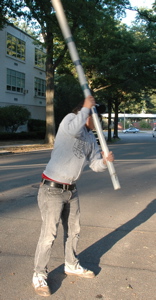 the kinds you might think of hiring someone for: painting, digging, purging, and heavy lifting.
It took two fourteen-year-old boys — the Demolition Department — two days to take down the swingset. On day one they dug the legs out of the ground and disconnected them from the anchors, and on day two they unbolted all the pieces. They worked unsupervised, figuring out the tools and the problems as they went. A hammer and a couple of wrenches were all they needed until the end, when rusted-together sections of the main horizontal crossbar resisted their muscle power. I brought out a hacksaw, and then a power saw. Thirty minutes of application yielded only some shallow grooves in the metal. They put their heads together, ignored common sense, and took turns standing the 12 foot pipe on its end and then letting it go so that it would crash against an old maple. This loosened the rust, but not enough. When last I looked, Eli and Arthur were standing in the road, with the pipe on its end, getting read to let it go onto the pavement. “Boys,” I thought, and left them to their own devices. It worked.
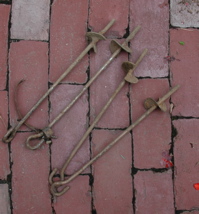
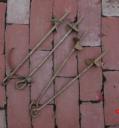 My bargain with them did not require them to dig up the swing anchors and patch the holes. That task fell to me, but it’s the kind of thing I like to do anyway. The first of the four anchors was a struggle, because I was still working out my removal method: digging around it, cutting tree roots, prying out stones, and shimmying it while unscrewing. Only in extracting all four from the ground did I become confident in how safe they make a swingset. There really was no way the back-and-forth of a swinger would ever have gathered enough force to jerk them out of the ground. And now they’re out, unmoored and, like old teeth, their usefulness used up, so we’ll throw them out.
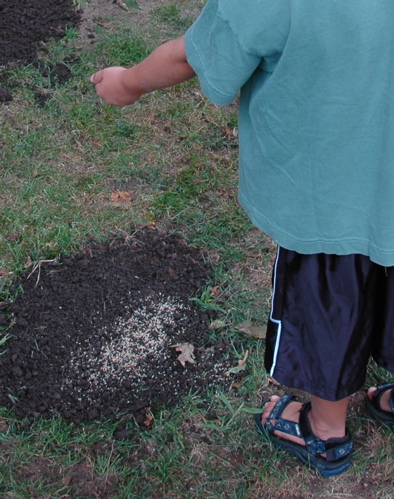
The Girl Squad — Lydia, Mary, and Carolina — were talked into spading up the dirt in the packed down ruts as I harvested all the loose stones and put them into a little rain ditch I’m making under a downspout. 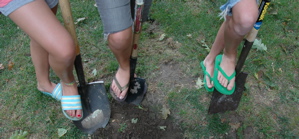 They went on to bigger and better things (surfing videos on Youtube) while I emptied and spread the dirt. Another helper, five-year-old George, joined me just when it was time to spread some grass seed, and I showed him how to sprinkle the seed and then spray with water. I asked George how long he thinks it’ll take before the grass seed sprouts; he paused, and answered seriously, “About seven days.”
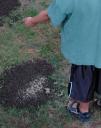 Right now there are seven neat, dark circles of dirt and a newly open space in the backyard. Many hours of effort of seven human beings went into undoing a structure that took two men (Jimmy and my father) a whole day to construct. There were costs as well: $120 labor ($50 x 2 teenagers + 20% tip); $21.85 (Domino’s pizza order + $3 tip); and $25.96 ($6.69 x 4 bags dirt). Total: $167.81.
And these are how our late summer days go.







 leaf stitch word
