Adrienne Rich and “The Trees”

The poet Adrienne Rich died at age 82 yesterday, March 28.  The New York Times in its obituary describes her as “among the most influential writers of the feminist movement.” This is true. Let’s also acknowledge her as one of the great writers, period, of the 20th century. Her body of work is still fresh and relevant.

The most recent issue of Granta included a new poem, “Endpapers,” which prompted me to re-read the anthology Facts of a Doorframe (new edition, 2002) and essays Arts of the Possible (2002). I first read her work deeply in a graduate class taught by Renée Bergland at Simmons College, which I attended from the age of 35 to 38. This is perhaps late to come to Adrienne Rich, seeing that she had been around as an influential writer since the 1960s, but it was the right time for me. Awakenings, after all, tend to happen once a person has some adulthood under her belt. A favorite poem from Doorframe is “The Trees.” If you know me or are a reader of this blog, this won’t surprise you. What’s surprising about the poem, however, is how unromantic it is for a nature poem: trees in a greenhouse break out as though patients from an asylum.

See below the jump for an excerpt of the poem by Rich and an excerpt of a paper comparing Rich’s “The Trees” to Frost’s “Birches” (another poem loved by me) I wrote in April 2003 for Renée’s excellent women’s poetry course. I have some new thoughts on the poem, too. Continue reading

Old paper, new uses

Every September, when the kids bring home a stack of textbooks from school and a teacher’s order to put covers on them, I take out the brown paper grocery bags and get to work. An hour later, there is a stack of books all tightly and cleanly covered on the dining room table. I recall Eli once saying, with a touch of wonder in his voice, “Mom, this is your secret talent.”

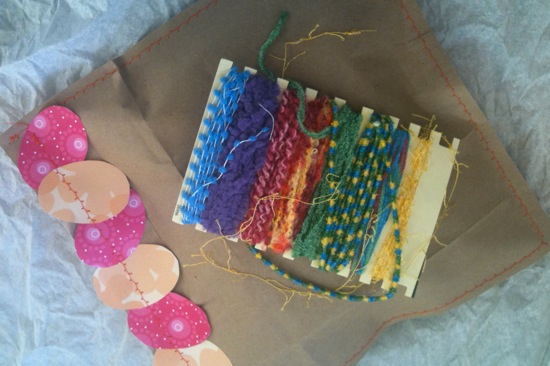
Grocery bags, and other sources of discarded paper, make mighty nice gift wrap too. Last year, I wrapped some small gifts by turning the printed side in on two squares of paper from bags and sewing up three sides. Then I inserted the gift and sewed up the fourth side, with scrap paper appliqués. I tied them up with fancy string. This year, I might go totally green, and use bits of twigs instead of the colored paper scraps for embellishment.

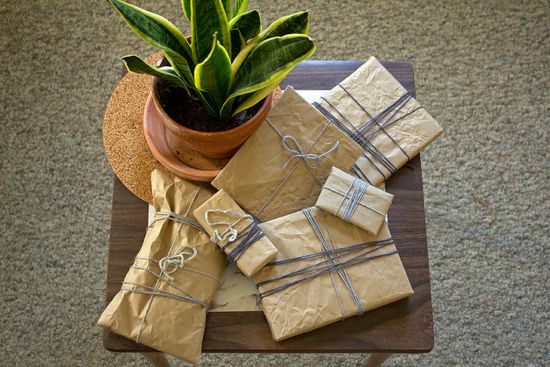
Jodi Anderson, who keeps the blog Daybook, wrapped gifts this year with the brown packing paper she found in the box her husband’s new saw came in. She used long lengths of yarn in place of ribbon.

credit: Jodi Anderson, 2011

And if I had a lot of outdated sewing patterns, I might steal Lisa Brainerd’s method for wrapping the items she sells and ships through her Etsy store. In January, I received a plain brown box in the mail from her.  Opening my purchase was as satisfying as the item (a pin) itself.

first surprise: pattern paper

second surprise: a purchase, wrapped like a gift, and bonus acorn

third surprise: more pattern paper!

final surprise: the thing itself (alongside the bonus felt acorn with a real cap)

Accidentally brought back from the dead

Last spring a Christmas cactus died slowly from neglect in one of our bathrooms. In late May, in a flurry of post-semester cleaning and organizing, I moved the pot with the petrified soil and dessicated leaves out to the back steps. I wondered if the roots of the plant, soaked by whatever rain should fall, would sprout a new plant. And, if not, I could toss it into the nearby compost.

The pot hid among some other more viable planters all summer. It was only two weeks ago, when I brought in the plants in advance of the Halloween snow, that I noticed it was alive again. Not a new sprout — the old thing, alive.

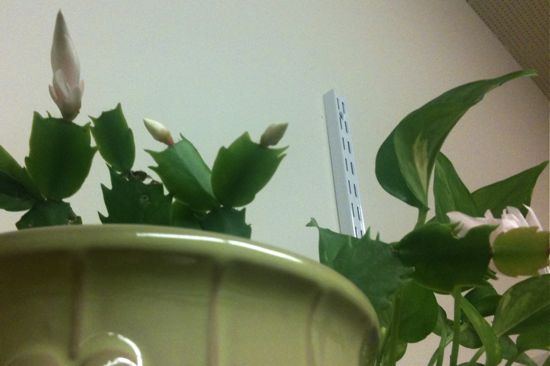
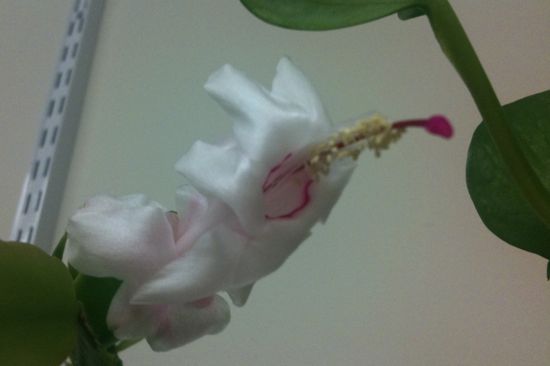
I brought it to work and proceeded to lose track of it again. (Why do I do this?) Thursday night, on the way out the door for the three-day weekend, I reached up to water the Kalanchoe and Pothos and noticed that the cactus, hiding again behind the two bigger plants, had… blossomed.

Perhaps all the time I had believed myself to be making mistakes with the cactus I had been doing exactly what it needed, and what it didn’t.

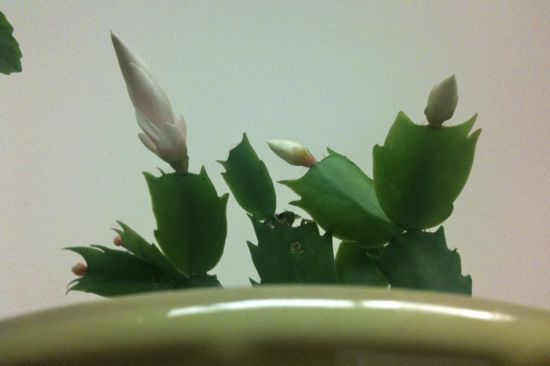
Are those... could they be... buds?

Buds indeed.

One show stopper.

Long, slow slide into winter

I’m busy — go, go, go — but the yard is taking its time fading from its summer vivacity.

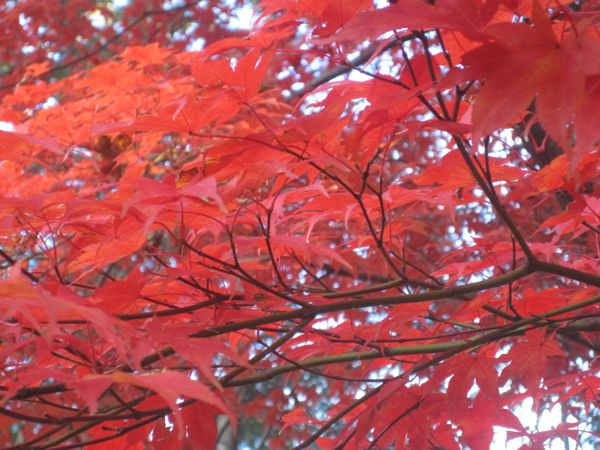
Jimmy is in California, so I’ve been doing both the late and the early shift around the house. This morning I drove Grace and George to school early for an optional gym class. When I got back home at 7:20am, I stood in the driveway for a while and stared up at the top leaves of the maple rising above the roof line from the backyard.

The previous two days have been beautiful around Boston; my time has been spent in offices, lecture halls, and labs. The long walk from the parking garage through the main campus and to my office, and then back again at night, I have welcomed. Rain was predicted today, and that the gentle weather still lingers seems akin to finding the last cookie in the box. I am going to stop and enjoy this.

Lydia left for the bus at 7:40am. More coffee tempted me and so did the laptop, but instead I went outside with the camera. The maple habitually persists in holding on to its red leaves, but I know from past years that I’ll wake up one day and the leaves will have been shed all at once, like a dog shaking water from its coat. I also know that someday I won’t live here anymore, and I’ll miss the tree like you miss a friend after they move away.

It turns out there are other fascinations in the yard right now even though growth has slowed or ceased for the year.

This slideshow requires JavaScript.

As I stood on the front steps taking a picture of the rotting jack o’ lantern, I heard my name called from down the sidewalk, “Hi, Jane.” My neighbor Susan, all suited up for work and out with her dog, stopped to ask about Eli and his adjustment to college. Her daughter Emma is doing fine at her university, too. We talked too about the beauty of the New England fall, which seems always to coincide with the busiest few months of the year, ending with the exhaustion of Christmas. Susan told me that yesterday she had to go to legislative hearing at the State House and was grateful for being forced, in a way, to take the train and then walk through the Common to get there. Otherwise, the day would have passed her right by.

Last-ditch attempt to solve the unsolveable

I can grow sunflowers and potatoes. I can propagate perennials. I can coax along a sapling into a tree. I’ve also had pretty good luck with cultivating infants into people.

I am unable to keep a front lawn alive.

On beautiful Sunday, I took the first step at solving this persistent problem, which has followed me to this house on Puddingstone Road from our old place on Davis. Following the soil sampling instructions, I dug up several 4″ cores of soil from various points on our front dirt patch, mixed them evenly, and put them aside to dry. Today I’ll mail a cup of this soil in a zipped plastic bag to the UMass Soil and Plant Tissue Testing Laboratory.

A diagnosis will be the first step toward getting to the bottom of this guessing game.

Years ago, Jimmy and I were quite taken by Barbara Damrosch‘s advice on gardening: It’s “very simple, really. You just have to learn to think like a plant.”

But thinking like a lawn? How does one do that? I, lawn-like, drink a lot of water but can barely remember to take my own vitamins. This may be connected to my failure to properly fertilize the lawn as needed.

Perhaps I want my lawn to be neglect-able, and it is very needy. I need to learn to think “needy,” to be high maintenance, which I think a lawn is.

I am willing to give it one last try. Why lawn? Why not a xeriscape? I do like that look, and two years ago I blanketed the front yard with sunflowers. But I like a little grass too.

And the thing about grass is that you don’t really need a design. You just plant it, and it becomes big green blank space.

Uncluttered, that’s what a lawn is.

—–

P.S. to my father, a lawn master. Dad, I know what you’re going to say, “Water.” I do. And, in fact, the lawn in the back yard is alive. Why does our front lawn die off — and I do mean die, not just go fallow — every year? Help.

Meander: to move aimlessly

I worked at home today, and I really did. All morning the window in the kitchen, where my papers were spread out, was open, and I could hear the early grackles outside and the neighbor’s mower and little grandson. By mid-day, all of them seemed to be calling, Come out, come out, come out!

I put some money, keys, juice, phone, and, of course, my glucometer in an old backpack from my mother and sneakers on my feet, and I went. No exercise agenda, no time limit.

At the corner of Bellingham and Grove, I saw the iron cover for a town water or sewer pipe (it looks like a test tube stopper, about 8″ diameter) still popped off the pipe. It’s been like that for three weeks, and I have been thinking that one of the Bellingham people would notice and call. It seemed no one has. So I stood on the corner, searched for the Brookline DPW on my phone, and I called them. “We’ll report it,” said the lady who answered.

Past the cemetery entrance. I saw a Mercedes drive in and some town workers clustered around a dump truck. The cemetery is one of the nicest kept public spaces in our town.

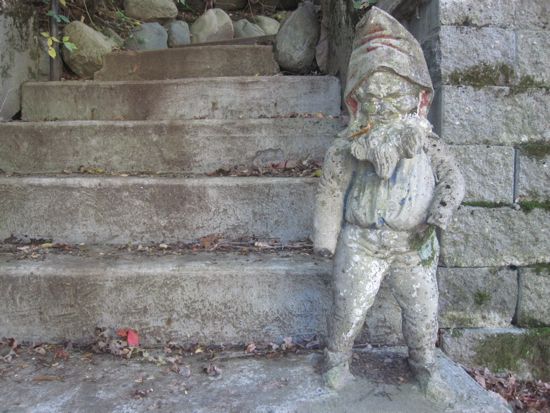
Down Allandale, with the road quiet enough that I could hear my feet on the sidewalk and birds in the trees. I looked at the site where they are building three new houses where there used to be one old pink one. Next door, there is still an old house with newer garden steps and an old weathered garden elf whose feet are caught in concrete.

At the farm, I went in all the greenhouses, empty of annuals. One was filled with bamboo plants and another with trays of clover.
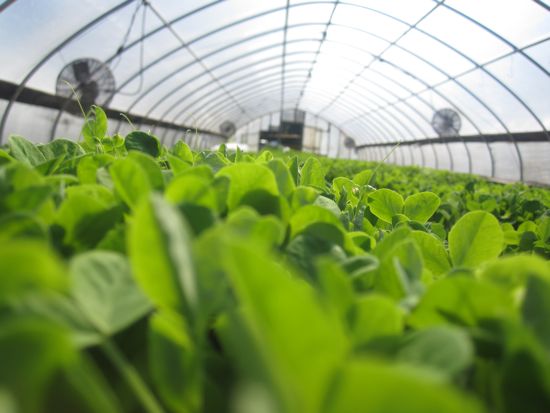
There were sparrows enjoying dust baths on the ground around a tractor. Some sparrows were even wriggling in the sand caught in the tractor’s big wheel treads. One sparrow wriggled in a puddle and didn’t fly away, like the others, when I walked closer.

Everywhere, boxes of gourds. In the shed behind the main store, where they dole out the weekly farm shares, there was a table laden with vases filled with sunflowers. A young woman, busty and with red-gold hair dressed in a black short-sleeve tee and knee-length black shorts, danced behind the table, in the style of Natalie Merchant, and showed off, I gathered, for the guys who work with her on the farm.
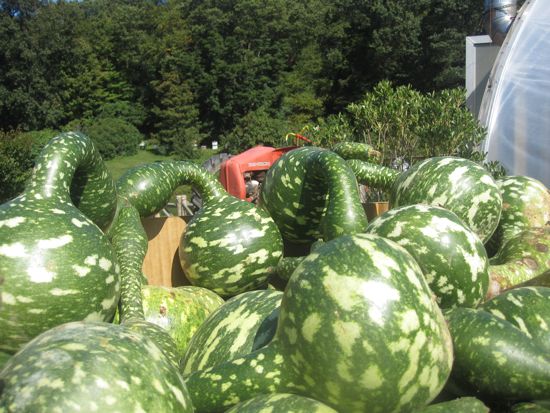
I wanted to take her picture, but I’m not a photographer and don’t know how to intrude like that. Later, I regretted not asking her. Inside the store, there were — amazingly — fresh strawberries and blueberries for sale. From Quebec, $8 each. The picture will have to do; the price was too dear.
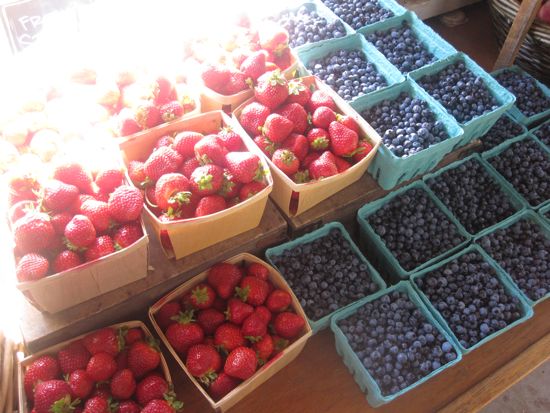
Through the neighborhood and down to the West Roxbury Parkway and then the VFW Parkway. So many chipmunks, not afraid of cars whizzing by but afraid of me walking.

On a bench, I sat to eat the nuts I bought at Allandale and drink water. White spray-painted graffiti, one word: WRECK. On the edge of the bench, acorns, lichen, and a baby pinecone. Across the parkway, women with babies at the park, men playing basketball.
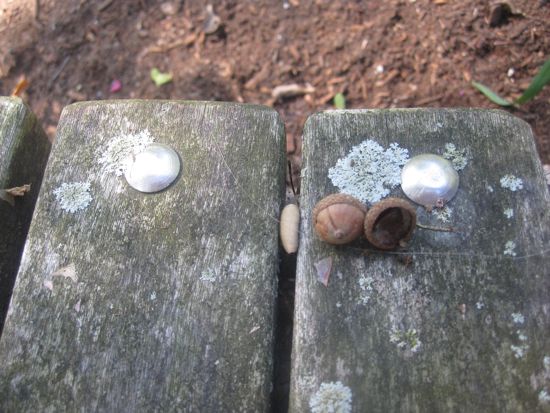
At CVS, a birthday card for Eli. On the sidewalk outside Bertucci’s, a woman with a face lift and in a denim jacket too young for her. This thought: your hands are still old.

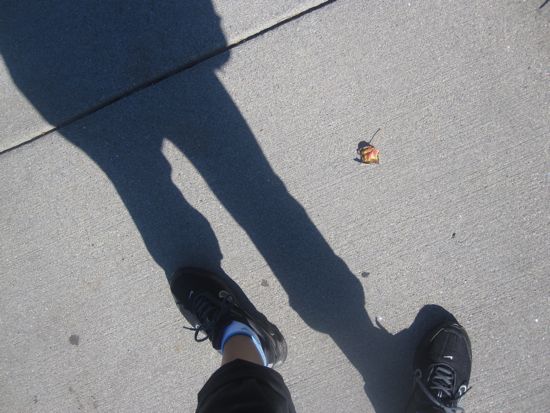
Back up Independence. A leaf on the sidewalk like tiger stripes painted on. Just one leaf. Me, like a giant. The ruler of the sidewalk world.
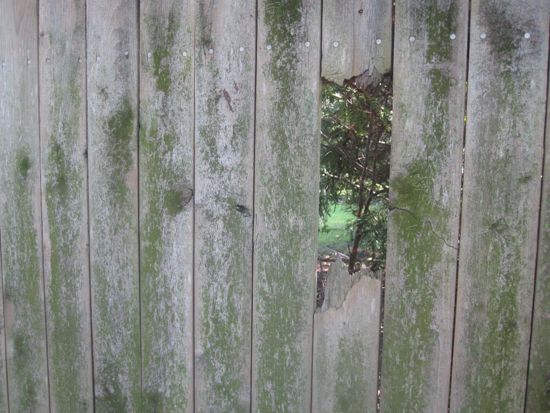
A block later, a hole in a neighbor’s fence. Ah, a secret garden! I hoped. I looked in: only driveway and car. Disappointment.
As I walked, it seemed to me that everything in the world may be happening when I’m at work and not noticing. That birds wriggle in sand and pumpkins warm in the sun and the dwarf keeps guard and farm girls dance and houses get built and cemeteries are maintained — this is the action.

And usually I miss it.

Little garage on the prairie

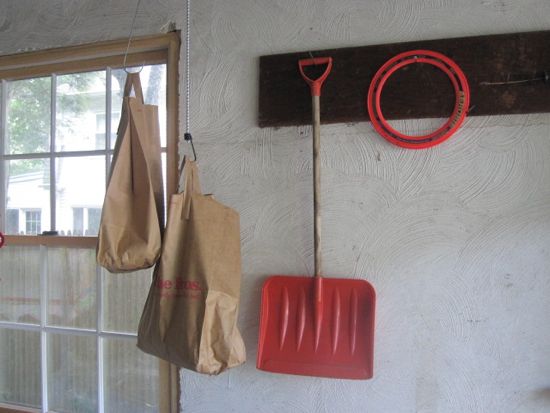
Last summer, after I dug up all the potatoes in my first patch ever, I cooked some and set some aside. I also hung brown grocery bags of potatoes by bungee cords from the overhead door track in the garage. I didn’t want to hang them in the cellar, fearing a rodent attack. So, a ‘root garage’ would have to do.

Over the fall and winter, we ate some potatoes. The garage is unheated, and yet they didn’t freeze. Feeling very much like Caroline Ingalls, a hero of mine, I left quite a few in the bags uneaten, as seeds for a future patch.

Well, this spring I did not do potatoes. I wanted a break from caring for so many living things to tend to other interesting challenges (writing, skating) as well as to children and students, who cannot wait. I suppose Caroline Ingalls, more legitimately concerned with survival than I am, would never have taken a break from kitchen gardening — it would have short-changed the family’s diet profoundly.

Recently I commenced the annual summer ritual: the garage clean-out. (Why doesn’t the garage stay cleaned out? We haven’t accumulated any new garage stuff.) The bags hung there, still dry, and no rotting potato juice stained the bottoms.

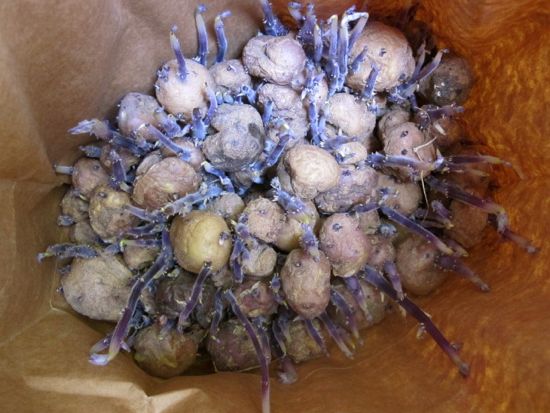
It had been months since I looked in. I imagined a bag full of potato raisins: dried, shrunken, and tough nuggets. What I found: intact purple seed potatoes, sprouted, reaching their arms up to me, begging to be planted.

Did I plant them? If I were Caroline Ingalls, I would have.

But I’m not her, and I didn’t. Off to the compost they went. Their bountiful energy will go into some other growing thing.

Making a place

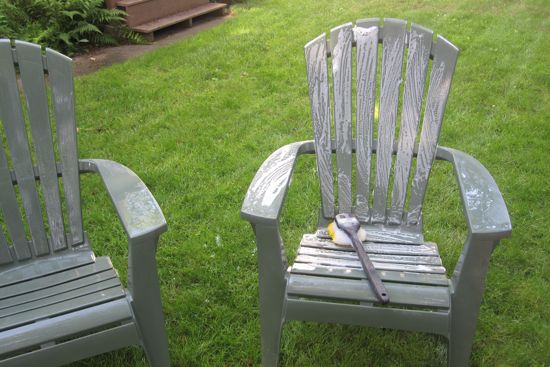
I mowed the grass and bagged all the clippings. I hesitated a moment — hadn’t enough labor been done for a day? — and then filled a bucket with water and dish soap, uncoiled the hose, and scrubbed the winter mildew and spring birdshit from the plastic Adirondack chairs.

Yes, I sat for a while and surveyed my handiwork. I wish now I had taken it one comfort further and had a beer.

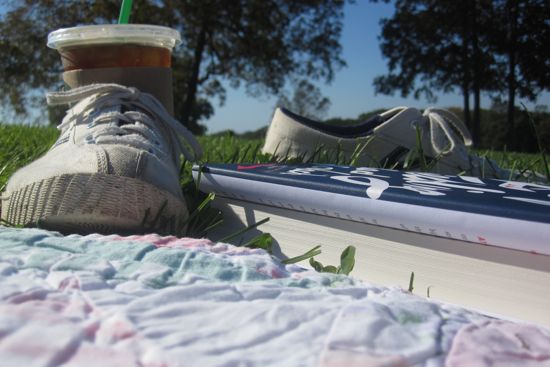
Eventually, I went inside. At some point I looked out the kitchen window to visually touch base with the order I had restored, and I saw Lydia had spread a quilt out in the middle of the chair circle. There were books all around her.

She yelled, “Please bring me a camera!” I did.

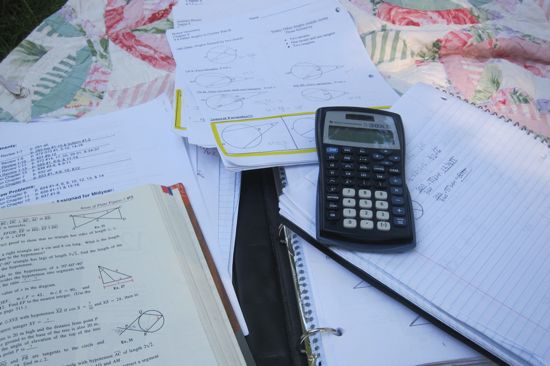
I discovered her photos later: the math textbook and worksheets on the quilt, another with her feet against a backdrop of trees, and an oblique view of her arm and a bracelet.

Nothing lasts intact. The birds and mildew will find the chairs again; the grass will grow shaggy. Already, Lydia’s math final is over and done with. Still, I feel as though something has been accomplished.