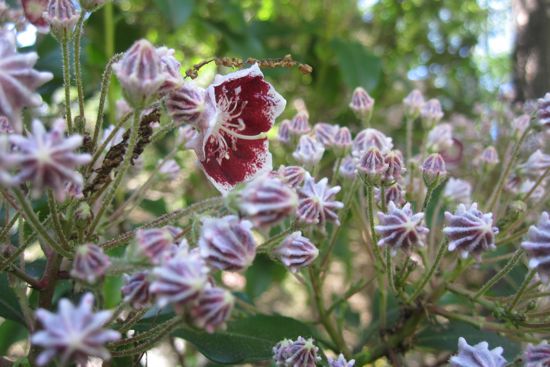
The kalmia (mountain laurel) show begins.
leaf
Tightening my gardener’s belt
This year, I’m putting my yard on an austerity program. There have been a few purchases to take care of a barren spot in the backyard, which was a weed patch inherited from the previous owners that I’ve left empty while I’ve ruminated on what to plant there, but otherwise I will mostly shop for plants among what’s already growing out back.
Here is the extent of what I’ve purchased, to the tune of about $150:
- 2 clethra “Ruby Spice”
- 3 New Guinea impatiens (white)
- 3 verbena (blue)
- 1 Japanese primrose (white) — my only purchase off list
- 3 heuchera “Encore”
- 3 trays of impatiens (assorted whites) — four plants for $1.39 at Christmas Tree Shop
- 4 bags mulch
- 1 flimsy trellis
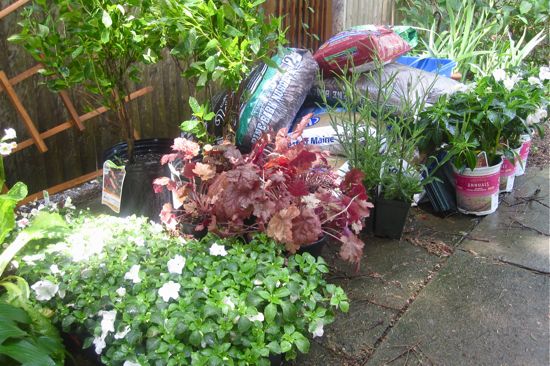
ready and waiting for duty
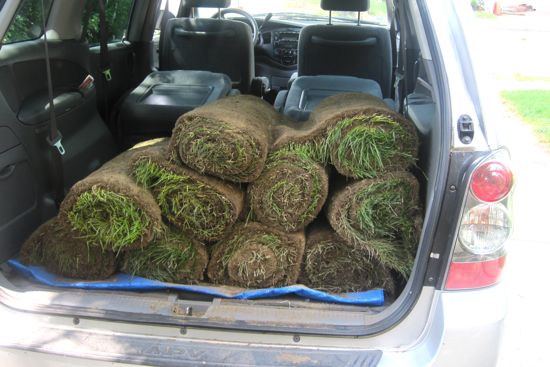
rolled sod: heavier than it looks
From the yard, I have more than 30 irises I dug up in the fall, separated, and dumped in a bin with some dirt. These are the most forgiving perennials, and they survived winter above ground and are now starting to bloom in that bin, clamoring to be planted.
The excessive winter snow and spring rain have given a boost to the green perennials, like hostas, ferns, and Solomon’s seal, and I’ll dig some of those up, divide them, and move offspring around the yard to fill in.

my own shade plant thrift store
At my mother’s house, I noticed some ferns growing up happily among the stones in a wall, and I think I’ll browse my rock pile (doesn’t every gardener have one?) and distribute some rocks around transplanted ferns.
In the next few days, the weather looks perfect for outside labor. My goal is to get it all done in one sprint and then enjoy the yard. I have other projects to nurture without undertaking one of my intensive yard projects. To do all this, as well as scrub down the outdoor furniture, will have to be enough this summer.
Stay tuned, though: I’ve always wanted to plant some quick-growing fall crops, like lettuces, and there may be a late season experiment later on.
It’s bigger than you.
I’ve noticed that, in my yard anyway, shortly after the buds of the crocuses start to swim up through the crocus leaves, the rabbits come out and nibble the leaves and those almost-flowers down to a stub. Two days ago I walked around the yard and counted the crocuses on the verge. Today I walked around the yard again. Crocuses: most nibbled and now inert for another year. Only one flower, hidden under leaves, left.
I sigh. The phrase “Oh, life,” goes through my head, and next, “It’s bigger than you,” and then the whole song. This is how the mind works, and I can’t help the association. Unlike Stipe’s persona in the song, I am not bitter over aborted buds, but I do think so many of the tasks of adult life involve a reconciliation between the dream and the real. Yes, it’s easy to be sanguine about the damage done by a rabbit; perhaps these kinds of things are practice (like kindergarten) for encountering bigger forces.
I love this song and video. This goes out to friend and fellow fan, James.
Restored riches
 We were sitting in the living room. Upstairs Eli whooped, and a few seconds later he burst out, “Hey, I found my wallet!”
“Hooray!” we answered, having all been waiting for this moment. A few days earlier, Eli had lost his wallet, and the search for it had been a running narrative in our house: the calls to the places he had visited, the rummaging under the seats of the cars, and the repeated question: “Could you have left it in [x place]?”
He thumped down the stairs, pants on and shirt off. Apparently the wallet was in his t-shirt drawer, which he rarely looks in because his laundered clothes seem to stay in the same basket they travel to his room in.
“I’m so relieved. I knew it was at home somewhere!”
His energy and lightness reminded me of a Kay Ryan poem I coincidentally had read the night before, called “Relief,” and I told him about it and what it made me recognize.
Relief
by Kay Ryan
We know it is close
to something lofty.
Simply getting over being sick
or finding lost property
has in it the leap,
the purge, the quick humility
of witnessing a birth–
how love seeps up
and retakes the earth.
There is a dreamy wading feeling to your walk
inside the current
of restored riches,
clocks set back,
disasters averted.
Still dreamy over his found wallet, Eli said, “Yes. Just last week my friends and I were talking about relief, and how it is the best feeling.” He smiled, and his voice emphasized best. I thought about how relief and happiness, like anger and sadness, might be twin emotions.
A few days later, Jimmy and I went outdoors to pick up all the branches and trash that the disappearing snow has revealed one layer at a time. In our yard we found Dunkin Donuts cups, an ice cream container, scraps of vinyl from the new crosswalk that was scraped up by the plow, a pack of breath mints (empty), snack bar wrappers, and a small-size pizza box. None of these items seemed to originate from our trash. Perhaps our Starbucks cups, strawberry boxes, water bottles, Diet Coke caps, and gum wrappers were found in other yards.
I raked away the leaves from the daisies and euphorbia, which, I observed, are getting their start, and chopped at the islands of snow still holding down branches of the weigela, ilex, and euonymous. Branches freed, the bushes immediately straightened up, not trained by this winter into hunched back-ness, as I had feared.
As I continued to rake around the yard, here and there I saw shoots of crocuses needling their way up. The worry inside me — that winter has been too cold, the snow too deep for the November-planted bulbs to survive and do what they do — flipped instantly, as easy as a coin toss but with the same held breath. They made it!
Winter’s softer edges
Winter hardens us. Not only the icicles are brittle.
A few hours of warm sun in late February, therefore, can loosen up the spirit as well as shrink the snow piles. One of my favorite concepts from middle school science class is sublimation, or the transition of a solid to a gas without passing through the intermediate phase, liquid. That’s what the snow does on warmer days: sublimates. (Some readers may prefer Freud’s use of the term to describe a particular kind of defense mechanism. It would be interesting to see if we could get those two definitions in alignment.)
As the snow disappears without leaving many wet patches, signs of life reappear. The world is not dead under snow, as I noticed in a walk around the neighborhood yesterday afternoon.
The moss is profuse and verdant and, when I put my hand on it, springy.
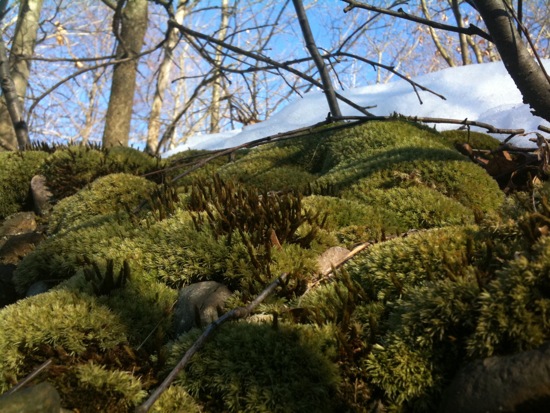
moss on a big puddingstone boulder
The lamb’s ears, though I have never grown this perennial myself, are vital and very soft.
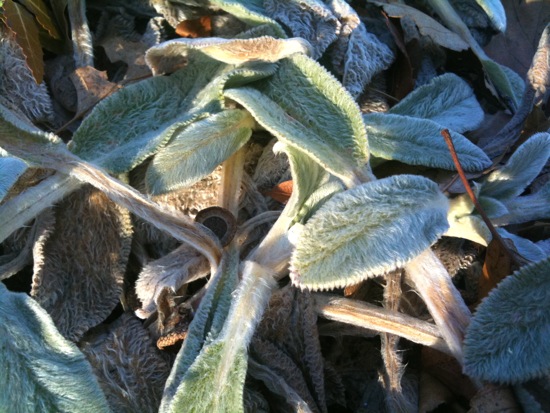
lamb's ears on neighbor's stone wall
And this little creature — a mole that I did not touch although I did speak to her — looks silky. Slit-eyed, she poked around the edges of the snow for a while, nibbling at acorn caps and looking for a way back into the ground.
Why do I call her a she? To me, the underside of her belly looked swollen and dotted with teats. Yet perhaps my imagination put them there, looking for even more signs of a coming spring.
Leaf stitch… bark?
I saw this on whip up, I found it on Flickr, and I bought it through Etsy. Lucky, lucky me.
 Made and photographed by Lisa Jordan of lil fish studios in Brainerd, MN.
The world is strange again.
On the morning of the snowstorm, I am awake at the usual time. There’s no rush to get going. Still, I turn on the coffee and check “what happened overnight on the Internets,” as Jimmy would joke.
From my father, I read a gang email to all five of his children, exhorting us to clean off our cars before the temperature drops below freezing. His message may affect each of my siblings differently, but me, I feel watched over in a good way.
I put on my gear and go outside. Jimmy shovels; I clear the cars properly, even their roofs, and then I shovel around them.
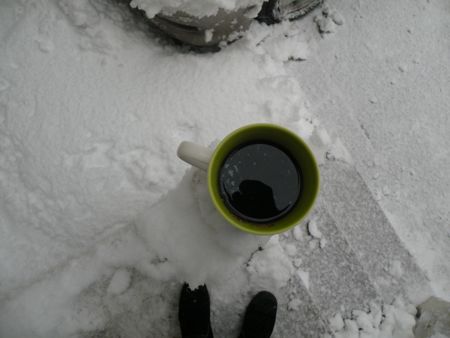
Any mug can be a travel mug, depending on where you're going.
Snow removal from the cars, driveway, and sidewalk takes about 90 minutes. We jam the shovels in a snowbank — it’s great snow for igloo-making, why don’t we make one? — and walk over to the shops at Putterham Circle. Only two are open: the convenience store and Starbucks. While there are no cars in the rotary that feeds the shopping center, inside Starbucks it is steamy with people.
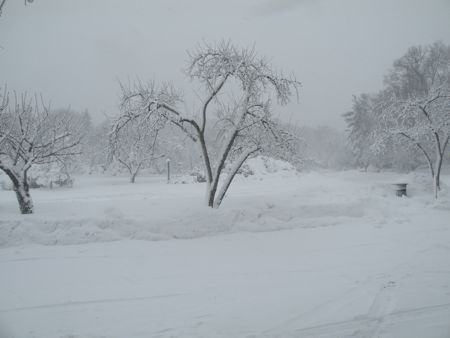
For once, no cars in Putterham Circle.
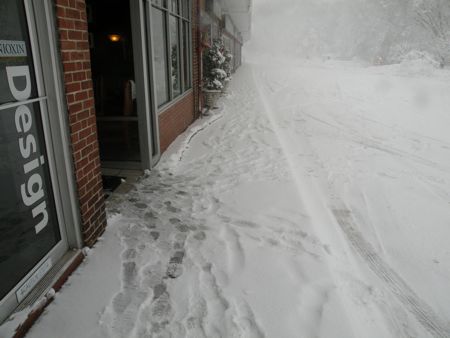
All footprints lead to the coffee source.
Then we walk, lattes in hand. It’s easy to shuffle across the intersection and down South Street. We walk and walk and pass only a few neighbors, here and there, out shoveling or snow-blowing. Ogden Street has not yet been plowed, and on the snow’s surface are chestnuts, still in their pods, that have just fallen.
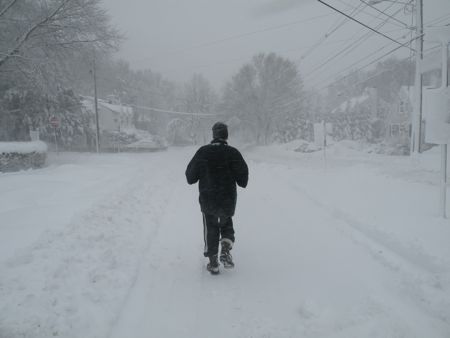
Jimmy walks blithely down the middle of South.
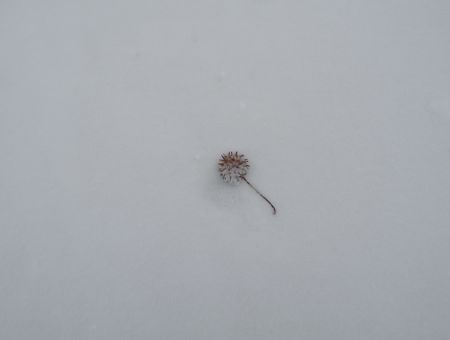
Now, this is still life.
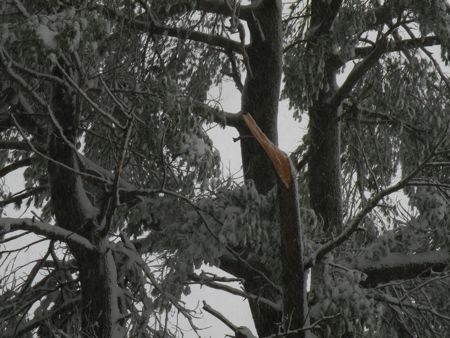
We see these fresh wounds everywhere.
Near Bournewood, we throw our empty cups into a dumpster in a driveway.
As we walk through the hospital grounds, I say, “I think Anne Sexton stayed here. And perhaps Robert Lowell.” Jimmy asks, “And Sylvia Plath?” McLean, in Belmont. Continue reading
Smashing pumpkin
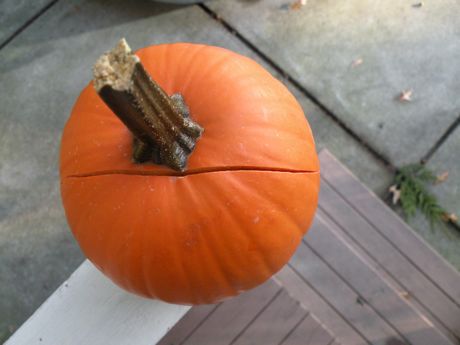
Never mind Angry Birds. What about Hungry Squirrels? 🙂 This morning this pumpkin was intact and perched safely on the porch banister.

today 12.14.2010 ~2:30p @Jane's house
Hungry Squirrels is an (impulsive) idea for my technically astute brother, Brian, who just developed and published his first iPhone app, MASTDinfo for Fenway Community Health Center, and will likely be producing some more. And I think he has his sights set on games.
Winter anticipation face
This passing of grackles
I am drawn to the notion of what in Spanish is called querencia. It is a special version of an individual’s sense of place, and the word conveys intimacy, deep knowledge, and a pull. I first read about this in John Hanson Mitchell’s book, The Paradise of All These Parts: A Natural History of Boston (Beacon Press 2008).
He describes querencia this way:
Those with a strong feeling of querencia will know the weather of their country, will know the dates of the arrivals and departures of local migratory birds, and the flowerings of trees and shrubs. They will be familiar with the course and names of local rivers and streams, the dates of the seasonal passages of fish, and the location of hidden animal trails, of dens, swamps, hollows, cliffs, and odd boulders or outcroppings. Furthermore, they will know that certain sites within their terrain exhibit almost mystical emanations.
Is it possible to feel this way about an entire state? While I am no expert on Massachusetts, I have lived in it my entire life, and I love it as I do my siblings, and indeed I have known it as long as I have known them. Yesterday, perhaps the most beautiful of all of October’s days, I took a break from my desk and walked outside to have a look at the Charles River, which was roughed up by the breeze. Cars honked across the Mass Ave bridge and the sun glossed the John Hancock Building. Leaves, yellow. Honestly, I felt my heart lift in my chest.
In the past two weeks, in my own yard I have been noting the comings and goings of the migratory grackles. It’s that time again. Although they irritate the air with the sound of one thousand squeaky gates, I am delighted to see them.
Their appearance makes the world seems familiar and surprising too: on one day they scurry like a frightened mob from tree to tree, knocking acorns down onto cars parked in the street, and on another day they choreograph their flight gracefully. Continue reading
 leaf stitch word