– For your eyes only

Pink locking diaryBound diaries and journals have not always been secured by a padlock or hidden between the boxspring and mattress. Thoreau and his Transcendentalist friends, in fact, often wrote them with the knowledge that they would be read, whether in their lifetimes or posthumously.

According to an article in the local Brookline TAB this week (11.1.07), which announces the publication of a new compilation of Thoreau’s journal entries called I to Myself (YUP 2007),

Keeping a journal to share with friends was a far more common activity for people of all educational levels in Thoreau’s era than today. “Back then almost everyone kept a journal, even farmers and definitely educated people,” says [Jeffrey S.] Cramer. People shared their journals. When Thoreau writes in his journal, you feel like he’s talking to you. In his journals he’s definitely writing to a reader.”

Verification for this remark appears in the chapter “Thoreau in His Journal” in the Cambridge Companion to Henry David Thoreau (CUP 1995). Yes, the Transcendentalists were devoted journal keepers who wrote, often, for each other. So were other Concord residents — clergy, teachers, naturalists, businessmen, lawyers, housewives, unmarried women, students, farmers (109) — writing in and keeping journals. About his own massive journals, which were circulated so often they became a kind of “lending library,” Bronson Alcott, the father of Louisa May, wrote that the collection:

…gathers up the fragments, and preserves in transcript, whatever there may be for future value & use, so that nothing of life shall be wantonly contemned or irretrievably lost…. The history of one human mind… would be a treasure of inconceivably more value to the world than all the systems which philosophers have built concerning the mind up to this day. (111)

I ask you, fellow bloggers, are we not participating in a grand tradition? Like our 18th and 19th century forebears, today’s electronic journals are also built on timeless topics — among more contemporary ones like restaurants, sex, movies, and baseball — such as these mentioned in the Cambridge Companion:

• domestic operations;
• reading records;
• travel narratives;
• business;
• notes on changes of seasons or weather;
• medical observations;
• flora and fauna;
• introspective registers;
• private histories;
• political or other social and institutional goings-on; and
• of course, combinations of several, perhaps many, of these. (108-109)

And none under lock and key.

—-

Image of pink diary from Smythson of Bond Street catalog.
– Oh, to draw!

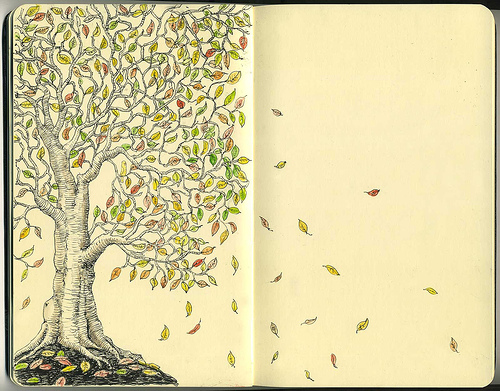
Today I’m wishing that my black notebooks — full of penciled words, notes to self, lists, names of books, phone numbers for contractors, half-baked ideas, found language, beginnings, and occasionally the pressed leaf of a plant I come across and want to remember — contained one thing as lovely as this:

“Autumn” by Mattias Adolfsson

“Autumn” by Mattias Adolfsson, http://mattiasa.blogspot.com

See more entrancing notebook images from various artists at the Moleskine Project. You might find yourself wishing my wish: to draw, and to do it well.

– Notes: more than flotsam and jetsam?

Doctors take notes. Nurses. Therapists, especially during the first meeting. Journalists. (During the Q&A after his talk at the Wesleyan Writers Conference in June, George Packer remarked that “facing his notebooks,” each time he returns to his desk at home in NY after leaving Iraq, is “daunting.”)

Right now I’m reading the 16th in Peter Robinson’s Inspector Banks series, Piece of My Heart, and I’m reminded that note-taking is also a constant activity in the police procedural. Detective Inspector Chadwick interviews Rick Hayes, the promoter of a concert at which a young woman has been knifed to death. During the short scene, almost all of Chadwick’s gestures have to do with his notebook:

[He] dutifully made a note of the names after checking the spelling (21).

Chadwick scribbled something on his pad, shielding it from Hayes (21).

He made a note, and then looked directly at Hayes (23).

Chadwick jotted something down. He could tell that Hayes was craning his neck trying to read it, so he rested his hands over the words when he had finished (24).

Real detectives, and not just fictional ones, rely on their notebooks just as much as Chadwick does. In fact, they’re trained to use their notebooks. A few pages from the General Orders of the Hong Kong Police Force, Chapter 53: Police Notebooks (a neat find that turned up in a Google search) instruct officers in a method for keeping the daily notebook. This is an excerpt of just the items that caught my eye:

An officer will make a fresh entry in his notebook at the commencement of each duty shift, detailing the date, time and particulars of the duty allocated to him.

Notes shall be kept in chronological order and shall be made in indelible blue or black ink.

An officer shall write legibly. If any deletion, alteration or addition is made, a line shall be drawn through the original entry in such a manner that it remains legible and shall be signed by the officer concerned or the person whose statement is being recorded.

An officer shall not erase or attempt to erase any entry in his notebook.

An officer shall not remove from his notebook any page or any part thereof, unless he is in court and is expressly directed to do so by a judge or magistrate.

I took a look at some of my own notebooks from over the years, not really journals (I don’t reflect so much as capture) and yet not as complete and orderly as a police notebook should be. Still, I seem to have collected a lot of… evidence.

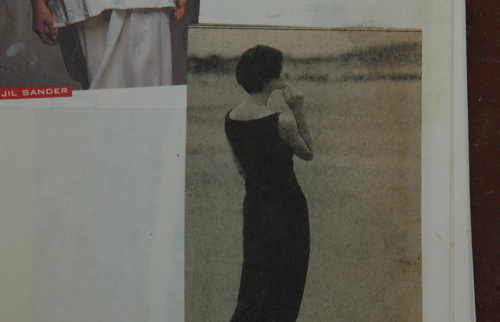
From the late 1980s, when I sewed a lot more than I do now, and therefore dreamed more of it, too, there is an entirely visual collection. I was constantly on the look-out then, when reading catalogs and magazines, for clothing shapes that attracted me. I used rubber cement to paste a lot of these items, like this one, into a small sketchbook.

Dress with long curve

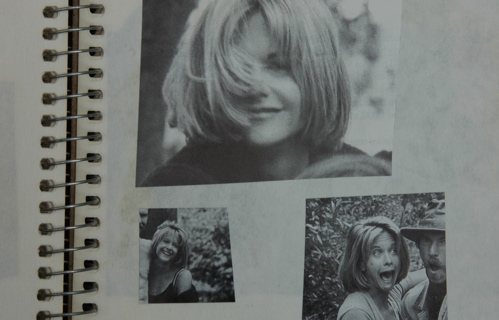
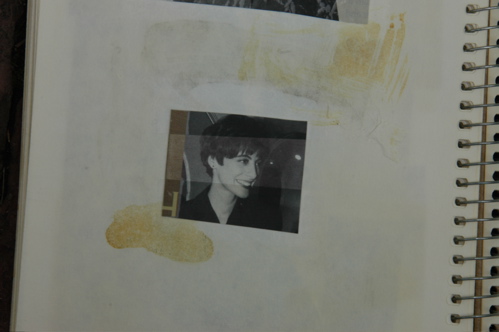
Around the same time, my friend Sybil and I were conducting an ongoing investigation into The Perfect Haircut. She had a manila envelope full of pictures sliced from news, celebrity, and women’s magazines; I kept a folder for ones under consideration. We occasionally traded pictures, and so some of mine ended up in her envelope and some of hers ended up pasted in the back of my clothing notebook. Here are two favorites (the first set is from a profile on Meg Ryan, actor; the second one shows just the head of Inez Someone, who was then a well-known French model):

Meg Ryan hair

Inez hair

All along, I’ve been keeping more notes than images. Most are traces of random thoughts, like this, from my notebook than spanned 1993-94:

Virtue. People are looking for virtue in the weirdest places. Exercising. Not eating (“I’m so good — I skipped dessert.”) Saving money. Hoarding vacation and sick days.

On the same page, after a few spaces, I scrawled a separate bit:

Privacy issue. Why are people so concerned about sharing their consumer and financial information and yet be so willing to talk about family problems and sex life w/ anyone who’ll listen?

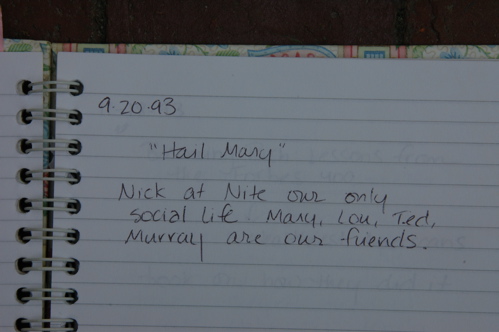
The entries are not all dated, but this one is:

Mary Tyler Moore show

(Over the years, other shows have supplied me with “friends”: Northern Exposure, ER, and, of course, Friends. )

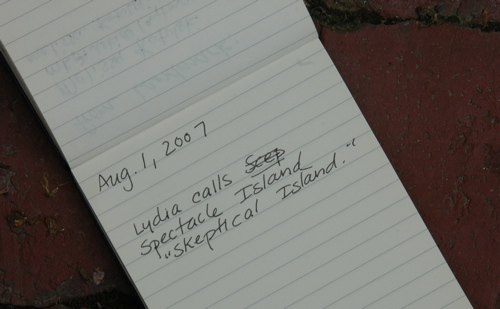
Yesterday I went with Lydia, her pal, and Toshika on a daytrip to three of the Boston Harbor Islands, sanctuaries that are less-visited parts of our city than, say, the Esplanade or the Public Gardens, perhaps because of the boat trip. I’ll argue that, because of the boat trip, as well as their scrappy, beachy beauty, the islands are a wonderful destination (and only ten dollars for an all-day boat ticket). I took one note, below. Will it help me remember yesterday, as all the above excerpts help me remember other yesterdays? Will it be useful to me somehow, someday?

Skeptical Island

There’s one thing I know from reading police detective novels, and from keeping my own hoard of scraps: You never know which bit, later, will emerge as a clue, as THE clue.