Ready or not for my close-up

A good thing about living in a household with artistic people is that there is always someone around to sing a song, pick up the guitar, give technical assistance with Photoshop or Audacity, draw a picture or diagram, edit a draft.

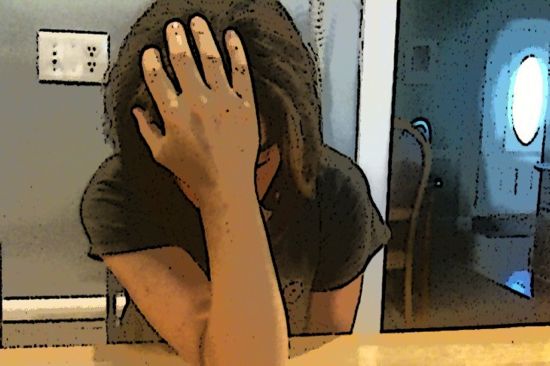
This morning, before she headed to camp, I asked Grace to take a photograph of me for a post I was writing for my blog on A Sweet Life. I gave her a few suggestions: I wanted a close-up of me; fatigue or frustration would be the emotional message; and I didn’t want my facial expression to convey the message — it had to be posture or color or something else.

We sat in the kitchen at the table, she across from me. She stage-directed me. “Use two hands.” Then, “Try one hand.” Or, “Too much hair.” She’d look at the camera display screen. “Smile a little so your face is smoother, but not so much that you’re smiling.” “One more time, and sit forward.”

She picked one. Wow, it looked so stark and real. I could see a ligament in my neck where it meets the collarbone and the nasolabial fold that improves when I’m smiling. But I wasn’t smiling. Did I really want to look this plain? Couldn’t I get this junior artist to put a visual spin on it?

“Could we try Toon Camera?” I asked. Continue reading

Pillars of civilization

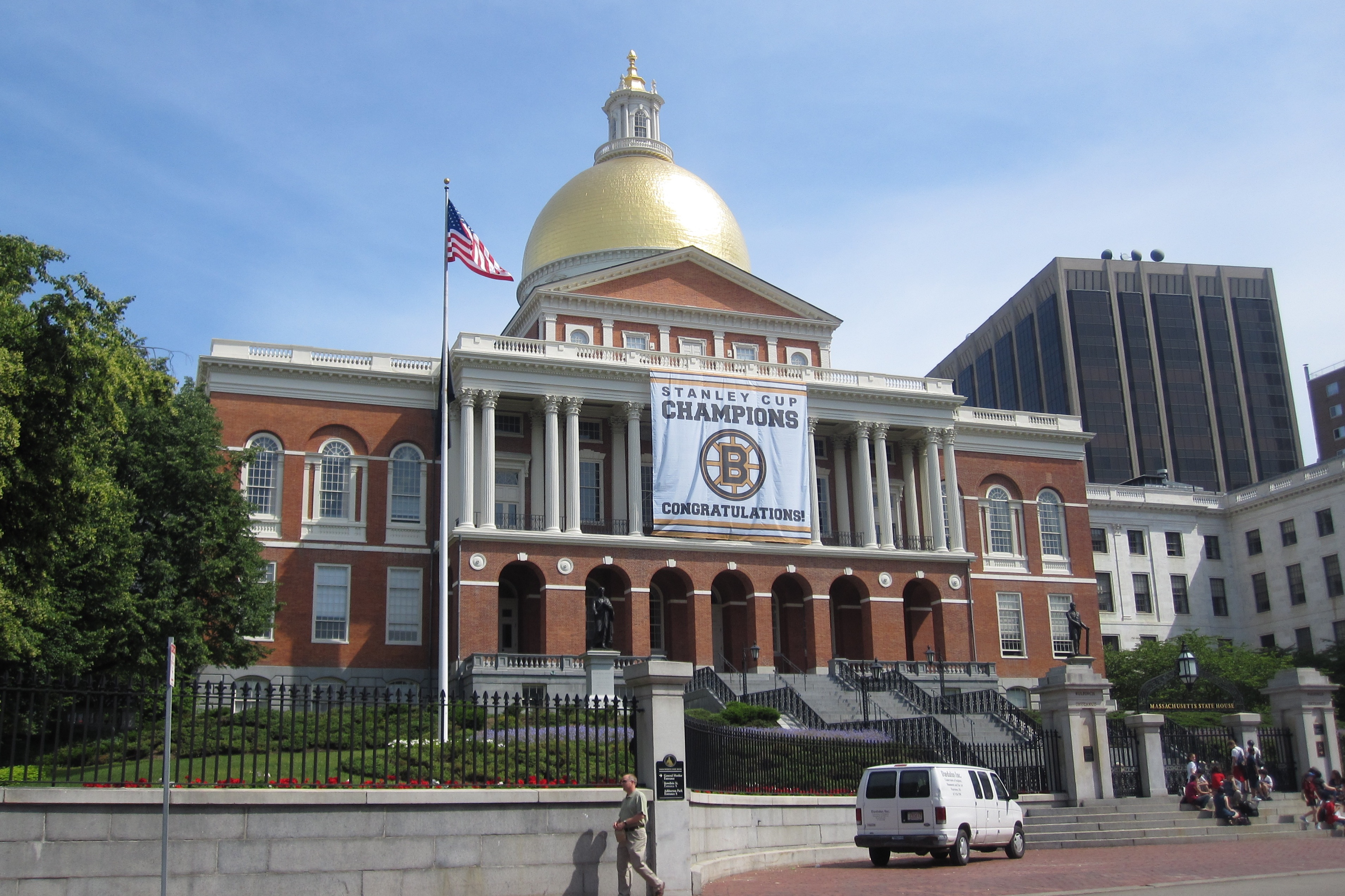
We unloaded the two busloads of Brookline fifth graders in front of the State House. Driving up Beacon Street, with all but the gold dome hidden by trees, I had not seen the huge Bruins banner hanging from the ballustrade and down over the portico.

Massachusetts State House, June 20, 2011 @10am

Our bundle of children, parents, and teachers stood on the sidewalk as the buses pulled away and left us. I leaned over to one of the other parents and murmured in her ear, “Ah, those twin pillars of civilization, politics and sports.”

Squinting, she nodded and agreed: “Especially in Massachusetts.”

This was the first stop on our Boston architecture tour. The teachers ran it like a quiz show with points for correct answers.

Teacher: Who was the architect of the State House?

Students: Charles Bulfinch

Teacher: Which English building did he imitate?

Students: Somerset House

Teacher: Who, in 1802, covered the wooden dome with copper?

Students: Paul Revere

Teacher: Why was the dome painted black during World War Two?

To this question, there were many responses, all guesses. One student answered poetically: “It was a dark time.”

Only the parent chaperones, all in their 40s, knew the answer to this one, having heard of the wartime practice of blackout. None of us, though, had ever lived it.

It was a bright, hot day at the end of the school year. Summer beckoned. The dome sparkled. Among the lucky, we feared nothing more than sunburn, lost lunch money, and a dawdling child. Our leisurely tour through Boston history — a stand-in for the American struggle for independence — began.

Relics

oak seedling and acorn relic

This fact once had a hold on me: that a baby girl is born with about 1 million ova. When my daughters were infants, I would stare at them, trying to grasp the reality that future grandchildren, if I were to have them, had gotten their start as cells inside my body. And the baby that I was diapering, was watching play with her toes, was soothing to sleep had a package of potential life inside her.

Contemplating this, I had a feeling not unlike the one you have when you stand in front of a mirror holding another mirror, and hold it in such a way that you see yourself reflected on and on and on and on.

Even as the babies grew into children — the daughters and the son — and their once physical connection to me was lost, I held on to the idea that cells that had originated inside me remained inside them like traces, souvenirs, relics. At the same time I felt perversely proud of my body (for doing what it does sort of automatically), these immigrant cells felt like losses to me, too, as though they took something from me.

My contrary feelings and ideas about my old cells residing in my children were so pressing that I of course had to write a poem about them. An early version (not the first draft) looked like this:

Relic

       for a daughter

Cheeks full. Lips
dripping pearl. You
have sucked

me soft.
What I had—
sinew leaping
blood replenishing
bones toughening—
spent.  Clean shell
I cultivate urge:

grow, colony, grow!
Multiply and billow
like yeast yet keep
my relic.

Moored boat,
patient seed, egg
inside me inside she
(my harbor, my flower),

remain, and divide.

Later, perhaps years, I dug the poem out and revised and revised it. I was going through a period of loving the cooler voices of poets like Mark Strand and Louise Glück, and I was a little embarrassed by my exclamation and stacked images. Continue reading

Student success, my reward

Social Q's column, NYT, 4.24.2011

This weekend Eli and I will finally do some baking and thank-you-note writing for the high school teachers who wrote him the recommendation letters that helped him apply and get accepted to colleges. The baking (chocolate beet cupcakes?) is a way to recognize their labor with ours. In his notes, Eli can let them know he has decided to attend UVM out of the various schools he was accepted to.

Perhaps it’s that time of year, but I’ve been wondering about the outcome of some recommendation letters I wrote for students over the winter for internships, etc. or the personal statements I helped them revise last summer and fall for grad school applications.

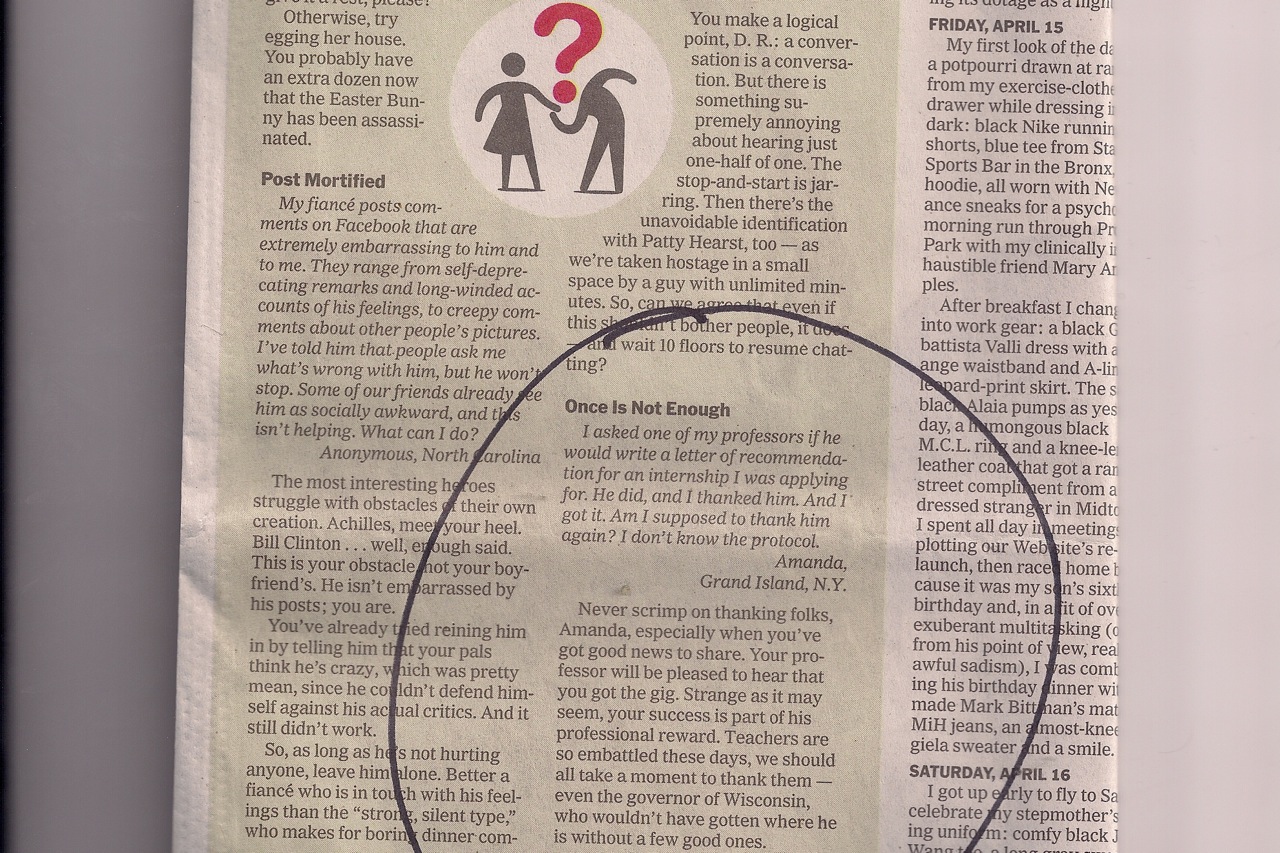
On Sunday, the Social Q’s column in the New York Times published a query by a college student confused about the protocol of thanking her professor for a letter he wrote. (See photo of clipping above.) Must she thank him a second time, after learning that she got the internship? Philip Galanes, the etiquette expert, replied, “Your professor will be pleased to hear that you got the gig… [because] your success is part of his professional reward.”

Dear Students, it’s true. We teachers are invested in your futures, just as physicians are invested in their patients’ health, and parents in their children’s well being and independence. It’s not that we are so self-effacing that we have no lives of our own — of course we have lives — but you’re like our garden. And because the processes of growth, despite all our knowledge of them, still seem so magical and the signs often imperceptible (children, like plants, seem to grow and develop overnight in the dark), it really is thrilling to see evidence that you are flourishing.

Yesterday, after a delay of almost a year, I got an email from a student who told me the outcome of his MD/PhD program applications. Together we had worked on his personal statement, he writing and I responding. He told me he has been accepted to a desirable program. Having worked with him on that personal statement, I know what this means to him.

What it means to me? I have an ego, too: In the collective work of educating young people, my individual contribution matters.

Restored riches

We were sitting in the living room. Upstairs Eli whooped, and a few seconds later he burst out, “Hey, I found my wallet!”

“Hooray!” we answered, having all been waiting for this moment. A few days earlier, Eli had lost his wallet, and the search for it had been a running narrative in our house: the calls to the places he had visited, the rummaging under the seats of the cars, and the repeated question: “Could you have left it in [x place]?”

He thumped down the stairs, pants on and shirt off. Apparently the wallet was in his t-shirt drawer, which he rarely looks in because his laundered clothes seem to stay in the same basket they travel to his room in.

“I’m so relieved. I knew it was at home somewhere!”

His energy and lightness reminded me of a Kay Ryan poem I coincidentally had read the night before, called “Relief,” and I told him about it and what it made me recognize.

Relief

by Kay Ryan

We know it is close
to something lofty.
Simply getting over being sick
or finding lost property
has in it the leap,
the purge, the quick humility
of witnessing a birth–
how love seeps up
and retakes the earth.
There is a dreamy wading feeling to your walk
inside the current
of restored riches,
clocks set back,
disasters averted.

Still dreamy over his found wallet, Eli said, “Yes. Just last week my friends and I were talking about relief, and how it is the best feeling.” He smiled, and his voice emphasized best. I thought about how relief and happiness, like anger and sadness, might be twin emotions.

A few days later, Jimmy and I went outdoors to pick up all the branches and trash that the disappearing snow has revealed one layer at a time. In our yard we found Dunkin Donuts cups, an ice cream container, scraps of vinyl from the new crosswalk that was scraped up by the plow, a pack of breath mints (empty), snack bar wrappers, and a small-size pizza box. None of these items seemed to originate from our trash. Perhaps our Starbucks cups, strawberry boxes, water bottles, Diet Coke caps, and gum wrappers were found in other yards.

I raked away the leaves from the daisies and euphorbia, which, I observed, are getting their start, and chopped at the islands of snow still holding down branches of the weigela, ilex, and euonymous. Branches freed, the bushes immediately straightened up, not trained by this winter into hunched back-ness, as I had feared.

As I continued to rake around the yard, here and there I saw shoots of crocuses needling their way up. The worry inside me — that winter has been too cold, the snow too deep for the November-planted bulbs to survive and do what they do — flipped instantly, as easy as a coin toss but with the same held breath. They made it!

There is nothing to write.

On the contrary, there is always something to write.

Occasionally a child or teenager will stand in front of the opened refrigerator door and, uh, meditate. With the right hand on the handle and feet planted on the floor, s/he will stand there, silent and contemplative. And finally, if I am sitting there at the table, s/he will say, “There is nothing to eat.” (Full disclosure: I too, as a child, was guilty of perpetrating this on my mother.)

cartoon fridge, this morning. lots of dairy, I just noticed.

“Have an apple,” I say.

No.

“Fry an egg.”

I don’t want an egg.

“Leftover soup. Cheese and crackers. Celery and peanut butter. A sandwich.”

No, no, no, and no.

“Well, you must not be that hungry,” I conclude.

S/he will say, before stomping out of the room: There is never anything to eat in this house!

It seems to me that people who write, either because they want to or because they have to, will occasionally stand in front of the open-doored refrigerators that are their minds and be disappointed that a delectable cake, already sliced and plated, is not sitting there on the middle shelf waiting for them to grab and eat it. Instead, they have to choose a few ingredients and assemble them into something they might want to eat. Often, they turn away.

To that, I say, “Don’t just stand there with the door open!” Instead, do this. Continue reading

Attractions of ordinary life

bed to make

Two nights before Christmas, Betsy and I sat at the bar at Legal’s in Chestnut Hill, having a quick drink and bowl of chowder before we went to see The Fighter. That now seems ages ago. For a while she and I talked about our attraction to cinematic portrayals of ordinary life: the food, routines, chores, and even squabbles of the everyday. B. also mentioned the fiction of Alice Munro; I thought of Charlotte Bronte, Jane Austen, Charles Dickens. And yet to say those works are only about the quotidian is to reduce them.

Because we never travel farther than New Jersey during the Christmas week — I’ve never spent my holiday in the Virgin Islands, Costa Rican rainforest, or Hawaii as some families do — and this time we haven’t traveled at all, the last week has been lush with the quotidian. Laundry. Tidying. Mail sorting. Reading. And cooking, especially cooking.
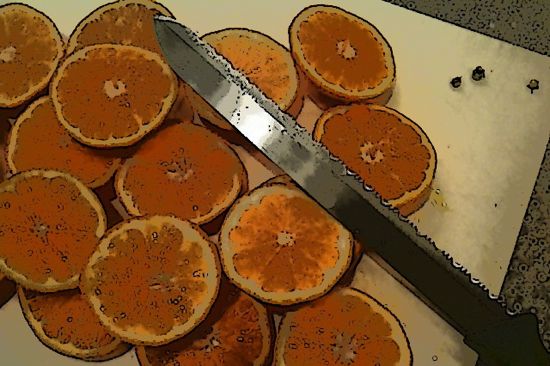
clementines to simmer and preserve

When the hands are busy, the mind is free. As I’ve chopped or made beds or run errands or wrapped gifts that I have since returned, sometimes with a clenched jaw, I’ve been thinking of the pressure on some of us to turn one’s own everyday life into an art form: concentrated, heightened, shareable. I both succumb to and participate in that.

As a child, my favorite bag lunch consisted of two hard-boiled eggs with salt, bread and butter, an apple, and cookies if possible. My own children want “something good” for lunch — and this may be a result of our having occasionally provided the show-stopping lunch — and it’s not enough, for example, to have an apple in a bag. The apple must be cored, peeled, and packed with sliced lemon. (Yes, I initiated that.)

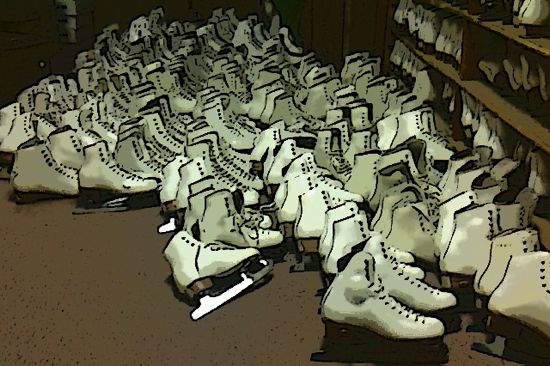
last year's skates to sell, in the back room at the Ice House

Incrementally over time, the bar has been raised for all of us with a stable income. We are surrounded with labor-saving devices — vacuum, dishwasher, clothes dryer, car — and we use them to make more labor possible.  This week, Grace and I drove out to the Ice House to upgrade her skates and get hers and mine sharpened, and then we drove miles back to the rink for skating. Sometimes I long for (or perhaps romanticize) the hours spent on the frozen swamp ice deep in the woods that surrounded my childhood neighborhood. In its surface were embalmed sticks and leaves and air bubbles, which made for a pebbled glide, and here and there boulders and rotted trunks made interesting obstacles that we could do nothing about but skate around or over. Dulled blades were not a concern.

a fine girl to skate with

Once, seeing me crouching in the dirt in the front, my neighbor Gail, who never gardens but knows more the names of plants than I do, said to me, “You’re Martha Stewart.” I think this was a compliment, but I felt it as a stab. To convert everyday life to something that can be packaged, photographed, and sold is not my intention. If this is life, I want to make it into something, for me, yes, but also to share with others.

What causes the clenched jaw is when there is a collision between what I want to make and what others want me to make. Many nights, not very hungry, I’d be happy with a potato and fried egg for dinner. I am even often tempted to make a dish my father invented when we were kids and my mother went to night classes and he had to feed us, normally her job. It is the briefest recipe, not even deserving of a list or adjectives for that matter. Take a package of hot dogs, slice them into coins, saute them until crisp, stir in a jar of Prince or Ragu tomato sauce, and heat through. Boil water and cook a pound of spaghetti. Voila, dinner. My brothers and sisters could attest to how delicious this is, although not much to look at. Would my kids eat it? Maybe once, as a novelty.

Meanwhile, too, you know, much of the human population is malnourished, 40% of the world’s children do not go to secondary school, and the planet’s fossil fuel reserves are boiling down. And still here I am worrying about what I’ll plant in my backyard come spring, and also the expectations that both drive and thwart self-actualization.
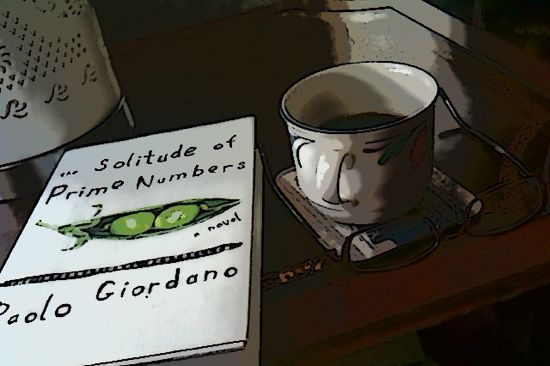
to read, to drink

—–

Photographs taken on the iPhone using ToonCamera. Only $0.99.
Creative holiday spelling

Ten-year-old Grace has an excellent vocabulary, as do Eli and Lydia, and she uses it in her writing and speaking. (Yesterday, for example, she implored me, “Please don’t scowl.” How much more precise it was than “don’t be unhappy,” which I was not.) The meaning of a word, though, may be more important to Grace than its precise spelling. Here’s a note she wrote and stuck to the refrigerator.

Misspellings prompt my imagination more than correctness does. And this misspelling makes me recall, too, other memorable and wonderful writing mistakes. A few years ago an ESL student of mine wrote a personal essay about her faith in Jesus Crisis.

A stalking Santa and a savior at his wit’s end — maybe there’s an idea in there for a story appropriate to this pressured and frantic time of year.

The band room is not the high school.

Gwyneth Paltrow was quite fetching on GLEE when she sang the Cee Lo song, “Forget You,” which I had heard many times on the radio.

I had no idea what I was really missing, though, until I went recently to open mike night at Brookline High School. My son Eli’s band, Hippos on Campus, opened my eyes and ears to Cee Lo’s original version.

The audience was mostly made up of high school students; some intrepid parents were there too. Grace was sitting next to me, and in the video you can see a shot of her at 02:14 . Also in the video at 00:48 you can see one of the high school music faculty, Carolyn Castellano, scurrying in front to give a student a megaphone.

Later in the night, from behind the piano, Carolyn reminded her students, “The band room is not the high school.”

I parsed her remark and took it to mean that, within the context of rules and right answers, there also has to be a place for subversiveness in education. Some teachers, like Carolyn, seem to manage this balance well: She drives her students to be ambitious and practiced musicians (Eli is the bass player in her jazz band at the high school), and yet prods them to think, act, and play with originality. Students find it hard to get praise from her, and yet the really serious ones want to work with her because she treats them as though they were musical peers.

It’s hard to teach inside these contraries, and although I value them, I’m not so sure I pull them off in a radical or dramatic way. On the one hand, I have a responsibility to teach the conventions of scientific writing and communicating. On the other hand, I have a responsibility to the student who aims to do work that is authentic and meaningful. In my practice, I seem to be more structured in the classroom as a lecturer and more open to individual work in small groups and 1:1 conferences. Interestingly, this may resemble the division between my public and private self in general, and my public and private teaching self.

I really admire professionals like Carolyn who seem to take public risks in their teaching while still upholding really high standards for their students. Funny, though, when I told Eli my interpretation of the band room/high school remark as slyly subversive, he wondered if Carolyn, whom he knows well, had really intended instead that her students remember to behave once they leave the band room.

Either way, the remark conveys the same dichotomy.
—–

For a more polished and still angry version of “Fuck You,” watch Cee Lo himself, in a Pepto pink suit, sing it here on a BBC special: Link.