The agony of writing comments on student work

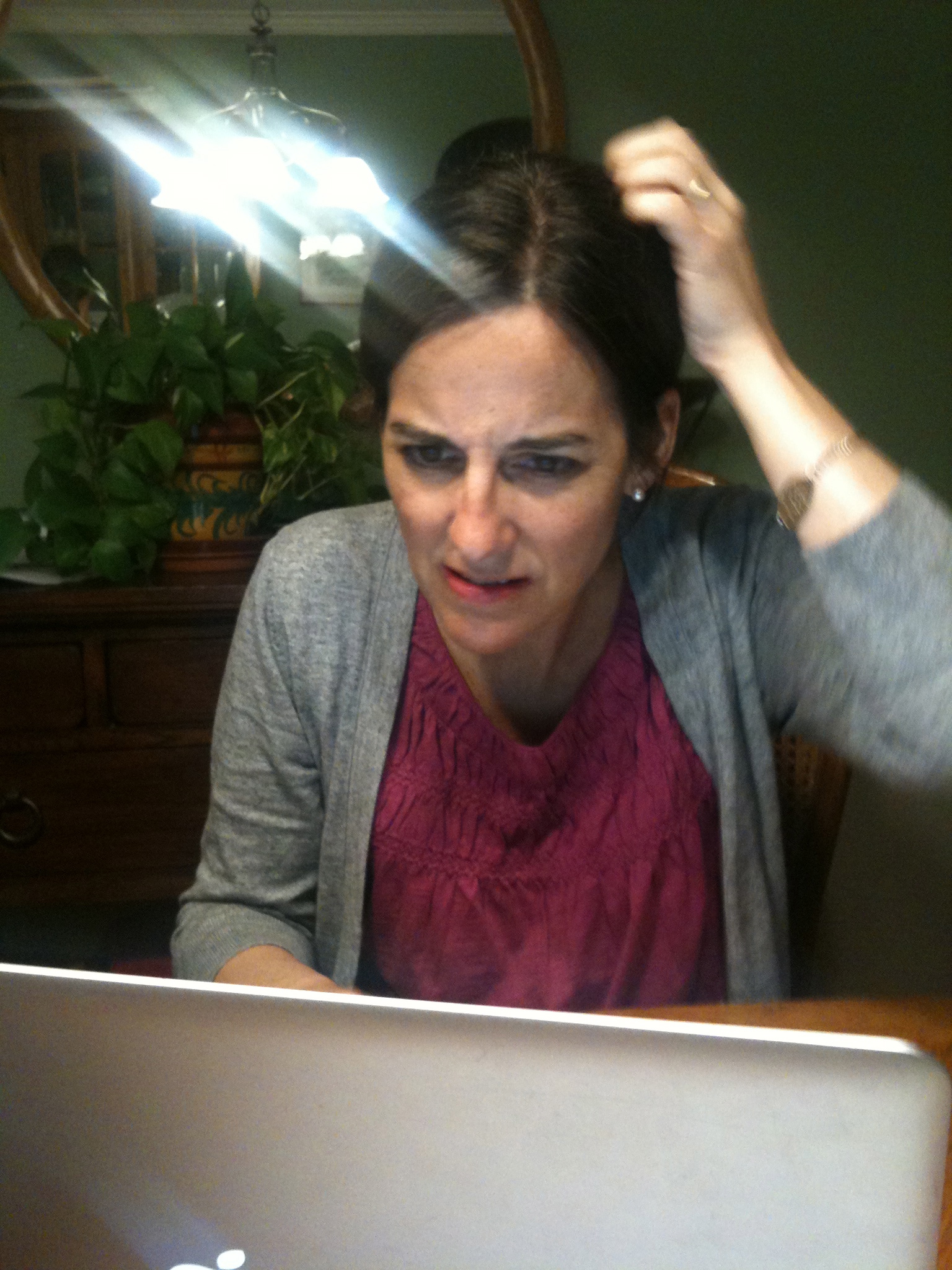
That’s me, sitting at my desk at home, which is really the dining room table, where dining rarely happens. We usually eat in the kitchen unless company comes, and then I put away my laptop, power cord, scratch paper, and pen.

Lydia took this candid photo with her phone when I wasn’t paying attention to her. The draft of a report by a student was diverting me from my own students, aka children, and their homework.  Sometimes Lydia and Grace spread their books and worksheets on the same table, and we homework-it alongside each other. Let’s hope this gives me credit someday for being an involved parent.

The past two weeks have been all about final papers and final presentations, and I have been meeting with students, helping them rehearse talks and improve slides, and reading submissions. Have I worked on my own writing? Not really. I have thought about it.

In a recent column on her writing habits, Anna Quindlen, who writes every day between 9am and 3pm — “an elementary school schedule” — argues that a writer must lead “a humdrum life” and not “write other stuff.” If you have a busy life, and you are writing other stuff (like, I infer, comments on student writing), “you won’t write it.”  Here, the pronoun it stands in for all that glorious self-authored work a writer is destined to do, unless responsibility gets in the way.  Too many lunches, Quindlen adds, also get in the way.

She invokes her Barnard writing professor, B.J. Chute, who told Quindlen and her classmates “not to take jobs that involved writing of any kind because there was no chance we would then go home at night and take up our own material.”  Very good point. I do wonder, though, how fiction writer B.J. Chute managed to get her teaching done without writing on student work. Continue reading

Adrienne Rich and “The Trees”

The poet Adrienne Rich died at age 82 yesterday, March 28.  The New York Times in its obituary describes her as “among the most influential writers of the feminist movement.” This is true. Let’s also acknowledge her as one of the great writers, period, of the 20th century. Her body of work is still fresh and relevant.

The most recent issue of Granta included a new poem, “Endpapers,” which prompted me to re-read the anthology Facts of a Doorframe (new edition, 2002) and essays Arts of the Possible (2002). I first read her work deeply in a graduate class taught by Renée Bergland at Simmons College, which I attended from the age of 35 to 38. This is perhaps late to come to Adrienne Rich, seeing that she had been around as an influential writer since the 1960s, but it was the right time for me. Awakenings, after all, tend to happen once a person has some adulthood under her belt. A favorite poem from Doorframe is “The Trees.” If you know me or are a reader of this blog, this won’t surprise you. What’s surprising about the poem, however, is how unromantic it is for a nature poem: trees in a greenhouse break out as though patients from an asylum.

See below the jump for an excerpt of the poem by Rich and an excerpt of a paper comparing Rich’s “The Trees” to Frost’s “Birches” (another poem loved by me) I wrote in April 2003 for Renée’s excellent women’s poetry course. I have some new thoughts on the poem, too. Continue reading

Writing to confront the human heart in conflict

At last, another writer has excavated an issue about writing that has been worrying me. Does the desire to write and publish spring from some creative well (that is the hope) or does it spring from neurosis (that is the worry)?

In Sunday’s New York Times Magazine, Steve Almond, story writer and essayist, argues convincingly that the rise of writing workshops parallels a decline in talk therapy. He claims that what brings many individuals to writing, and to MFA programs, is less an interest in craft than a location for their “loneliness and sorrow.” About himself as a young writer, he says

I figured I had gone into the literary racket because I had urgent and profound things to say about the world and because I was a deeply creative person. But looking back, I can see that the instigating impulse for me, for all of us really, was therapeutic. We were writing to confront what Faulkner called “the human heart in conflict with itself.” And not just any heart. Our hearts.

Gulp.

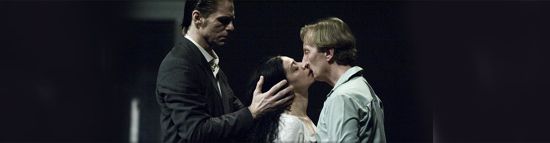
copyright: Pina (2011), by Wim Wenders

A few weeks ago, Jimmy and I went out for a quick dinner at Mantra (definitely on the down curve) before seeing Pina in 3D nearby. This you should see. Determined not to talk about the children or money, we discussed our side projects: he’s working on a novel about a discontented middle-aged man trying to reconcile himself to his life with antics both professional and personal, and I am working on a YA novel about a family of three children who have been abandoned by their parents and are trying to make it on their own, without revealing their situation to concerned adults around them. The more we described the characters and events to each other, the more concerned I became.

“Um,” I finally said, “Don’t you think this is really, really messed up?”

“What’s messed up?” Jimmy asked, perhaps having more fun with this conversation than I was.

“That maybe what we’re writing aren’t really novels, but just projections of our own subconscious conflicts and desires? Like maybe we should quit writing and straighten ourselves out?”

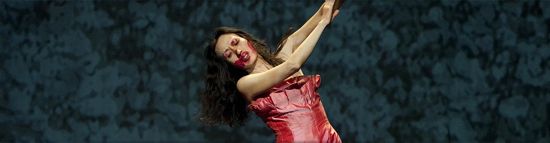
copyright: Pina (2011), by Wim Wenders

Jimmy responded with a writer’s answer: “In my writing, I’m trying to go to the places I fear to go.” Apparently, in his novel, the protagonist’s wife is killed, and this is upsetting to Jimmy, and so he’s writing into the terror. Armchair psychologist that I am, I speculated to myself that he also secretly and occasionally fantasizes about the disappearance of his own wife. (That’s okay, as long as I can remain alive in another dimension.)

And, hey, my subconscious is besmirched too. My protagonist may be a 13 year old girl and not a middle-aged married woman, but the mother of this girl — and the father — end up abandoning their kids in a series of events both planned and unplanned. What does that say about me? Continue reading

– Little bursts

During one sustained yoga pose (downward dog), I looked at my hands, fingers splayed on the mat. Wow, I thought. Look at you. I acknowledged them for 45 years of work. No appliance could do what they’ve done and still be so capable.

Later, lying on my back, with my legs straight and feet in the air, I looked at my bare knees and calves, and I liked them. Marvels.

My regular habit, after Wednesday yoga, is to go to the Clover Food Truck on Carleton Street and get a soy BLT, my discovery of the spring. At $5, it’s a perfect food.

Today I sat on a bench next to the parking lot, half in the sun and half out, and ate it. On the bench perpendicular to mine, a young woman and man talked about happiness, and all the pressures in the way of it. She said to him: “There are too many choices. And having to choose work you love, or a person you love, is overwhelming. I read that people are less happy when they know there is other work, or someone else out there.” He said to her: “I said to my therapist that, among all my options, the least disagreeable to me is dentistry.”

One pigeon walked on the cement pavers near my feet. Of course, pigeons do not fear us. It came closer and seemed to stand there, turning and waiting. I looked at its three-clawed feet and stick legs. Do you know they’re pink? A dark rose. The feathers are less gray than a dusky purple, with shimmers of green around the neck.

In Olive Kitteridge by Elizabeth Strout, on the occasion of her son’s wedding Olive thinks about what she knows of loneliness and ruminates, too, on its antidote:

Olive’s private view is that life depends on what she thinks of as “big bursts” and “little bursts.” Big bursts are things like marriage or children, intimacies that keep you afloat, but these big bursts hold dangerous, unseen currents. Which is why you need the little bursts as well: a friendly clerk at Bradlee’s, let’s say, or the waitress at Dunkin’ Donuts who knows how you like your coffee.

Or a sandwich from a truck.

On the way home, I stopped the car for a few seconds where Ames Street joins Memorial Drive. A few pedestrians passed in front of me, which made me turn my head to follow them. I saw a woman holding a toddler, still awake but slumped in her arms, the child’s head lolling on the mother’s shoulder. I remembered the slack weight of a baby against my chest: that closeness, that power. The child held out her own hand and looked at it, turning it palm down, then palm up. She closed her fingers into a little fist and looked at that, too. There was no haste in her movements. She could stare at that hand and turn it over and over, forever.

– I’ll take reality.

I have always preferred reality.

I was the child who read the Little House series, Nancy Drew, Tree Grows in Brooklyn, Jane Eyre, Secret Garden, Pig Man, and Anne of Green Gables.

And like my daughter Lydia, I have always liked facts. One spring, when I was about 16 years old, I took a stack of books out of the library’s nonfiction section on farming, gardening, and vegetables. (That summer I also attempted a 10 x 15′ garden on a clayey waste plot in my family’s back yard. What I recall is that lettuce grows quickly, and slugs like to make a home among lettuce leaves, which a person finds out when she holds that salad lettuce up to her mouth and sees a baby crawler on a leaf.) Another time I took out a less goal-oriented selection of books on the human body — a bunch of owner’s manuals. (I remember a set of photographs from a dermatology book on effects of aging, and how an older person could pinch skin on the back of her hand and it would stay in a little teepee shape for a second or two. I tried this on my own hand then and could not imagine a little skin teepee as a possibility.)

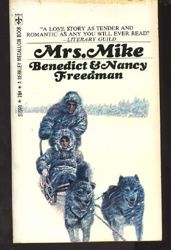
In my fiction reading, as much as I followed plot I liked learning how people did things with their hands: laundry in big tubs, food over an open fire, sleeping 3 or 4 to a bed, toys from sticks and rags, and treatments from poultices (ah, Kaiser Pease’s onion bath in Where the Lilies Bloom). When I picked up Mrs. Mike again, at least 30 years after I first read it, it was to find the description of an emergency amputation that has stayed with me:

I filled a kettle. I lifted it to the stove. The cries drew me back. His nails dug long furrows in the wood of the table. His dark eyes rolled back under his lids, leaving white, unseeing holes. The smooth muscles moved in Sarah’s arms. Back and forth, back and forth. The trap bumped and clanged against the table. Sarah’s strong man’s hand pressed the saw’s teeth deeper into the wound. It quivered, it quivered like jelly. A strange laughter stirred me. Mother and child, I thought. Mother and child. Then Sarah begin hacking. The bone chipped and splintered. I looked at her face, at the clamped lips! I looked at her hands. I thought, how can she do it! I looked again at her face, relentless and calm… His body lay under her hands, twisting, screaming, while she hacked at him calmly with a saw. I stared at a flap of hanging flesh.

Continue reading

Resonance, wonder, and toys

In his essay “Resonance and Wonder,” Stephen Greenblatt writes about two powers permeating the works of art in museums:

By resonance I mean the power of the displayed object to reach out beyond it formal boundaries to a larger world, to evoke in the viewer the complex, dynamic cultural forces from which it has emerged and for which it make be taken by a viewer to stand. By wonder I mean the power of the displayed object to stop the viewer in his or her tracks, to convey an arresting sense of uniqueness, to evoke an exalted attention.

Read his essay (a .pdf is here), and your experience of artifacts in museums may be forever enriched as mine have.  In this post, I translate his ideas and use them to consider toys, Jane Eyre, The Matrix, and other things that stand in for objects.

When you first encounter an object — especially one you instantly are wowed by — you stand in wonder. There’s something really personal about that experience. You feel delight, surprise, enchantment. It’s an oh my god! moment. Greenblatt says that museums like MoMA amplify wonder with tactics they use to display objects, with boutique lighting, for example, which throws a pool of light around objects in a dimmed room, in the same way that jewelry stores and designer clothing shops do. Lighting isolates an object and hold it up for display. That isolation is important: it intensifies your wonder. It’s immediate, with no past or future; it’s love at first sight. Continue reading

– Ancestral division of labor

In doing some reading and note-taking on the history of agriculture for my blueberry project, I came across this.

The need to care for children helped create division of labor among hunters and gatherers. Men hunted, women gathered. Of the two pursuits, gathering was clearly more important. While the capture of a single large animal might have provided a clan of forty people with meat for two weeks, it was gathering that gave our ancestors a dependable diet — probably about seventy percent of their caloric requirements in the arid tropics. Though it has been generally assumed that hunting provided more food than gathering in the high northern latitudes (above 40 degrees), an American anthropologist studying tribes along the western Canada/U.S. border (45 – 48 degrees N.) found that even this far north, with plentiful game and declining plant resources, women provided seventy percent of the diet from gathering. (7)

Shattering: Food, Politics, and the Loss of Genetic Diversity, by Cary Fowler and Pat Mooney (U of Az Press: 1990).

While I know that many men cook and feed their housemates and families (as, for example, Bryan T., my childhood neighbor does his), the feminist in me did a little cheer when ancient women got that affirmation. Seventy percent of a population’s caloric requirements — that’s a lot of roots, seeds, nuts, and fruits.

– Reverse commuter

Do you know the work of the contemporary poet Deborah Garrison?

This one, in particular, is something I read out loud to myself every year, in the fall around this time.

I Saw You Walking

I saw you walking through Newark Penn Station
in your shoes of white ash. At the corner
of my nervous glance your dazed passage
first forced me away, tracing the crescent
berth you’d give a drunk, a lurcher, nuzzling
all comers with ill will and his stench, but
not this one, not today: one shirt arm’s sheared
clean from the shoulder, the whole bare limb
wet with muscle and shining dimly pink,
the other full-sheathed in cotton, Brooks Bros.
type, the cuff yet buttoned at the wrist, a
parody of careful dress, preparedness—
so you had not rolled up your sleeves yet this
morning when your suit jacket (here are
the pants, dark gray, with subtle stripe, as worn
by men like you on ordinary days)
and briefcase (you’ve none, reverse commuter
come from the pit with nothing to carry
but your life) were torn from you, as your life
was not. Your face itself seemed to be walking,
leading your body north, though the age
of the face, blank and ashen, passing forth
and away from me, was unclear, the sandy
crown of hair powdered white like your feet, but
underneath not yet gray—forty-seven?
forty-eight? the age of someone’s father—
and I trembled for your luck, for your broad,
dusted back, half shirted, walking away;
I should have dropped to my knees to thank God
you were alive, o my God, in whom I don’t believe.

—Deborah Garrison

From the New Yorker issue of October 22, 2001.

– One way to pass time

This is what Grace said, in sequential increments, after I gently asked her to stop reading over my shoulder:

I am just going to lie down on the couch…

and use my mind…

to keep busy…

and make objects move…

and race across the room…

and watch them.

And so I watched eight-year-old Grace, and that indeed is what she seemed to be doing. As she lay on the couch, her head swiveled as though tracking something, and her eyebrows occasionally tented in surprise. Her lips moved, ghost talking.

– Feels like this

In an essay, Patricia Hampl writes:

I was attracted too to the in-between position of the writer. More exactly, I was after the suspended state that comes with the act of writing: not happy, not sad; uncertain of the next turn, yet not lost; here, but really there, the there of an unmapped geography…

The elusive pleasure to be found in writing (and only in it, not the before of anticipation, not the after of accomplishment) is in following the drift, inkling your way toward meaning. (126)

I agree: not the before, not the after, the in.

And yesterday, walking to the train and having one of those imaginary conversations that I often do with those who populate my head, I said (internally and not out loud), “Didn’t you know that I am secretly a detective?”

And while I’m not actually a detective (yet how would you know?), I am when I’m writing.

___

Hampl, Patricia. “Other People’s Secrets.” The Business of Memory: The Art of Remembering in an Age of Forgetting, ed. Charles Baxter. St. Paul, MN, Graywolf Press: 1999. 116-131.

P.S. Thank you to Lowry Pei for recommending the essay, which is interesting in many ways.