– For your eyes only

Pink locking diaryBound diaries and journals have not always been secured by a padlock or hidden between the boxspring and mattress. Thoreau and his Transcendentalist friends, in fact, often wrote them with the knowledge that they would be read, whether in their lifetimes or posthumously.

According to an article in the local Brookline TAB this week (11.1.07), which announces the publication of a new compilation of Thoreau’s journal entries called I to Myself (YUP 2007),

Keeping a journal to share with friends was a far more common activity for people of all educational levels in Thoreau’s era than today. “Back then almost everyone kept a journal, even farmers and definitely educated people,” says [Jeffrey S.] Cramer. People shared their journals. When Thoreau writes in his journal, you feel like he’s talking to you. In his journals he’s definitely writing to a reader.”

Verification for this remark appears in the chapter “Thoreau in His Journal” in the Cambridge Companion to Henry David Thoreau (CUP 1995). Yes, the Transcendentalists were devoted journal keepers who wrote, often, for each other. So were other Concord residents — clergy, teachers, naturalists, businessmen, lawyers, housewives, unmarried women, students, farmers (109) — writing in and keeping journals. About his own massive journals, which were circulated so often they became a kind of “lending library,” Bronson Alcott, the father of Louisa May, wrote that the collection:

…gathers up the fragments, and preserves in transcript, whatever there may be for future value & use, so that nothing of life shall be wantonly contemned or irretrievably lost…. The history of one human mind… would be a treasure of inconceivably more value to the world than all the systems which philosophers have built concerning the mind up to this day. (111)

I ask you, fellow bloggers, are we not participating in a grand tradition? Like our 18th and 19th century forebears, today’s electronic journals are also built on timeless topics — among more contemporary ones like restaurants, sex, movies, and baseball — such as these mentioned in the Cambridge Companion:

• domestic operations;
• reading records;
• travel narratives;
• business;
• notes on changes of seasons or weather;
• medical observations;
• flora and fauna;
• introspective registers;
• private histories;
• political or other social and institutional goings-on; and
• of course, combinations of several, perhaps many, of these. (108-109)

And none under lock and key.

—-

Image of pink diary from Smythson of Bond Street catalog.

– Natatorium

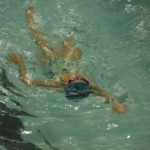
At the pool where Grace swims, and where she learned to swim, I keep being mystified by the inscription that’s visible from the water and the gallery.

Three teaching obligations

“A parent is obligated to teach a child Torah, a trade and how to swim. Talmud, Kiddushin 29a.”

The first time I read it, years ago, I chuckled. What an unexpected combination: the Torah and “how to swim” in the same sentence? I have stared at and thought about the words many times. Now accustomed to them, I try to imagine a history in which the group of three represented the bedrock of a life: scripture, livelihood, and refreshment (or survival?). I’m not sure about the third thing.

Entering the Jewish community center yesterday, Grace said she’s disappointed in one aspect of the swim team: “They’re not teaching us anything.” What do you want them to teach you? “The side stroke,” she answered. Because she doesn’t know the side stroke yet, I guess that by “teach” she means “to introduce to something new.” Perhaps the new is what’s noticeable to her.

As I, however, sat on the bleachers on the pool deck and watched Grace swim with 24 other children, I marveled at the skill of the coach. He structures the hour; he gives directions; he explains the strokes as he demonstrates the moves with his own body; he repeats what he just said; he responds to questions; he encourages the swimmers to keep moving, moving, moving; he gives on-the-spot feedback like “Kick from the hip, not the knee”; he keeps order; and he walks the perimeter, offering encouragement: “Grace, that’s a beautiful stroke. Keep going. Move. Finish on the wall. Everyone, finish on the wall.”

That’s teaching in action. (And isn’t it a pleasure to watch others teach?) The swimmers practice what they know, become more deliberate, deepen their knowledge, and persist, lap after lap.

As I write this, I wonder, suddenly, if the third thing — “how to swim” — has to do with the teaching of the body. Teaching the Torah seems to be an intellectual and spiritual task. Teaching a trade has something to do with the practical. And learning how to swim is about conducting the self, the physical one, buoyantly and alone.
First arm upFour limbs in waterArm up, again

– Sitting still

This drought is hard on living things with shallow root systems. For weeks I’ve been moving the sprinkler around the yard, trying to hit each spot every few days. Around 8 o’clock the other night, I was standing in my driveway, watching the oscillating streams that were illuminated by the street light. On the other side of Puddingstone Road, Steff emerged with her children from the lit foyer, saw me in the mostly dark, and asked in a friendly way if I was watching my grass grow. “Yes… yes, I am.” A simple answer, yet not quite right.

Plant & brick detail, wet

Often in the summer I sit on the front steps, looking at the current state of affairs in the yard: subtle undulation of brick, mix of blooms and leaves, shadow and light on the lawn. Sometimes I look across to the temple, and I check out the greenness of the grass or the alertness of the annuals or the bend in the trunk of the tall white birch, which Dick tends while Rufus, his bulldog, keeps him company. In an hour, creatures might shift a bit, puddles may appear, but nothing much changes — nothing more than this, anyway:

A haiku by Shiki (Japanese. 1867-1902):

The sparrow hops
Along the verandah,
With wet feet.

Our front door, unless we’re asleep, is always open to the storm door, so we can look out. This morning, Grace perched herself on the front steps: Grace, sitting still for a changenot feeling well, sitting quietly. That’s my summer spot. Today I sat inside, on the stairs that go up, and looked out at her looking out. I thought of how a moment freezes when we watch our children, still, like this. Eli told me once that he’s noticed me stand in a doorway and watch the girls, who go to bed earlier than he does, as they lie there. “You like to watch us sleep, right, Mom?” All parents do: It’s the only time, kids, that you stop moving, and that Time stops, going neither forward into your future or looking back over its shoulder at your earlier selves. It stops. I study you, in the absolute present. This is not time expanding, as it does when a person becomes absorbed in the activity of writing or gardening or making music or love. That kind of flow has movement in it, even if the movement makes the experiencer lose consciousness of self and time. What I’m talking about here is Time… pausing. Time bare of verbs.

One by Issa (Japanese. 1763-1827):

How lovely,
Through the torn paper window
The Milky Way.

I was not, then, watching the grass grow two nights ago. More like me, grass, water, dark, warm air, streetlights, and still.

Grace and Jane on front steps—–

Photographs of Grace alone and Grace & Jane by Eli.
Haiku from
Haiku (Everyman’s Library, 2003).

– Summer fades

For season-watchers, thoughtful gardeners, and poetry readers, here is an excerpt from Louise Glück’s poem “October,” from her collection Averno (FSG 2006).

4.

The light has changed;
middle C is tuned darker now.
And the songs of morning sound over-rehearsed.

This is the light of autumn, not the light of spring.
The light of autumn: you will not be spared.

The songs have changed; the unspeakable
has entered them.

This is the light of autumn, not the light that says
I am reborn.

Glück’s precision and steady hand remind me that there may be allure in what is plain. Even if it unsettles you. Especially if.

– Sign in stone

Do you know how an image, from a book or movie or even your own dreams, can enter and then stick in your mind? For days, since reading this passage in If on a winter’s night a traveler by Italo Calvino, I’ve been seeing this hand in stone — my version of it — everywhere:

Monday. Today I saw a hand thrust out of a window of the prison, toward the sea. I was walking on the seawall of the port, as is my habit, until I was just below the old fortress. The fortress is entirely enclosed by its oblique walls; the windows, protected by double or triple grilles, seem blind. Even knowing that prisoners are confined in there, I have always looked on the fortress as an element of inert nature, of the mineral kingdom. Therefore the appearance of the hand amazed me, as if it had emerged from the cliff. The hand was in an unnatural position; I suppose the windows are set high in the cells and cut out of the wall; the prisoner must have performed an acrobat’s feat – or, rather, a contortionist’s – to get his arm through grille after grille, to wave his hand in the free air. It was not a prisoner’s signal to me, or to anyone else; at any rate I did not take it as such; indeed, then and there I did not think of the prisoners at all; I must say that the hand seemed white and slender to me, a hand not unlike my own, in which nothing suggested the roughness one would expect in a convict. For me it was like a sign coming from the stone: the stone wanted to inform me that our substance was common, and therefore something of what constitutes my person would remain, would not be lost with the end of the world; a communication will still be possible in the desert bereft of life, bereft of my life and all memory of me. I am telling the first impressions I noted, which are the ones that count.

It’s not just the image. I love the simple surprises in “mineral kingdom,” “free air,” and “white and slender,” the slant repetition of “desert bereft of life, bereft of my life,” and the narrator’s measured acceptance of the remarkable “thrust out” hand he has seen and what it means to him.

– Found: two-line dialogue

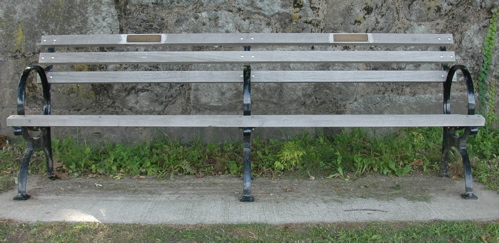
The Brookline Reservoir is ringed by a gravel path. Along the path are benches, on many of which are affixed small brass tribute plates, evidence of some past fundraiser, I guess. Most of the inscriptions are some version of this: In memory of Paul Smith. With love from Elaine, Mike, and Kim.

There are exceptions. One bench inscription says, “Don’t walk by.” That stopped me.

And then there’s the talking bench. Bench dialogueWell, it doesn’t actually burst into speech. However, one plaque has something to say to the other.

Read from the left…

“do you think they’ll sit down?” –Bobbi Davis

… to the right:

“yes, I hope so.” –Stan Davis

These few words, the punctuation, and the names suggest an entire relationship. I picture the ghost of Bobbi, the fun one, easily agitated, leaning forward and speaking emphatically to the ghost of Stan, mild, taking life as it comes, sitting back.

Think about how so many pairs of people you know — whether spouses, sisters, best friends, or characters in a favorite story — can be distilled into the particular lines that they play out over and over again. The cronies who made the gift to memorialize the Davises apparently knew these two well enough to choose and write down a couple of lines that could make strangers known to passers-by.

– Notes: more than flotsam and jetsam?

Doctors take notes. Nurses. Therapists, especially during the first meeting. Journalists. (During the Q&A after his talk at the Wesleyan Writers Conference in June, George Packer remarked that “facing his notebooks,” each time he returns to his desk at home in NY after leaving Iraq, is “daunting.”)

Right now I’m reading the 16th in Peter Robinson’s Inspector Banks series, Piece of My Heart, and I’m reminded that note-taking is also a constant activity in the police procedural. Detective Inspector Chadwick interviews Rick Hayes, the promoter of a concert at which a young woman has been knifed to death. During the short scene, almost all of Chadwick’s gestures have to do with his notebook:

[He] dutifully made a note of the names after checking the spelling (21).

Chadwick scribbled something on his pad, shielding it from Hayes (21).

He made a note, and then looked directly at Hayes (23).

Chadwick jotted something down. He could tell that Hayes was craning his neck trying to read it, so he rested his hands over the words when he had finished (24).

Real detectives, and not just fictional ones, rely on their notebooks just as much as Chadwick does. In fact, they’re trained to use their notebooks. A few pages from the General Orders of the Hong Kong Police Force, Chapter 53: Police Notebooks (a neat find that turned up in a Google search) instruct officers in a method for keeping the daily notebook. This is an excerpt of just the items that caught my eye:

An officer will make a fresh entry in his notebook at the commencement of each duty shift, detailing the date, time and particulars of the duty allocated to him.

Notes shall be kept in chronological order and shall be made in indelible blue or black ink.

An officer shall write legibly. If any deletion, alteration or addition is made, a line shall be drawn through the original entry in such a manner that it remains legible and shall be signed by the officer concerned or the person whose statement is being recorded.

An officer shall not erase or attempt to erase any entry in his notebook.

An officer shall not remove from his notebook any page or any part thereof, unless he is in court and is expressly directed to do so by a judge or magistrate.

I took a look at some of my own notebooks from over the years, not really journals (I don’t reflect so much as capture) and yet not as complete and orderly as a police notebook should be. Still, I seem to have collected a lot of… evidence.

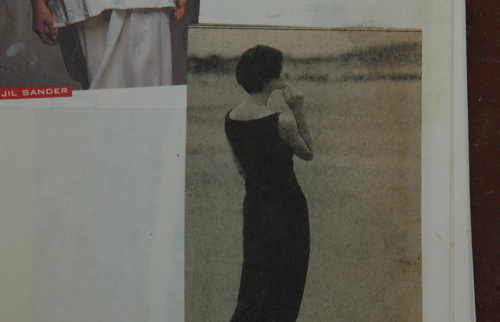
From the late 1980s, when I sewed a lot more than I do now, and therefore dreamed more of it, too, there is an entirely visual collection. I was constantly on the look-out then, when reading catalogs and magazines, for clothing shapes that attracted me. I used rubber cement to paste a lot of these items, like this one, into a small sketchbook.

Dress with long curve

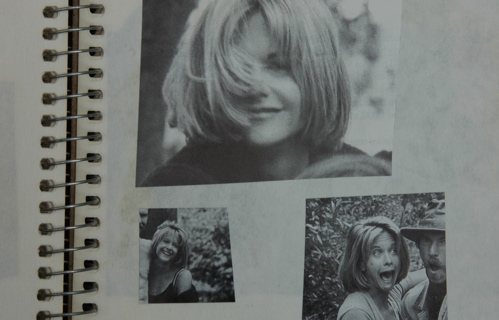
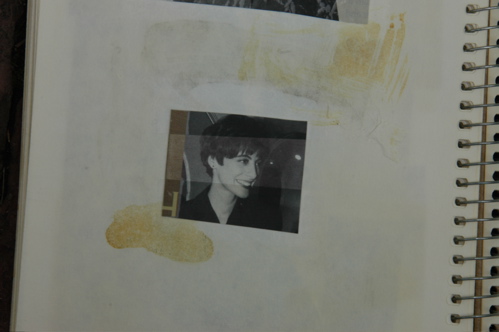
Around the same time, my friend Sybil and I were conducting an ongoing investigation into The Perfect Haircut. She had a manila envelope full of pictures sliced from news, celebrity, and women’s magazines; I kept a folder for ones under consideration. We occasionally traded pictures, and so some of mine ended up in her envelope and some of hers ended up pasted in the back of my clothing notebook. Here are two favorites (the first set is from a profile on Meg Ryan, actor; the second one shows just the head of Inez Someone, who was then a well-known French model):

Meg Ryan hair

Inez hair

All along, I’ve been keeping more notes than images. Most are traces of random thoughts, like this, from my notebook than spanned 1993-94:

Virtue. People are looking for virtue in the weirdest places. Exercising. Not eating (“I’m so good — I skipped dessert.”) Saving money. Hoarding vacation and sick days.

On the same page, after a few spaces, I scrawled a separate bit:

Privacy issue. Why are people so concerned about sharing their consumer and financial information and yet be so willing to talk about family problems and sex life w/ anyone who’ll listen?

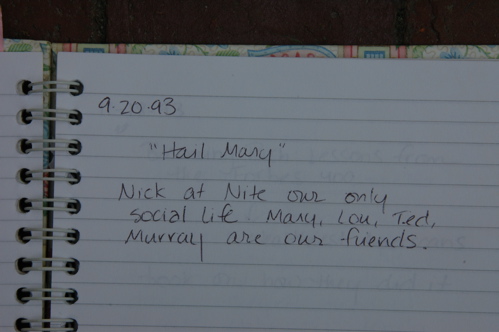
The entries are not all dated, but this one is:

Mary Tyler Moore show

(Over the years, other shows have supplied me with “friends”: Northern Exposure, ER, and, of course, Friends. )

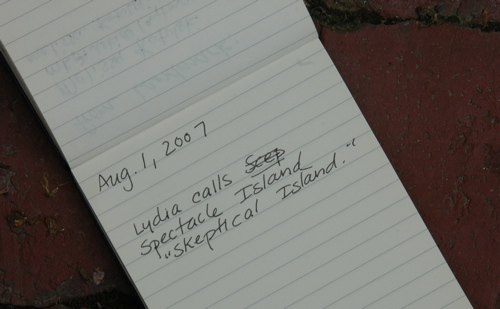
Yesterday I went with Lydia, her pal, and Toshika on a daytrip to three of the Boston Harbor Islands, sanctuaries that are less-visited parts of our city than, say, the Esplanade or the Public Gardens, perhaps because of the boat trip. I’ll argue that, because of the boat trip, as well as their scrappy, beachy beauty, the islands are a wonderful destination (and only ten dollars for an all-day boat ticket). I took one note, below. Will it help me remember yesterday, as all the above excerpts help me remember other yesterdays? Will it be useful to me somehow, someday?

Skeptical Island

There’s one thing I know from reading police detective novels, and from keeping my own hoard of scraps: You never know which bit, later, will emerge as a clue, as THE clue.

– Right words, right time

Work continues on the revision of an essay that’s really important to me. It’s getting closer to coherence, meaning, and shape, but it’s not exactly… singing.

Sometimes you come across the words of wisdom from another writer, right when you need to read them. The weekly issue of the Grub Street e-mail newsletter hit my inbox, with this remark in the banner:

The story is always better than your ability to write it. My belief about this is that if you ever get to the point that you think you’ve done a story justice, you’re in the wrong business. ~Robin McKinley

Substitute “essay” for “story,” and this comforts me. Perhaps reaching for the essay (the vision of the essay?) is what makes the writing go.

And who is Robin McKinley? I don’t know. But his/her words make me want to know more.