Student success, my reward

Social Q's column, NYT, 4.24.2011

This weekend Eli and I will finally do some baking and thank-you-note writing for the high school teachers who wrote him the recommendation letters that helped him apply and get accepted to colleges. The baking (chocolate beet cupcakes?) is a way to recognize their labor with ours. In his notes, Eli can let them know he has decided to attend UVM out of the various schools he was accepted to.

Perhaps it’s that time of year, but I’ve been wondering about the outcome of some recommendation letters I wrote for students over the winter for internships, etc. or the personal statements I helped them revise last summer and fall for grad school applications.

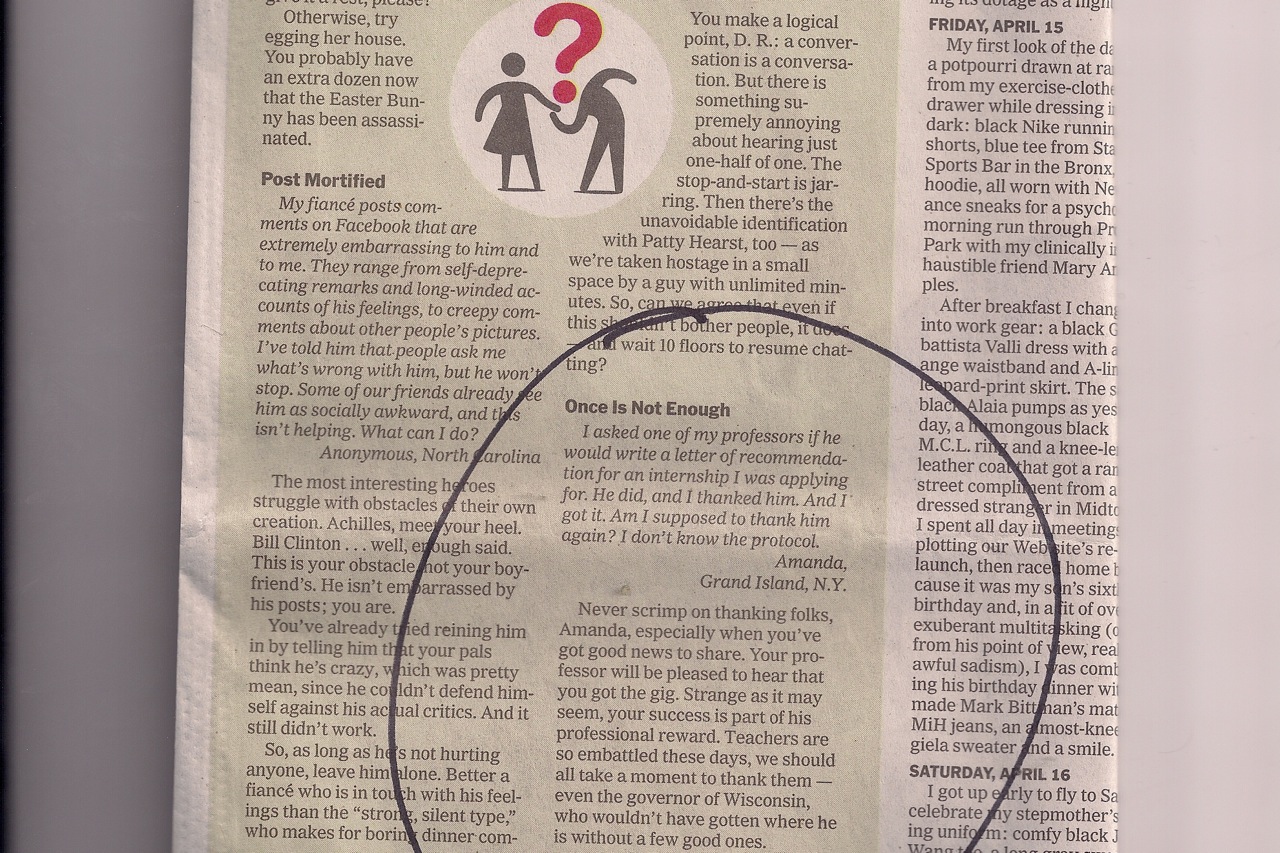
On Sunday, the Social Q’s column in the New York Times published a query by a college student confused about the protocol of thanking her professor for a letter he wrote. (See photo of clipping above.) Must she thank him a second time, after learning that she got the internship? Philip Galanes, the etiquette expert, replied, “Your professor will be pleased to hear that you got the gig… [because] your success is part of his professional reward.”

Dear Students, it’s true. We teachers are invested in your futures, just as physicians are invested in their patients’ health, and parents in their children’s well being and independence. It’s not that we are so self-effacing that we have no lives of our own — of course we have lives — but you’re like our garden. And because the processes of growth, despite all our knowledge of them, still seem so magical and the signs often imperceptible (children, like plants, seem to grow and develop overnight in the dark), it really is thrilling to see evidence that you are flourishing.

Yesterday, after a delay of almost a year, I got an email from a student who told me the outcome of his MD/PhD program applications. Together we had worked on his personal statement, he writing and I responding. He told me he has been accepted to a desirable program. Having worked with him on that personal statement, I know what this means to him.

What it means to me? I have an ego, too: In the collective work of educating young people, my individual contribution matters.
School love

Today I walked over to one of the undergraduate teaching labs to drop off my comments on drafts for students who are learning, section by section, to write an IMRaD paper on the research they are doing on a polymerase.

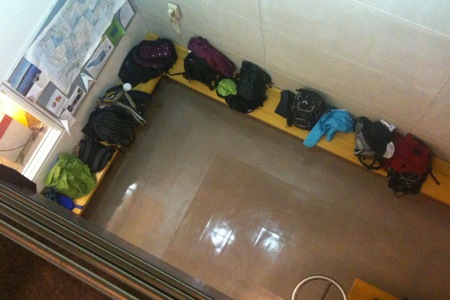
The lab is in the basement, and one walks down an open staircase to get to it. As I descended, I looked over the railing at the students’ belongings — backpacks, water bottles, jackets, bike helmets — strewn on the benches outside the lab. Around and down I went, and on all sides of the stairwell outside the lab were these signs of school.

My heart felt full. I imagined this same bounty of backpacks and jackets outside other schoolrooms with students of other ages. Kindergarten cubbies, the hallway outside the Grace’s 5th grade class or Eli and Lydia’s high school homerooms, the undergraduate microbiology lab. What those backpacks mean is this: We are a community of learners, this is our gear, and we need this stuff to do what we do.  And then I thought about how great it is to be a teacher, to have a responsibility to these students.

This feeling is inchoate; I cannot quite nail it down in words. The descent down the staircase, the view of backpack after backpack after backpack, and, finally, a glimpse through the windows into the lab of all the white-coated young people at the benches, working and talking, made me buoyant. School is more than a place; it’s an idea, one that students and teachers carve out of otherwise pressured and complex lives.

For a few minutes, I was so happy to be reminded by the backpacks of my good fortune — my luck! — to be working at this place and participating in an idea I believe may be the very best one we’ve got: we are human, and therefore we learn.

The way I do the things I do

On drafts, I prefer to handwrite my margin comments and type my summary comments. Writing by hand is (a) faster for me and (b) friendlier for the author, leaving traces of a reader. I have neat handwriting, and I don’t savage a page with my own scribbles, so this works well.

a glossary of sorts

Many of my comments are particular to the content: “These are your objectives, but what problem with this protein — a research one — is at the heart of what you plan to do?” Then there are the moves I make over and over in everyone’s draft, pointing out some aspects of style that could be improved, and I want to leave the responsibility for alteration or correction to the author. They are, quite simply, the ones shown here, and I define them on some spare scrap at the beginning of the hard copy of a draft.

Sure, I have a good vocabulary, feel for style (not just my own), and knowledge of grammar, and I could go the extra step and make all these changes. My hope, though, is that these marks will bring choices or errors to the attention of the author and that s/he will puzzle them out, alone or in a conversation with me.

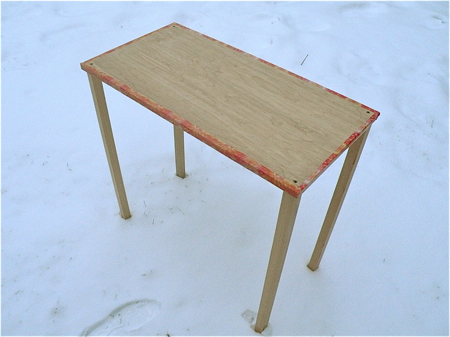
Origins of my $8 table

I like order. While I am no perfectionist, and I recognize that we live in a chaotic universe, I feel more at peace when t-shirts are folded and put away neatly and tasks are on lists.

my January laundry table

Where there is no order, I enjoy imposing it. I see a mess, and my imagination starts selecting, categorizing, and straightening. When I am in a colleague’s unruly office, I must resist the temptation to say, “I could help you with this.” (What a time suck that would be.)

I like the revision part of writing as much as I like the generation part. The mental activity is not unlike cleaning out a closet. Creativity is not all right brain. Could anything ever get made without the desire to bring coherence to a wash of ideas, experience, sensations, stuff? The left brain brings shape to raw material and finds what my friend Jan calls the spine of a piece.

I often think about one creative activity when doing another: writing when gardening, for example.  Recently, I organized the laundry corner of the basement, quickly made a rudimentary table, and thought about teaching while doing both. And I didn’t just think about teaching while my hands were busy; I thought about my wonderful junior high shop teacher, Richard Bayrouty, who died in December, and the benefits of real hands-on learning.

In 1977, when I entered 7th grade, there was a policy shift in my hometown’s school system that girls could take industrial arts, or “shop,” as an elective. If I remember correctly, before 1977 all girls took home economics (cooking, sewing, laundry) and all boys took shop. That year, the policy loosened, and suddenly there was cross-registration. Boys who wanted to make and eat cookies took “home ec” with Ms. T. Girls who knew how to sew, cook, wash, and iron, as I did, took shop. My friend Lynn-Marie, who recently wrote to me that she never “caught on to home ec” and “never really liked to cook,” and I were the only two girls that year in Mr. Bayrouty’s class.

He had the best classroom. Continue reading

More than the end

Lately, I have been thinking about endings because students are rehearsing and making presentations, ones that begin strong, build purposefully, and then break off awkwardly. At best, presentations seem to end with a gracious thank you to collaborators. Speakers perhaps wear themselves out, and when they’re done, they’re done.  Tough luck, audience.

Linda Flower (1979) described writer-based prose as an expression of the writer’s thoughts, for the writer, with no other purpose. Such prose is revealed in problems like a chronological process-based structure (first I did this, and then I did that) rather than an idea-driven one.  This kind of prose is not concerned with a reader’s experience; it is a record of the writer’s experience of thought, reading, or action. For my concerns about presentations, Flower’s theory of writer-based prose might be reframed as speaker-based speech. When I experience one of these presentations that simply break off — and, hey, I’ve occasionally made a few of these myself — I think what I’m seeing is an example of a speaker who has said everything she wants to say. Spent, she stops.

Stopping, though, is not concluding. Continue reading

The band room is not the high school.

Gwyneth Paltrow was quite fetching on GLEE when she sang the Cee Lo song, “Forget You,” which I had heard many times on the radio.

I had no idea what I was really missing, though, until I went recently to open mike night at Brookline High School. My son Eli’s band, Hippos on Campus, opened my eyes and ears to Cee Lo’s original version.

The audience was mostly made up of high school students; some intrepid parents were there too. Grace was sitting next to me, and in the video you can see a shot of her at 02:14 . Also in the video at 00:48 you can see one of the high school music faculty, Carolyn Castellano, scurrying in front to give a student a megaphone.

Later in the night, from behind the piano, Carolyn reminded her students, “The band room is not the high school.”

I parsed her remark and took it to mean that, within the context of rules and right answers, there also has to be a place for subversiveness in education. Some teachers, like Carolyn, seem to manage this balance well: She drives her students to be ambitious and practiced musicians (Eli is the bass player in her jazz band at the high school), and yet prods them to think, act, and play with originality. Students find it hard to get praise from her, and yet the really serious ones want to work with her because she treats them as though they were musical peers.

It’s hard to teach inside these contraries, and although I value them, I’m not so sure I pull them off in a radical or dramatic way. On the one hand, I have a responsibility to teach the conventions of scientific writing and communicating. On the other hand, I have a responsibility to the student who aims to do work that is authentic and meaningful. In my practice, I seem to be more structured in the classroom as a lecturer and more open to individual work in small groups and 1:1 conferences. Interestingly, this may resemble the division between my public and private self in general, and my public and private teaching self.

I really admire professionals like Carolyn who seem to take public risks in their teaching while still upholding really high standards for their students. Funny, though, when I told Eli my interpretation of the band room/high school remark as slyly subversive, he wondered if Carolyn, whom he knows well, had really intended instead that her students remember to behave once they leave the band room.

Either way, the remark conveys the same dichotomy.
—–

For a more polished and still angry version of “Fuck You,” watch Cee Lo himself, in a Pepto pink suit, sing it here on a BBC special: Link.

Pleasures and problems of the ideal text

Writing teachers, when they read drafts, have a hard time resisting the temptation of the ideal text. As we read student work, we may be simultaneously reading — or really, creating — an ideal text in our mind of what that draft could become. No doubt this ideal text is based on our knowledge of other texts we have read and perhaps even written ourselves.

Ideal texts may help us see our students’ work ambitiously, as though all writings hold great potential. Ideal texts may also prevent us from seeing the work for what it is and for what it wants to become, or for what the writer wants it to become. Brannon and Knoblauch (1982) describe how an awareness of ideal texts and the inexperience of students can lead a teacher in a way to “appropriate” her students’ work (158).

The kinds of texts we encounter at school can be more than essays or reports. Oral presentations are texts. Videos. Portfolios. A proposed experiment. In the project labs I am assigned to at MIT as a communications instructor, it seems to me that the engineering and science faculty read or consider their students’ independent design and research projects against some ideal that the faculty themselves conjure in the acts of reviewing and teaching.

This ideal-text creation is largely optimistic, and, at the beginning of the semester, we see only potential. The push is forward. Right around now, though, with only two weeks before the last day of classes, our ideal-text creation machine is seeming a little peaked, which can paradoxically lead to teacherly acts of will and desperation: extra writing conferences, more office hours, and lavish feedback.

There’s another tarnished ideal text we teachers are facing right now and that is this: our own teaching. Perhaps I should drop the communal “we” right here and admit that the tarnished ideal text that I am facing, at this late moment in the semester, is my own teaching.  Way back in September, what I planned to accomplish and even be as a teacher was like a vision. And now I hold the reality of my teaching in my hands like a small pile of stones. Certainly, I have amassed something — I’m a better teacher now than I was 7 years ago when I started, and surely this has happened incrementally, including this semester — and yet the gains are modest-sized.

Oh, I’m not completely self-effacing. Not at all. As much as I’m seeing the shortfall in my work, I see too what I have achieved. In fact, nearing the end of the semester can be a weird time of reconciliation. Somehow, by making an account of what I didn’t accomplish, I force myself to look for what I have been doing: 4 classes and 60 students, and it looks like they’ll all reach the finish line intact and with a few flourishes.

I’m starting to reflect, too, on what my students have achieved, as I’m talking to them in meetings and conferences and as I think of them. I am reminded that they are not only the texts that they produce; they are very smart people to begin with who are growing as thinkers and doers, and teammates and teachers. In class, meetings, and peer reviews, I observe them teaching each other more and more. Often, I feel them teaching me.
—-

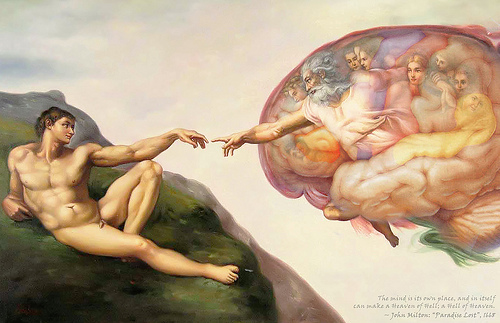
Image, “Brain of the Sistine Chapel,” by tj. blackwell on flickr.

A is for awesome.

Lydia and I were talking about school, hers and mine. We considered motivation, and what fires people up to be and do the best  they can. She told me about her high school history teacher and an upcoming presentation assignment that Lydia wants to nail. In part, she is motivated by the teacher’s rubric:

A equals awesome.

B is not bad.

C is meh.

D is “Um…”

Lydia is aiming for “awesome.” I would go pretty far, too, for an authentic awesome. And if on the first draft I got a meh, I might laugh at the teacher’s humor, figure out what to do, and keep trying.
—–

Photograph of the CN Tower, Toronto, August 2010.

Rethinking the red pen

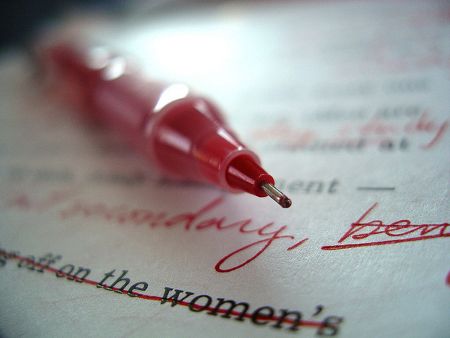
Grace promised to loan me a fine point pen with which to mark a stack of summaries. I opened her pencil case and found only a red one.

“I need a black one. All you have is red?”

“Yeah.” Grace, who sat across a table piled high with her homework and mine, looked at me quizzically.

“I can’t write on my students’ work with red ink.”

“Sure you can,” said Grace. “And, why not?”

“Well, because the red pen is perceived as… harsh, um, kind of censoring. A pencil, or even a green pen, seems kinder.”

Grace got that Mom, You’re a Lunatic look on her face. “I wouldn’t mind the red pen.”

“You wouldn’t?”

She sighed. “If I used perfect penmanship to write something, and then the teacher wrote on it with red pen and messy handwriting, that would be bad and probably hurt my feelings. But if the teacher has nice handwriting like you, Mom, and wrote carefully with a red pen on top of a student’s nice work, I wouldn’t mind.” Continue reading

Road not taken

While a junior at Wellesley College, I developed a crush on my not-young history professor. These things happen all the time in education — students falling for professors, and sometimes the inverse too — and perhaps even more so in single-sex environments.

It turns out I was more comfortable with my fantasies of conducting a romance with him than I was with the reality. During a moment in his office, it seemed as though Professor Zimmer (a pseudonym) was offering me an invitation, and I, out of good sense or fear or both, turned away.

That was the end of our story, but not the end of the story for me. The crush and the offer and his later, early death have taken root in my imagination, and again and again in my life I have pulled them out to consider them. About the place of this memory in my life I wrote an essay, “Dead and Gone.” The moment when the flimsiness of the crush encounters the cold fist of reality is described here:

The room was still, my body pinned in the chair and in space. Without moving my eyes, I watched the dust sparkle again in the air between us, and I looked at him and I did not look away. This was a test, and I wanted to pass it.

The office was his, and the silence was his to disrupt. “You know, if you ever want to talk about your major, or the class, we could meet again. In the afternoon, or later. We could even go get a beer.” There was a pause. “Sometimes I’m free in the evening.” And he looked at me without looking away.

I felt as though I was being dared: dared to be the object of attention, dared to interpret his offer, dared to say, Yes, I’d love to. I sat there, pinned and thinking. And the big billboard of my romantic fantasy gave way and fell into pieces. I saw us meeting in the parking lot near the town grocery store after dark, and him pulling up in the kind of old Volvo that all the professors drove and pushing open the passenger side door and me getting in, and me ducking down below the dash so nobody could see me as we drove and drove and drove away from town to somewhere he would take us. And on the floor of this car I saw all the crap that’s always on the floor of these cars, because as a babysitter for other professors and their children I had driven these cars and ferried children not my own around town in them, and I recognized the bits of cereal and plastic lunch baggies and receipts and the discarded envelopes of mail opened in the car and the gloves and winter grit and the floor mats askew. And I had plenty of time to study this stuff on the floor because my head was tucked down, and there was no view out the window for me, because I was hiding — he was hiding me — and this, I suddenly saw, is how our time together outside of school would be.

“Thank you,” was all I could say out loud. I had no words for whether I would consider history or not, meeting or not, because suddenly I knew that all I wanted was to remove myself from what would only, it seemed then, become sordid. Old car, old motel room in some other town, old dirt.

A few of my readers have seen this essay in draft, and their feedback and encouragement helped shape it. Thank you again.

—-

Photograph, “Volvo Dashboard,” by Jean Pichot on flickr via creativecommons.org