– My very own teacher

I met with a graduate student today, whom I interviewed for a study I’m conducting on the poster session. At one point in the interview he paused in answering a question about himself and interjected, “I’ve got to give a shout out to my Dad.” And then he told me something he had learned from his father, a professor.

with first teachers, on the beach, 1966

Today is my father’s birthday. My father is a teacher, too. Although I am not aware of following exactly in his footsteps (he taught math), I’m sure I often tiptoe in them.

In honor of him, I share with you an excerpt of a reflection I wrote in 2003 for a grad school course on teaching writing. If you stick with it for a few paragraphs, you’ll find out how powerful it is to grow up with a teacher in your very own home.

* * *

Rewards

First, a few words about my beloved third grade teacher, Mrs. Eva Doyle.  I remember three things I learned from her: the multiplication tables up to a factor of eight, all the state birds, and crocheting.  The state bird project sticks in my mind because of the pure pleasure for me in colored pencils, detailed work sheets, characteristics of each bird (a yellow throat, for example), and beautiful bird names.  Multiplication memorization and crocheting are also vivid, because of how Mrs. Doyle used the promise of a needlework lesson to reward math mastery.  When every student in the class had made his or her way through the tables, she told us, the class would learn to crochet, as a group.  Eventually, after some duration of time I do not remember, Mrs. Doyle brought in a bag of yarn balls and a crochet hook for everyone to keep.  We pulled our 20 or so chairs into a circle, and our teacher walked around our perimeter, leaning over our shoulders to give help. In this manner, Mrs. Doyle taught us girls and boys how to make a chain, then a daisy chain, and finally, a granny square.  The ambitious kids went on to make five granny squares, with a grab bag of colors provided by Mrs. Doyle (from her own money probably), and stitch them together to make a hat. I made one of those hats. Continue reading
– Big pond, many fish

I missed the 4C’s convention in Louisville this year (sponsored by the Conference on College Composition and Communication), which is a biggie in the teaching writing world.  I went last year and even gave a presentation, one among hundreds of presenters. This year, Alex Reid went, and he did some basic arithmetic that describes how dilute the audience gets at one of these huge conferences where everyone is vying for a little sip of the attention water. He estimates that, on average, most of the 3,000 attendees make it to 6 out of about 600 panels and that most panels attract between 10 and 30 audience members. That’s the thing about big ponds.

I was swimming in another school of fish last weekend, attending the 2010 ACPA annual convention in Boston (sponsored by the American College Personnel Association, the leading organization for student affairs professionals). It was a good chance to hang out with James and also reconnect with that world, in which I felt more a part when I worked in academic support and writing centers. Even though I no longer have official student development responsibilities, I do believe that I will again, someday, and that in the meantime I continue to be a deeply interested observer in how undergraduates mature and how the academy can support their development in thoughtful and humane ways.

I went to five or six panels; I took notes. Rather than writing a summary, I’ll try to capture what floated to the top and what ideas have stayed with me enough that I’m still thinking about them a week later. Continue reading

Resonance, wonder, and toys

In his essay “Resonance and Wonder,” Stephen Greenblatt writes about two powers permeating the works of art in museums:

By resonance I mean the power of the displayed object to reach out beyond it formal boundaries to a larger world, to evoke in the viewer the complex, dynamic cultural forces from which it has emerged and for which it make be taken by a viewer to stand. By wonder I mean the power of the displayed object to stop the viewer in his or her tracks, to convey an arresting sense of uniqueness, to evoke an exalted attention.

Read his essay (a .pdf is here), and your experience of artifacts in museums may be forever enriched as mine have.  In this post, I translate his ideas and use them to consider toys, Jane Eyre, The Matrix, and other things that stand in for objects.

When you first encounter an object — especially one you instantly are wowed by — you stand in wonder. There’s something really personal about that experience. You feel delight, surprise, enchantment. It’s an oh my god! moment. Greenblatt says that museums like MoMA amplify wonder with tactics they use to display objects, with boutique lighting, for example, which throws a pool of light around objects in a dimmed room, in the same way that jewelry stores and designer clothing shops do. Lighting isolates an object and hold it up for display. That isolation is important: it intensifies your wonder. It’s immediate, with no past or future; it’s love at first sight. Continue reading

– Grades beep, rattle, and hum.

But grades don’t speak.

It’s report card week in Brookline, and as usual we got a heads-up e-mail from the high school headmaster, prodding us to ask our sons and daughters to hand over their quarterly assessment. “The report card is an important school communication,” he concluded.

One thing every parent of a high schooler knows is how little communication there is between home and school, especially compared to the mountain of notices, bulletins, and newsletters that come our way during the K – 8 years, not to mention the PTO breakfasts and principal’s coffees and “special” events. (For the record: I do like parent/teacher conferences.) Eli is a junior in high school, and I met his teachers once at an open house event. Yes, I had a nice and helpful conversation with a few of them. However, that and a few visits Jimmy made to similar open houses constitute the extent of home/school communication in the last three years. I’m generally okay with that, but I am not okay with grades standing in for communication.

Grades might be aggregated data, and they might even be signals, but, because they lack (a) teachers’ interpretation and (b) opportunity for direct feedback, they cannot be communication. Continue reading

– Draw a picture. Make a sandwich. Teach writing.

Grace comes to work with Jane and finds the art supplies.

Grace comes to work with Jane and finds the art supplies.

During a scheduled hour to discuss their upcoming proposal drafts, I asked a group of 10 chemical engineering students to explain to each other their research projects, the rationale, the experimental design, and prior research. They talked productively for a half-hour and listened to each other with curiosity and asked relevant questions. All good. Certainly, we could have filled the rest of the hour with more talk.

I looked at the classroom’s two white boards and one easel pad and clutch of dry erase markers and Sharpies. I invited them, instead, to draw.

In small groups, they drew branching diagrams of their proposed experiments and explained their plans — and, even more importantly, gaps in their plans — to their peers. I walked around. They asked questions about how they might frame their experimental design in their drafts.

My friend and colleague Lisa had the classroom reserved after me, and she came in five minutes before we finished. Later, on the way to the copy machine, I saw Lisa’s students (in a different section of the same class) sprawled on the floor with big pieces of white paper and clustered around the white boards, drawing and gesturing with hands and markers. Continue reading

– Feedback season

Wite OutWhen it’s midterms for students, it’s midterms for teachers. (There’s something rather binge-and-purge about school, isn’t there?) In the past two weeks, since Columbus Day, I’ve been reading, commenting on, and grading the drafts of technical reports and scientific analysis papers, about 35 altogether. They’re long (average: 20 pages), but after the first few in a batch, I get into a rhythm. And while I don’t copy and paste comments from one report into another, I do notice similar issues and may make similar comments among reports.

I don’t claim any of the following lines as poetry. Here are some of the kinds of things I write or type in the margins. Continue reading

– Learning to write: a meme

Over at digital digs, Alex Reid (someone I don’t know but whose thoughts I enjoy reading), writes about how he learned to write. While his post raises illuminating questions about a well-accepted pedagogy — that teachers’ experiences of learning to write and developing a writing practice are central to their teaching of first year composition — his post also gives me an idea for a meme.

He captures his development of a writer by describing three contradictory practices. I’m going to do the same, and then I’m going to tag four friends.

My practices?

1. The first grade I got in college was an F. The class was English 150: Critical Interpretation. The professor was Robert Polito. The assignment was to do a close reading of a Shakespeare sonnet. Continue reading

– The anonymous they

Crowd blurToday I heard students discussing feedback that their team had received from a few instructors on a presentation. The students’ sentences uniformly began with the pronoun “they.”

They liked [such and such].

They said [so and so].

They didn’t like [such and such].

After several of those sentences, the “they” became a blur, and, even though I had a sense of who those instructor/feedback-givers were, it all started to feel vague to me. The actors — the givers or performers of the feedback — were made anonymous by the use of the nonspecific, plural pronoun.

I don’t want to shake my finger at the students. Indeed, I’ve heard teachers use the same pronoun to the same effect, referring over and over to an anonymous conglomerate of students as “they.”

They don’t do [such and such].

They seem to like [this or that].

They want [more].

This usage cloaks the identity or characteristics of individuals in a particular group. “They” also indicates that a group is not “we.”

And so, by designating an anonymous and even homogeneous them, we somehow reinforce the unity and presence of our us. There’s an implicit binary.

I have noticed that this tendency to invoke an anonymous “they” is not restricted to the realm of education. For example, after the dot-com bubble crash, I would sometimes hear people, still in great pain from having lost money and hope, rail against the violations of an anonymous They. They did this. All they wanted was that. They never told us that [something bad] could happen.

“They” is a very useful pronoun. It effectively and succinctly signifies a large group of others (in fewer letters than “large group,” or “the regulators,” or “the instructors,” or “the students in my intro psych class”), a group somehow distinct from our group. I do not think we should or even can eliminate the word from our speech.

However, when I catch myself using the pronoun “they,” I do wonder what experience or characteristics I’m trying to distance myself, and my peers, from. That’s what this use of “they” does — creates distance.

What does that distance offer us?

—–

Image “Liverpool Street station crowd blur” by victoriapeckham on Flickr. License via Creative Commons.

– Not too comfortable

Notebook page This week I audited a lecture given by the lead professor of a big mechanical engineering course that I’m involved in. I was there to signal my interest and get some information on an upcoming assignment.

At some point, the students were prompted to draw a human-powered hovercraft. I was sitting next to another communications lecturer, Mary, and we looked at each other, as if to say, Are we gonna do this, too? After all, we don’t draw — we write, we speak, we teach.

And yet, we were there. So, we gave it a whirl, too.

Anyway, mine is powered by a jolly human who steps up and down on resistance pedals, like on a stair master. The action of the pedals somehow fills a series of air bladders, which collect compressed air, and then force the air, incrementally, down into an air reservoir. The air forcefully puffs out of an array of pores, which creates a cushion of air between the craft and the ground.

I certainly felt humbled by doing the exercise — what I can’t draw, what I don’t know — but I also, by drawing, thought much more deeply about the challenge than I would have if I had just watched the students in the class draw.

Hover craft

It was a good chance, actually, to be a student myself for an hour.

And rudimentary as my drawing is? Once I submitted to the spirit of the task, making it was fun, like being 12 years old and building a fort with the neighborhood gang.

– Uneasy nostalgia

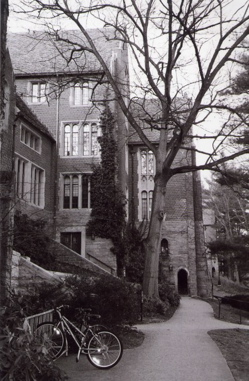
Outside Founders Hall

Outside Founders Hall

I finished writing and revising “Dead and Gone,” and I sent the essay off to editors of a journal who asked to see more of my work. One editor e-mailed me back today, confirming its receipt. All I can do now is wait.

A few readers and friends have asked about the incident central to the essay: a meeting between my Wellesley College professor and me.

That scene, which is the last bit from the essay I’ll post, is at the center of the story. It’s what I most recall about the professor and  our acquaintance, and it’s what I have turned over and over in my mind as I have considered my college years (1983 – 1987) and what the encounter has meant to me.

Curious? Continue reading