– This one goes to eleven.

At the end of the spring ’07 semester, my friend and colleague Lowry Pei and I were catching up and talking about some habits that should be basics for writing teachers. The next day Lowry suggested, by e-mail, that we generate a list. We opened a new Google document and became more purposeful. Our motivating idea was to (in LP’s words) “make the statements as direct and concrete as possible, make the list fit on (let’s say) a 3×5 card, hand it out: instant faculty development.” Soon, what started as a conversation became a deliberate collaboration; by the end of August, we had winnowed down and finished our compilation, and published it, simply, as a handout for faculty workshops.

And then we worked on it some more. Just a few days ago, to a broader audience, Tomorrow’s Professor published an expanded version of “11 Things You Could Start Doing Today for the Benefit of Your Students’ Writing.” May it be useful to you, if you teach.

– Natatorium

At the pool where Grace swims, and where she learned to swim, I keep being mystified by the inscription that’s visible from the water and the gallery.

Three teaching obligations

“A parent is obligated to teach a child Torah, a trade and how to swim. Talmud, Kiddushin 29a.”

The first time I read it, years ago, I chuckled. What an unexpected combination: the Torah and “how to swim” in the same sentence? I have stared at and thought about the words many times. Now accustomed to them, I try to imagine a history in which the group of three represented the bedrock of a life: scripture, livelihood, and refreshment (or survival?). I’m not sure about the third thing.

Entering the Jewish community center yesterday, Grace said she’s disappointed in one aspect of the swim team: “They’re not teaching us anything.” What do you want them to teach you? “The side stroke,” she answered. Because she doesn’t know the side stroke yet, I guess that by “teach” she means “to introduce to something new.” Perhaps the new is what’s noticeable to her.

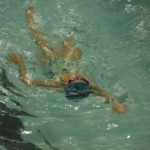
As I, however, sat on the bleachers on the pool deck and watched Grace swim with 24 other children, I marveled at the skill of the coach. He structures the hour; he gives directions; he explains the strokes as he demonstrates the moves with his own body; he repeats what he just said; he responds to questions; he encourages the swimmers to keep moving, moving, moving; he gives on-the-spot feedback like “Kick from the hip, not the knee”; he keeps order; and he walks the perimeter, offering encouragement: “Grace, that’s a beautiful stroke. Keep going. Move. Finish on the wall. Everyone, finish on the wall.”

That’s teaching in action. (And isn’t it a pleasure to watch others teach?) The swimmers practice what they know, become more deliberate, deepen their knowledge, and persist, lap after lap.

As I write this, I wonder, suddenly, if the third thing — “how to swim” — has to do with the teaching of the body. Teaching the Torah seems to be an intellectual and spiritual task. Teaching a trade has something to do with the practical. And learning how to swim is about conducting the self, the physical one, buoyantly and alone.
First arm upFour limbs in waterArm up, again

– Wide eyed

Girl raising hand, with enthusiasmAt a conference of developmental educators today, I learned something from one of the speakers. If a person is a novice — a student was given as the example — that person could be considered “unconsciously incompetent.” If a person is an expert — a professor was given as the example — that person could be considered “unconsciously competent.”

Not having heard this pairing of “unconscious” with variants of competence before, I looked them up in a web search. These phrases are used commonly, in more fields than higher education. (Laparoscopy is one.)

And while I do not want to be treated, should it ever come to that, by an inexperienced laparoscopist, I’ve always found it fun to be a novice, and to teach them. Not unconscious, not incompetent. More like conscious, and on our way to somewhere we haven’t yet reached.

– Games teachers play

Items to keep in your school bag:
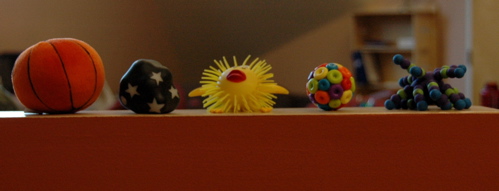
Five toys on ledge

Not by nature a maker of fun, I do like to have fun, and I believe that others need it, too. Do you notice, for example, in a classroom, if the teacher is not providing any chuckles, a student in class will start performing that function? Intuitively, we all know, even if we resist the knowledge, that the Class Clown is essential. Just as every group could use a leader or two, every group could use a fun-maker.

Even a serious teacher like me can design some fun. Props help. A few weeks ago, seeing that my September and October calendars were filled with appointments for visiting classrooms on campus and giving students my brisk “Come to the Writing Center” speech, I bought five toys. Diversely, they squish, boing, and bounce.

I bring them into the room and put them on the desk. Boing!I introduce myself in 15 words or less, and then I ask the students to think for 30 seconds on this question: “What makes writing so hard?” I add: “Every answer is the right answer.” I wait. And then I hold up the first ball and I give my brief instructions: “I’ll throw this to one of you. When you catch it, say your first name, and then tell us what you find so hard about writing.” I toss, a student catches, and the ball makes a surprising, mechanical “boing” sound. He laughs. The group laughs. The catcher answers: “I’m Paul. And getting my ideas down is hard for me.” Yes, I say, that’s challenging, for all writers in fact.
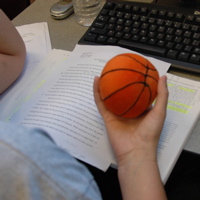
I give another stage direction: “Paul, throw that ball to one of your classmates. It’s someone else’s turn to tell us her first name and what’s hard about writing.” The next person answers. Squish spiderAfter that I introduce a new toy, and then another — they’re getting the hang of it now — and learn a few more things about what makes writing hard for students: “grammar,” “finding the right word,” “thesis” (over and over), “getting the length right,” and “starting.” Within a few minutes, all five toys are in play, and the students seem to have figured out the drill, and they’re looking at each other, waiting for a turn, aiming if they’re throwing, and talking to me and each other. The game, furthermore, is giving me material; I’m not a lecturer, and I get most of my energy from the questions and thoughts that students bring to or make in class. In this case, their responses give me an entrée to a conversation about how 1:1 tutorials in a writing center support students at all stages of the writing process and for any writing challenge.
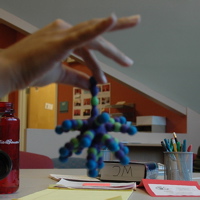
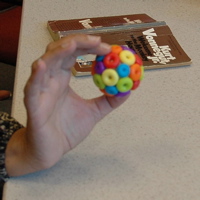
Fruit loop superballIt’s fun with a purpose, I know. In order to teach, a teacher must build some sort of bridge — or, at least, toss a fruit loop superball — between herself and students.

—-

Thanks to Joanne Manos and Kristen Daisy, in the Writing Center that afternoon, for their willingness to “lend a hand” to these pictures of the toys.

– Being there

On Thursday, a new student, M., came in to the Writing Center for the first time. She had an assignment from her criminal justice class on the rule of law that she “just couldn’t start.” I sat next to her at the computer as she did the first thing: locate a definition for the rule of law. A Wikipedia article popped up; she pointed at it and said, unprompted, “Oh, I’m not gonna use that one. Anyone can write those.” So, she didn’t need too much help from me on research.

I also noticed, as our time together lengthened, that my usefulness to her was mostly in my presence, and in my occasional murmuring of vague questions like “Well… so… what do you make of that?” or nudges like “Yeah, write that down.” In front of her was a yellow ruled pad, which she kept turning to, writing note after note with a blue pen. Writing pad, pen, other vital stuffAs she wrote, she spoke some version of what she was writing: “Okay, and next I want to say that the rule of law is how it should be, and not how it actually is.” And then she would write and so on, back-and-forth between saying out loud and writing. I sat there, tilting in my chair, content to watch a young woman fill a page and hear her think out loud. Sometimes Sarah, at the front desk and the only other person in the Writing Center at the moment, would overhear and affirm M., who at one point said, “This is so much easier than it was last night, sitting alone in my room and trying to write it.”

Near the end of the hour with M., she wanted to start typing her response to her instructor’s question about rule of law, and would I look over something else she had brought in, a short essay on her educational goals? I sat nearby at the table, with her draft and my pencil. The first few paragraphs covered territory I’ve toured before: Education helps you realize your dreams; Education gets you respect. Some biographical information at the end surprised me. Her parents and friends are trying to call her back home; they don’t support her desire and determination to get an undergraduate degree, head to law school, and be a lawyer. “I have to find new friends,” her essay says, in so many words, in the conclusion. I penciled in the margin: “takes courage.”

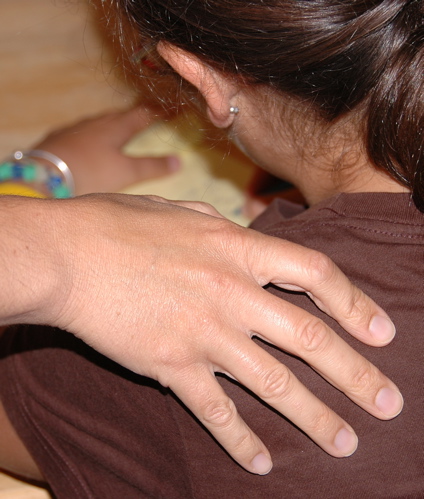
Hand on shoulderTo start out – to get going anywhere – without a companion, well, who among us wouldn’t feel the vastness of what that requires? Writing alone, always moving forward into the unfamiliar… there’s only so much of that one person can manage.

– Back to school

At an orientation for students involved in a bridge-to-college program, in which we offer enhanced, personal support to students who, in high school, were academically shaky, we asked them to put their heads together and come up with a list of characteristics delineating the “ideal instructor.”

What Makes a Good Teacher (according to students)

  • likes questions
  • loves what she or he is teaching
  • hardworking
  • dedicated to helping students achieve
  • active
  • could be fun in class
  • engaged in class
  • is like a friend
  • outgoing
  • is into it

Those items are all exact quotes. My favorite, and the most simply profound, is the last one. Personally, I don’t have a dog-and-pony show and, as anyone who knows me can tell you, I can’t tell jokes. I hope I’m a friend to my students, but I’m not a buddy. What I can do is show my students I’m “into it” — whether I’m in class or a tutorial — by engaging in what I want them to engage in. When they read in class, I read. When they puzzle, I puzzle with. When they write, I write. And I’m into it. Interested in an example? Continue reading