– Desperate measures

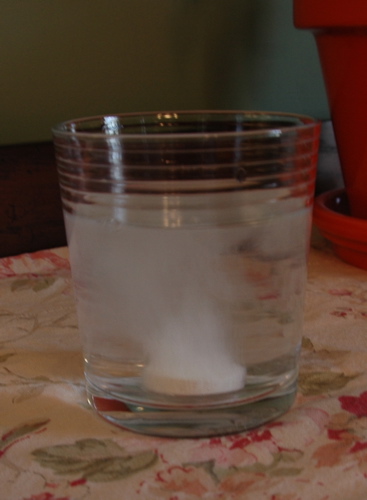
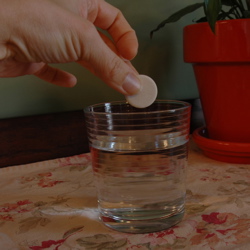
Hand, tablet, waterThis week Eli was sick with a cold. On Thursday, one of my tutors apologized for bringing her sickness to work. On Friday, one of my colleagues brought along her obviously sick child to a staff meeting.

Such occurrences don’t bother me. I figure that my persistent exposure to germs are an occupational hazard of both parenting and teaching. I don’t use hand sanitizer. I abide by the five-second rule and sometimes eat things that have fallen on the floor. I do not fear touching doorknobs. I’ll drink out of another person’s water glass, if offered. You can drink out of mine, if you like.

This morning I woke with a cough, a deep chest one. Right now I have two part-time jobs that together add up to more than one, and fatigue is my new tag-along. My guard is down. The palace has been invaded.

It might be too late, but I’ll try anything. Eli and my mother are recommending AirBorne, a packet of so-called immunity boosters in a fizzing tablet. Normally I eschew such remedies, preferring chemicals and a nap.

FizzzzzzzThis item has a homey list of ingredients, however, which sound as though they were grown in someone’s yard: lonicera, forsythia, ginger, schizonepeta (what’s this?), echinacea, and other herbal names. It looks and tastes like Alka-Seltzer. L’chaim, everybody.

– Convergence

Last week we saw Ratatouille (Pixar 2007) for the first time. Remy is a French rat who loves fine food; his ambition to become a chef is stoked by imaginative visitations from the late Auguste Gusteau, a once-renowned restaurateur who wrote a book titled

Anyone Can Cook.

Yesterday I was sorting through a pile of non-urgent papers that I’ve been hiding, even from myself, in my top desk drawer at home. I came across a document, “NCTE Beliefs about the Teaching of Writing,” that a colleague asked me to read months ago. My eyes fell on the first belief, in bold type:

Everyone has the capacity to write.

These are beliefs. Like the jolly Gusteau, a person can choose to believe that each individual has the capacity to cook (not to become a great chef, but to cook). Like the Writing Study Group of the NCTE, a teacher can choose to believe that each student can write.

What if, however, a chef or a teacher held a similar belief, and yet also maintained an attitude inconsistent with that belief?

How many times have I heard someone grumble about students (especially incoming ones): “They can’t write”? I don’t think that a teacher, whose work is essentially optimistic, believes that college students do not have the capacity to write. What such a teacher is really saying is that her students’ writing does not meet her expectations, or college expectations, and she is daunted by that, and it brings her down. And yet, I wonder, what power does that attitude (“They can’t write”) have on one’s beliefs about one’s own students and, more so, one’s own teaching?

Once in a while I meet a new student in the Writing Center, and, as I read her writing for the first time, I see that it lacks so much in the way of clarity and sense that I do a quick, internal inventory for any teaching skills I might have to offer her as a writer and I come up almost empty. In such an instance, I do feel daunted — it’s like a stone in my chest — and I even set my sights low, not for the student but for the paper at hand. “Jane, just be an attentive audience. Give the student that.” So, I read and I get her to tell me about it. I don’t always understand her reply entirely, but I usually understand enough of it to have a conversation with her about her personal narrative, or reading of a novel, or thoughts about a historical event. I don’t correct or suggest. I listen, ask, nod, smile.

I have been tutoring S., who is such a writing-challenged student, for more than a year. She continues to make sentences that seem more spoken than written, and her grasp of American English idiom is based on what she hears, not what she reads. (For example, in a paper about a high school teacher, she described that person as being “inch arch” of a learning center. She and I figured out that the teacher was “in charge” of a learning center.) Encouragingly, I also see that her sentences are longer and more flowing and that her papers are more fully developed with detail and discussion. She sustains. And that’s a powerful sign of her growth as a writer, but it might be hard to recognize it if I were ticking off her many errors. And there are many; I do see them (and we are just beginning to work on some).

When another teacher, in genuine moments of fatigue or frustration, says to me, “My students can’t write,” I offer, gently, “They’ll get there.” I do not know what my tutee, S., will do in her writing, in school, and in her life beyond my time with her, but I do believe she will get there.
– Power tool

A few weeks ago, Eli came across instructions online for making his own messenger bag out of fused plastic bags. He e-mailed it to me and asked if we could make one. In the past few days, we did.

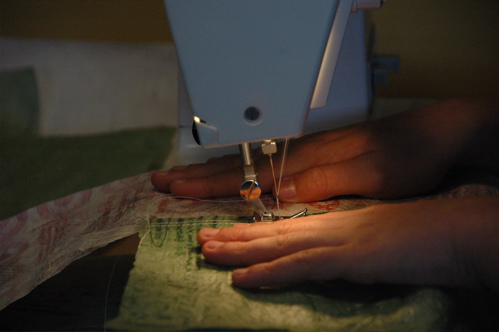
An absolute novice, he approached the sewing machine tentatively yet was open to advice and coaching. After his first few wandering seams, he got the hang of it. And eventually he got into it. From start to finish, we prepped, cut, sewed, and finished that bag together. I believe that Eli experienced the awe and sweetness of having one’s hands close to substantial mechanical power and guiding that force with purpose.

Eli guides fabric in the machine

If you know Eli and me, and you’d like to see highlights from our project, then click here for a slide show (and choose “Gallery View” for most pleasing size). If you’re a sewer, or if you enjoy reading accounts of do-it-yourself projects, then read beyond this paragraph for my description of how we adapted Bre Pettis’s directions to make Eli’s bag. At the very end, you’ll find a photo of the bag we made. Continue reading

– Slow down, you move too fast…

It is customary for Tom Cavanagh, the principal of the K-8 school in Brookline that Grace and Lydia attend and Eli graduated from, to begin his frequent e-letters to the school community with a quotation and a short thoughtful essay. This one hit my Inbox on a day in which I, and everyone who works with me in the writing center, had spent careening from tutorial to tutorial, task to task. The principal’s words spoke both to my conviction that everything we do in education is necessary and therefore hard to say “no” to, and to a hunch that we must allow ourselves a moment now and then to pause and take a breath. Please keep reading, courtesy of the man his students call, respectfully, “Mister Cavanagh.”

Chestnuts, a handful

—-

Season of mist and mellow fruitfulness!
Close bosom-friend of the maturing sun.

–John Keats, “To Autumn”

Several years ago, during a particularly hectic autumn, I was running from project to project and classroom to classroom. One afternoon I was racing up the stairs and as I came into the office, I told Mrs. Helen Hunt, my former secretary, that I wanted to quickly dictate a letter to her. As I waited impatiently in my office for her to come in, I made a quick phone call and shuffled some paper on my desk. When Mrs. Hunt came into my office and sat down, I immediately started dictating the letter. However, when I looked over at her, I realized that she was not taking the dictation. Instead she was staring serenely out the window seemingly in another world. Following her gaze, I looked out the window and saw that she was staring at the magisterial oak trees that canopy over my office.

“Aren’t the trees beautiful at this time of year?” she sighed.

“Yeah,” I said grudgingly and carried on with my dictation.

However, Mrs. Hunt was not quite ready to let go of the moment. She stood up and walked across to the window and said, “Come here, Tom.” Knowing it was useless to proceed with my agenda, I got up and stood next to her at the window. She pointed toward a small outgrowing maple tree on the knoll and pointed to the flame bushes that are outside Ms. Cherkerzian’s and Ms. Roses’s rooms, and she explained to me what each of them were. And then she walked over to the side window that points towards the Hoar Sanctuary and made me look at all the elms and oaks and maples blending in a colorful autumnal weave.

It was a lovely sight and I momentarily gave up my urge to get back to dictation. Finally sensing that she had my total attention, Mrs. Hunt said softly, “You know, Tom, it’s important to stop to see the beauty that’s around us and to really enjoy nature.” This incident was to me what is called a ‘teachable’ moment. And from that moment on I have tried — sometimes in vain — to remember to enjoy the extraordinary beauty that New England offers.

I share these thoughts with you because we are in the waning days of the most beautiful autumn of recent years. And, perhaps, many of you are like me: forced marching from one obligation to another and missing what is directly in front of our eyes. Below [in the principal’s letter] you will see a rapid-fire listing of various school events and programs. Many of them may make it on your calendar and you will find yourselves with more to do than time allows. Might I respectfully play the role of Mrs. Hunt and remind you not to let the seemingly interminable burdens of each day cause you to miss what’s in front of your very eyes. — Tom Cavanagh

—-

Today Eli and Lydia, at Arnold Arboretum, took turns with the camera, snapping shots to illustrate their principal’s essay, and occasionally posing for each other. The handful of horse chestnuts image, above, and the tree trunk & leaves picture, below, are by Eli.

Leaves, tree, shadows

– Master/Novice

Since writing the “Wide eyed” post on novices, I’ve been seeing references to newness everywhere.  (Is my unconscious attention looking for them?)

Shirin Neshat, a “visual artist who works primarily in video,” has produced a body of work — Passage (2001), for example — that has garnered prizes and earned permanent placement in the collections of the Guggenheim, the Whitney, and the British Museum (Collins 86).  Although such a project has risks, she’s at work on her first film-length project, an adaptation of a novel by Iranian writer Shahmush Parsipur.  Neshat tells interviewer Lauren Collins that she felt “compelled to make Women Without Men“:

“It got to a point that it was a biennial here, a biennial there,” she said… “I started to get really tired of it. I needed a project that would let me be alone, let me be a beginner again.  I wanted to hide from the art world.  There was a danger that I would lose persepective–the integrity, honesty, and naïveté being washed away.” She pounded her fist against her palm to illustrate a wave eroding the shore. (90)

Historian and cultural critic Jacques Barzun is about to turn 100.  His former student, Arthur Krystal, “first encountered” Barzun in 1970, when Krystal was 22 and a graduate student at Columbia where Barzun, then 62, was University Professor of History; in spite of many differences, the two “hit if off” (Krystal 100).  Remarking on Barzun’s reputation and many accomplishments, Krystal points out a quality in his now friend that differentiates his work, and his stance, from others’:

Barzun regards himself in many respects as an “amateur” (the Latin root, amator, means “lover”), someone who takes genuine pleasure in what he learns about.  More than any other historian of the past four generations, Barzun has stood for the seemingly contradictory ideas of scholarly rigor and unaffected enthusiasm. (94)

I see that my friend and colleague Jan Donley, a writer and teacher, has altered the title of her website’s page on teaching to call it “Learning.”  One of my favorite running conversations with Jan has been on the seeming contradiction of being inside and outside an experience at once.  We’ve talked, for example, about being present in a classroom moment while stepping outside it, so that one can deeply participate and get some perspective, simultaneously.  A kind of duality.  It’s hard, requiring a person to let go and remain steady at the same time.  Now I’m mulling over Jan’s suggestion that, to be a teacher (and a writer), one must be a learner, too.

Which reminds me of a conversation I had last Easter with my father, Stephen Kokernak, about students.  (He was a teacher, a more than good one, of high school math for almost four decades.)  I was venting to him and my sister Sally about how some of my freshman students were not stepping up to the plate: not doing the reading, not bringing the book or homework to class.  My father commiserated as a teacher, and also talked about his own habits in college.  Then he said (something like this): “You know, I think it wasn’t until I became teacher that I finally figured out how to be a student, when I had to learn how to learn.”

To be a master and a novice at once seems key for being a teacher, writer, filmmaker.  Does the inverse work?  To be a student — a learner — must there be opportunities for teaching?

—-

Sources:
Collins, Lauren.  “Voice of the Veil” (Shirin Neshat).  New Yorker, Oct. 22, 2007.  86-92.
Krystal, Arthur.  “Age of Reason” (Jacques Barzun).  New Yorker, Oct. 22, 2007. 94-103.

– This one goes to eleven.

At the end of the spring ’07 semester, my friend and colleague Lowry Pei and I were catching up and talking about some habits that should be basics for writing teachers. The next day Lowry suggested, by e-mail, that we generate a list. We opened a new Google document and became more purposeful. Our motivating idea was to (in LP’s words) “make the statements as direct and concrete as possible, make the list fit on (let’s say) a 3×5 card, hand it out: instant faculty development.” Soon, what started as a conversation became a deliberate collaboration; by the end of August, we had winnowed down and finished our compilation, and published it, simply, as a handout for faculty workshops.

And then we worked on it some more. Just a few days ago, to a broader audience, Tomorrow’s Professor published an expanded version of “11 Things You Could Start Doing Today for the Benefit of Your Students’ Writing.” May it be useful to you, if you teach.

– Natatorium

At the pool where Grace swims, and where she learned to swim, I keep being mystified by the inscription that’s visible from the water and the gallery.

Three teaching obligations

“A parent is obligated to teach a child Torah, a trade and how to swim. Talmud, Kiddushin 29a.”

The first time I read it, years ago, I chuckled. What an unexpected combination: the Torah and “how to swim” in the same sentence? I have stared at and thought about the words many times. Now accustomed to them, I try to imagine a history in which the group of three represented the bedrock of a life: scripture, livelihood, and refreshment (or survival?). I’m not sure about the third thing.

Entering the Jewish community center yesterday, Grace said she’s disappointed in one aspect of the swim team: “They’re not teaching us anything.” What do you want them to teach you? “The side stroke,” she answered. Because she doesn’t know the side stroke yet, I guess that by “teach” she means “to introduce to something new.” Perhaps the new is what’s noticeable to her.

As I, however, sat on the bleachers on the pool deck and watched Grace swim with 24 other children, I marveled at the skill of the coach. He structures the hour; he gives directions; he explains the strokes as he demonstrates the moves with his own body; he repeats what he just said; he responds to questions; he encourages the swimmers to keep moving, moving, moving; he gives on-the-spot feedback like “Kick from the hip, not the knee”; he keeps order; and he walks the perimeter, offering encouragement: “Grace, that’s a beautiful stroke. Keep going. Move. Finish on the wall. Everyone, finish on the wall.”

That’s teaching in action. (And isn’t it a pleasure to watch others teach?) The swimmers practice what they know, become more deliberate, deepen their knowledge, and persist, lap after lap.

As I write this, I wonder, suddenly, if the third thing — “how to swim” — has to do with the teaching of the body. Teaching the Torah seems to be an intellectual and spiritual task. Teaching a trade has something to do with the practical. And learning how to swim is about conducting the self, the physical one, buoyantly and alone.
First arm upFour limbs in waterArm up, again

– Wide eyed

Girl raising hand, with enthusiasmAt a conference of developmental educators today, I learned something from one of the speakers. If a person is a novice — a student was given as the example — that person could be considered “unconsciously incompetent.” If a person is an expert — a professor was given as the example — that person could be considered “unconsciously competent.”

Not having heard this pairing of “unconscious” with variants of competence before, I looked them up in a web search. These phrases are used commonly, in more fields than higher education. (Laparoscopy is one.)

And while I do not want to be treated, should it ever come to that, by an inexperienced laparoscopist, I’ve always found it fun to be a novice, and to teach them. Not unconscious, not incompetent. More like conscious, and on our way to somewhere we haven’t yet reached.

– Games teachers play

Items to keep in your school bag:

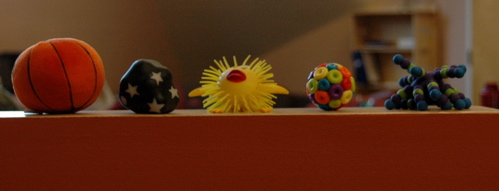
Five toys on ledge

Not by nature a maker of fun, I do like to have fun, and I believe that others need it, too. Do you notice, for example, in a classroom, if the teacher is not providing any chuckles, a student in class will start performing that function? Intuitively, we all know, even if we resist the knowledge, that the Class Clown is essential. Just as every group could use a leader or two, every group could use a fun-maker.

Even a serious teacher like me can design some fun. Props help. A few weeks ago, seeing that my September and October calendars were filled with appointments for visiting classrooms on campus and giving students my brisk “Come to the Writing Center” speech, I bought five toys. Diversely, they squish, boing, and bounce.

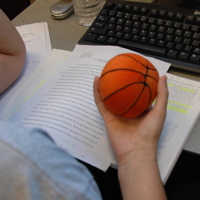
I bring them into the room and put them on the desk. Boing!I introduce myself in 15 words or less, and then I ask the students to think for 30 seconds on this question: “What makes writing so hard?” I add: “Every answer is the right answer.” I wait. And then I hold up the first ball and I give my brief instructions: “I’ll throw this to one of you. When you catch it, say your first name, and then tell us what you find so hard about writing.” I toss, a student catches, and the ball makes a surprising, mechanical “boing” sound. He laughs. The group laughs. The catcher answers: “I’m Paul. And getting my ideas down is hard for me.” Yes, I say, that’s challenging, for all writers in fact.

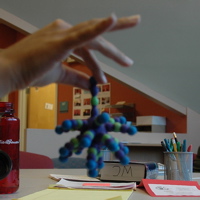
I give another stage direction: “Paul, throw that ball to one of your classmates. It’s someone else’s turn to tell us her first name and what’s hard about writing.” The next person answers. Squish spiderAfter that I introduce a new toy, and then another — they’re getting the hang of it now — and learn a few more things about what makes writing hard for students: “grammar,” “finding the right word,” “thesis” (over and over), “getting the length right,” and “starting.” Within a few minutes, all five toys are in play, and the students seem to have figured out the drill, and they’re looking at each other, waiting for a turn, aiming if they’re throwing, and talking to me and each other. The game, furthermore, is giving me material; I’m not a lecturer, and I get most of my energy from the questions and thoughts that students bring to or make in class. In this case, their responses give me an entrée to a conversation about how 1:1 tutorials in a writing center support students at all stages of the writing process and for any writing challenge.

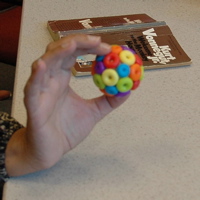
Fruit loop superballIt’s fun with a purpose, I know. In order to teach, a teacher must build some sort of bridge — or, at least, toss a fruit loop superball — between herself and students.

—-

Thanks to Joanne Manos and Kristen Daisy, in the Writing Center that afternoon, for their willingness to “lend a hand” to these pictures of the toys.

– Potatoes, and other prompts

I like the concreteness of things. Focusing on them while writing also frees me from my vague and persistent thoughts. Put an old key, a knife, an unfamiliar picture, or brooch in front of me, and I feel interest in at least describing the item. That inevitably leads to a connection with my own experience and, sometimes, a new question.

In her handbook, Writing Alone and with Others, which is filled with attractive writing New potatoesexercises, Pat Schneider offers many examples of using objects as “triggers” in her workshops for writers. Sometimes, she places a covered basket of 30 or 40 items on a table, removes the cover, and asks group members to take one or two objects, hold them, and freewrite for 10 minutes or so. Other times, she has multiples of the same item, and hands one to each member, getting them to all start writing from a similar place, as a way of seeing how individual writers will all mull differently over a shell, for example. Some items she suggests, like cinnamon sticks, even have scent.

  • Here are Schneider’s suggestions for a diverse basketful: shaving brush, rusty horseshoe, a ball and jacks, baseball, crocheted doily, piece of frayed rope, bottle of pills (with label scratched so pills become unidentifiable), rosary beads, crumpled cigarette pack, page of scripture written in Hebrew, small teddy bear, broken dish, mirrored compact, man’s pipe, baby bottle, old piece of jewelry, spool of thread with a needle stuck in it, dog whistle, artificial flower, plastic Jesus figuerine, and empty whisky bottle.
  • Suggestions for multiples of same object: mothball (in plastic snack bags to protect hands), piece of penny candy, a nail or screw, a vitamin pill, acorn, torn piece of a map, slice of raw carrot, rock, a small piece of sandpaper along with a bit of cotton, or a long stem of wheat or grass.

Collect some acorns. Buy a bag of wooden clothespins or new potatoes. Make your own object-filled basket. Offer surprise to your students. Or, assemble a collection, put it aside for a few weeks, and then take it out again to prompt your own writing. Surprise yourself.

—–

Picture credit goes to BBC Food.