– My very own teacher

I met with a graduate student today, whom I interviewed for a study I’m conducting on the poster session. At one point in the interview he paused in answering a question about himself and interjected, “I’ve got to give a shout out to my Dad.” And then he told me something he had learned from his father, a professor.

with first teachers, on the beach, 1966

Today is my father’s birthday. My father is a teacher, too. Although I am not aware of following exactly in his footsteps (he taught math), I’m sure I often tiptoe in them.

In honor of him, I share with you an excerpt of a reflection I wrote in 2003 for a grad school course on teaching writing. If you stick with it for a few paragraphs, you’ll find out how powerful it is to grow up with a teacher in your very own home.

* * *

Rewards

First, a few words about my beloved third grade teacher, Mrs. Eva Doyle.  I remember three things I learned from her: the multiplication tables up to a factor of eight, all the state birds, and crocheting.  The state bird project sticks in my mind because of the pure pleasure for me in colored pencils, detailed work sheets, characteristics of each bird (a yellow throat, for example), and beautiful bird names.  Multiplication memorization and crocheting are also vivid, because of how Mrs. Doyle used the promise of a needlework lesson to reward math mastery.  When every student in the class had made his or her way through the tables, she told us, the class would learn to crochet, as a group.  Eventually, after some duration of time I do not remember, Mrs. Doyle brought in a bag of yarn balls and a crochet hook for everyone to keep.  We pulled our 20 or so chairs into a circle, and our teacher walked around our perimeter, leaning over our shoulders to give help. In this manner, Mrs. Doyle taught us girls and boys how to make a chain, then a daisy chain, and finally, a granny square.  The ambitious kids went on to make five granny squares, with a grab bag of colors provided by Mrs. Doyle (from her own money probably), and stitch them together to make a hat. I made one of those hats. Continue reading
– Stories, built

My MIT friend and colleague, Lisa Dush, also runs Storybuilders, which helps organizations and individuals make digital stories. In January, I went with her to Washington, DC to work with the staff of College Summit, a really cool nonprofit organization that works with high schools to raise their college-ready culture and get more kids into college. For two full days, we worked with the six staff members on developing and revising their stories, recording the audio tracks, uploading photo files into the video software, and constructing the mix of words, sound, images, and effects. Later, Lisa worked with the College Summit folks on production.

She recently sent me a link to the finished stories! Here is Darin’s on College Summit alumni leaders. Even though I heard Darin read his story aloud many times during workshop, and also looked over his shoulder as he sorted through images, I was surprised and moved by several moments. This is a powerful testament to peer mentors (and superhero underpants).

More of the College Summit stories can be found at the Storybuilders’ site on Vimeo.

– Distressing ratio

I just walked back from giving a short lecture across campus. It was a 20 minute performance, complete with (a) slides that articulated and illustrated common issues that students struggle with in writing a technical report and (b) enthusiasm.

As I walked back, I added up the time spent looking again at the batch of reports and my summary comments; making 14 slides, with examples from student writing; and mentally rehearsing. Time? Seven hours.

Sometimes I’ve heard professors tell students it takes an hour of preparation for every one minute of presentation. I did not spend 20 hours on my talk today, although perhaps all the time spent reading & commenting on the papers that led to this talk counts for preparation.

This makes me realize, though, that some professions (all?) are like icebergs: most of what one does (as a teacher, writer, dancer, bass player) is hidden from the people we work for (students, readers, fans, audience).

——

Post script: Later Jimmy asked, “How many people were in that lecture?” I answered, “Fifteen students and one professor.” And he reminded me to include those numbers in my ratio, which in turn reminded me that it’s not all about me and my experience!

– Big pond, many fish

I missed the 4C’s convention in Louisville this year (sponsored by the Conference on College Composition and Communication), which is a biggie in the teaching writing world.  I went last year and even gave a presentation, one among hundreds of presenters. This year, Alex Reid went, and he did some basic arithmetic that describes how dilute the audience gets at one of these huge conferences where everyone is vying for a little sip of the attention water. He estimates that, on average, most of the 3,000 attendees make it to 6 out of about 600 panels and that most panels attract between 10 and 30 audience members. That’s the thing about big ponds.

I was swimming in another school of fish last weekend, attending the 2010 ACPA annual convention in Boston (sponsored by the American College Personnel Association, the leading organization for student affairs professionals). It was a good chance to hang out with James and also reconnect with that world, in which I felt more a part when I worked in academic support and writing centers. Even though I no longer have official student development responsibilities, I do believe that I will again, someday, and that in the meantime I continue to be a deeply interested observer in how undergraduates mature and how the academy can support their development in thoughtful and humane ways.

I went to five or six panels; I took notes. Rather than writing a summary, I’ll try to capture what floated to the top and what ideas have stayed with me enough that I’m still thinking about them a week later. Continue reading

Three E’s: a paradigm

Years ago, when I was freelancing as a development researcher and writer, I helped the director of a new institute on children’s health prepare for a speech. I did the research that framed her remarks, which she wrote and ultimately presented to an advisory board. This was before the proliferation of Web-available information (in fact, Lydia was 8 weeks old at the time — 14 years ago!), and I conducted the research like a gumshoe, going stealthily from library to library, consulting periodical indexes, photocopying articles, and interviewing researchers.

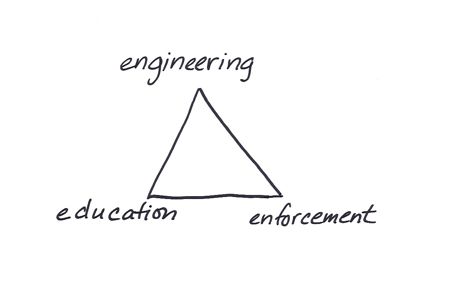
At the Educational Development Center in Newton, I spoke at length to a library associate who first interviewed me, as a way of getting a bead on my questions and assignment. She asked me if I was familiar with the “Three E’s,” a neat way to think about public health problems, and she drew a simple diagram on the chalkboard in her office.

She explained that there are three kinds of approaches to addressing and attempting to solve entrenched problems, like teen pregnancy or gun violence: engineering, enforcement, and education. “Say you want to address rising teen pregnancy. An education approach would be to design a school-based curriculum at prevention. You might try to meaningfully inform teenagers about the responsibilities of parenting and offer them pragmatic advice about contraception. An enforcement approach would be to segregate pregnant teens from the main school program — this might be a disincentive to nonpregnant teens. The engineering approach would be the offering of Norplant, free of charge and through a school’s health clinic, to sexually active girls.” She added, “Whenever you can come up with an engineering solution to a health problem, it’s easier and usually more effective because it minimizes the human behavior aspects that enforcement and especially education rely on. Education is the hardest way to affect change.” Continue reading

– Grades beep, rattle, and hum.

But grades don’t speak.

It’s report card week in Brookline, and as usual we got a heads-up e-mail from the high school headmaster, prodding us to ask our sons and daughters to hand over their quarterly assessment. “The report card is an important school communication,” he concluded.

One thing every parent of a high schooler knows is how little communication there is between home and school, especially compared to the mountain of notices, bulletins, and newsletters that come our way during the K – 8 years, not to mention the PTO breakfasts and principal’s coffees and “special” events. (For the record: I do like parent/teacher conferences.) Eli is a junior in high school, and I met his teachers once at an open house event. Yes, I had a nice and helpful conversation with a few of them. However, that and a few visits Jimmy made to similar open houses constitute the extent of home/school communication in the last three years. I’m generally okay with that, but I am not okay with grades standing in for communication.

Grades might be aggregated data, and they might even be signals, but, because they lack (a) teachers’ interpretation and (b) opportunity for direct feedback, they cannot be communication. Continue reading

– Draw a picture. Make a sandwich. Teach writing.

Grace comes to work with Jane and finds the art supplies.

Grace comes to work with Jane and finds the art supplies.

During a scheduled hour to discuss their upcoming proposal drafts, I asked a group of 10 chemical engineering students to explain to each other their research projects, the rationale, the experimental design, and prior research. They talked productively for a half-hour and listened to each other with curiosity and asked relevant questions. All good. Certainly, we could have filled the rest of the hour with more talk.

I looked at the classroom’s two white boards and one easel pad and clutch of dry erase markers and Sharpies. I invited them, instead, to draw.

In small groups, they drew branching diagrams of their proposed experiments and explained their plans — and, even more importantly, gaps in their plans — to their peers. I walked around. They asked questions about how they might frame their experimental design in their drafts.

My friend and colleague Lisa had the classroom reserved after me, and she came in five minutes before we finished. Later, on the way to the copy machine, I saw Lisa’s students (in a different section of the same class) sprawled on the floor with big pieces of white paper and clustered around the white boards, drawing and gesturing with hands and markers. Continue reading

My Beck dream disappears

In the year that I started teaching (2003), I had many night dreams that I would remember and think about the next day. One especially, even though it was about Beck, seemed to be about me, and teaching.

In the dream, I waited outside the Orpheum among a crowd. People pressed up against the main entrance doors. People spilled out of the alley onto Tremont Street, not bothered by the cars that edged around them. People climbed up and hung from a rickety, wooden staircase that clung to the outside wall of the building and ended at a door at balcony level. In the dream, it was a late September afternoon, the sun slanting. I had a ticket for the Beck show and could have made my way easily through the front doors, but instead I climbed the wooden stairs, pushing up and up and up, and slipped into the door at the top. Inside: darkness.

My eyes adjusted to the poor interior light, and, from the top, I made my way down balcony steps, along box seats on the side that hung from the wall, and into the door to the right of the stage. No one stood in my way or stopped me; I kept weaving in the direction I was going.

Going backstage at the Orpheum was like going backstage at my college’s auditorium: just a few stairs up, and there I was among the curtains, rigged-up lights, people in black shirts with clipboards, steamer trunks, lit Exit signs. Backstage, there is no place to sit down. Move, move, move, or stand.

I edged around a curtain, feeling it touch my back like hair, or a hand, and stood out of view of the audience yet close enough to center stage that I could see the house, performance area, and backstage at once. There was Beck, alone in front of the audience, with just his amped guitar, big hat, and a vest. He sang “Mixed Bizness.” He played hard, danced his plastic moves, and jerked his shoulders and guitar when he hit a line like “Freaks flock together.” He seemed to be possessed by the music, deep into it, as mesmerized by his performance as the audience was. Continue reading

– Explicit lessons

Eli, at the dinner table, asked us if there were any “explicit lessons” we had taught him. He couldn’t think of any.

“Uh, what do you mean?” I asked.

He gave an example: “My friend’s parents taught him you should always walk a girl to the door.”

Hmm. Well, that is not anything I or Jimmy had ever thought to make explicit. I do recall, from my own youth, that my parents thought this was a good thing: boys should make sure girls get home safely — and that means to the front door, and into it. (And who makes sure that boys get home safely?) Yet, I have failed to pass this along.

“What about a message like ‘Be kind’?” I suggested.

Apparently, that doesn’t count.

“Turn off the lights when you leave a room?”

Nope.

“Brush your teeth? Get a good night’s sleep?”

No and no.

Eli did not seem to mind that we couldn’t come up with anything. “Basically, I think I know a lot of stuff and you didn’t have to teach it to me.” He said something like this, in so many words, and added that he was able to think through, on his own, a lot of situations and dilemmas he encountered.

Wonderful, his mind is at ease. However, mine has not been. I’ve been mentally backtracking through Eli’s 17 years on the planet (and Lydia’s 13 and Grace’s 9), looking for moments when I have communicated an explicit lesson or made a parental speech.

I have thought of only four items for what must be a rather skimpy guide to life. Here they are. Continue reading

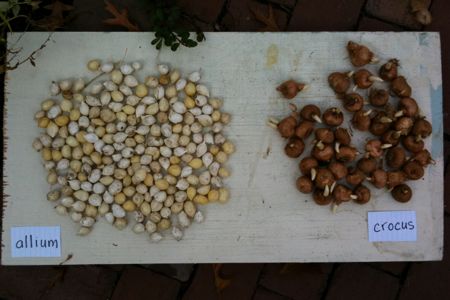
– Bulbs and boxes

What I like about bulbs, which I planted on Sunday, is their utter forgetability. I dig a hole, drop them in, leave their spot unmarked, and forget. The cold and short days of winter will pass — some sparkling days swiftly, most days grindingly — and then one day I’ll be walking up to the house, with my head down and hands in my bag searching for keys, and I’ll see them. The cocked, belled heads of the crocii will be first.

We moved into this house in the summer of 1999, not sure what was planted but for the big, gumdrop shaped old shrubs. Much of the planted parts of the yard seemed taken over by leaf mold or invasive ground vines. That first summer, the most we did was cut back the overgrown parts and mow the neglected grass. In late February 2000, though, stomping through the yard with Eli and Lydia who were still small and close to the ground themselves, we spotted tell-tale little blue heads poking up just inches from patches of cold, bare ground still circled by snow. Planted by someone else before us, they were like a gift from the past to the future. And there we were.

I had a feeling like that recently when I went up into the attic to rummage through my boxes of books and papers I had packed up in June 2006, when my job at Simmons College ended due to budget cuts. (That was a sad, sad time.) I’m currently getting ready to teach a course next semester on expository writing at the Harvard Extension School, and I’m basing it on the first year writing course I taught at Simmons, in which we read and wrote about biographical texts of my choosing. (At MIT, I don’t choose the texts for the WAC courses I’m involved in; the lead professor does.) I opened box after box and found treasure after treasure: books, DVDs, notes, and handouts I had forgotten. If I were in a movie, I would have had to toss those papers into the air to communicate my glee. Instead, I leafed intently through them, my interest in my dearest interests rekindling; I made a pile of keepers. While I did not speak aloud to the empty attic, I felt like whooping, “Yippee!”

Sometimes pieces of ourselves get shut up and put away, underground or in attic boxes. The putting away can seem as though an interment: Oh, that part of myself, or my talents? It is dead to me. Never again. And then, months or years later, the boxes get reopened, the green leaves and colorful heads push up from the ground, and we realize that the book, the bulbs, those little packets of life, have only been waiting for us, keeping themselves alive, shut away in darkness.