– Walk into the dark

This excerpt is from a ruminative and sparkling post by writer and teacher Alexander Chee on today’s Koreanish:

Part of what is interesting to me about writing is how writing is a social act—a performance for others, a way to connect that has not one guarantee to it. You write and you don’t know that anyone will ever read it or care. You have to proceed in line after line, like someone descending a stairway towards an unknown space below and past an unknown number of stairs also. It may even be an eternal descent until death. You don’t know how much you’ll have to write before you begin to connect to others—that is the crisis of the student writer, for example, but all writers, I think, recognize that crisis as simply a student writer’s introduction to the idea that they could write for their whole lives and never succeed, and they won’t know, even if they write.

You are basically asking them to walk into the dark and trust that they’ll meet someone there. Someone to whom they’ll entrust all of this work. Most of the time you never say this to them because it is a terrible thing to encounter and everyone makes their own peace with it.

– Future professor

I offered to drop Eli off at school on my way into Cambridge this morning. As we got closer to the high school, right around the time of the first bell, activity intensified: cars, bikes, crossing guards, pedestrians, teens, teachers. As we were stopped at an intersection, a student crossed it diagonally. Tall, slight, curly-haired, and hunched under the weight of his pack, he continuously blinked, grimaced, and adjusted his head on his neck as he made his way across, as though the sun and the concrete world were just too much for him and intruded on his private musings.

“Look at that funny kid,” I said to Eli, and I pointed.

“Yeah, I noticed him,” he replied.

“Someday he’s going to be one of those absent-minded professors,” I said.

Eli paused. He smiled. “And yet, his students won’t not like him.”

I knew what he meant. “He’ll be both. You’re right.”

And on my way to work, alone in the car, I thought about being a student and, along with my friends, loving our funny, weird, and quirky teachers and, as a way to show how much we had studied the objects of our affection, performing for each other our elaborate impersonations of the well-loved teachers’ mannerisms. We would laugh, and the laughter was never mean-spirited. It was gleeful, buoyant, and conveyed recognition. And I dare say the impersonations and laughter knit us together, too.

– Personal essay checklist

Here’s a great criteria checklist for the personal essay genre, whether you’re writing them or teaching students how to write them. I discovered it yesterday while browsing the pages of What the Writing Tutor Needs to Know by Margot Iris Soven (Thomson Wadsworth: 2006).

  1. Does the essay enlighten the reader through an interpretation of self, the self in relation to others, or the self in relation to the world?
  2. Is there sufficient description of events and people?
  3. Does the essay convey the author’s mood or feelings?
  4. Has the author responded to all of the questions in the assignment?
  5. Is the style personal? (Usually includes the personal pronoun “I,” descriptive adjectives, and conversational language.)
  6. Are mechanics correct? (Soven 131)

There are so many aspects of this that I like. Most attractively, it’s simple, yet manages not to be vague. Furthermore, the list leads with the hardest tasks — enlightenment and interpretation — which nod at the key feature of an essay; it’s idea-driven. The essay’s relationship to the reader is emphasized. “Sufficient” detail is enough; description does not have to be exhaustive.

Mentally, I measured some of my essays-in-progress against this list, and some of them passed and a few did not. About the few that seem still to be lacking, I realized that I am still struggling with the first item. What are the essays about, at the level of the idea? They might tell a story, or present anecdotes and observations, but they do not (yet) present to a reader an original interpretation of the story or anecdotes.

I’m not teaching the essay this year — all my classes are science writing ones — but, if I were, I’d use this checklist with students, to help them make observations about essays written by other authors as a way to get them thinking critically and creatively about their own. In the meantime, I’ll apply this checklist to my work.

– Devil inside

Every teacher has their “duh” moments, and probably at least one per semester. You say something to your class, and it’s immediately apparent by the looks on their faces that you’re so wrong, or uncouth, or just not with it. By being wrong or simply inexperienced, however, you sometimes learn the coolest things.

Like this semester, in my section of the writing component of an introductory genetics course (which was hard for me to teach, as a newcomer to MIT, and hard for the students to get), I had this brilliant idea to make, with the class, a glossary of sorts for the scientific report that each student was writing on a very similar set of experiments. I had noticed, as I was reading their drafts of the report’s introduction, that the student writers varied dramatically in their use of a technical vocabulary. So I stood near the white board, marker in hand, and asked them, “What are the terms and concepts you think you should cover in this report?”

It was a way of them teaching each other — and me, too — the material, and it worked. As I wrote on the board each term they offered, I asked the speaker to say something about the term, “polymerase,” for example. That student might say, “It’s an enzyme in DNA.” And then another student might add, “It’s what causes amplification.” And then I might ask, “What’s amplification?” And so on. Everyone took notes!, without prompting.

I had a question, too, about this one term that cropped up in almost every one of their drafts: “wild type.” Hmm, what’s this? I immediately associated it with other terms I know, like wild card, wild thing, and wild horses. Crazy, out of control, the outlier. I said, “Someone explain to me this term: wild type.”

There was silence. Smiles. Looks around the room. A few giggles.

“Uh, wild type is just basically the version of a gene as it occurs in nature,” explained one student. She was hesitant, not in her knowledge, but as a way to show tact. Another student added, “It’s a gene that’s not mutated.” This is, I gathered, common knowledge (although not, then, to me).

I laughed out loud at myself. Then they laughed. It was a “duh” moment, but it turned out to be a good one, too.

I remembered this today as I was driving home along a winding back road and occasionally checking my speedometer to make sure I was adhering to the limit. And then I was thinking of (a few) people I know who try to respect posted speed limits. And I broadened that category to people I know who honor common courtesies, follow procedures, recognize the importance of Scrabble rules, and so on. Sometimes it can feel like a burden to always remain within bounds. It’s a weird comfort, though, to realize that even though you may not be a wild thing, you’re always the wild type, through and through.

—–

P.S. Does anyone remember “Devil Inside” by INXS? I was a fan of that band in the 1980s, and Jimmy and I went to Great Woods to see them when I was in my mid-20s. Even then, I somehow felt too old to be in that crowd.

– Four characters

Months ago, I asked a favor of Y., a student I have known for two years. She is a regular in the writing center, and she was in my composition class last spring. All teachers secretly root for and are attracted to certain kinds of students, and this is something you start to know about yourself, as a teacher, as semesters roll by. A colleague of mine, a steadily productive one, admitted to relishing her work with the “out there,” unpredictable students. And me? This student, Y., is of the kind I have my eye on: hard-working, quiet, smart without fanfare.

I asked Y. to translate for me the scroll that the Chinese father of X., another (former) student, made for me a few years ago, when X. was graduating from her Master’s program. The parents were visiting the United States for the first time, and the daughter asked her father, apparently a skilled calligrapher, to make a scroll each for a few teachers and bring them along as gifts; I was a lucky one. Although fluent in Mandarin, her native language, X. was as unable as I to read the scroll. She explained: “It’s traditional.”

Y., current student (and, yes, her name begins with the letter Y and the former student’s name begins with the letter X), took this on as a project. Once in a while, since I have asked her, she has popped in to the writing center to update me on her progress, to give me a clue or two about the meaning she was finding.

Yesterday she stopped by and asked to meet formally. Y. had heard it was my last day in the writing center, not just for the semester, but for always. We sat down together, and she translated, at length and with plenty of her own commentary on Chinese poetry, the scroll. In four lines, the poem is about what we might, in English, call melancholy. Set at the end of spring, a time of year that intensifies such feelings, it uses the imagery of the garden, grass, and water to evoke an older person’s recollections of “people who are missing” — people who have gone before, grown children who have moved away. “It’s metaphor,” said Y.

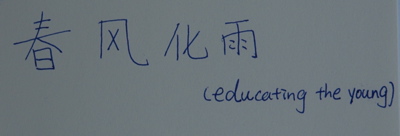
There was more for Y. to teach me. She gave me an envelope and said it was okay for me to open it. In her longish farewell note to me, written in careful English and careful Chinese, there were these four characters:

Excerpt from Y\'s note

The four characters represent these words: SPRING ** WIND ** TRANSFORM ** RAIN

Y.’s note offered an English translation — “educating the young” is what a teacher does — but her longer commentary on the characters, which she spoke aloud and illustrated on scrap paper, was richer. Let’s see if I can do Y. justice. Here goes:

SPRING seems to be a time of year that suggests both beginnings and the end of beginnings. This is the moment in which a teacher meets her student. The teacher is WIND, which, by its gentle force, TRANSFORMS and disperses the RAIN, which is knowledge. By transforming the rain into droplets that are not too small and not too large, and by dispersing them to the grass (grass, which stands for students, is implied), a teacher teaches.

I am so taken by this, these qualities of teaching and knowledge being powerful and yet ephemeral. I like, too, how the teacher is unbundled from knowledge; there is wind and there is rain; and neither contains the other, although they mingle. Y. shared a new metaphor with me that seemed instantly right.

It’s mid spring in New England. I’m moving on and might never see Y. again, although I don’t know. To each other, we may become, over time, people who are missing. Not gone, not dead: missed.

– Teachers’ skulls

At the salon where I get my hair cut, every client gets a scalp massage from the shampooist after the final rinse. The sensation is bliss.

Today, Chris, a petite, instantly friendly young woman, took charge of my heavy head. She kneaded and kneaded. My whole body felt better. I was on a cloud…

Chris: Uh. (Knead, knead.) You have, like, the tightest skull.

Jane: Really?!

Chris: Yeah. What do you do?

(She doesn’t give me time to answer.)

Chris: A teacher?

Jane: Yes!

Chris: Teachers have the tightest skulls.

Jane: Really?

Chris: Wow, isn’t that weird, that I guessed what you do?

Jane: Yes.

Chris: (Knead, knead.)

Jane: What should I do?

Chris: I’m not really sure. I mean, I don’t know if I have a solution.

Jane: Oh.

Chris: (Knead, knead. Squeezes. Wraps towel.) I’ll tell you what I do for myself. And I’ve recommended this to some teachers. (She motions me out of the chair and walks me to the stylist’s chair.) There’s this hot tub place in Cambridge…

And she proceeded to tell me, in detail, about Inman Oasis, a place where, for $10, you can soak your bones (and skin, in a bathing suit) for an hour, and do nothing else.

Chris: I really think this is something teachers need to do. And you’re a teacher.

I am going to take her advice. It was so intently and kindly given.

– Reciprocity

Sometimes a student enters the Writing Center in distress, having been told by a professor that his writing is so “unreadable” that the professor has not attempted, beyond the first paragraph, to read it.

These instances make me think again about the writer’s job, yet even more so about the reader’s. They each must try hard to reach the other. Writer, write hard. Reader, listen hard. Communication is a meeting in a middle place. Not a compromise, though. A meeting.

I like how Joseph M. Williams, the author of perhaps my favorite handbook on style, Style: Ten Lessons in Clarity and Grace 6e (Longman 2000), reflects on a writer’s role in this relationship:

We write and revise our earliest drafts to discover and express what we mean, but in the drafts thereafter, we write and revise to make it clear to our readers. At the heart of that process is a principle whose model you probably recall: Write for others as you would have others write for you. (220)

He says much more about the golden rule and a writer’s obligation, and I wholeheartedly recommend the chapter “Ethics of Prose.” In it, Williams also says this, about the golden rule and readers:

Some readers read less well than others, and some expect more from a writer than their meager investment of time and effort earns them. In fact, just as writers have an obligation to readers, so do we as readers have an obligation to writers: If we assume that writers work hard to say something important to us, we should read thoughtfully and generously, at least until we decide they have given us good reason to stop. (221-222)

Reading and listening — paying attention — to the words of another require generosity: a gift, a gesture. It takes effort to look beyond the lack of clarity in a student’s writing, but if we believe that they are making an attempt to say something important to us (it’s our assignment, after all!), then we should reciprocate. Williams calls such an exchange “fair” (222).

A penciled notation on the inside page reminds me that I paid $6.50 at Brookline Booksmith Annex for a used copy of Style. The latest edition, the 9th, is much more. Still, it’s worth it.

– “It counts.”

Yesterday, after meeting with a small group of students, I set myself up in an empty lounge with a cup of coffee and a stack of Materials and Methods sections from my students’ scientific reports.

Before digging in, I sent an e-mail to a friend, another writer who tutors and teaches at a college in Pennsylvania, and said, “I’m not working on my writing right now, but my iBook is open and I’m about to write some comments on student drafts, if that counts.”

He wrote back instantly: “It counts. Oh yeah, it counts.”

– Membrane

At the dining room table, I comment on and grade papers. I start early, before breakfast. Then breakfast goes by. I am still grading papers. I am still in my pajamas.

Grace wants to get dressed and start the day and do something. She can’t. “Mama, put your clothes on. I don’t feel comfortable when I’m dressed and you’re not.”

<Sigh> “Okay,” I say and get up and change into pants and a t-shirt. I go back to the dining room table and the papers. Grace gets dressed.

Jimmy asks, “What’s that about?”

I answer, “Oh, she’s so permeable.”

He says, “You mean co-dependent?”

“I’m sticking with permeable,” I say and smile.

– Walk 500 miles

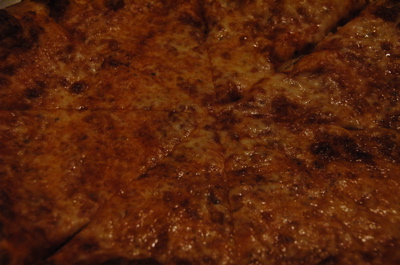
Does this look good to you?

Pizza slice

What would you do to get some? Walk 500 miles? Pass up tickets to the World Series? Give up your spring break?

If not those, then could the promise of pizza get you to show up at a meeting?

Not me. I’ve noticed, however, that this is a lure for students. A huge one. Right now I’m dividing my time between two different colleges, which are so different that I’d think the students at them would be motivated by different rewards, yet I notice a striking prevalence of the words FREE PIZZA on posters and chalkboards announcing club meetings, grammar workshops, and support groups.

Does it work? If you offer a snack to someone to get them to ingest, oh, comma rules, will he stick around long enough to learn how to fix his comma splices?

I’m skeptical.

Around the time I turned 40, I said to my children, as they waited impatiently for the usual Friday night delivery: “I’m so done with pizza.” Really, I’ve had enough. Because I’m not into pizza, if I offered it to students, there would be something condescending in that. I like comma rules, but I doubt that they do, so the pizza would be a cheap trick. A manipulation.

So what if I tempted them with something that tempts me too? Good olives. A roasted potato. Grilled flank steak from a recipe my friend Marcia gave me years ago. Walnuts. Almonds.

(Picture that poster. FREE ALMONDS.)

I’m interested in these questions of motivation. It takes empathy and creativity to persuade people to do what they don’t actually want to do. Yet, we keep relying on the same tired old tricks.

The blog Motivation Matters at Education Week has been covering the cash incentives that schools offer K-12 students to apply themselves to various tasks: reading, enrolling in AP courses, completing homework. Recently, Ken Bushwiller reported that panelists at the American Economic Association’s annual meeting demonstrated that “giving students incentives was not very effective.”

Alex Kjerjulf, a self-identified Chief Happiness Officer, considers the contemporary workplace and claims, “Many people don’t feel motivated at work, and there’s a very simple explanation for this: The motivational techniques used by most managers don’t work.” His blog post, which includes a vivid illustration, is titled, “Why Motivation by Pizza Doesn’t Work.”

Kjerjulf discusses extrinsic and intrinsic rewards and comes down firmly on the side of helping people find their own internal motivation. What is it that employees deeply want to do? (Hint:”eat pizza” is not the answer.)

What is it, I wonder, that students deeply want to do at school? More specifically, what is it that they want to do in my writing class?

Steven Reiss, a professor of psychology at Ohio State University, argues that there are more than the two kinds of motivation: “It’s all a matter of individual differences. Different people are motivated in different ways.” His research has theorized 16 basic desires.

This is news to me. Reiss’s findings seem sound. When I think about motivating students to undertake the assignments in my course, however, I could become overwhelmed trying to design incentives for all their human differences. This one might be motivated by pizza, that one by cash, he by the stuff itself, and she by acclaim.

Just as one person cannot be all things to all people, one teacher cannot design all rewards for all students.

Does that leave me back at square one? Hmm, maybe. How about this, though? I’ll offer them free almonds. Well, not really almonds. What if I offered them the promise of the same rewards that motivate me? A chance to talk about writing with other smart people. Good questions. Stuff worth reading. Moments of writing together. A little time, here and there, to get to know something about each other. Mutual support for the long haul and the steps we take alone.

Not everyone will bite, but some will. And there will be plenty for me.

—–

Thank you, Eli Guterman, for putting aside your dinner for five minutes to take the pizza picture. And thanks to a YouTube member for the clip of The Proclaimers doing an acoustic version of “I’m Gonna Be,” which includes the unforgettable line: “I would walk 500 miles and I would walk 500 more.” I love it.