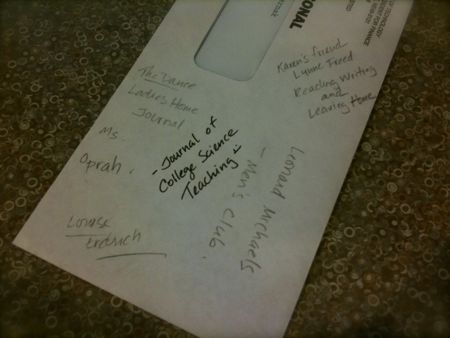
– Front of the envelope

I hadn’t even opened my pay stub — there it was, dropped on my desk — when I called its envelope into service. My office mate, Karen, and I were talking about things to read, journals that might consider our work, and women’s magazines that should not be overlooked.

Sometimes, you just have to write something down, and it cannot wait for the notebook.

– Audience problems

Not having an audience is a problem.

Having an indifferent audience can present another problem, especially if you are speaking in front of them. Try lecturing to sleepy students at 2 o’clock in the afternoon sometime. Watch those eyelids flutter.

Misunderstanding the audience can lead to their disappointment, or even your own. When I was in nonprofit development, I spoke at the First Annual Conference on Black Philanthropy, and watched half my audience walk out of the room one at a time because I had completely failed to understand the cultural values shared by most of the people in the room who were not me.

Yesterday, in working with a 13 year old writer, I was reminded of an audience problem that affects, especially, writers of creative nonfiction and memoir. And that problem is knowing an audience too well.

This writer, whom I’ll call Justin, is writing a personal narrative that will be developed into a 3-minute digital story, with voice over and music tracks, and photographs from his own collection. Justin is one of several teens in a local community center involved in making digital stories through my friend Lisa’s business, Storybuilders. His story mentions his mom, siblings, and, most notably, his teacher. The most striking detail in Justin’s notes for the story, in fact, involves the teacher and how she disciplines her students when they’re distracted: she spritzes them with a water bottle. Continue reading

– What I am thinking about this week

Lee did not ask me or anyone to follow him in writing, but I read his post, and what can I do but be prompted?

Thoughts, especially written-down ones, propagate thoughts. That is one thing I am thinking about right now.

Today in the grocery store I stood in line near an old, yet very well groomed woman. She was tiny and precise: short, thin all over, ironed black shorts and ironed white summer blouse, black framed sunglasses proportioned for her face, short hairdo the color of dried grass with a little pink to it. She paid by check. “I don’t do bank cards,” she said to the clerk. It’s a family-owned grocery store, and they accomodate habits like these. In her cart she had two of many things: two boneless chicken breasts, two russet potatoes, two yogurts. I looked at her left hand, which was bony and veined of course, and she wore two or three bands on the ring finger, one heavy with stones. Her hand seemed to droop, perhaps simply from that fatigue that strikes us all at 4:30pm, but the view of those rings and all the food twins in her cart put this phrase in my head: heavily married.

Revision is an open wound. As long as a piece or project is underway and unfinished, it is susceptible to every influence that comes near it. That’s good, but also hard to experience, and manage. On this, I will have more to say in the future. Continue reading

– Bingeing on sticky notes

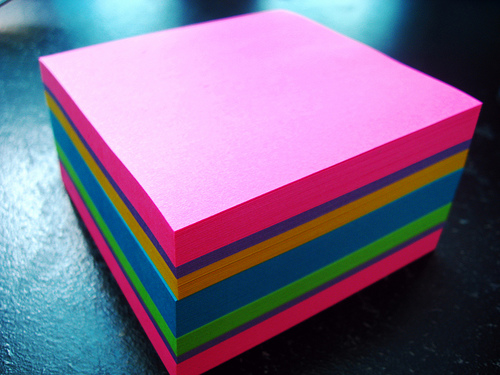
“Post-it® notes came out when I was in college.” I mentioned this to a group of students as I was passing out stacks of the colored sticky notes, along with a Ziploc® bag full of Sharpie® markers: tools for an article annotation and mapping exercise.

I continued, “In fact, I recall my friend Jeanne buying a pack — they only came in yellow at the time — and her marveling to me at their coolness. Secretly, I was thinking that the little pad with adhesive strips was about the stupidest invention ever: Don’t paper and a piece of tape do a sufficient job?”

How wrong I was, I concluded. “It’s hard to imagine school life today without sticky notes.”

Teachers, not just students, need sticky notes too. In the past few weeks I’ve been thinking through and organizing a presentation, for the WAC International Conference, on “The Professional Poster Session and Its Simulation in the Undergraduate Setting.” I interviewed four PhD students on their first experience as poster presenters at professional conferences in their disciplines, and I had about 80 pages of interview transcripts. That’s a lot of material to boil down into an interesting 15 min and 12 slide talk. So, I decided to walk my own talk, get out the sticky notes and markers, clear off the kitchen table, and sit down and sketch first… with words. Continue reading

– Bought back my own time

In the last couple of months, for various projects, I’ve been interviewing people and recording those interviews for later transcription. Some transcription I’ve done on my own. For every minute of audio, it takes me four to eight minutes to transcribe the dialogue. An hour-long recording could take as many as eight hours to turn a conversation into material for an article or data for a qualitative study. I had a handful of those.

Recently, I wrote about a digital recorder that has been a handy tool in those interviews and a play-back app that makes transcribing more efficient. Now I’d like to give a shout-out to CastingWords, a web-based transcription service. I uploaded .WMA files to their site, chose the 6-day, $1.50 per minute option, and crossed my fingers. In two days, my first transcription arrived in my mailbox. Within six days, the whole order was complete.

I’ve been going through the transcripts. Hooray! They are high quality and accurately capture the text of what was said, as well as the little touches in timing and fillers (“um, yeah”) that turned each digital file into the record of a conversation.

If, like me, you’re ever in a situation where you want to buy back some of your own time (I paid about $340 to conserve about 30 hours of my own time) and subcontract tape transcription to specialists, I highly recommend the staff (really, Mechanical Turk Workers) at CastingWords. The output is excellent, and the manner of doing business with them — entirely via the web — was efficient.

—-

Parking meter image by Lance McCord via Flickr and creativecommons.org.

– Validation

It takes more strength to go slowly.

Said today by yoga teacher Portia. The remark had something to do with the lowering and raising of our legs, but it seemed personally applicable. Like, it’s okay that I can be a slowpoke (in writing, thinking, cooking, reacting, painting, responding, folding, driving, etc.). And that slowness might come from strength, and not a deficit.

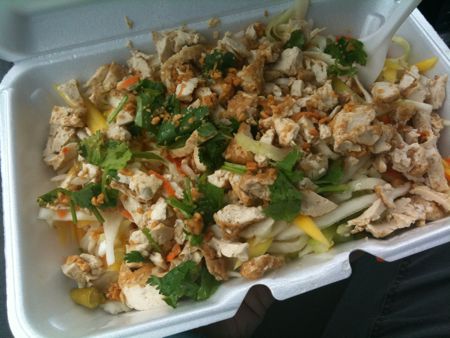
After yoga, there was no Clover Food Truck to get my usual, so I stood in line at Goosebeary’s Food Truck instead. I ate the Mango Salad with Tofu, not quickly. Vegetarian food can be heavenly too, you know.

– My new tool

For my telephone interview with physician/author Danielle Ofri, I used my new tape recorder and telephone pickup.
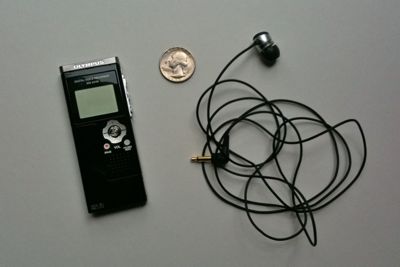
Olympus recorder and telephone pickup

I recommend both: the Olympus WS-331M digital voice recorder (about $100) and the Olympus TP7 telephone pickup (about $20). The pickup is neat. It plugs into the mic jack of the tape recorder, and then the ear bud goes in the interviewer’s ear. As I listened to Danielle, the ear bud recorded what I heard in my ear, or Danielle’s voice, and the recorder’s external mic captured my voice.

On my sister Sally’s recommendation, I used Express Scribe v 5.02 from NCH Software (free) to play back the audio file as I transcribed it. First, I connected the recorder’s USB terminal to my Mac’s USB port and saved the .WMA file on my desktop. Then I imported the .WMA file into Express Scribe, which allowed for lots of control (speed, volume, start, stop, ff, etc.) as I listened to the file, re-listened to passages, and typed.
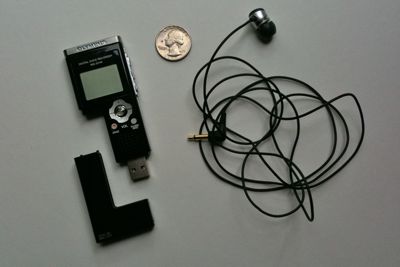
Olympus recorder, with USB terminal exposed, and telephone pickup

I actually bought the recorder to tape some interviews I’m doing with students for a teaching-related research study. For that recording situation, nothing more than the recorder and a list of questions are needed. I followed the same procedure for transferring the .WMA files to my MAC, for later transcription.

The only accessory that could improve this experience of recording and transcribing is a foot pedal to control the playback of the recording. I did designate a few hot keys in Express Scribe to speed the frequent stopping and restarting of the playback, but a foot pedal would have saved even more time and hand motions.

A few weeks ago I was a beginner at the recorded interview. This nifty little setup made me feel like a pro.

——

Post script: I almost called this post “My new gun,” as an homage to a great, yet little-seen Diane Lane film called… My New Gun (1992). Marcia recommended it to me years ago. It’s a stealth surprise: weird, suspenseful, sexy.
– I’ll take reality.

I have always preferred reality.

I was the child who read the Little House series, Nancy Drew, Tree Grows in Brooklyn, Jane Eyre, Secret Garden, Pig Man, and Anne of Green Gables.

And like my daughter Lydia, I have always liked facts. One spring, when I was about 16 years old, I took a stack of books out of the library’s nonfiction section on farming, gardening, and vegetables. (That summer I also attempted a 10 x 15′ garden on a clayey waste plot in my family’s back yard. What I recall is that lettuce grows quickly, and slugs like to make a home among lettuce leaves, which a person finds out when she holds that salad lettuce up to her mouth and sees a baby crawler on a leaf.) Another time I took out a less goal-oriented selection of books on the human body — a bunch of owner’s manuals. (I remember a set of photographs from a dermatology book on effects of aging, and how an older person could pinch skin on the back of her hand and it would stay in a little teepee shape for a second or two. I tried this on my own hand then and could not imagine a little skin teepee as a possibility.)

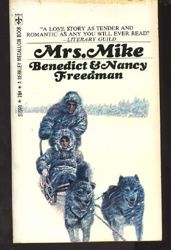
In my fiction reading, as much as I followed plot I liked learning how people did things with their hands: laundry in big tubs, food over an open fire, sleeping 3 or 4 to a bed, toys from sticks and rags, and treatments from poultices (ah, Kaiser Pease’s onion bath in Where the Lilies Bloom). When I picked up Mrs. Mike again, at least 30 years after I first read it, it was to find the description of an emergency amputation that has stayed with me:

I filled a kettle. I lifted it to the stove. The cries drew me back. His nails dug long furrows in the wood of the table. His dark eyes rolled back under his lids, leaving white, unseeing holes. The smooth muscles moved in Sarah’s arms. Back and forth, back and forth. The trap bumped and clanged against the table. Sarah’s strong man’s hand pressed the saw’s teeth deeper into the wound. It quivered, it quivered like jelly. A strange laughter stirred me. Mother and child, I thought. Mother and child. Then Sarah begin hacking. The bone chipped and splintered. I looked at her face, at the clamped lips! I looked at her hands. I thought, how can she do it! I looked again at her face, relentless and calm… His body lay under her hands, twisting, screaming, while she hacked at him calmly with a saw. I stared at a flap of hanging flesh.

Continue reading

– Stories, built

My MIT friend and colleague, Lisa Dush, also runs Storybuilders, which helps organizations and individuals make digital stories. In January, I went with her to Washington, DC to work with the staff of College Summit, a really cool nonprofit organization that works with high schools to raise their college-ready culture and get more kids into college. For two full days, we worked with the six staff members on developing and revising their stories, recording the audio tracks, uploading photo files into the video software, and constructing the mix of words, sound, images, and effects. Later, Lisa worked with the College Summit folks on production.

She recently sent me a link to the finished stories! Here is Darin’s on College Summit alumni leaders. Even though I heard Darin read his story aloud many times during workshop, and also looked over his shoulder as he sorted through images, I was surprised and moved by several moments. This is a powerful testament to peer mentors (and superhero underpants).

More of the College Summit stories can be found at the Storybuilders’ site on Vimeo.

– Be good to it.

It’s important to gratify the body.

Those are the words of a yoga teacher. She said them before our brief rest period. I thought of them again when, at the end of the hour on Wednesday, we massaged our own faces and scalps.

A person can interpret this value any way s/he likes. I do not think, however, that Portia meant we should press our faces into a bag of Doritos or have yet another cup of coffee, which is what I am doing right now, at my desk.

There are many things she might have meant. This is worth thinking about.