Last summer I started and made substantial progress on a draft of a memoir/essay about having a crush on one of my Wellesley College professors, *not* having an affair with him, and reading many years later of his death from prostate cancer. A first excerpt is here, and another one is here. (There’s also a reflection on writing the essay here.)
Then, I put the essay aside for the winter and did other things and wrote other pieces as well as lots of comments on student work.
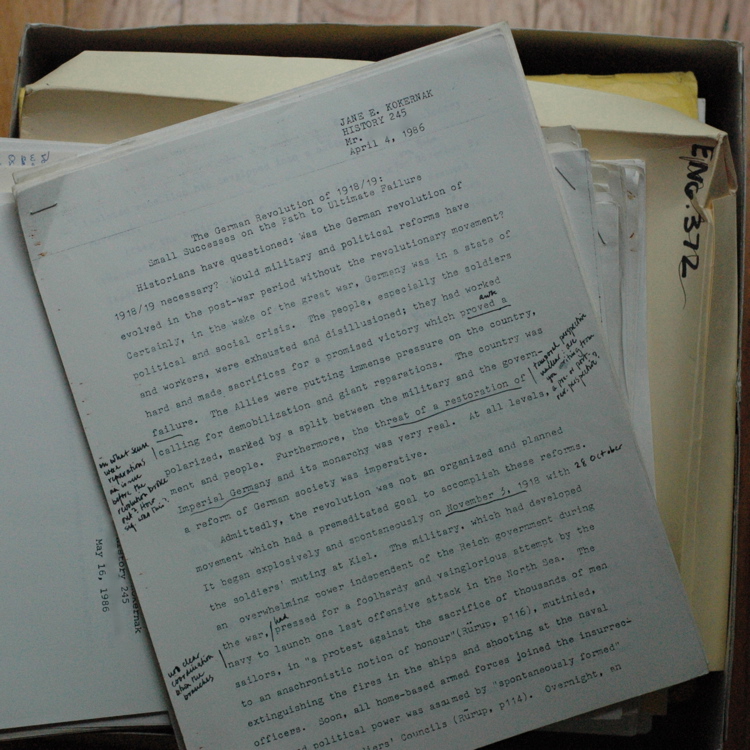 Resolved to finish the draft, I picked it up again a couple of weeks ago. I hit a snag when I felt I had exhausted my memory of that time in college. Searching for something concrete, I opened up my college archives (a green cardboard box) and found three papers I wrote for that professor.
Ah, evidence. It helps. In writing about those papers and his comments, I found my way back into the essay and finished the draft. It’s funny how artifacts function, however. While they are more lasting and stable than memory, our interpretation of them is often — usually — slippery.
Excerpt #3, “Dead and Gone (draft)”:
All that I have left from Mr. K’s class (History 245) are three papers I wrote, typed, handed in, and got back with his handwritten feedback and grade. These are my only concrete artifacts of my time in that course. Who knows, though? Maybe in the College Archives, or in his own papers, there are records of that course from that semester: a syllabus, a grade book, his own notes if he kept them. (All teachers must keep some sort of notes.) But this is all I have and all I’m willing to put my hands on. Continue reading



 leaf stitch word