Weeding and thinking

The crabgrass is an invader. Not only has it staked its claim on various islands of the lawn, it has mingled with the flowers in the front yard too. What we call “weeds” is socially constructed, you know. Crabgrass is simply one kind of grass, equal to others, but we don’t like it, we can’t control it, so we think of it as a weed: undesirable and to be eradicated.

I’ll live with it on the lawn — and it only grows out front, where there’s sun — but I dislike crabgrass among the flowers I planted intentionally.
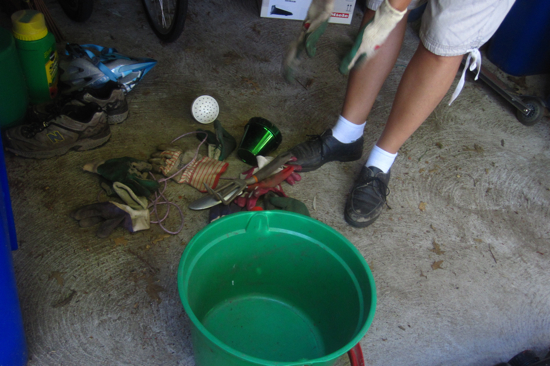

Weeding is good to do early in the day. It focuses the mind and then clears it. Was I procrastinating the semester prep I need to do when I put on my work shoes and gathered the bucket and tools? Yes. If one is putting off something else, though, it is good to at least accomplish another task. Recently I read that the highest-achieving people always do their most difficult work first. Ah, not me. I like a little puttering first, sort of like walking around the block before a run. The warm up, the loosening.

It is satisfying to grab the head of a clump of weeks, pry the dirt a bit from below, and then pull, feeling the roots of the weed pull back and my own gentle force eventually overcome their tenaciousness. Is this similar to the satisfaction dentists, doctors, and even aestheticians feel in their work with the human body? The organism resists; the professional — wilier, and with tools — overcomes. This may also lead to the despair that is sometimes felt in working with the human body, with nature in general: ultimately, its own force or fragility asserts itself and the counter force we apply fails. The river overflows the bank; the freckles proliferate; illness has its way; children grow and become themselves; we age.
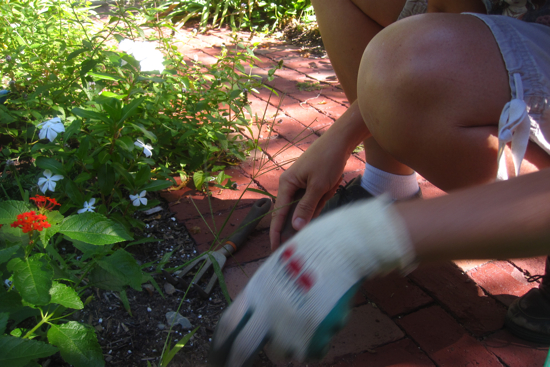

Working with one’s hands — and typing does not feel like work with one’s hands, although hand writing does — focuses the mind on the task. There are a set of small decisions to make as well as continual adjustments. To any passerby, I probably look quite still as I weed, just my hands and fingers busy, but I inch my way down the front walk and my mind, meanwhile, buzzes with thought: about the flowers and which ones to plant again next year, about the fall tasks around the corner, about water and my access to an abundant amount of it, and about the burden and pleasure in owning a piece of the earth.

Eli once said it’s so weird that people can own property, a piece of the planet, and when you stop to think about it, he’s right. Surely, we have to live somewhere, but strange that only Jimmy and I have a claim on these particular 7,000 square feet of dirt in Brookline, Massachusetts. And how far down do our rights go? A foot? Down to the sewer and gas pipes? All the way to the center of the earth? I picture a cutaway view of my house on the earth’s crust and the massive sliver of geological layers on which we rest. And if I do own the sliver all the way to the planet’s core, do I also have responsibility for it?

The parts of life that touch me have this awesome responsibility: if I know about it, or am associated with it, I am implicated in its maintenance or outcome. To not take responsibility (and I don’t, always) is to make an active decision to *not* concern myself, to shut off that part of my brain or body that could act. I won’t help (though I could); I won’t care (though I do); I will leave this to someone else.

I’m not borrowing the rhetoric of the self-help movement to assert my need for “me time” (I hate that expression). Occasionally I have this dialog with myself because I am lazy or tired or even because I lose faith in myself.
Continue reading

Writer’s Dozen: Mary Oliver and Sound

This is the third in a series of posts, called “A Writer’s Dozen,” on texts that have been important to me as a writer.

on the Provincetown shore, 2010

Words have more than meaning.

Words have sound, and how words sound affect the quality of something written.

For example, you could use either the word “moist” or “damp” to describe the armpits of a character’s shirt; the meaning — slightly wet — is about the same. And yet the sound of moist, which causes a pressing together of lips to create the mm, a pursing to form the oy, and then a sinister baring of teeth for the soft and hard st, evokes more disgust than the simple, matter-of-fact damp with its softer consonants.

D and p, in fact, are mutes, and m is a liquid. These are terms for types of consonants, grouped into what Mary Oliver calls “families of sounds” in A Poetry Handbook (Harcourt Brace, 1994).

Sounds of words matter — Oliver compares the nouns stone and rock and the commands “Hush!” and “Please be quiet!” — because, as she writes, “there is, or can be, a correlation between the meaning, connotation, and actual sound of the word.”

I love this book for its clarity, simplicity, and helpfulness. At different times in my life, especially my teens and mid-30s, I have had a great impulse to read and write poetry,  with scant formal training in it, and by that I mean no college or grad school poetry workshops. I did, as an adult, take a few classes in poetry through the Brookline Center for Adult Education, where I learned and wrote a lot. (One doesn’t have to get credits to get educated, I say.)

It was around this time I encountered Oliver’s Poetry Handbook for the first time. Over the years, whether I’ve been writing poetry or not, it has been a helpful reference on sound, meter, rhyme, and line breaks. Even if you are more a poetry reader than writer, this book can help you understand how words and combinations of them can do their work.

On rhythm, she writes:

The reader, as he or she begins to read, quickly enters the rhythmic pattern of a poem. It takes no more than two or three lines for a rhythm, and a feeling of pleasure in that rhythm, to be transferred from the poem to the reader. Rhythm is one of the most powerful of pleasures, and when we feel a pleasurable rhythm we hope it will continue. When it does, it grows sweeter. When it becomes reliable, we are in a kind of body-heaven. Continue reading

Imagine the luck of her future second graders

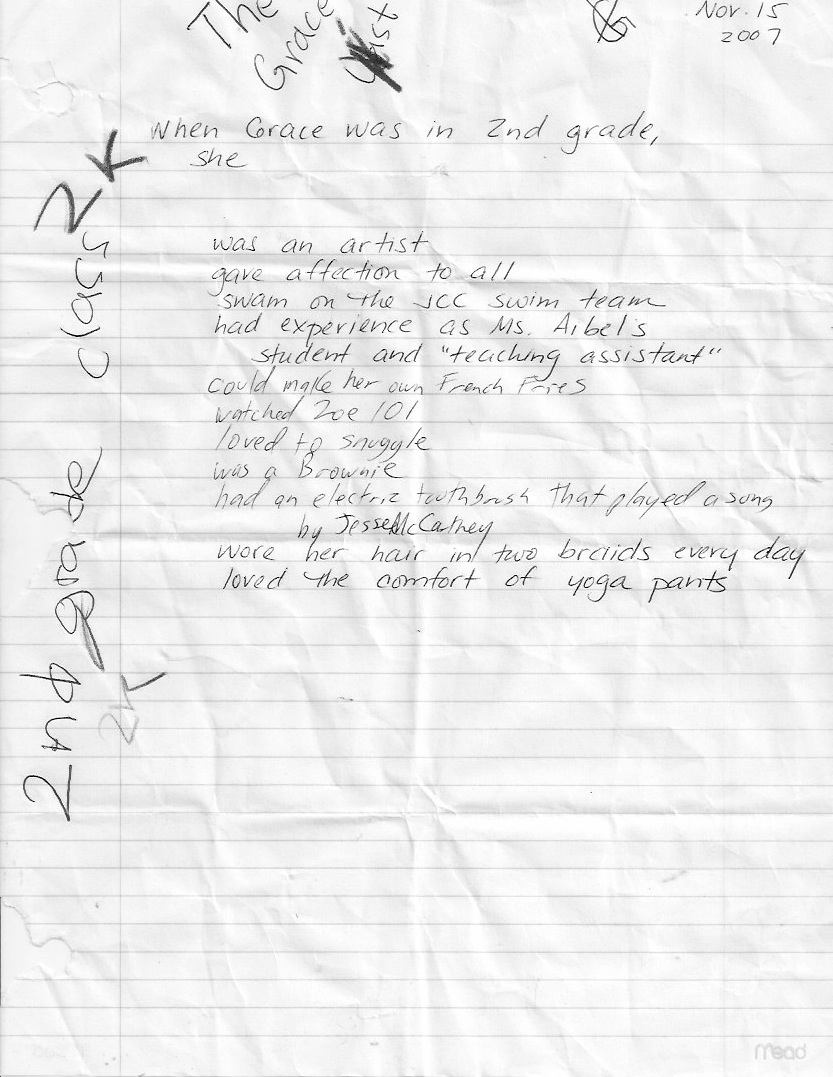
Grace and I have been bitten by the organizing bug, and we are culling our collections. I took four boxes marked “Jane’s Junk” and got them down to one, and Grace has stripped her closet down to the essentials and tackled her desk drawers. Last night she came across a list made five years ago when she was in the second grade. Knowing I like to save the textual artifacts of childhood, Grace handed it to me. You can click on the thumbnail to see the scanned version in full size or read the transcript below.

From the handwriting, it looks like Jimmy and I took turns at dictation. I asked Grace, “What was this list for?”

She replied, “When I was in second grade and thinking about becoming a teacher, I thought it would be neat to be able to tell my second graders some day what I was like when I was their age.”

This is what she was like, as reported on November 15, 2007:

When Grace was in 2nd grade, she

  • was an artist
  • gave affection to all
  • swam on the JCC swim team
  • had experience as Ms. Aibel’s student and “teaching assistant”
  • could make her own French fries
  • watched Zoe 101
  • loved to snuggle
  • was a Brownie
  • had an electric toothbrush that played a song by Jesse McCartney
  • wore her hair in two braids every day
  • loved the comfort of yoga pants

Wouldn’t it be wonderful if Grace, or Eli or Lydia, became a teacher? Then there would be three generations of us: my father, my mother-in-law, I, and one of the kids. Now that would be a family legacy.

States of matter, a dream

In Colson Whitehead’s “Rules for Writers,” number five is “Keep a dream diary.”

Sometimes, if I am awakened by a dream, I turn on the light near the bed and grab a scrap piece of paper — usually one of those blow-in cards from a magazine I’m reading — and a pencil, and I write it down.

Last night I had a dream that my skating teacher and his wife had a baby, and they wanted me to take care of it. So, I took that newborn swimming, and it swam.

The dream is still vivid, especially the baby and the YMCA-like pool.

Ice, water. (What’s next, an evaporation dream?) What does it mean?

Summer chores: pleasure and pain

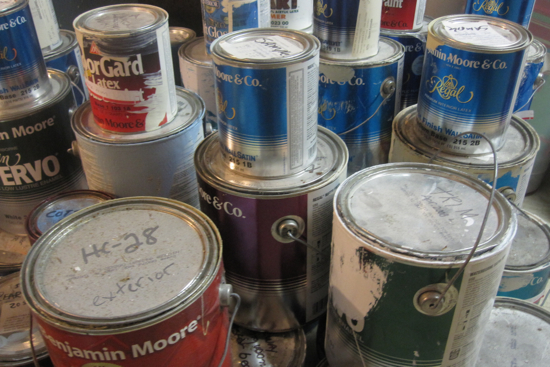
a fraction of my paint can hoard

In his essay, “Good-Bye to Forty-Eighth Street,” E. B. White describes a move from the six-room Manhattan apartment he then shared with his wife. Even in 1957 people accumulated lots of stuff; it’s not just our epoch that is so acquisitive.  Contemplating my own home, which is fairly tidy, I feel about it the same way that White felt about his apartment:

A home is like a reservoir equipped with a check valve: the valve permits influx but prevents outflow. Acquisition goes on night and day — smooth, subtly, imperceptibly. I have no sharp taste for acquiring things, but it is not necessary to desire things in order to acquire them. Goods and chattels seek a man out; they find him even though his guard is up. […] This steady influx is not counterbalanced by any comparable outgo. Under ordinary circumstances, the only stuff that leaves a home is paper trash and garbage; everything else stays on and digs in.

In the passage above where I’ve used a “[…]” as a placeholder for many sentences I’ve omitted, White lists the various things that have made their way into his life without his beckoning or actively acquiring them: books, oddities, gifts, memo books, a chip of wood sent to him by a reader, and “indestructible keepsakes” left behind by someone who has died. Later in the essay he writes about the special problem of trophies. (Note: While my post is not at all about teaching, I think it could be a fruitful assignment in a creative writing class to have students make a long list of items that could fill that “[…]” spot. Perhaps an idea for a poem would emerge.)

White and his wife had only six rooms in this apartment. In our house, we have seven rooms, plus more closets, and an attic and basement. Ah, therein lies the problem. A former grad school professor of mine once said to me, as she and her husband packed up a house to move in with a daughter upon their retirement: “People should not be allowed to know that they have attics and basements.” Continue reading

Same route, different thoughts

I took the same route back to my parked car today as I did last Monday afternoon: through the Common, down Charles Street, and across the Longfellow Bridge back to Kendall Square from Park Street.

This time, I took my own photo.

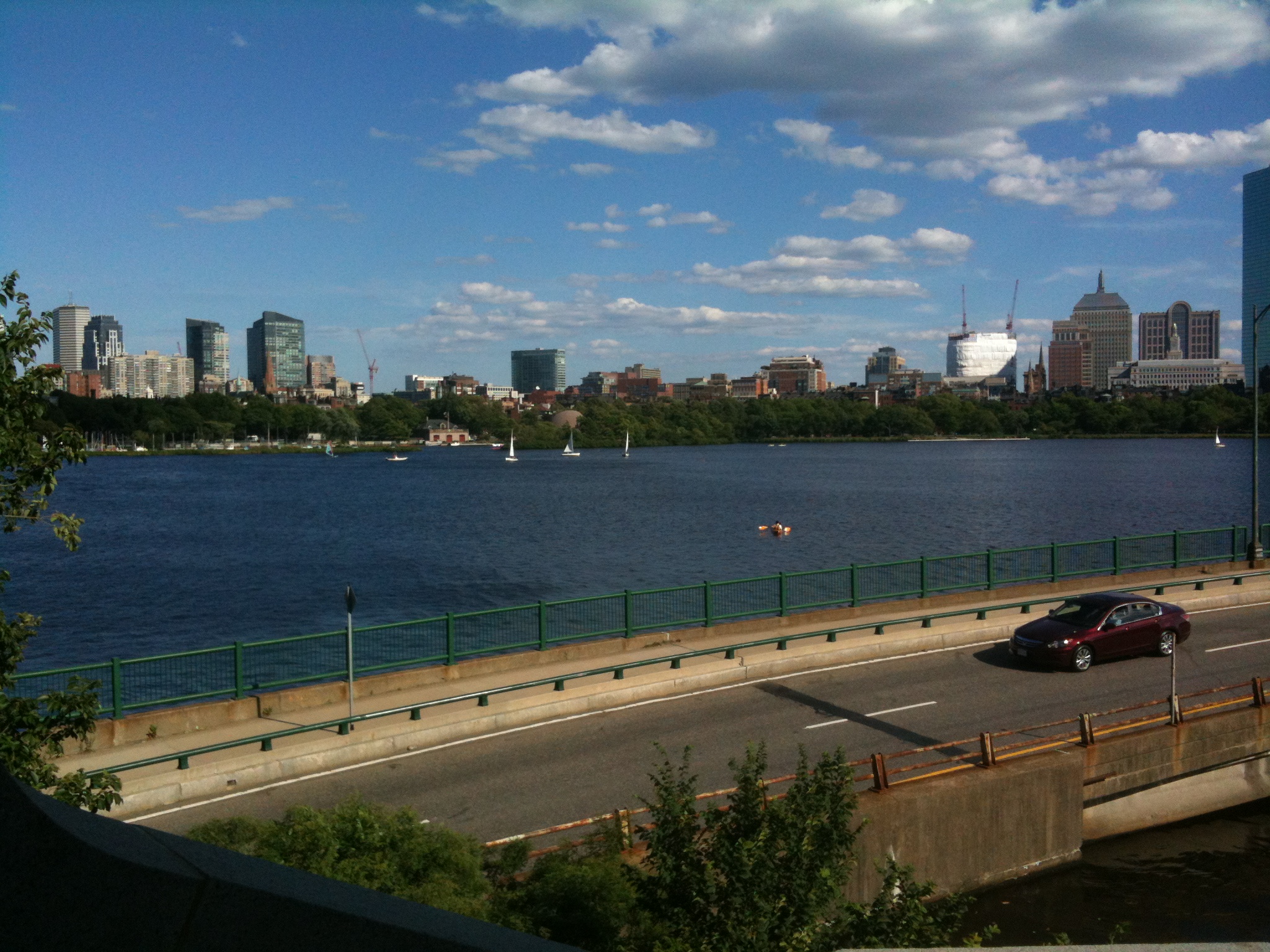
on Longfellow Bridge, nearing Cambridge, today at 4:45pm

I met no strangers on the bridge, but I did walk by many of them. One smiled.

On my walk, I thought for almost the whole time about the power of the words, “I’m sorry.” My shift on the GLAD Legal InfoLine was busy today. Lots of calls. So many of the calls I get have to do with gay marriage or immigration issues. Once in a while there is one that has to do with crime, and the caller as victim of one. Today there were two.

To one fellow, after he had told me a long yet coherent story about being beaten, I said, “I’m so sorry that happened to you. It sounds very upsetting.” Until that moment, his voice had been measured and regular, sort of like the tone of voice a friend would use as you sat together at a coffee shop and discussed an incident that had happened to a third friend.

His voice broke. “It was.” That was all he said. I could hear the loosening inside him. I felt loosened myself, not crying but as though I could.

I got practical again and made some suggestions. He rallied. I’d like to think we both felt as though we were moving forward in solving a problem and that it seemed, for the moment, better.

Writer’s Dozen: William Zinsser and Voice

This is the second in a series of posts, called “A Writer’s Dozen,” on texts that have been important to me as a writer.

In learning to write, there is always some unlearning to do. As writers, we build up our vocabularies and strategies in ways useful to us, but sometimes we get locked into those ways, and our writing becomes disembodied, unnatural, overwrought, show off-y. For writing to be good and worth reading, it has to fit the rhetorical situation and have a voice – a real one that could only come from that writer.

For me, the best definition and treatment of “voice,” as it applies to writing, comes from William Zinsser in his On Writing Well (1976): it is your “commodity as a writer” and conveys your “attitude toward language.” As writer, it is uniquely you.

Last week, some colleagues and I were reading stacks of essays by first-year students, as part of a writing assessment project at another local university. We read in mostly silence, but on our lunch and coffee breaks we would discuss features of student work that we liked or didn’t like. This is the writing teacher’s version of water-cooler gossip.

Uniformly we were irked by students using 50-cent words when plainer ones would do. For example, instead of using “posit” as a verb, which we saw used repeatedly in one essay, we prefer “state” or “argue” when quoting from an article or book or “say” when quoting from an interview.

The fancy word choices enraged one or two of my colleagues. I like a more straightforward style myself, but I understand why students write in what they believe to be a more formal register: to sound smart and to reach the teacher. (For a nice discussion of register, try this: link.)

Entering the academy and the conventions of academic writing is “like learning a new language,” I suggested to my colleagues. “It’s awkward at first, and it takes some mastery of the language before you use it naturally.” Before you get to the point of sounding like a native, there’s a lot of stilted use that doesn’t sound quite right to experienced ears.

I mostly practiced creative writing when I was in high school, and I was considered to be a fluent writer. When I got to college, however, and turned in my first academic paper – over which I had toiled devotedly and seriously – and got an F for a grade, with the comment, “This is not an analytical essay,” I realized I was unprepared for this new country called College and its strange customs. It was a new start and a tough one. Continue reading

Walking and talking

On the short train ride today between the Kendall Square and Park Street stations, so many conversations about our intentions — to be or make something, go somewhere, decide, give up, let go — were on my mind. As I walked up the stairs from the lower platform to the main one, and then up into the mid-day sun, I arrived at this:

Let’s no longer talk of the things we want to do. Let’s do them.

A four-piece brass band was playing at the mouth of Winter Street. The guys were older and paunched, all wearing yellow vests, and they enthusiastically tootled “Under the Sea” from The Little Mermaid. It was wonderfully done. I looked, but there was no cup on the sidewalk collecting change. One song, and they left.

If you want to make music, make it.

art over Winter Street

On Mondays, I usually go to the Starbucks on Winter and get a cup of coffee and the fruit-and-cheese bistro box for lunch before heading up to GLAD. Walking there, I saw a man with a beautiful, muscled body walking up the middle of the street from downtown. Otherwise bare, he wore only tan shorts and flip flops, and as we neared each other I could see that his face had been burned and later treated with skin grafts — it was like melted wax, smoothed and cooled, but the eyes dark and liquid and still piercingly human.

Perhaps this is what you do when your face, your badge, is odd: you flaunt the body. Continue reading

Writer’s Dozen: Natalie Goldberg and Bones

Goldberg, pen, and cake

Permission, sincere belief, and urgency: those are what Natalie Goldberg gives to readers of Writing Down the Bones (Shambhala Publications, Boston: 1986). This post is the first of Writer’s Dozen, a series on 13 texts that have meant a lot to me as a writer.

When I first encountered this book, in the graduate-level Teaching Writing course at Simmons College in the spring of 2003, I wondered why Professor Lowry Pei had assigned it. I cringed reading the first chapter, “Beginner’s Mind, Pen and Paper,” and Goldberg’s hokey advice on choosing a “fast-writing pen because your thoughts are always much faster than your hand” and purchasing “a cheap spiral notebook” over a “fancy” one so that “you feel that you can fill it quickly and afford another.”

Let’s get to the point, I thought. The pen-and-paper suggestion seemed to be a detour and right at the beginning of the book when I was eager to get started. Clearly, this was for adults, and did they really need guidance in finding these most basic tools? If they do, they’re not going to get too far as writers. The snob in me was having her say in my internal dialogue.

Other chapters describe the timed “egoless” freewrite, writing as daily practice, distance of time, and some more fruitful topics. My position on Goldberg’s method started to soften, though, only when I read her command that we shouldn’t “identify too strongly with [our] work.” Words, when writing them, are “a great moment going through” the writer. Not being a Buddhist, as she is, I didn’t quite understand what she was getting at, but I found it a relief to think that I could write deeply and then move on to deeply writing something else, having left the old thing behind, done.

My initial resistance to Writing Down the Bones and the spiritual dimension to Goldberg’s approach had to do with my age (38), agnosticism, and experience writing and getting writing (for work and school) done. I didn’t think I necessarily needed anyone to tell me to write, write lots, write regularly. At first, I wondered if this book was intended purely for the beginner or the unsure, which I believed myself to be not at all.

But I quickly liked and was intrigued by the ideas of this writing professor, Lowry Pei, who has since become mentor, colleague, and friend, and I thought I’d go along with it and see how Goldberg fit into Pei’s approach. I was still keeping my emotional distance from Bones, not sure it applied to me. Continue reading