When the billboard of romantic fantasy falls to pieces

Here’s my essay, “Dead and Gone,” about an affair I did not have with my Wellesley College history professor: link. Although the central anecdote is about a college moment, the idea that underpins the essay is the cost of cautiousness.

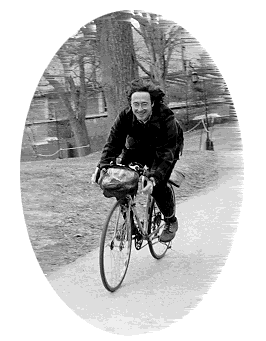
To the left is the photograph of him that was printed with his 1999 obituary. To libel the dead is, I understand, impossible. Still, I have not revealed his name. (Google, you can’t find him here.)

Note: A few of you may have read an earlier version of this. Alas, this new version has been rejected by three journals, and so I have published it, for good.

Once, this girl could do anything

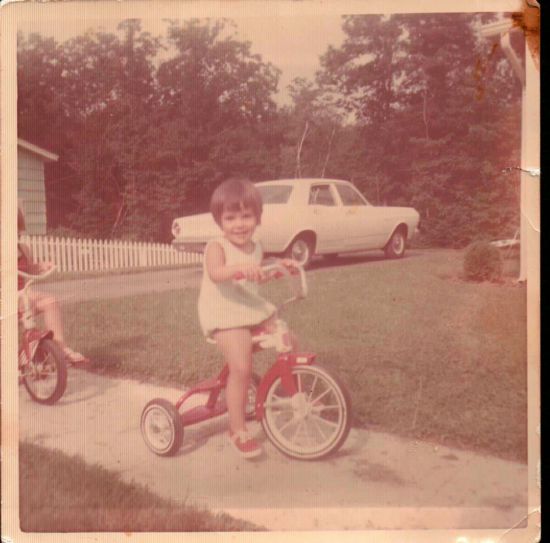
My brother Michael has appointed himself the family archivist. He has been scanning old snapshots, giving them titles, and posting them on Facebook. I look at the images of myself, siblings, and parents from the 60s and 70s with wonder, and a pang.

My impulse is to say, “This is everything we were before [fill in the blank] happened.”

As I first stared at this image of me on my tricycle, I actually felt myself to be on the tricycle. I looked down at my chubby legs; I felt my rump on the curved seat. I remembered the time I rode the bike without sneakers and imagined that I felt my own innocent curiosity: I am going to do this because my mother said not to. My toes got stuck in one of the pedals, and my mother had to call Mr. Galaski from two houses away, because my father wasn’t home, to bring his tools to undo the pedal and get me out.

I stared at the image, too, from the perspective of today and had a feeling of looking at a picture of my own baby. The equation is as simple as this: I = my own baby. I even wanted to nibble on myself in the picture, as I wanted to nibble on my own children when they were infants and delicious.

I teared up, too. “This is everything I was before [fill in the blank] happened.”

Bountiful possibility. An almost-blank slate. Continue reading

What I’ll do for a story

Lydia stood at the top of the steps and yelled down. “Mom, Brian just texted me and asked if we could take care of his cat this weekend.”

I yelled back, “Sure.”

A few seconds passed.

Lydia continued, “He wants to know if you’ll give him his injections.”

“Only if I can write about it,” I replied.

A few more seconds passed.

Lydia: “Of course.”

So I did. Link.

Flimsy, flimsy ego

rubber band heart, found by Grace on table, June 9

The ego can only bear so much.

On Sunday — skates tied, blood sugar checked (low), juice box drunk, and gloves on — I stood for a few minutes at the entrance to the Babson ice and watched the activity. There were about 8 young girls in shorts, heavy tights, cute sweatshirts, and lush ponytails jumping and turning and skating backwards with precision and verve. There were an equal number of adults in black track pants and black parkas standing near the boards, studying the girls. Occasionally, a girl would skate over to one of the adults and listen to instructions. Sometimes, the adult would demonstrate, beautifully, what s/he wanted the girl to do. The girl would do it.

And there was me. I stood there for a couple of minutes, hesitating. I had already paid my $30 to get on the ice for freestyle/practice time, and I had an appointment with Fred, who was already out there with a young girl, about halfway through the 80 minutes. I had arrived intending to practice. I stood there, losing my nerve.

As I told my friend Rosemary last week, as we stood in front of the shelf marked “Buddhism” in the Trident, my internal dialogue, for better or worse, is turned up pretty high. (I’ve heard this called “mind chatter.”) Sunday, as I stood at the gate to the Babson ice, I thought, “Why am I doing this? Nothing can come from it.”

“But I am doing this,” myself said to myself. I began.

As I skated, I was overcome with intense self-consciousness, and not of the good kind. I imagined myself getting in the other skaters’ way — the real skaters — and so I tried to stay out of their way. I imagined that one coach, a woman about my age, was giving me the hairy eyeball, as if to intimidate me off the ice.

I practiced the easy things, not wanting to make a mistake among the masters. I scolded myself. I propped up my ego by remembering something Grace once said when I was skating with her and confessed to doubts about my ambition. “Mom!” she said. “At least you’re out there and not sitting on the bleachers!” I practiced harder things.

I imagined again that hairy eyeball turned in my direction. I mentally constructed some believable excuses and apologies I would give to Fred when my appointment with him began.

Get a hold of yourself, Jane. Think other thoughts. Continue reading

Meander: to move aimlessly

I worked at home today, and I really did. All morning the window in the kitchen, where my papers were spread out, was open, and I could hear the early grackles outside and the neighbor’s mower and little grandson. By mid-day, all of them seemed to be calling, Come out, come out, come out!

I put some money, keys, juice, phone, and, of course, my glucometer in an old backpack from my mother and sneakers on my feet, and I went. No exercise agenda, no time limit.

At the corner of Bellingham and Grove, I saw the iron cover for a town water or sewer pipe (it looks like a test tube stopper, about 8″ diameter) still popped off the pipe. It’s been like that for three weeks, and I have been thinking that one of the Bellingham people would notice and call. It seemed no one has. So I stood on the corner, searched for the Brookline DPW on my phone, and I called them. “We’ll report it,” said the lady who answered.

Past the cemetery entrance. I saw a Mercedes drive in and some town workers clustered around a dump truck. The cemetery is one of the nicest kept public spaces in our town.

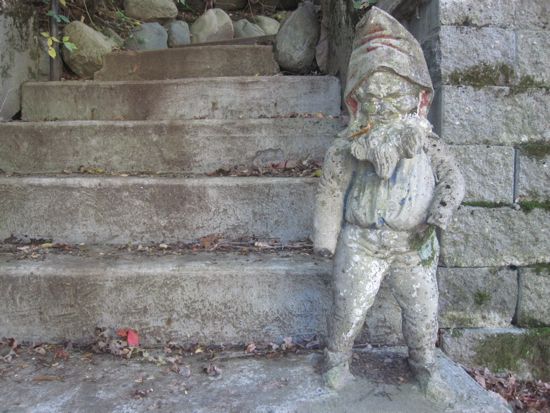
Down Allandale, with the road quiet enough that I could hear my feet on the sidewalk and birds in the trees. I looked at the site where they are building three new houses where there used to be one old pink one. Next door, there is still an old house with newer garden steps and an old weathered garden elf whose feet are caught in concrete.

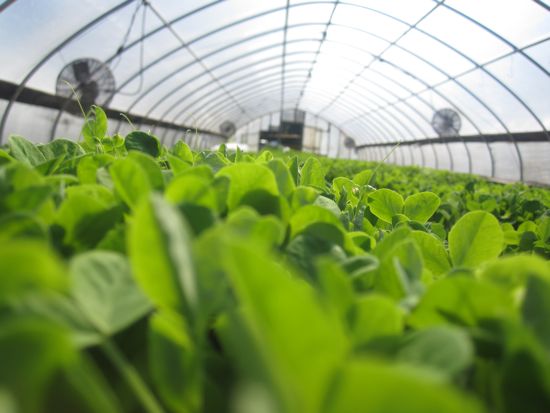
At the farm, I went in all the greenhouses, empty of annuals. One was filled with bamboo plants and another with trays of clover.
There were sparrows enjoying dust baths on the ground around a tractor. Some sparrows were even wriggling in the sand caught in the tractor’s big wheel treads. One sparrow wriggled in a puddle and didn’t fly away, like the others, when I walked closer.

Everywhere, boxes of gourds. In the shed behind the main store, where they dole out the weekly farm shares, there was a table laden with vases filled with sunflowers. A young woman, busty and with red-gold hair dressed in a black short-sleeve tee and knee-length black shorts, danced behind the table, in the style of Natalie Merchant, and showed off, I gathered, for the guys who work with her on the farm.
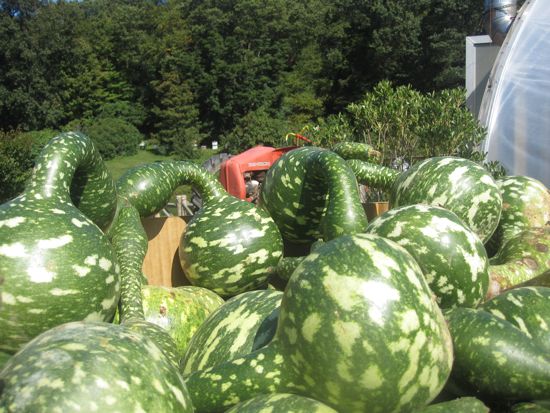
I wanted to take her picture, but I’m not a photographer and don’t know how to intrude like that. Later, I regretted not asking her. Inside the store, there were — amazingly — fresh strawberries and blueberries for sale. From Quebec, $8 each. The picture will have to do; the price was too dear.
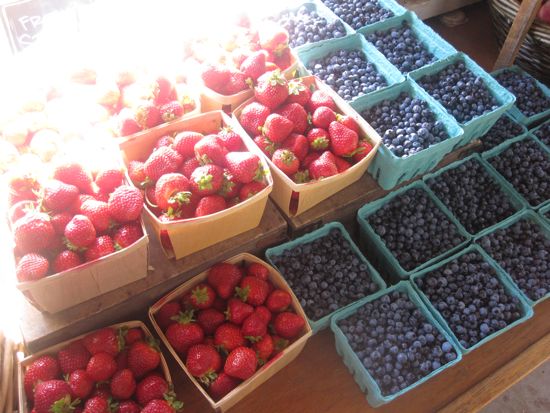
Through the neighborhood and down to the West Roxbury Parkway and then the VFW Parkway. So many chipmunks, not afraid of cars whizzing by but afraid of me walking.

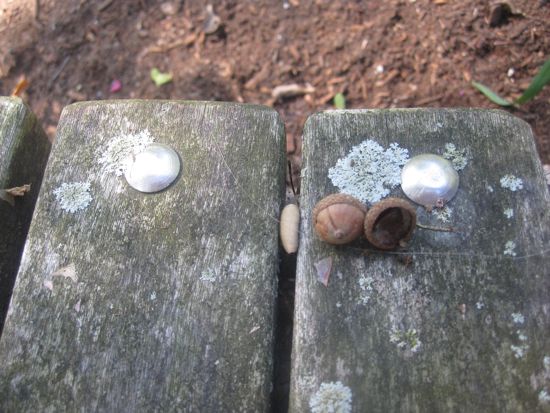
On a bench, I sat to eat the nuts I bought at Allandale and drink water. White spray-painted graffiti, one word: WRECK. On the edge of the bench, acorns, lichen, and a baby pinecone. Across the parkway, women with babies at the park, men playing basketball.
At CVS, a birthday card for Eli. On the sidewalk outside Bertucci’s, a woman with a face lift and in a denim jacket too young for her. This thought: your hands are still old.

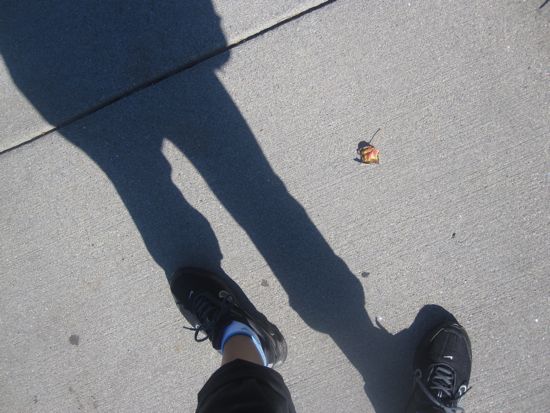
Back up Independence. A leaf on the sidewalk like tiger stripes painted on. Just one leaf. Me, like a giant. The ruler of the sidewalk world.
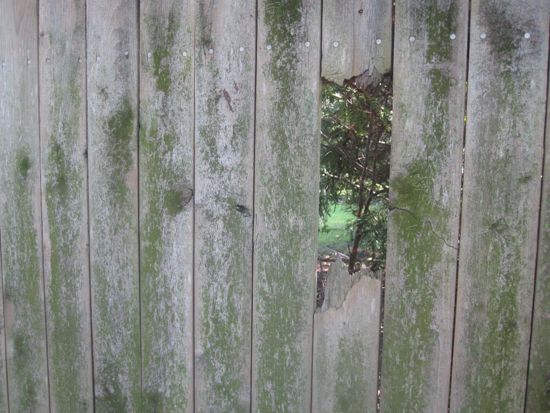
A block later, a hole in a neighbor’s fence. Ah, a secret garden! I hoped. I looked in: only driveway and car. Disappointment.
As I walked, it seemed to me that everything in the world may be happening when I’m at work and not noticing. That birds wriggle in sand and pumpkins warm in the sun and the dwarf keeps guard and farm girls dance and houses get built and cemeteries are maintained — this is the action.

And usually I miss it.
How to cheat on college reading

I stood at the reserves desk in the library where I could check out the assigned reading. This was in the fall of 1985; I was a junior in college; and this was before the age when text could be digitized and placed on the web. When professors assigned readings, students had to buy or borrow a physical copy of the text to read it.

Kathleen M., a senior who was passing through, saw me and walked over. She was funny, and I liked her. “What are you doing?” she asked me.

“Obviously, I am getting ready to do my reserve reading.”

“No one does the reserve reading,” she remarked. She smiled.

“What?” Wait a minute, I was thinking. She’s a brilliant student. (Kathleen went on to a top-tier law school.) Don’t all good students do all the reading? I did all the reading. It was killing me.

“Only read what you need to, is what I mean,” she said.

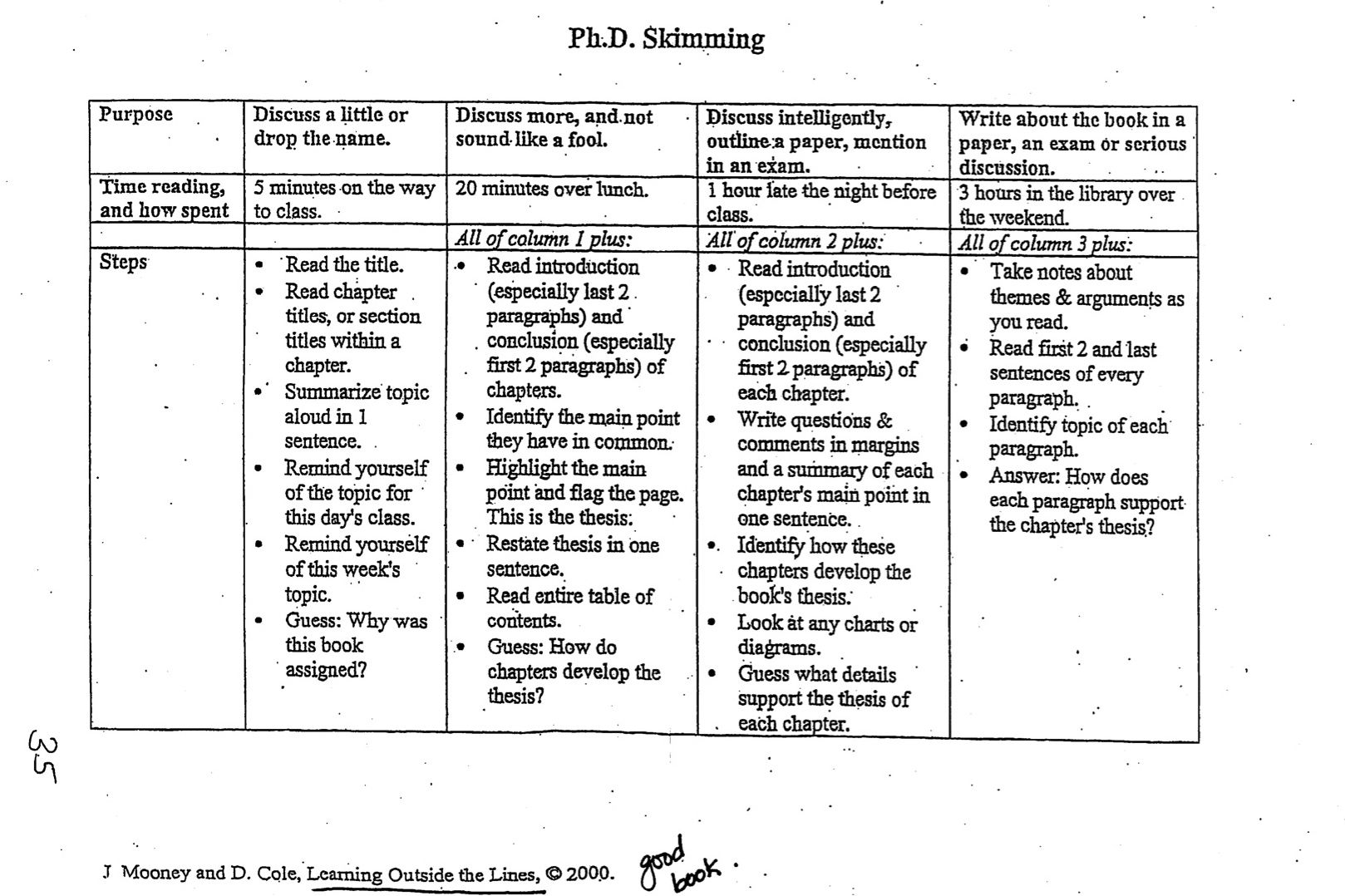
To me, reading meant starting at the cover, turning to the first page, reading the first word, and reading every word until I got to the last page — all the while taking notes — and doing this for every item on the professor’s list. Kathleen explained that I should look at the syllabus, see what was coming up next in class or exams or papers, and skim what seemed most relevant to what the professor was covering. “You can kinda tell from the syllabus,” she added.

The librarian returned, and I took the folders full of photocopied book chapters back to my table. I got out the syllabus and looked at lecture topics and exam and paper descriptions. Indeed, it was all right there, a set of clues as to what to read (and what to skim or even skip) embedded in the class schedule.

I didn’t read all the assigned reading word-for-word, that night or ever again. I figured out how to read what I needed to. This was a paradigm shift for someone who (a) loved (and still loves) to read and (b) took some pride in her academic duties.

Interestingly, I became a better student at that moment because it prompted me to start managing my work, as opposed to simply doing it, and I also believe I learned more. I also started talking more in class, which helped me learn more and become more visible.


What would my professors have thought, if they knew I was suddenly reading less and sometimes skipping reading assignments altogether? As a college teacher now, I know that my colleagues and I put together our syllabi with great care and think and talk about what readings are fundamental to the course. When I taught at Simmons College, I recall one long lunch date with a political science prof during which she spoke agonizingly about her students’ failure to do the reading. “You’re a writing teacher. You must have them read stuff,” she said. “How do I get my students to read?” Continue reading

A feedback lexicon

Leave it to others to run marathons.

I, instead, participate in another endurance sport: the writing of miles and miles of comments on student writing.

In the past two weeks, in addition to having to submit the final report (with data) on a grant project I collaborated on, I wrote substantial comments on 40 essays and 28 research posters for two summer projects. There was so much to do in a short period of time that last Sunday morning I was sitting at my laptop at my dining room table at 7 a.m. to begin a day’s work.

My comments are typed, so I have a record of them, and for each project I copied and pasted them into one file to look at them for good language for future comments: Did I come up with a tactful yet straightforward way of saying, for example, “This has no evidence”?

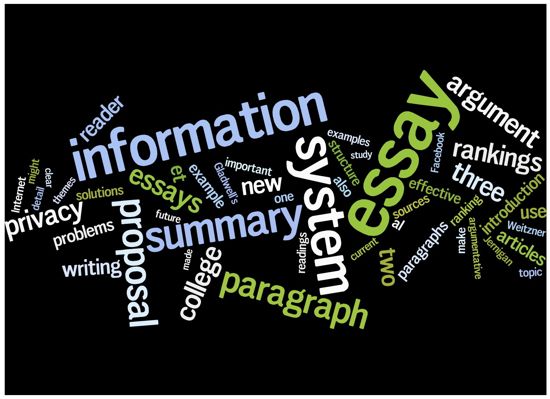
Although I continuously referred to the rubric, I had no way of knowing, however, if there was any consistency to my comments as I was doing them. So I turned to Wordle to see if there were any patterns, and I hoped that what Wordle revealed in its illustration of my feedback lexicon would have some relationship to my intentions. Before I created the word map, therefore, I wrote down a list of terms I thought/hoped I used more frequently.

You can see the Wordle of my top 50 words as the illustration at the top.  Most of the words have to do with writing features or issues (e.g., paragraphs), although some of them have to do with the topics students were assigned to write on (one topic was information privacy and the other the college rankings system). I’m relieved to see that there is some relationship between my key words and what I recall of the rubric.

And there is also some relationship between the words I recall using most and the words I used most. Here’s the list of terms I wrote down before doing the Wordle, with some comments on their appearance in the graphic:

  • information (appears first on my list and is prominent in the graphic)
  • readings/sources (“articles,” “readings,” and “sources” appear in the graphic)
  • summary (strong in the graphic, too)
  • propose/proposal (ditto)
  • illustrate (not in the graphic, although “example” is)
  • some/more (not in the graphic)
  • understanding (not in the graphic)
  • synthesis (not in the graphic)
  • detail (in the graphic, quite small)
  • citation (not in the graphic)

So, one disappointment in my comments is that the word “synthesis” does not appear in the graphic of my top 50 words. One of the requirements of the summary prompt was that use of sources be synthesized. Ideally, I would have commented on whether or not a student did that in each essay. Perhaps I used synonyms (e.g., integrate or weave), but I may have missed a chance to emphasize this important terminology, which should become familiar to a college writer early on. Same for the word “citation” — I wish that it, or acknowledge or attribute or cite, appeared on the list of top 50. (It’s possible that source/readings/articles/use in some combination are how I addressed this in the comments, though, and all four of those appear in the graphic.)

And yet I do see some terms on the graphic that are really important in academic writing: argument, paragraph, structure, examples, reader, problems, topic, and even essay.

I did this as a reflective exercise. In future comment writing, I might try this midstream as a kind of quality control: am I hitting all the notes I want to hit? what could be dropped (my use of the tentative “might”)? what could be more emphasized (the word “idea”)?

Skating story, told and retold

This week, for the first time in a year, I saw my friend Lisette, who is like me a teacher and unlike me a former college athlete. Around the time I started teaching college writing (eight years ago), she said to me, “It’s good to do one new thing every semester that gets you out of your comfort zone.” This was an idea she had picked up, I think, from her college volleyball coach.

On Tuesday afternoon at the playground, I told Lisette and her oldest son Griffin about a little skating accident I had recently, and how the coach made me get back on the ice as soon as I could stand again.

It’s good to have friends and coaches that prod you to take risks, especially when you are not naturally inclined to some kinds of them.

And, of course, I had to write about my fall. Find the story, published here.