Wrecked by belief: the true story of a verdict

I have read some reporting and commentary on the Casey Anthony trial, especially in the last few days. Something went wrong there, and I too believe that the little girl died by neglect, maltreatment, or malicious intent. The mother is surely guilty of some serious, serious wrong. Although the stories constructed by the prosecution and the defense seem flimsy, still my sense of how humans behave tells me that the mother harmed her daughter enough that she died, and then with her family’s help she obliterated the physical evidence.

And yet I am not appalled or surprised by the jury’s verdict of “not guilty.” The prosecution’s case was built on circumstantial evidence. The job of a jury is to judge the facts of the case as they have been presented. Were there enough facts?

In 1998, I served as a juror on a criminal trial in Massachusetts. A teenage girl had accused her stepfather of sexually assaulting her, and the Commonwealth of Massachusetts prosecuted him for the charges. Along with my fellow jurors, we found the girl, whose first name was also Jane, to be a totally credible witness, and we believed that she had been harmed by Dennis, her stepfather, and also by her mother, Wendy, who took the stand in support of her husband and undermined her daughter’s testimony.

The case built by the Commonwealth, however, became an exercise in He Said/She Said. The Quincy Police had gathered no physical evidence, no material witness.

In 2003, five years after the trial, I wrote a short account of my experience for a graduate school class on pedagogy at Simmons College. Each of us had to write in response to a prompt that one of our classmates had designed as something s/he  would assign to high school or college students in a writing class. The prompt I addressed asked me to reflect on Robert Frost’s poem, “The Road Not Taken,” and describe an experience in my life in which I had had to make a difficult choice. I didn’t pretend to be a high school writer; I wrote the essay [read it here] from my age and experience. Continue reading
Deep reading, restored


I feared I had lost my attention span as a reader.

Over the winter, with so many work and family responsibilities, I maintained my daily commitment to reading (Jimmy calls it the “Jane Ten” — the 10 minutes I must read every night, no matter what, before I turn in — of which I’ve never missed a day) but only in fragments.

Here and there I read reviews in the New Yorker, articles in the New York Times or Onion online, magazine headlines at the grocery store check out, an essay or two from an anthology, and attachments sent my way by friends and colleagues: “Check this out.” I checked.

I wasn’t really reading, though. I was surfing the printed word. For me, real reading is a sustained, complete experience.

Honestly, I thought I had changed with the times. We multi-task. We browse. We lose interest. In April, I was worried it was over between me and books. They’re long! I don’t have the time! That was the inner dialogue of the new (fragmented, distracted) me.

The semester ended. Finally there was time to walk down the street to the branch library and wander its aisles and read jacket covers and first pages. I found the recent and umpteenth volume in my favorite series, the Inspector Banks mysteries by Peter Robinson. It was my transition back into whole books.

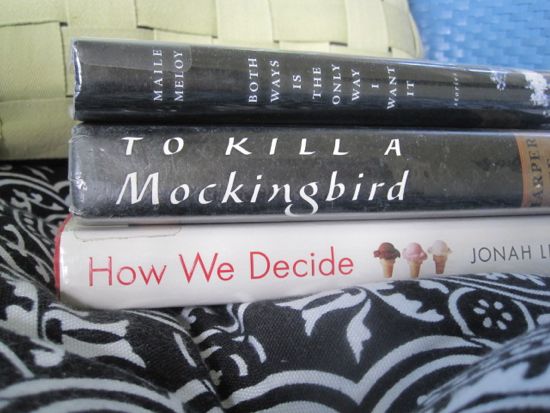
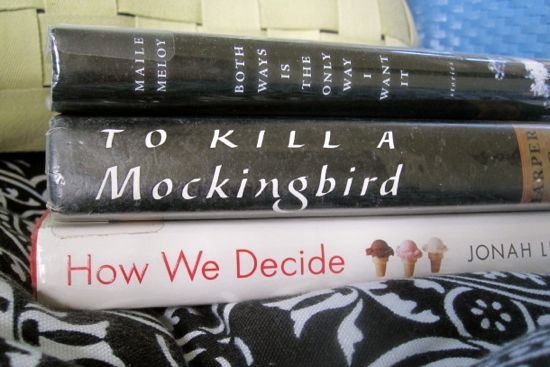
And the next three, one after the other, were Both Ways Is the Only Way I Want It (stories), by Maile Meloy; To Kill A Mockingbird, by Harper Lee (because I had never read it); and How We Decide, by Jonah Lehrer. Yes, yes, and yes.

I’m relieved that I am still a reader. That I wasn’t much of a reader (of longer works) during the academic year, however, tells me that having too much to do, in too many fragments, is an obstacle to sustained inquiry.

What other kinds of experience do our chopped-up days get in the way of?

Ready or not for my close-up

A good thing about living in a household with artistic people is that there is always someone around to sing a song, pick up the guitar, give technical assistance with Photoshop or Audacity, draw a picture or diagram, edit a draft.

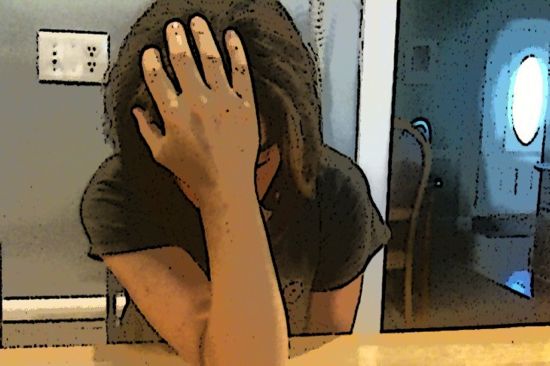
This morning, before she headed to camp, I asked Grace to take a photograph of me for a post I was writing for my blog on A Sweet Life. I gave her a few suggestions: I wanted a close-up of me; fatigue or frustration would be the emotional message; and I didn’t want my facial expression to convey the message — it had to be posture or color or something else.

We sat in the kitchen at the table, she across from me. She stage-directed me. “Use two hands.” Then, “Try one hand.” Or, “Too much hair.” She’d look at the camera display screen. “Smile a little so your face is smoother, but not so much that you’re smiling.” “One more time, and sit forward.”

She picked one. Wow, it looked so stark and real. I could see a ligament in my neck where it meets the collarbone and the nasolabial fold that improves when I’m smiling. But I wasn’t smiling. Did I really want to look this plain? Couldn’t I get this junior artist to put a visual spin on it?

“Could we try Toon Camera?” I asked. Continue reading

A hard and bitter seed

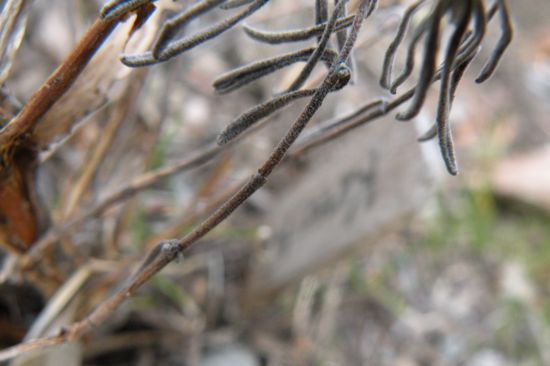
heather, brought down by winter

The first few fragments here have been knocking at the door of my attention. So I wrote them down, and then I followed one sentence with the next, the next, the next, and so on. At some point it became what we call free writing, and it ended where it did.

I hate writing.
I hate skating.
Yard work.
Teaching.
Parenting sometimes, and reading.
All of these things I supposedly love: I hate them.

That’s how I feel on the verge of doing them.

A couple of weeks ago and with enthusiasm I bought some supplies for my yard clean up. I took the afternoon off. The next day I went out there and faced what I intended to do. Tear out two old bushes and bundle them up for the town’s compost pickup. Dig up the weed patch and lay down rolled sod, heavy and awkward.  Move an azalea, in too much sun, to a shady spot, and an American cranberry bush from shade to sun.

I sat in a dirty plastic lawn chair for a while and thought how it didn’t matter, how fruitless my effort would be. Who cares, really, who will ever notice, if the azalea gets more comfort in the shade and the cranberry more berries in light? Okay, I will notice. But I won’t always live here. Some future owner will look at my non-artistic, non-modernist attempts at gardening, rip them out, and install beautifully identical boxwoods with space in between. And the old screened porch (with original and much-repaired screens), buttressed by the elderly hydrangea, will get torn down to make room for a family room. And the ferns and hostas might seem like garbage plants to a fancier owner and end up in a brown paper bag on the curb.

Still, it’s possible to begin even with a fog of pragmatic despair hanging over me, so I did.

I feel this way, too, the more and more I skate. I must be improving, right? I can look back on five years ago, and even five months ago, and say to myself, “I can do this now. I can do that.” An hour before I gather my things and car keys to leave the house for the rink, though, I say to myself, “There is no forseeable outcome to this: no contest, no show, probably no mastery.”

But then I go, because it’s on my calendar and I promised myself that I would.

And I smell the dirt, or I smell the ice, and the shovel makes a sandy, muffled sound as it connects and the hockey player over there digs in until the ice groans its particular protest which is so satisfying to the human ear, and I feel as though maybe I can begin. (Beginning is a kind of restarting.)

At first I am hating it still, but I am also giving it a chance. I say, “Jane, try ten minutes, or thirty. If nothing happens, you can stop.” I am without grace, as though I really am a beginner, yet of course I lack the utter, naive enthusiasm of the absolute beginner. I am between beginner and master, that no man’s land. Continue reading

Second chance for the rejected

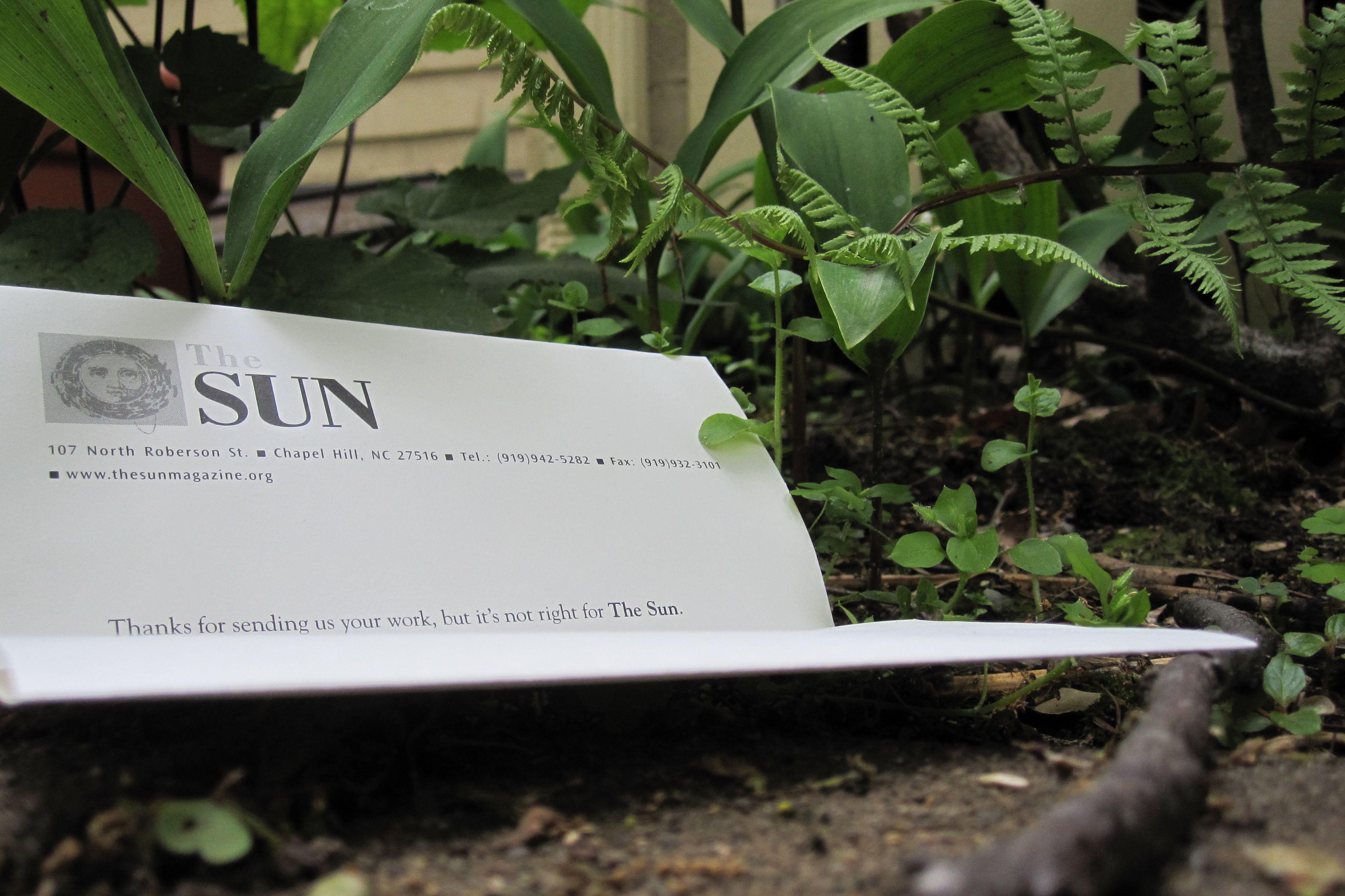
On the floor in the cellar, I found an encouraging rejection — part form letter, part handwritten note — I had gotten from an editor at The Sun and then set aside for safekeeping. The letter must have slipped out of one of those cardboard boxes I’ve marked JANE – STUFF and put on a shelf, intending to sort its contents (some day).

So, the rejection stuck in my mind for a day and prompted me to think about all the good writing out there that never finds its place among readers. A lot of writing no doubt gets turned away because it’s not good. Some writing, the kind I’m interested in here, may get turned away because it’s not a so-called good fit for the publication.

These literary misfits need a place, like the Island of Misfit Toys where cool playthings hung out and waited for the day when Santa would take them to the right child. There are cool poems, stories, and memoir that didn’t make it into one of many (low paying, highly competitive, and prestigious) literary journals.

Good yet misfitting submissions need their own Santa Claus. I have an idea for a journal, called Displacement (for the condition of having been displaced, and also the psychological defense mechanism in which emotions or desires are shifted from some original object to another one), that could be it. Continue reading

Relics

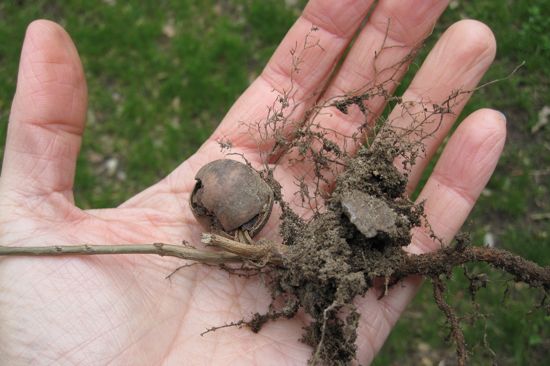
oak seedling and acorn relic

This fact once had a hold on me: that a baby girl is born with about 1 million ova. When my daughters were infants, I would stare at them, trying to grasp the reality that future grandchildren, if I were to have them, had gotten their start as cells inside my body. And the baby that I was diapering, was watching play with her toes, was soothing to sleep had a package of potential life inside her.

Contemplating this, I had a feeling not unlike the one you have when you stand in front of a mirror holding another mirror, and hold it in such a way that you see yourself reflected on and on and on and on.

Even as the babies grew into children — the daughters and the son — and their once physical connection to me was lost, I held on to the idea that cells that had originated inside me remained inside them like traces, souvenirs, relics. At the same time I felt perversely proud of my body (for doing what it does sort of automatically), these immigrant cells felt like losses to me, too, as though they took something from me.

My contrary feelings and ideas about my old cells residing in my children were so pressing that I of course had to write a poem about them. An early version (not the first draft) looked like this:

Relic

       for a daughter

Cheeks full. Lips
dripping pearl. You
have sucked

me soft.
What I had—
sinew leaping
blood replenishing
bones toughening—
spent.  Clean shell
I cultivate urge:

grow, colony, grow!
Multiply and billow
like yeast yet keep
my relic.

Moored boat,
patient seed, egg
inside me inside she
(my harbor, my flower),

remain, and divide.

Later, perhaps years, I dug the poem out and revised and revised it. I was going through a period of loving the cooler voices of poets like Mark Strand and Louise Glück, and I was a little embarrassed by my exclamation and stacked images. Continue reading

Student success, my reward

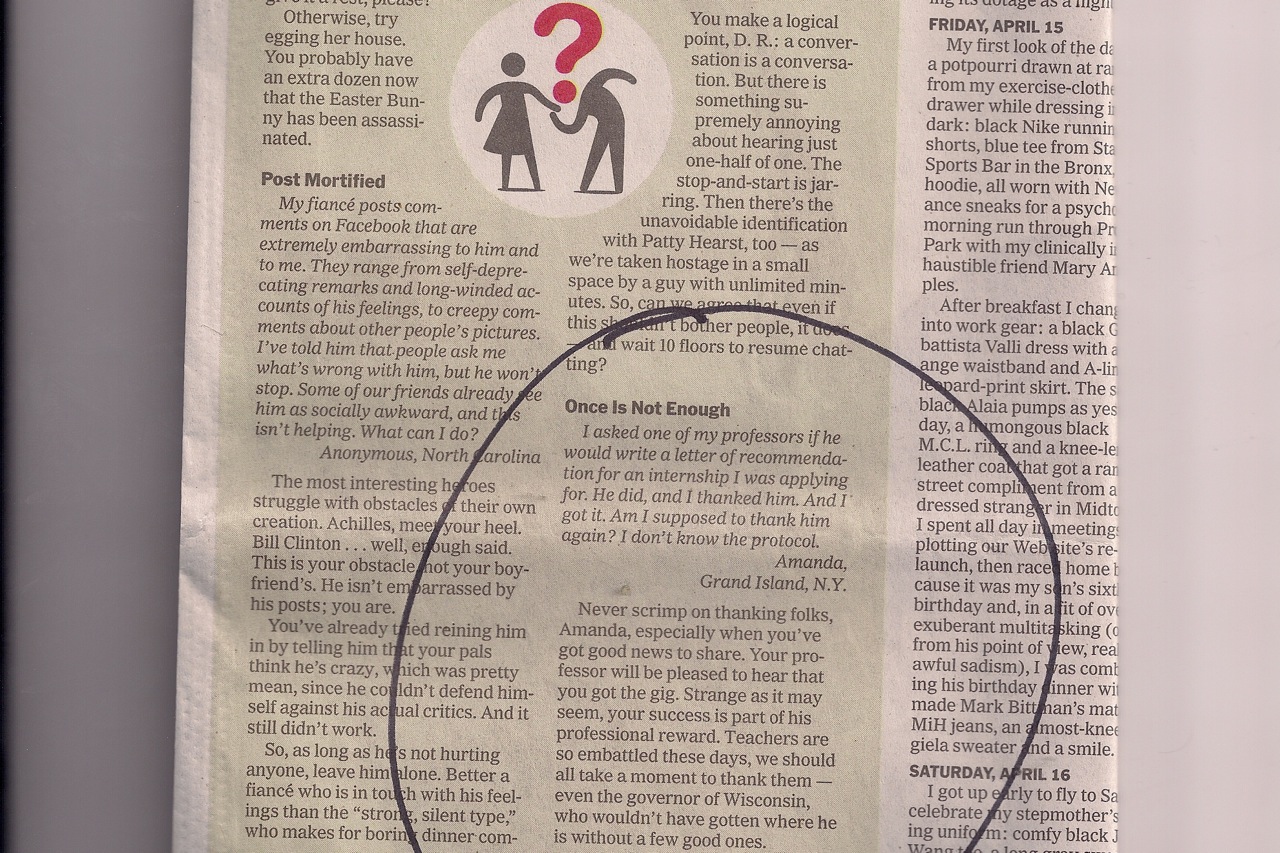
Social Q's column, NYT, 4.24.2011

This weekend Eli and I will finally do some baking and thank-you-note writing for the high school teachers who wrote him the recommendation letters that helped him apply and get accepted to colleges. The baking (chocolate beet cupcakes?) is a way to recognize their labor with ours. In his notes, Eli can let them know he has decided to attend UVM out of the various schools he was accepted to.

Perhaps it’s that time of year, but I’ve been wondering about the outcome of some recommendation letters I wrote for students over the winter for internships, etc. or the personal statements I helped them revise last summer and fall for grad school applications.

On Sunday, the Social Q’s column in the New York Times published a query by a college student confused about the protocol of thanking her professor for a letter he wrote. (See photo of clipping above.) Must she thank him a second time, after learning that she got the internship? Philip Galanes, the etiquette expert, replied, “Your professor will be pleased to hear that you got the gig… [because] your success is part of his professional reward.”

Dear Students, it’s true. We teachers are invested in your futures, just as physicians are invested in their patients’ health, and parents in their children’s well being and independence. It’s not that we are so self-effacing that we have no lives of our own — of course we have lives — but you’re like our garden. And because the processes of growth, despite all our knowledge of them, still seem so magical and the signs often imperceptible (children, like plants, seem to grow and develop overnight in the dark), it really is thrilling to see evidence that you are flourishing.

Yesterday, after a delay of almost a year, I got an email from a student who told me the outcome of his MD/PhD program applications. Together we had worked on his personal statement, he writing and I responding. He told me he has been accepted to a desirable program. Having worked with him on that personal statement, I know what this means to him.

What it means to me? I have an ego, too: In the collective work of educating young people, my individual contribution matters.

Snarky little bits

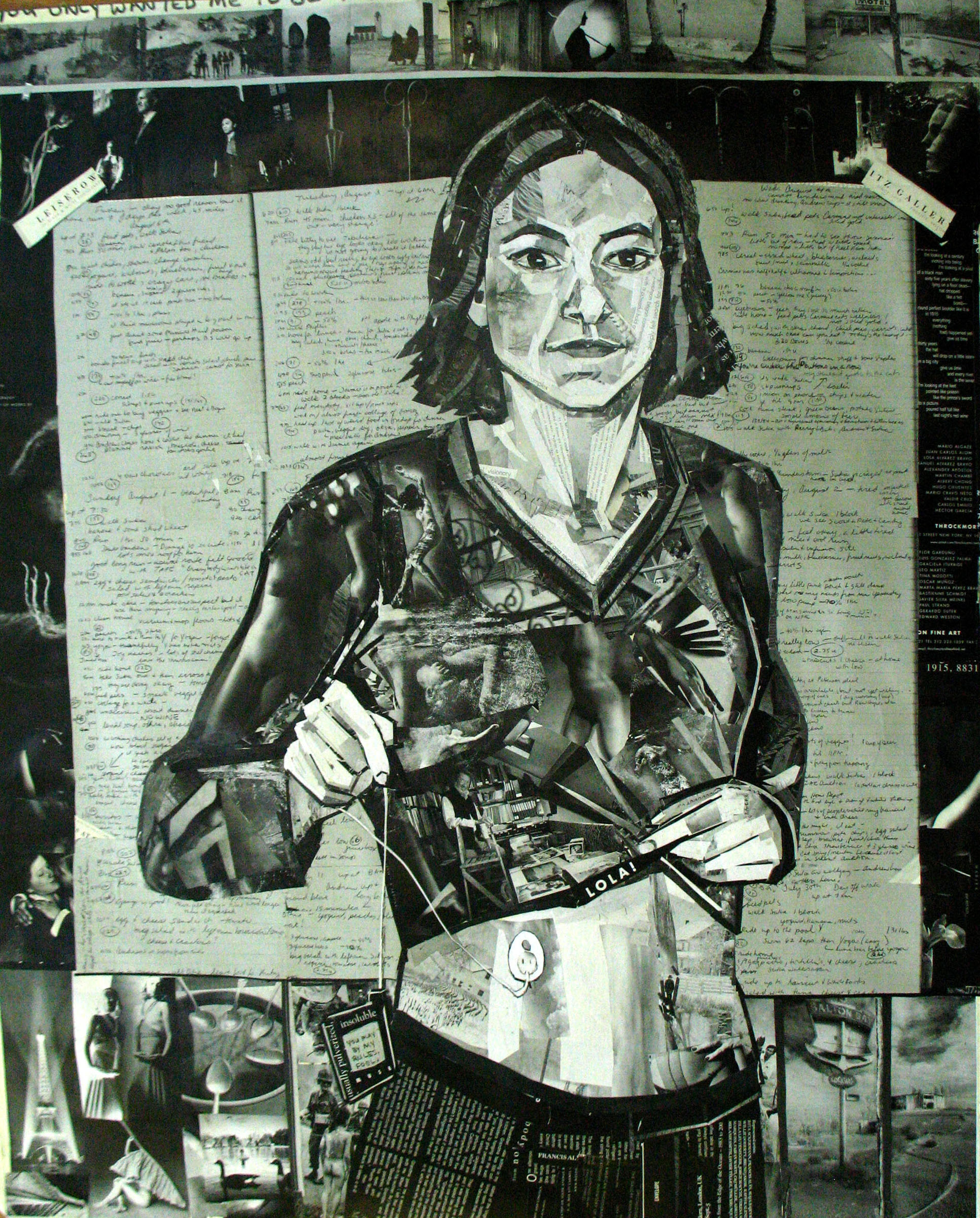
The Boss of Me, by Kathryn DeMarco

I do not know of many representations of diabetes in art or culture, at least ones that interest me. There is the movie, Steel Magnolias (1989). The Julia Roberts character Shelby, who has diabetes, is possessed by a hypoglycemic episode (really, it’s freakishly portrayed) while in a beauty parlor chair, as you probably have seen, and she later dies young.

Ann, the protagonist of the Kathryn Harrison’s novel, Exposure (1993), has diabetes, too, but does not die young. A New Yorker, videographer, crystal meth addict, and shoplifter — doesn’t she sound busy? — Ann doesn’t take insulin when she is supposed to and yet she does take that meth. Clearly, she has (out of) control issues. It’s a strange story, even stranger than I’ve described, and yet at least Exposure is literary.

Art is not required to be representative. I know that. But still, I can’t help but look for myself out there. As a woman, for example, I do like to read novels with women characters. It follows that, as a person with diabetes, I might like to read a few good novels with diabetic characters or see diabetes refracted through film, music, or visual art.

I’ve stayed on the trail, and several weeks ago I came across the work of collage artist Kathryn DeMarco, who makes self-portraits, some featuring explicit or oblique references of her body with diabetes. Online, I found her portrait above, The Boss of Me, and stared at it a long time in recognition. I’ve held the same pose, looking in my bathroom mirror, holding up my shirt to look at the white adhesive patch on my midriff, the pump held in my hand like a heavy fish still attached to the line. And the look on the face — not smiling, not frowning — is sober and forthright. Like mine, when I look at myself. Continue reading

A hunt for illustrations

"love & fear," by David Pham on Flickr

Usually, I use my own photographs as illustrations for posts. Sometimes, I hunt for them on Flickr, which involves the dual challenge of finding images that communicate, although not too tritely, and that are licensed by Creative Commons.

The search for the image does not come before I write the post or even after I’m done. I search sometime in the middle, when I know what the post is about yet I am still developing the idea or story. The right image is not only for the reader’s experience, it’s for my writer’s one. A photograph is inspiration and a kind of information.

Yesterday, I wrote a short piece for A Sweet Life on loving and fearing my doctor. Link. It started out as loving him and hating the visits, but when I searched Flickr for love/hate images, I mostly found pairs of hands with “love” inked on one set of digits and “hate” inked on the other set. Trite. The frustrating search helped me, though, realize that “hate” was too extreme a characterization of what I feel about quarterly visits to my diabetes doc. Fear is a more apt complement to love.

And so I browsed through Flickr images for love twinned with fear, and, in addition to many mentions of 1 John 4:18,  I found the above image by shapeshift (David Pham). Taken in 2005, the photograph is of a mural on the wall of a construction site in the Mission, San Francisco. I like the intimacy of the pair, with the human heart and skull dwarfing them in size. She is showing him something; he looks down at it, literally. They smile, even though the fragility (and glory) of the heart and the unavoidability of death hover over them. These observations and others, whether I dealt with them explicitly or not in “Why I Love and Fear My Doctor,” fed me while finishing the post. The reflection, prompted by the image and my hunt for it, took me to a different ending than the one I had planned.

Of course I hope the illustration does some work for the reader, too.

Twenty nickels

20 nickels on the kitchen table

The weight of my insulin pump, 100 grams, is equivalent to a dollar’s worth of nickels. Lately, though, it has been feeling a lot heavier, which may say more about the state of my diabetes mind than it does the specifications of the pump. Read more here: link.