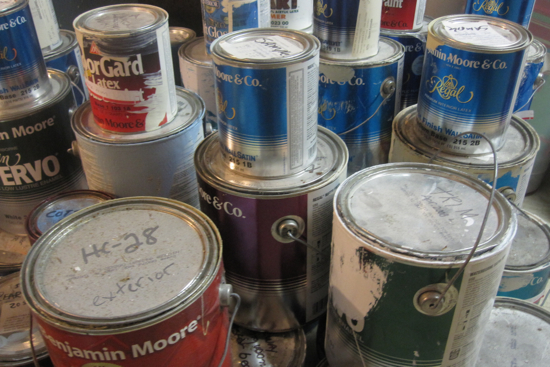
a fraction of my paint can hoard
In his essay, “Good-Bye to Forty-Eighth Street,” E. B. White describes a move from the six-room Manhattan apartment he then shared with his wife. Even in 1957 people accumulated lots of stuff; it’s not just our epoch that is so acquisitive. Contemplating my own home, which is fairly tidy, I feel about it the same way that White felt about his apartment:
A home is like a reservoir equipped with a check valve: the valve permits influx but prevents outflow. Acquisition goes on night and day — smooth, subtly, imperceptibly. I have no sharp taste for acquiring things, but it is not necessary to desire things in order to acquire them. Goods and chattels seek a man out; they find him even though his guard is up. […] This steady influx is not counterbalanced by any comparable outgo. Under ordinary circumstances, the only stuff that leaves a home is paper trash and garbage; everything else stays on and digs in.
In the passage above where I’ve used a “[…]” as a placeholder for many sentences I’ve omitted, White lists the various things that have made their way into his life without his beckoning or actively acquiring them: books, oddities, gifts, memo books, a chip of wood sent to him by a reader, and “indestructible keepsakes” left behind by someone who has died. Later in the essay he writes about the special problem of trophies. (Note: While my post is not at all about teaching, I think it could be a fruitful assignment in a creative writing class to have students make a long list of items that could fill that “[…]” spot. Perhaps an idea for a poem would emerge.)
White and his wife had only six rooms in this apartment. In our house, we have seven rooms, plus more closets, and an attic and basement. Ah, therein lies the problem. A former grad school professor of mine once said to me, as she and her husband packed up a house to move in with a daughter upon their retirement: “People should not be allowed to know that they have attics and basements.” Continue reading






 leaf stitch word