Telltale art

In July, I got lucky and went to TEDx Boston. My favorite talk was not the expert one by presentation superstar Larry Lessig, but the surprising one by artist Eric Mongeon, on his persistent obsession with what he calls the “dark and thrilling work” of Edgar Allen Poe and his struggle to illustrate and publish Poe’s stories.

What Mongeon says, in part one, about Poe’s work makes me want to return to the stories: “He was writing about fear in uniquely modern terms. All of Poe’s characters experience fear when their fundamental beliefs about their social, personal, or practical situation are somehow invalidated. The world becomes uncertain, because the picture of reality falls out of sync with the experience of reality. And at the root of fear is uncertainty.”

In part two, Mongeon describes a situation he found himself caught in. After years of generating material for his secret Poe project, he realized he was in The Vortex: “A viscious circle of research, rejection, and refinement. It is unrelenting, and it is self-perpetuating because you feel like you’re actually making something.” He soberly adds, “Doing isn’t the same thing as making.”

And finally he knits it all together — Poe’s stories, his own story, fear — deftly.

Original ideas, and a really original presentation. Everything fits: the script, the images, the timing, his clockwork pacing of the stage, and some strategic pauses. Simmering is how I’d characterize this, and worth studying.

This passing of grackles

I am drawn to the notion of what in Spanish is called querencia. It is a special version of an individual’s sense of place, and the word conveys intimacy, deep knowledge, and a pull. I first read about this in John Hanson Mitchell’s book, The Paradise of All These Parts: A Natural History of Boston (Beacon Press 2008).

He describes querencia this way:

Those with a strong feeling of querencia will know the weather of their country, will know the dates of the arrivals and departures of local migratory birds, and the flowerings of trees and shrubs. They will be familiar with the course and names of local rivers and streams, the dates of the seasonal passages of fish, and the location of hidden animal trails, of dens, swamps, hollows, cliffs, and odd boulders or outcroppings. Furthermore, they will know that certain sites within their terrain exhibit almost mystical emanations.

Is it possible to feel this way about an entire state? While I am no expert on Massachusetts, I have lived in it my entire life, and I love it as I do my siblings, and indeed I have known it as long as I have known them. Yesterday, perhaps the most beautiful of all of October’s days, I took a break from my desk and walked outside to have a look at the Charles River, which was roughed up by the breeze. Cars honked across the Mass Ave bridge and the sun glossed the John Hancock Building. Leaves, yellow. Honestly, I felt my heart lift in my chest.

In the past two weeks, in my own yard I have been noting the comings and goings of the migratory grackles. It’s that time again. Although they irritate the air with the sound of one thousand squeaky gates, I am delighted to see them.

Their appearance makes the world seems familiar and surprising too: on one day they scurry like a frightened mob from tree to tree, knocking acorns down onto cars parked in the street, and on another day they choreograph their flight gracefully. Continue reading

The continuum

Sunday night, I couldn’t sleep. I stayed up late to work, one in a long string of staying-up-late nights, and then I couldn’t let go. For two hours I lay in bed and ruminated over the papers I had stayed up to review. Not wanting to fret about insomnia (which only exacerbates insomnia), I occasionally said to myself, “It’s okay. At least I’m resting my body.”

At 3am, I moved to the couch. I noticed the many ways the lights from the street made their way into the room. I bunched a feather pillow under my head and replayed a couple of weeks of work in my head. And then I thought about the weeks ahead. In no way was I worried or panicking. It was simply as though my brain continued to develop and work on problems even as my body lay there immobile.

At 4:30am, with the same loop of images still playing in my head, I thought to myself: “I am mentally ill.” No, really.  It occurred to me that this is what people mean by obsessive thoughts. Leave it to me to have them about drafts, and colleagues, and presentations, and this student and that one, and even that pile of folders on my desk that I keep meaning to put in the shredder bin.

“Ah, no. Not mentally ill,” I thought. “Just fucked up.” I did have enough awareness to step outside myself a bit, look at my thoughts, and recognize how unproductive they are. I wasn’t able to quiet them, but I could reality-test them.

Years ago, my friend Betsy told me and our small circle of friends about the mentally ill/fucked up continuum. This is not unlike the sexuality continuum, although M.I. and F.U. have nothing to do with a person’s sexual identity. Essentially, we are each of us M.I. or F.U., and there are gradations between. Continue reading

A is for awesome.

Lydia and I were talking about school, hers and mine. We considered motivation, and what fires people up to be and do the best  they can. She told me about her high school history teacher and an upcoming presentation assignment that Lydia wants to nail. In part, she is motivated by the teacher’s rubric:

A equals awesome.

B is not bad.

C is meh.

D is “Um…”

Lydia is aiming for “awesome.” I would go pretty far, too, for an authentic awesome. And if on the first draft I got a meh, I might laugh at the teacher’s humor, figure out what to do, and keep trying.
—–

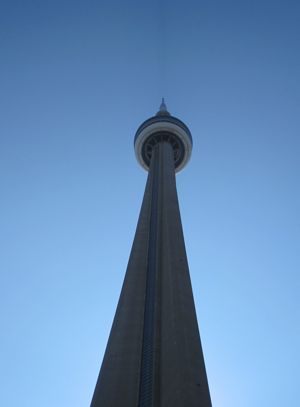
Photograph of the CN Tower, Toronto, August 2010.

The case for coffee

In 1992, during a hospital stay after my diagnosis with diabetes, I was faced for the first time with a meal that, at that time, was institutionally considered nutritious: undressed turkey, steamed vegetables, a boiled potato, diet Jello. No salt, no butter, no sweets. Worst of all: no caffeine in the coffee.

Feeling all hope bleed out of me, I implored the dietician, “Could I just have one cup of real coffee? One?” (Insulin, I could deal with. But a life with no coffee?)

“Honey, have as much coffee as you like,” she said, to my great relief. “Everyone needs a vice, and this is not such a bad one.”

That’s become almost a mantra for me, and I’ve embraced coffee like a maniac. Turns out, though, it may be less a vice than a health virtue*:

  • People who drink 1-2 cups of coffee a day had an elasticity of major blood vessels around 25% higher than those who drink little or no coffee
  • Compared to not drinking coffee, at least 2 cups daily can translate to a 25% reduced risk of colon cancer, an 80% drop in liver cirrhosis risk, and nearly half the risk of gallstones
  • At least six studies indicate that people who drink coffee on a regular basis are up to 80% less likely to develop Parkinson’s disease
  • A study published in the journal Circulation looked at data on more than 83,000 women older than 24. It showed that those who drank 2 to 3 cups of coffee/day had a 19% lower risk of stroke than those who drank almost none. A Finnish study found similar results for men
*Data are from GeekStats (search term: coffee).

So now I might be looking for a new vice, one that tastes as good.

—–
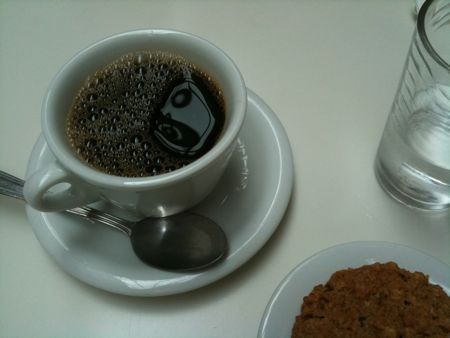
Picture-perfect coffee drunk by me at b espresso, Toronto, in August 2010.

Bits and pieces

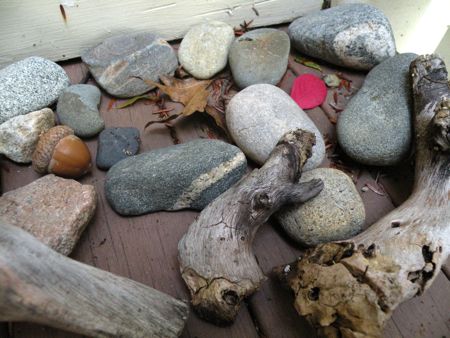
By the back door, on the way into our house, I empty my hand or pocket of whatever acorn or stone that has caught my eye as I rake, sweep, or beachcomb. Leaves occasionally fall there too and hang out for a while, until a wicked wind swirls them away. When I emptied the planters of their spent annuals yesterday, I set aside what I call the tree bones — small pieces of weather- or insect-rotted branches I collect on walks and then strew around the yard — and put them in the growing pile of finds.

I have no idea what I will do with this hoard, and yet it accumulates.

Writing can go like that sometimes.

A couple of weeks ago I was rummaging in my desk drawer for quarters. I needed two to get a cup of coffee from the office Keurig. Under the pencils, binder clips, box of tea, folded canvas bag, and loose band-aids, I saw a stapled document. I started reading the page I could see. It was not about science and therefore out of place; usually everything I read at work has to do with the technical. Whose is this? I wondered as I read about a dream of an unknown man, a car, and two people kissing. Who gave this to me? I was perplexed, almost disturbed. Continue reading

Backyard cat: stalker, or friend?

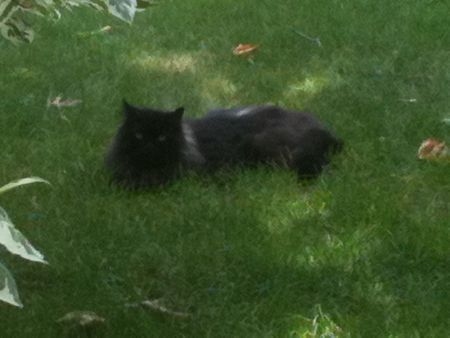
I look out the kitchen window several times a day and lock glances with its urine-gold eyes, which are pressed into a blank of black fur. I go out the porch door and down the steps, and there it stands, stock-still, defying me to shoo it. Not thinking of it, I head to the car in the driveway, and there the creature lurks, as though to say, “Wherever you go in this yard, there I will be.”

It’s my neighbor’s cat, and I think it’s haunting me.

Cats have never been fond of me. Growing up, we had one as a pet for a while. Named Saljami, short for Sally Jane Michael, she preferred my sister Sally over all of us. Saljami was sleek, gray, and striped, and she lived mostly in the yard and woods. One litter she gave birth to in my sister’s bed; I remember waking one night to see Sally sitting up in the other twin bed, with my parents around her and cat afterbirth on Sally’s nightgown. That’s how much the cat loved her. Not me.

In third grade, as a duet with Laura Farron, I sang “The Siamese Cat Song” on stage at Memorial School. Laura got scared in the first verse, and I ended up soloing. I wore a yellow dress that my mother had made, and one of the two pairs of cat glasses that our music teacher, Mrs. Holt, had supplied us with. My little disguise seemed to protect me from the audience, and I recall a feeling of elation as I belted out the verses.

In college, I babysat for a family that kept the food dishes of its two Siamese cats on the kitchen counter. This disgusted me, and when I cleaned up after dinner, I moved the cat dishes to the floor. The cats would jump up on the counter and stare me down. I always put the food dishes back in their places, and left the room.

When I first met Jimmy, whom I would later marry, and we visited his mother’s house, she still owned the family cat, Syd. I was indifferent to this old cat. In fact, as I sat in the den with my future relatives and had a conversation, totally ignoring Syd, of whom I was not afraid, Syd sometimes pounced on and scratched my leg. In retelling the story of how much the cat seemed to dislike me, I would remark that I couldn’t understand how I would provoke that much aggression in an animal toward which I felt neutral. I neither liked nor disliked Syd, or any cat. Jimmy would say, “Cats hate neutrality.” Continue reading

Green tomato moment

Time really does run out. And I’m not talking about mortality — we all know that. For some things we might do or experience in life, though, a moment passes, and it is gone. The gone moment must be acknowledged.

Often I hear people saying a sentence that begins, “I coulda been a [fill in the blank].” The first time I noticed this particular construction of sentence, I was only 25 years old, and the man who said it was perhaps 40 or so and someone I worked with. Apparently, he could have been an opera singer. But he was a university development officer. Alas, though, I think he wanted us to know, and he wanted to remind himself, that there was this germ of musical potential inside him. (Interestingly, he was doing nothing to propagate this germ.)

I’m human, and I can get stuck in this thought pattern, too. I don’t dwell on not becoming a pharmacist (yup, considered that), flautist, or Boston Globe reporter, or on not reprising the Francie Nolan story. It’s more like: I could have become the kind of person who would throw the plate, sob lavishly, shout “Pick me!”, or, in a manner of speaking, dance on the table. Honestly, I don’t even know how to turn on that impulsivity switch, and I am sincere when I say that — occasionally — I wish I had become the kind of person who could.

The gone moment must be not only acknowledged, it must be acted on. One must say, “This is what I am, what I have. What will I do with this?”

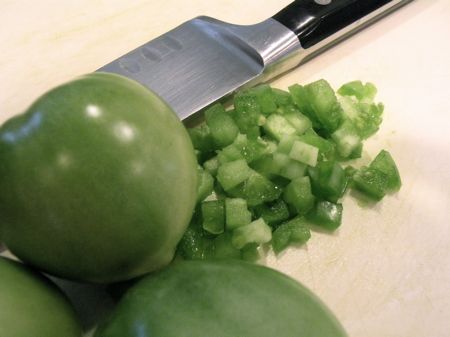
Which leads me to the actual topic of this post: green tomatoes. Let’s all confront what is our garden, or our neighbor’s garden. This summer seemed to be a poor one for tomatoes. Look around and see mostly hard and green ones still hanging on the vine, with the potential, but not likelihood, of ripening into juicy red ones.

It’s October 6th. It is time to recognize the green tomatoes, pick them, and eat. Here are recipes, personally tested by me and those around me, for Green Tomato Salsa and Fried Green Tomato BLTs. Perhaps, under different conditions, they coulda been red salsa or a more basic BLT, but I dare you to say that these are not absolutely, wonderfully edible.

Rethinking the red pen

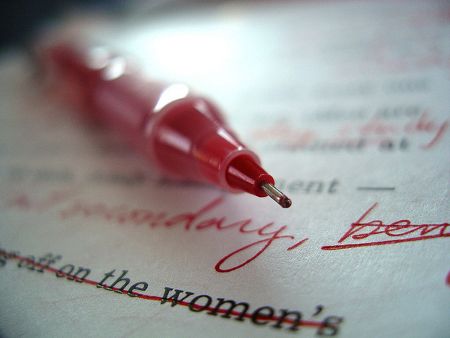
Grace promised to loan me a fine point pen with which to mark a stack of summaries. I opened her pencil case and found only a red one.

“I need a black one. All you have is red?”

“Yeah.” Grace, who sat across a table piled high with her homework and mine, looked at me quizzically.

“I can’t write on my students’ work with red ink.”

“Sure you can,” said Grace. “And, why not?”

“Well, because the red pen is perceived as… harsh, um, kind of censoring. A pencil, or even a green pen, seems kinder.”

Grace got that Mom, You’re a Lunatic look on her face. “I wouldn’t mind the red pen.”

“You wouldn’t?”

She sighed. “If I used perfect penmanship to write something, and then the teacher wrote on it with red pen and messy handwriting, that would be bad and probably hurt my feelings. But if the teacher has nice handwriting like you, Mom, and wrote carefully with a red pen on top of a student’s nice work, I wouldn’t mind.” Continue reading