Time of the season

An MIT friend/colleague posted this on her Facebook page:

This week: 22 student meetings (30 minutes each), 12 student presentations to watch and grade, rehearsal for panel talk, planning meeting for IAP workshop, go to conference, give talk, come home… By next Monday I expect to be a shambling, drooling zombie.

Her capsule summary of her week prompted me to print out my Google calendar and annotate it with things I needed to get done the evenings ahead of actual student meetings, deadlines, a rehearsal, a lecture. Last night I left it laid out on the dining room table. This morning it greeted me. I added the coffee.

All those cross-outs on my To Do list on the left, obviously a good thing, explains my absence from blogging. There are especially a lot of drafts to review, and in the bits of free time left over I find myself wanting to read (The Heart Broke In, by James Meek — so good), not write, or go outside instead.

Outside the windows and along the route to work, the trees are changing and getting ready to drop their garments. Watching the big Japanese maple in the backyard, which we can see outside the south-facing windows on the second floor of our house, involves the holding of one’s mental breath. The leaf color turns and turns and turns, the leaf stems continue to cling to the branches as though hanging from their fingertips, a few let go and fall, and one day soon — poof! — the rest will fall, blanketing the grass in a big crimson carpet.
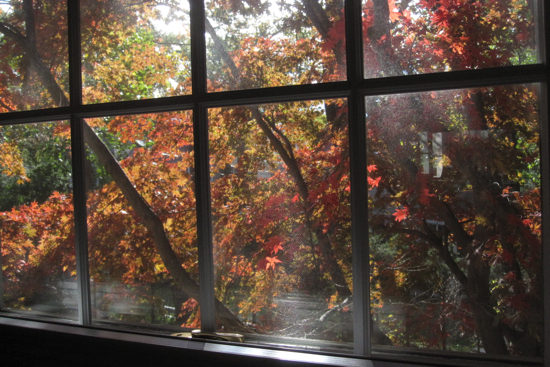
This is autumn: school burdens and tensions and the lead up to the holidays, while nature relaxes. I find myself wishing for the bottom of the To Do list to be reached, quickly, and simultaneously studying the unfolding of the season.

This is autumn too: leaves to rake, fallen branches to pick up, annuals to compost, and small and noticeable steps of progress and pleasure in one’s students (and children!).

We can, at once, be getting things done and in the moment. I do not think life can be lived entirely one way or the other.

—–
The title is of course an homage to the Zombies 1968 song, “Time of the Season.” I associate this with my brother Michael, who was one of the influential disc jockeys of my childhood. This 45 got a lot of play on my parents’ record player.
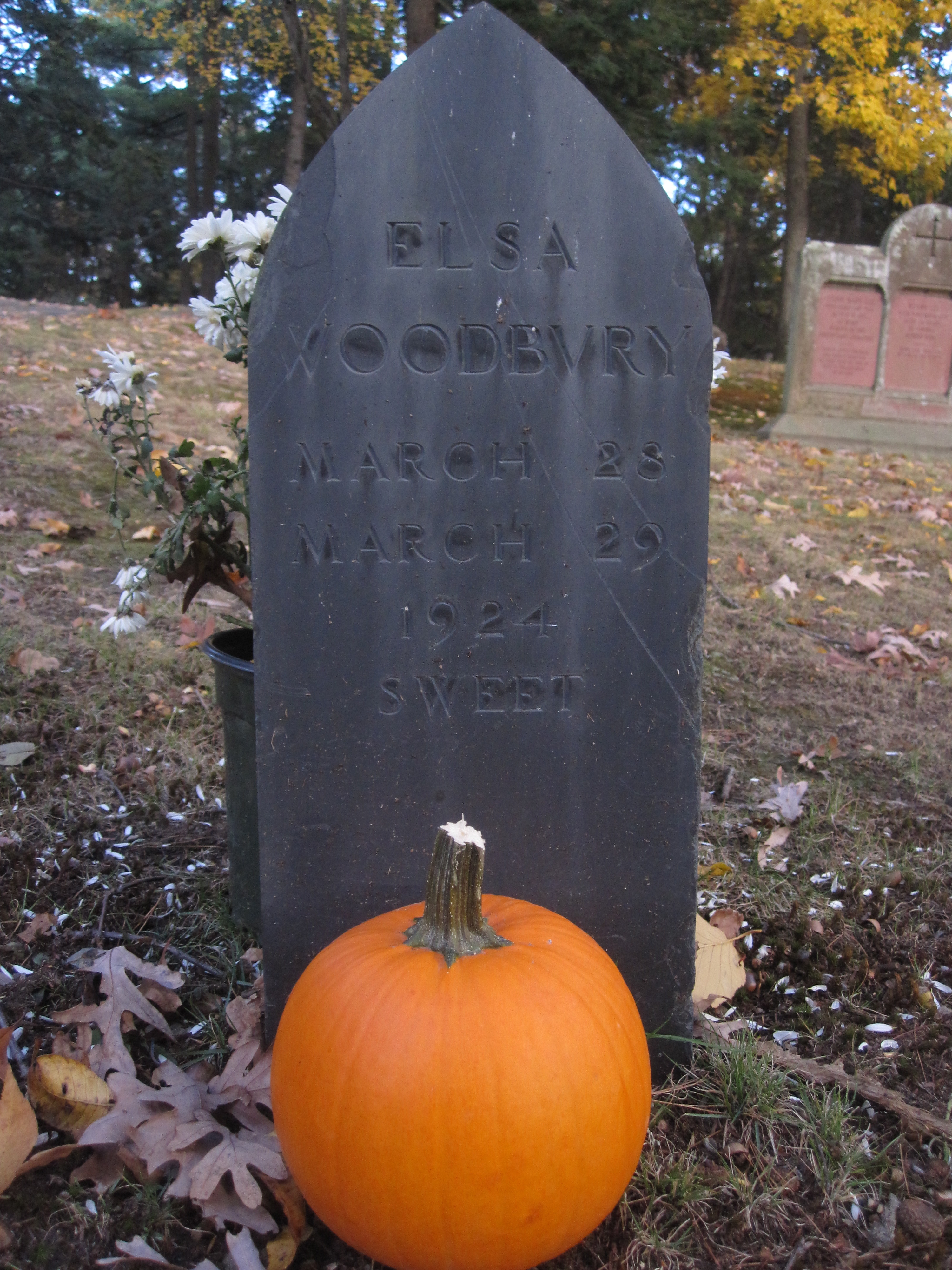
A pumpkin for Elsa Woodbury, d. 1924

Chores to do. Walk to take. We took a break from one and went on the other. Jimmy was enthusiastic, but I had to promise the reluctant Grace that when we hit 20 minutes we’d think about turning around.

Heading to Allandale Farm, we cut through the beautiful Walnut Hills Cemetery.  There are enough paths and gentle hills to make it a decent walk, which we’ve done many times. I thought I had seen all the gravestones of interest. Today this knee-high marker caught my eye for the first time; the small pumpkin at its foot was a beacon.

Infants died for many reasons in 1924, as Elsa Woodbury did at only one day old. The mystery is who is bringing a pumpkin to her grave 88 years after her death. No doubt her parents are dead. Grace speculated that a living, younger sibling could have done it. I wondered about a niece or nephew. Somehow, though, the memory of sweet little Elsa remained powerful enough in a family’s collective mythology that she would get a pumpkin for Halloween, the only one we noticed, by the way, in the cemetery today.

Does anyone else have a story idea for this find?

—–
Photograph by Grace Guterman, at my request.

A tree grows in Brookline

On Saturday I went to Allandale Farm looking for end-of-season hostas. No luck in the perennial section. I wandered by the trees, though, and saw an Eastern Redbud, a good understory tree that I’ve been looking around to buy. This one was about eight feet tall and 50% off. I went home in my little Honda, got Jimmy, and drove back to the farm in the minivan.

The tree fit horizontally in the back of the van, with the hatch open. I rode in the middle seat, holding on to the pot and looking at the branches fluttering out the open back. Another car followed us until we turned, and it did feel like being a kid again and sitting in the way back of a station wagon with the window down. Why that constituted adventure, I’m not sure. But it did.

On Sunday I got the hole started, digging in a corner of our backyard where trees from the three other yards that join ours at that point send out their root system into our patch. I snapped at those suckers with a pruner as a I went. Jimmy returned from an errand and finished the digging and root pruning. It takes about an hour to dig a hole for a small tree.

Gardening is occasionally a fight with the earth, when I am bemoaning weather, shade, or soil conditions — or even neighbor conditions. For example, the folks on our western boundary have a long row of hemlocks affected by that persistent fungus epidemic, and all we can do is live with the showers of needles that are shed from those ailing trees.

On Sunday, however, I had the feeling of planting a tree as being an act of capitulation and acceptance. This is where I live, this is our tiny corner, and this is our dirt. Bringing a tree into the yard seemed like a re-commitment ceremony, a signal that I embrace everything my habitat is and everything it is not.

In my adult life, in my relationships with the people closest to me, and in the roughest times with them, it is often my feeling of having my feet on the ground and my life physically connected to other lives that has reminded me of my place on the Earth: what I’m about, and where I fit in.

I do have those fleeting fantasies of being untethered and not tied to people or property, to live the free-floating life. Like everything that floats, however, there is no shape, color, smell, sound, or weight to that. I picture that as me alone in space and not in a place. That is not adulthood; that’s nothing-hood.

As I was planting my tree — and I reserved the best task for myself, the back filling of the hole with dirt, the mulching, the water — I was contentedly renewing my alliance with the patch of ground I live on and the people I live on it with. This is the you I take care of. I will be here for a while.

And whether this is who I am by nature, or who I have become over time and long habit, does not matter.

—–
Thanks to Mary Schwartz for her suggestion of a title for this post, which is of course an homage to that wonderful novel, A Tree Grows in Brooklyn (1943).

If a tree falls in an empty conference room, does anybody hear?

Last weekend I went to Orlando, Florida for an academic conference. Two colleagues and I were on the program to present a panel (that is, three integrated short talks) on the teaching and learning opportunities in original research projects for undergraduate mechanical engineers. We had been working on our project since last January: drafting the proposal and later the paper, revising them, drafting the slides, rehearsing, revising the slides, and going over them again. I estimate that about 250 woman-hours went into our talks.

Two people came to our panel. That’s right, two. Oh, and one came 15 minutes late.

This is the thing about academic conferences that everybody knows about but no one does anything about: there are too many panels on the program for the number of attendees, which disperses the audience among too many rooms. Yes, some panels I attended had 30 people in the audience, the size maybe of a class of students. Usually, you hope for at least 8 to 10. But two? Well, that’s just disillusioning, as one of my colleagues said. Our work had almost no effect.

I wonder, selfishly, what else could I have written with the same 100 hours I contributed to the panel? One could say I learned a lot from the research I did (my talk was based on a qualitative study I conducted among students on their experience of a set of assignments), and my colleagues and I consolidated our understanding of our own work through this experience, but, really, to have an audience is better.

In the talks I went to, the best was by keynote speaker Manuel Lima, who presented from his book Visual Complexity: Mapping Patterns of Information (Princeton Architectural Press, 2011). He argues that, as the dominant paradigm for visualizing knowledge has gone from the tree to the network, ideas of beauty must change from an emphasis on symmetry and order to complexity and disorder. Lima’s presentation ranged over history, art, science, Gestalt psychology, and our digital world. He used beautiful, disparate images from handmade manuscripts and other artifacts in surprising ways. Illustrations of trees, like this one from 1202 by Joachim of Fiore (in Lima’s book), gave way to abstract art and in particular a network-like painting, Autumn Rhythm, done in 1950 by Jackson Pollock.

The Tree of the Two Advents (1202)

I sat at a table with Manuel Lima at lunch and heard more about his ideas; I bought his book and got his signature. One always gets something of value out of these academic conferences. I am intrigued by the shift from trees to networks as the paradigm of knowledge in our era and by our ideas of classical beauty giving way to complex beauty.

Networks are not just at the center of a scientific revolution; they are also contributing to a considerable shift in our conception of society, culture, and art, expressing a new sense of beauty. As we continuously strive to decipher many of their inner workings, we are constantly bewildered by their displays of convolution, multiplicity, and interconnectedness. And the most elaborate of schemes are the ones that apparently seduce us at the deepest level. — Manual Lima, Visual Complexity (2011)

This is a big idea, the only one at the conference. My colleagues and I were ready with a well-done yet admittedly modest idea. Is this the thing to do, which Lima has done: dedicate one’s self to bigger ideas and bigger projects?

—–
Image credit: The Tree of the Two Advents, Joachim of Fiore (1202), via Brainpickings.org

Bounty of writers’ insights

Sweet autumn clematis (link) reaches its full beauty in early September and then lasts. I have a few spots of it in the yard — over an arbor in the front, along both sides of the chimney, and climbing up the neighbor’s fence — and this summer it exceeded its usual proliferation while I wasn’t looking. Suddenly, it seemed to explode into my attention. One day I said to a member of my editorial staff, Grace Guterman, “Please, when you have a moment, go out in the yard and take some photos for me!” I wanted to preserve the lushness. She did.

Also this month I have noticed in the news a proliferation of commentary from writers on writing that surprised me in some way. So that I don’t lose these good finds, I’m going to catalog and excerpt below the three that made the greatest impression on me.

1. Brian Martin recommends that writers train like athletes. Excerpts from his article in Tomorrow’s Professor:

Write for 15 to 30 minutes every day. Yes, that’s it: the core requirement is daily writing, at least five days a week, preferably seven.

Coaches expect their athletes – swimmers, runners and so forth – to train daily. Junior athletes are expected to show up for training every day, at the same time. Swimmers put in the laps and runners put in the miles. This sort of training enables dedicated high school athletes to achieve times better than world champions a century ago.

So what were top athletes doing back then? Those were the days of amateurs, usually from the upper class with spare time and access to facilities, who trained when they felt like it, typically on weekends. Very gentlemanly. But their performances weren’t outstanding by today’s standards.

What about writing? Most academics seem to be operating like the gentleman athletes of the past. They wait until they feel like writing. That usually means when they have a big block of time, or are forced to meet a deadline.

Most academics learn binge-writing from doing assignments in high school or undergraduate years. Binging becomes increasingly dysfunctional as tasks become larger. Writing an essay overnight is possible, but completing a 300-page thesis requires planning and sustained work. Continue reading

Sitting on my hands: parenting and self-restraint

Today is the second day of try-outs for a team that Grace really, really wants to be on. It’s volleyball, a sport she’s never played before.

Before the try-outs began, she asked the coach if she’d accept novice players, and the coach said, “Yes.” She’s willing to teach.

Still, Grace must demonstrate she has what it takes. I must confess that I have been very tempted to secretly influence the outcome. My persistent thought, all week, has been to email the coach (whom I’ve met) and make a persuasive and covert case for Grace. I imagine describing my daughter’s physical strength, desire, reliability, and team spiritedness. I have imagined striking a deal that goes like this: If you pick her for the team, I promise that we will do a lot of drills with her at home. We won’t let you down.

My tendency to over think is saving me, in this instance, from meddling. While I have written a perfect email in my head and fantasized Grace’s joy at being picked, I have also had a lengthy internal dialogue about the ultimate rightness of such parental “involvement.” The Jane who is all I WANT I WANT I WANT — and NOW! has been counseled by the Jane who takes the long view and is on the side of transparency and fairness. I also want the kids to incrementally grow in independence and self-advocacy, which means I have to sit on my hands a lot and not always prevent, not always fix.

There will be no Dear Coach email.

Yesterday, we helped Grace make sure she has the gear she needs for the second day of tryouts, and we bought our first volleyball. Jimmy spent some time in the backyard with her at dusk, with the outdoor lights on, catching balls that she served to him and throwing balls that she pounded back. At dinner, Grace described a message that she will say to the coach, on how much she wants to be on the team. Lydia advised Grace on some words she might add.

We can help our kids prepare for the contests of the world, which will be many. Much as I would like to, I cannot guarantee the outcome by my own efforts. I feel the temptation of trying to, though, so I resist mightily.

—–

Update (9.28.2012): Sad face. No volleyball team this year.

Writer’s Dozen: Peter Selgin and Limits

This is the fourth in a series of posts, called “A Writer’s Dozen,” on texts that have been important to me as a writer.

When he was in his early 20s and struggling to get started as a songwriter, Peter Selgin was attacked by a black Labrador retriever owned by the woman for whom he was apartment sitting in New York. The dog chomped into Selgin’s left wrist. He underwent microsurgery to address significant scarring around the ulnar nerve that affected feeling in and mobility of the hand. Results were minimal.

This event is described in his essay, “Confessions of a Left-Handed Man,” which is the centerpiece of a new book of essays by the same name. I first read this essay in Best American Essays 2006.

Always a left-handed artist and writer, Peter Selgin knew at age 25 that the full manual dexterity of his dominant hand would not return after the attack and surgery. In the essay he recounts his attempt to train his right hand, which felt like “trying to sing with [his] fingers holding his tongue,” to do what his left hand had always done for him. Around this time he also broke his leg. One night he walked on crutches to the East River with thoughts of killing himself. He had always been the left-handed boy — had identified himself as that — and the mirror opposite of his twin brother George, a right-handed boy who became an economist. At the river that night he had a “good bawl” and “hobbled back” to his room.

Twenty years later, he wrote the essay from a point in time he no longer felt that his left-handedness had any special meaning. It simply was. Furthermore, he continued to write and make art with his compromised left hand. The work he made before and after the injury, though, have “nothing in common” with each other. He calls his style “naive, even primitive,” and he asserts that his “lack of dexterity has freed [him] from glibness, which in turn has delivered [him] from the temptation” to show off.

Even though Selgin’s theme for his essay is humility — he says that, for an artist, “to master humility” is as important as mastering the techniques of his medium — for me, the lesson is about limits that we cannot overcome, that we must work within. There is nobility in this, and necessity, once the sorrow passes. Continue reading

Everywhere you go, there’s a habitat

I am working at home today. As a break, I thought I’d complete a fix-up of our old garage door. I went to screw on the new weather stripping and noticed that the handle to the pull-up door is rusted and bent.

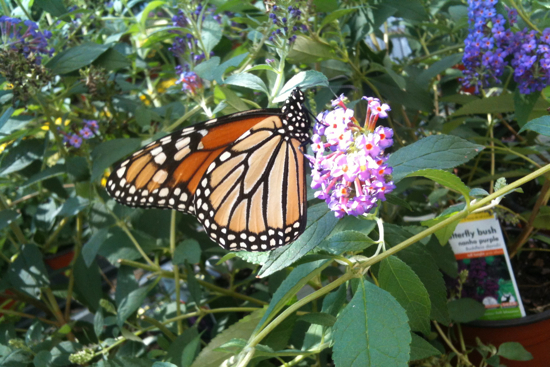
After I found what I wanted at the local Home Depot and paid for it, I couldn’t help wandering over to the Garden Department. I hovered around the on-sale perennials (two for $10), and I noticed this creature hovering around the butterfly bush, as it should.

The fall annuals, especially mums, are getting star billing at all the nurseries and garden centers right now, but try not to let your head get turned. Walk to the back of the store, where you’ll find some drooping and over-sunned perennials deeply discounted. It’s the perfect time to plant them. I bought two sets of 4 each (hosta and phlox), violating the rule of Plant in Threes, I know, but they were each the last of the batches, and I could not leave them lonely.

I like digging things into the ground now because it gives me a sense of anticipation for the spring. There will be a long period of darkness and rest in which I’ll forget about the new additions to the yard and then, come May, voilà. There they will be.