Friends who write letters

In early May, at the end-of-the-year potluck supper of the MIT figure skating club, of which I am a new member, I sat next to Florence. She is a student from Belgium who, in addition to getting a graduate degree in media studies this year, learned to skate and performed a solo in our March show.

Before the potluck supper, we had never talked. Over salad and lasagna and quiche and meatballs, I told her about my goals as a writer and she told me hers as a photojournalist. We were mutually engaged, and the conversation with her made the awkwardness of a social event totally worth it.

Image

mail from Florence and James

At the end of the night, she handed me a tiny pad of notepaper and pen and asked me to write down my mailing address. She had a book for me, something about narrative journalism, that she planned to send me as a form of inspiration. A few days later, the book The Literary Journalists arrived in a package along with The Midnight Disease. In the accompanying note, she referred to our potluck conversation and wished for “all the best in your writing enterprises!”

I felt as though my ambition, which had been feeling to me like an old dress that had fallen off its hanger and crumpled on the floor among the shoes, was freshened, ironed, and made wearable again by her interest and words. A person cannot always plug along alone without such collegial encouragement and enthusiasm. (There were two exclamation points in her note.)

Meanwhile, that same week, I got a hand-written letter also from James, whose presence in my life as a fellow writer and a real friend keeps me company even though we live far apart. Words — by email or the post — keep the embers of friendship glowing.

And over the past year, I’ve also gotten real letters from Ulrike, Susan, Rosemary, and even one of Rosemary’s friends, who passed along a used book she’d finished with. Marcia sent me a vacation postcard. Leslie, even though we share an office at work, sent me by mail an article she thought I’d enjoy; I know for a fact she also enjoyed creating something mail-able that may have grown out of her nostalgia for a pen-pal-rich childhood. My mother sent me a well received Mother’s Day card, which boosted my parenting self-esteem in one sentence, which, by the way, the children agreed with when I read it to them.

Are you wondering how to get someone’s attention — how to really reach them — at a time when email and status messages and even, gulp, blog posts seem to add to more and more clutter?

In your own hand, write some words. Put them in an envelope; add a stamp. Send.

A postcard or letter is personal and private and therefore more treasured. When I receive one, I think: this is for me, only.
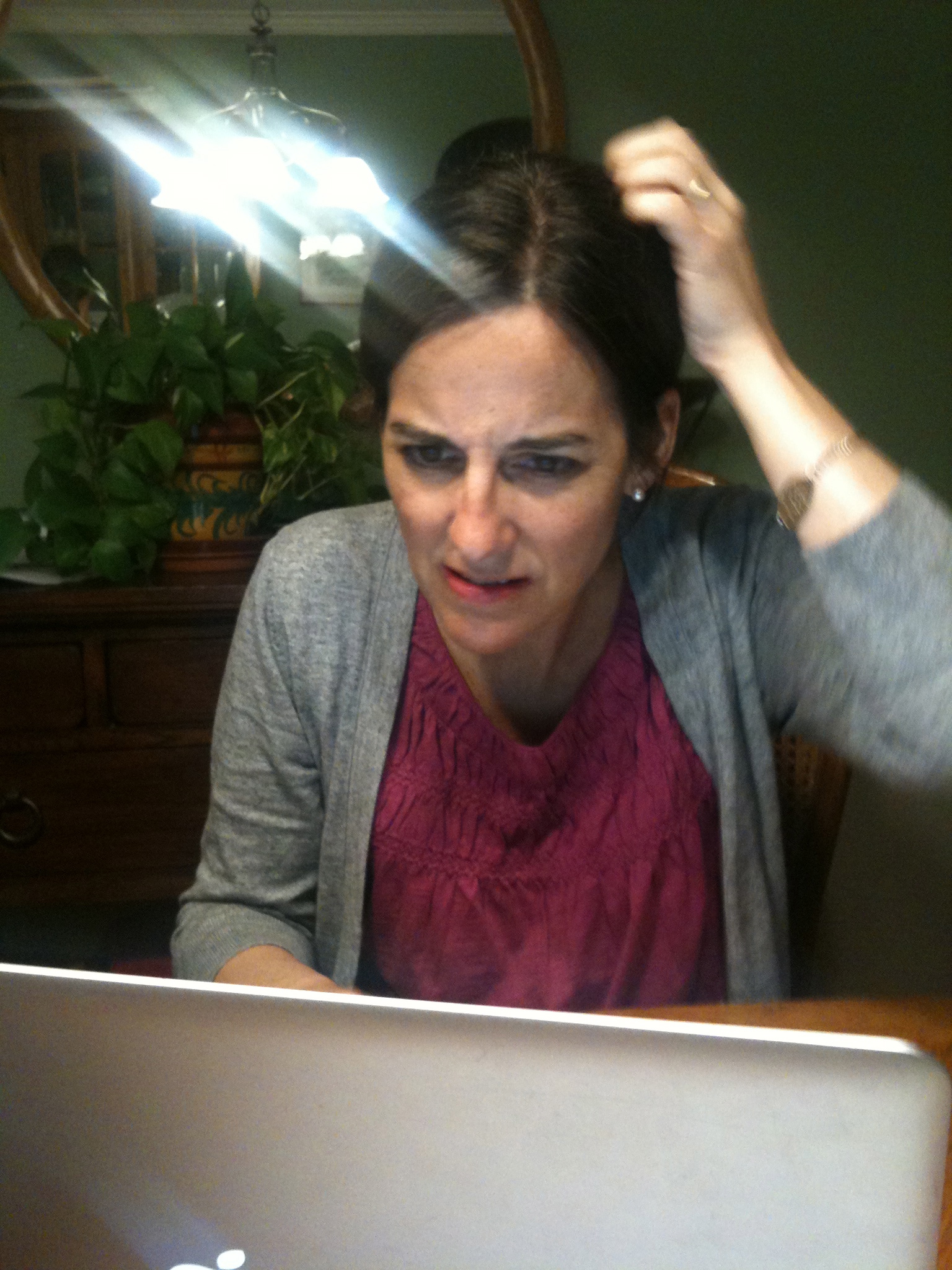
The agony of writing comments on student work

That’s me, sitting at my desk at home, which is really the dining room table, where dining rarely happens. We usually eat in the kitchen unless company comes, and then I put away my laptop, power cord, scratch paper, and pen.

Lydia took this candid photo with her phone when I wasn’t paying attention to her. The draft of a report by a student was diverting me from my own students, aka children, and their homework.  Sometimes Lydia and Grace spread their books and worksheets on the same table, and we homework-it alongside each other. Let’s hope this gives me credit someday for being an involved parent.

The past two weeks have been all about final papers and final presentations, and I have been meeting with students, helping them rehearse talks and improve slides, and reading submissions. Have I worked on my own writing? Not really. I have thought about it.

In a recent column on her writing habits, Anna Quindlen, who writes every day between 9am and 3pm — “an elementary school schedule” — argues that a writer must lead “a humdrum life” and not “write other stuff.” If you have a busy life, and you are writing other stuff (like, I infer, comments on student writing), “you won’t write it.”  Here, the pronoun it stands in for all that glorious self-authored work a writer is destined to do, unless responsibility gets in the way.  Too many lunches, Quindlen adds, also get in the way.

She invokes her Barnard writing professor, B.J. Chute, who told Quindlen and her classmates “not to take jobs that involved writing of any kind because there was no chance we would then go home at night and take up our own material.”  Very good point. I do wonder, though, how fiction writer B.J. Chute managed to get her teaching done without writing on student work. Continue reading

Critical thinking must involve communicating too

A recent post on Tomorrow’s Professor itemizes and describes seven intellectual habits of critical thinkers.

Critical thinking is one of those qualities that are prized in teaching and learning but is often evoked as a good thing without being nailed down. Like “art” or “emotional intelligence,” we believe in it, we know it when we see it, but we haven’t always formulated for ourselves what we understand it to be. The list below, by Edmund J. Hansen, primarily situates the use and cultivation of critical thinking in school, with some references also to its importance in society.

I must admit I read this list with myself more as thinker and not teacher in mind. Do I consistently practice these seven intellectual habits? Do you?

  1. Intellectual Humility: Be aware of one’s biases and prejudices, the limitations of one’s viewpoint, and the extent of one’s ignorance.
  2. Intellectual Courage: Face and fairly address ideas, beliefs, or viewpoints toward which one has strong negative emotions and to which one has not given a serious hearing. Recognize that ideas that society considers dangerous or absurd are sometimes rationally justified.
  3. Intellectual Empathy: Imaginatively (and, I would add, regularly) put oneself in the place of others so as to genuinely understand them.
  4. Intellectual Integrity: Be true to one’s own thinking and hold oneself to the same standards one expects others to meet. Honestly admit discrepancies and inconsistencies in one’s own thought and action.
  5. Intellectual Perseverance: Be disposed to work one’s way through intellectual complexities despite the frustration inherent in the task.
  6. Confidence in Reason: Believe that one’s own higher interests and those of humankind at large will be best served by giving the freest play to reason, by encouraging people to come to their own conclusions by developing their own rational faculties. Also have faith that, with proper encouragement and cultivation, people can learn to think for themselves.
  7. Intellectual Autonomy: Maintain an internal motivation based on the ideal of thinking for oneself; having rational self-authorship of one’s beliefs, values, and way of thinking. Depend not on others for the direction and control of one’s thinking.

I reflected on Hansen’s Habits of Critical Thinkers and noticed that he emphasizes the individual’s responsibility to the self as thinker, reasoner, judger, and perseverer and the benefits one might gain from these habits. Not that he ignores responsibility to others — after all, Hansen is a teacher and promotes these habits in education — but the actions he describes are largely mental, interior, and personal.

This list needs an eighth habit, and it’s one I discern among the ones he has articulated. While the seven above are lifted and paraphrased directly from Hansen, the one below has been crafted, albeit from his principles, by me:

8. Intellectual Advocacy: Be responsible for preparing and communicating — whether in text, speech, graphics, or other publicly available media — reasoned arguments that consider and advance ideas, proposals, and analysis that represent one’s deep thinking, careful study, and sincere concern.

I add this here as much as a reminder for myself as it is for any readers. Often, I pride myself on my skill at weighing information and others’ views. However, I often keep my thoughts to myself, wondering if this battle or that one is worth fighting. I have historically given too much credence to an axiom I learned as a child: “Silence speaks volumes.” Silence, in fact, does not speak at all. Critical thinking gets society nowhere without the thoughtful, well-reasoned, and even impassioned — if passion suits — communication of thinking’s results.

A person must use her critical thinking to question and investigate her own convictions, but she must have the courage to argue for the ones she has examined and can support with evidence (including examples), analysis, and reflection. Do this according to Hansen’s Habits: with honesty, humility, empathy, integrity, persistence, and autonomy.

—–
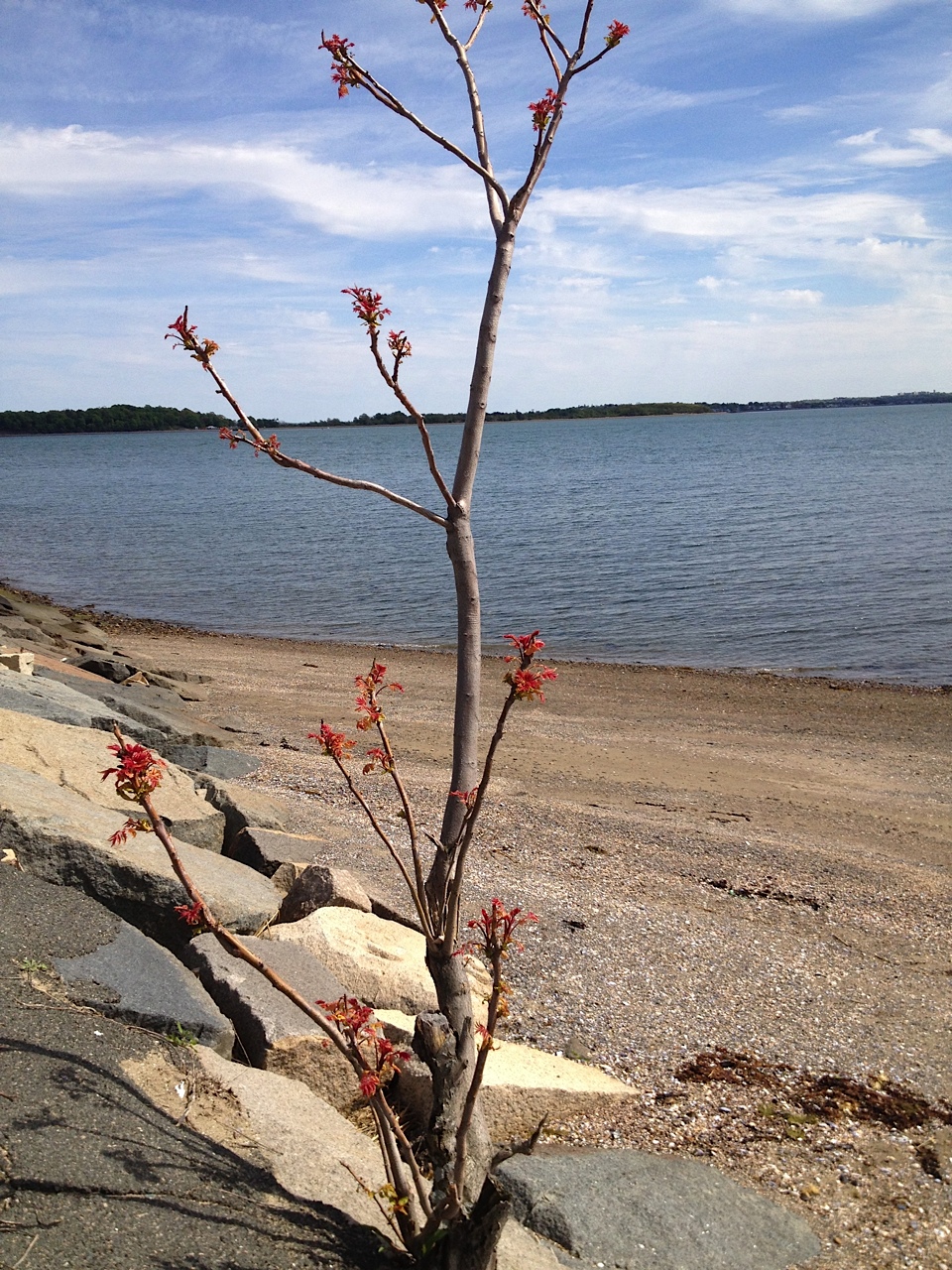
Image by Jimmy Guterman, on the jetty/walking path to Boston’s Castle Island, April 29, 2012.


A magical place where coffee grows on trees

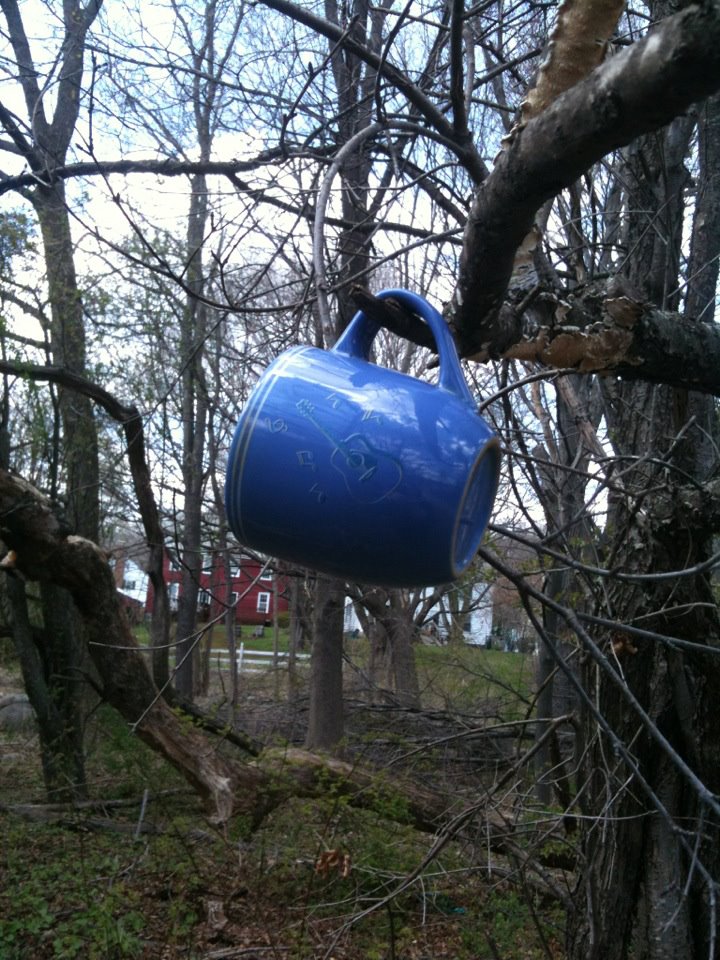
This magical place exists not too far away, in Milton, MA, where my sister Sally lives and where she spotted this perfect blue cup hanging from a tree. Sally sent a picture my way. The next day, walking the same route, the cup was still there. Later it disappeared.

There is a place in my brain activated by the word “coffee,” by the implements of coffee, and by the thing itself. If you’re my friend and you like coffee (James or Marcia, for example), then I like you extra. Siblings, you too.

Every coffee story or image reminds me of another one. Recently in one of my early classes, I got to the lab  right on time, 9 a.m.  It’s a big enough class that several other instructors are involved, and one of them is in the habit of stopping at Dunkin Donuts on the way in and buying munchkins to share and a coffee for himself. On this particular morning, I hadn’t had time to get my own coffee, and I felt forlorn, although I did fake a good coffee alertness face. And yet my eyes kept tracking the movement of Phil’s giant iced coffee around the room. I was like a dog who perks up when people food is about to be served: ears pointed, nose twitching, eyes wide.

The coffee-bearer offered the box of doughnut holes around, one instructor at a time. He reached me. “Do you want one?” he asked.

“Actually, I’ve been eying your coffee,” I admitted, perhaps panting a little.

“Oh, by all means have some!” he said enthusiastically.

I got a cup from near the wash-up sink. I held it out to him; he took the top off his plastic cup and poured. I was happy — it had not been hard to get what I wanted. I drank.

An hour passed as student teams worked on their projects, and instructors hovered around helping and prompting. I kept my eye on Phil’s iced coffee and noticed that half remained, with ice still bobbing in it. Want more? he signaled by pointing at the cup.

I nodded. He walked over and refilled my cup. “You’re like my dealer,” I said and smiled. He laughed.

—–
Image by Sally Kokernak Millwood, found April 10, 2012 in Milton, MA. Thanks, sis!

The tortoise wins her race

I didn’t win the race; I won my race.

Lydia and I ran the B.A.A. 5K along with 6,000+ other runners, our second race this year and my second race ever.  On the train ride back to our car at 9:30am, having done what we each set out to do — Lydia improved her time and I ran the whole route without walking — Jimmy asked me if this race felt different than the first.

Yes, it did.

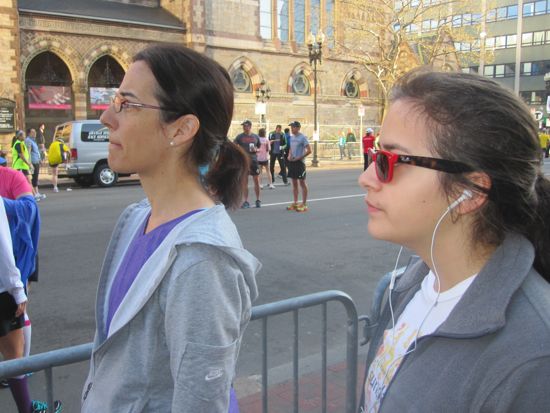
Before the race, Jane and Lydia contemplate the finish line.

I enjoyed this race more. There was only one hilly patch (near the State House), and my mental resources therefore were not focused on the stamina and positive self-talk needed to get up yet another one of the several hills in the South Boston 5K. My mind was free to think other thoughts.

After the start and as we were trotting up Boylston Street, I noticed a lot of women running past me in lululemon tanks with the ruffle down the back and several sporting lululemon running skirts.  What, by the way, is up with skirts on runners? Do they hide something? Does wearing one communicate a dichotomy in identity? I’m pretty; I’m strong. What’s wrong with simply I’m strong?

Lineup gathers on Boylston Street in front of the Boston Public Library.

Speaking of sartorial runners, before Lydia surged ahead I pointed her attention to another mother-and-daughter pair near us who were in full makeup, foundation included, with hair carefully blown dry.

All those overt beauties ran past me along with many other runners who were fast starters. My ego felt vulnerable in the first few blocks. I was determined to pace myself, and yet it’s a little disheartening to be passed by just about everyone. I had a talk with myself and bolstered the self-esteem. Continue reading

Adrienne Rich and “The Trees”

The poet Adrienne Rich died at age 82 yesterday, March 28.  The New York Times in its obituary describes her as “among the most influential writers of the feminist movement.” This is true. Let’s also acknowledge her as one of the great writers, period, of the 20th century. Her body of work is still fresh and relevant.

The most recent issue of Granta included a new poem, “Endpapers,” which prompted me to re-read the anthology Facts of a Doorframe (new edition, 2002) and essays Arts of the Possible (2002). I first read her work deeply in a graduate class taught by Renée Bergland at Simmons College, which I attended from the age of 35 to 38. This is perhaps late to come to Adrienne Rich, seeing that she had been around as an influential writer since the 1960s, but it was the right time for me. Awakenings, after all, tend to happen once a person has some adulthood under her belt. A favorite poem from Doorframe is “The Trees.” If you know me or are a reader of this blog, this won’t surprise you. What’s surprising about the poem, however, is how unromantic it is for a nature poem: trees in a greenhouse break out as though patients from an asylum.

See below the jump for an excerpt of the poem by Rich and an excerpt of a paper comparing Rich’s “The Trees” to Frost’s “Birches” (another poem loved by me) I wrote in April 2003 for Renée’s excellent women’s poetry course. I have some new thoughts on the poem, too. Continue reading

Writing to confront the human heart in conflict

At last, another writer has excavated an issue about writing that has been worrying me. Does the desire to write and publish spring from some creative well (that is the hope) or does it spring from neurosis (that is the worry)?

In Sunday’s New York Times Magazine, Steve Almond, story writer and essayist, argues convincingly that the rise of writing workshops parallels a decline in talk therapy. He claims that what brings many individuals to writing, and to MFA programs, is less an interest in craft than a location for their “loneliness and sorrow.” About himself as a young writer, he says

I figured I had gone into the literary racket because I had urgent and profound things to say about the world and because I was a deeply creative person. But looking back, I can see that the instigating impulse for me, for all of us really, was therapeutic. We were writing to confront what Faulkner called “the human heart in conflict with itself.” And not just any heart. Our hearts.

Gulp.

copyright: Pina (2011), by Wim Wenders

A few weeks ago, Jimmy and I went out for a quick dinner at Mantra (definitely on the down curve) before seeing Pina in 3D nearby. This you should see. Determined not to talk about the children or money, we discussed our side projects: he’s working on a novel about a discontented middle-aged man trying to reconcile himself to his life with antics both professional and personal, and I am working on a YA novel about a family of three children who have been abandoned by their parents and are trying to make it on their own, without revealing their situation to concerned adults around them. The more we described the characters and events to each other, the more concerned I became.

“Um,” I finally said, “Don’t you think this is really, really messed up?”

“What’s messed up?” Jimmy asked, perhaps having more fun with this conversation than I was.

“That maybe what we’re writing aren’t really novels, but just projections of our own subconscious conflicts and desires? Like maybe we should quit writing and straighten ourselves out?”

copyright: Pina (2011), by Wim Wenders

Jimmy responded with a writer’s answer: “In my writing, I’m trying to go to the places I fear to go.” Apparently, in his novel, the protagonist’s wife is killed, and this is upsetting to Jimmy, and so he’s writing into the terror. Armchair psychologist that I am, I speculated to myself that he also secretly and occasionally fantasizes about the disappearance of his own wife. (That’s okay, as long as I can remain alive in another dimension.)

And, hey, my subconscious is besmirched too. My protagonist may be a 13 year old girl and not a middle-aged married woman, but the mother of this girl — and the father — end up abandoning their kids in a series of events both planned and unplanned. What does that say about me? Continue reading

Scratching an itch

Recent travels in the neighborhood, either on foot or in car, have taken me past Allandale Farm, still closed for the winter. Curiously, there are two bulls regularly lounging in the shade near the algae-filled pond. I say curiously because this is a new sight at the farm, and I have no idea why they are there.

Driving past, I point them out to Grace. She has the same question as mine. “Why?”

“My guess is that the farm has rented them to sire the cows,” I say.

Then I recall that there are no cows there.

“Another thought,” I add, “is that the farm owns them, and they are renting out the bulls to impregnate cows on other farms.”

“I don’t really get it,” says Grace. For once, I decide not to explain everything. Beyond mentioning that cows are female and bulls male, I avoid the topic of animal husbandry.

But the desire to get up close and inspect the bulls remained. Today I walked over to the farm, cutting through the cemetery — yeah, I know, growth and death, circle of life — and made my way over to the pond. There is a shed and pen for the bulls, and as I approached, one of the bulls stuck his massive head over the wire fence. I was kind of flattered, as though the bull had pegged me as a friendly person who might give an apple or a pat. I was also intimidated: the bull was bigger than a VW Beetle, his head alone bigger than a 30 pound supermarket turkey.

Turns out, he didn’t want me, an apple, or a pat. He wanted to scratch. First he rhythmically scratched behind his right ear by rubbing it on the chain link fence post. His eyes rolled back in the sockets. Next he rhythmically scratched behind his left ear after deliberately adjusting the position of his head. This I videoed.

He was smart enough to get what he needed from his environment.

I walked home in the other direction, through a neighborhood of once-starter homes that have been lived in for ages. I noticed that, in most of the yards, a number of idiosyncratic gardening purchases and decisions have mostly led to clutter, either actual or visual. I made a mental note to go through my own yard carrying a big plastic garbage bag and to throw out the old plastic pots I’ve left here and there as well as the ugly or surplus ornaments. The season for gardening is beginning.

My last stop before home was the local Starbucks for iced coffee. Some itches are easy to scratch. I might as well this one, I thought.
—–
UPDATE (June 1, 2012): I was at Allandale today buying some mulch and a few dahlias. A young woman who worked for the farm loaded the mulch into the car. I asked her about the bulls: “Are you folks going to breed them?” She answered that the original intention was to farm them for meat, but that the longer they hang around, the more attached the farmers and the patrons are becoming to them. (And they are steer, not bulls, which I was politely told are castrated bulls.)

I also learned that they are a friendly species, Scottish Highland, “which are used in rehabilitative setting,” this young farmer explained. “They’re good with people.”

“So, like, they’re therapy bulls, er, steer?” I asked.

“Yes, like that,” she answered.

Not a runner, here I am running

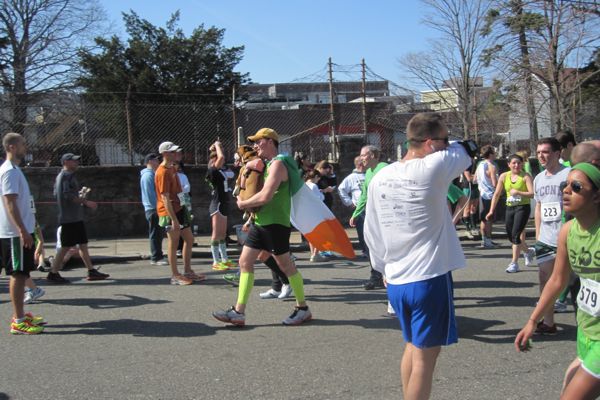
On Sunday March 18, Lydia and I ran our first 5K, the South Boston St. Patrick’s Day Road Race. The distance is modest in number, but it feels monumental as an accomplishment, and I wrote about it for my other blog on A Sweet Life: link. See Jane run! See others, like this fellow with his dog, run too.

Man with dog crosses finish line, South Boston, March 18

Beyond finding out that I can run for 3.1 miles, hills included, I experienced something else worth knowing that can help me with other things in my life I want to do (like writing and skating): habits are motivated by a goal.  Lydia and I spent several weeks plodding along with regularity, but our interest in and commitment to running really picked up when we registered for the race. Our habits suddenly had purpose.

The day after the race we ran again, and Lydia took us on a new route. She increased our distance by ten percent. Neither of us really felt like running — didn’t we deserve a rest? a treat? — but we did. In four weeks, on April 15, we have another 5K in Boston.

—–
Image credit: Jimmy Guterman

Ebb and flow, everyone. Ebb and flow.

“Let go your thoughts.” Portia, the yoga teacher, gently suggests this a few times in the first half hour.

I try of course, even though it is ironic that it takes effort — and it really does — to let go. A thought is like a rubber raft on water, and I nudge its pliable edge. The thought floats away, yet it floats back.

About one time out of 10, I experience the state of gone thoughts. Once, my thoughts were so gone I even felt my inner state exert an almost hand-like effort, reaching for and coaxing them back. But thoughts kept floating away, slipping and shapeless.

Nine times out of 10, the most I can do is let go of my emotional attachment to what may be on my mind. This happens mostly when I’m on my back with my eyes closed. “Oh, so I’m thinking that,” I think, and I watch it like a movie without a plot. But I watch.

I have persistently wondered if I’m just not a yoga person in the mental way. Most of the time in everyday life it’s hard to look at my thoughts dispassionately.

We end yoga in sitting position, and we face the teacher. We hold our hands pressed together in front of our hearts, and our fingers point up. Portia says, “Namaste,” to each of us. In turn, we say, “Namaste,” to her.

Then it’s over.

She tidies the room for the next group as we collect our shoes and bags. Today as she wandered about, Portia said in her low and unhurried voice, “Ebb and flow, everyone. Ebb and flow.”  (Before class, she had mentioned a problem with her cell phone, and I felt relief that she was of this world.)

I grinned and said, “I like ‘Ebb and flow’ so much better than ‘Be here now.'”

Uncharacteristically, she gently huffed and said more sotto voce, “Oh. We could have a long conversation about that one.” She paused; her lips pressed together. “Yeah,” she said with finality.

This felt like a connection. And maybe I am a yoga person.

—–
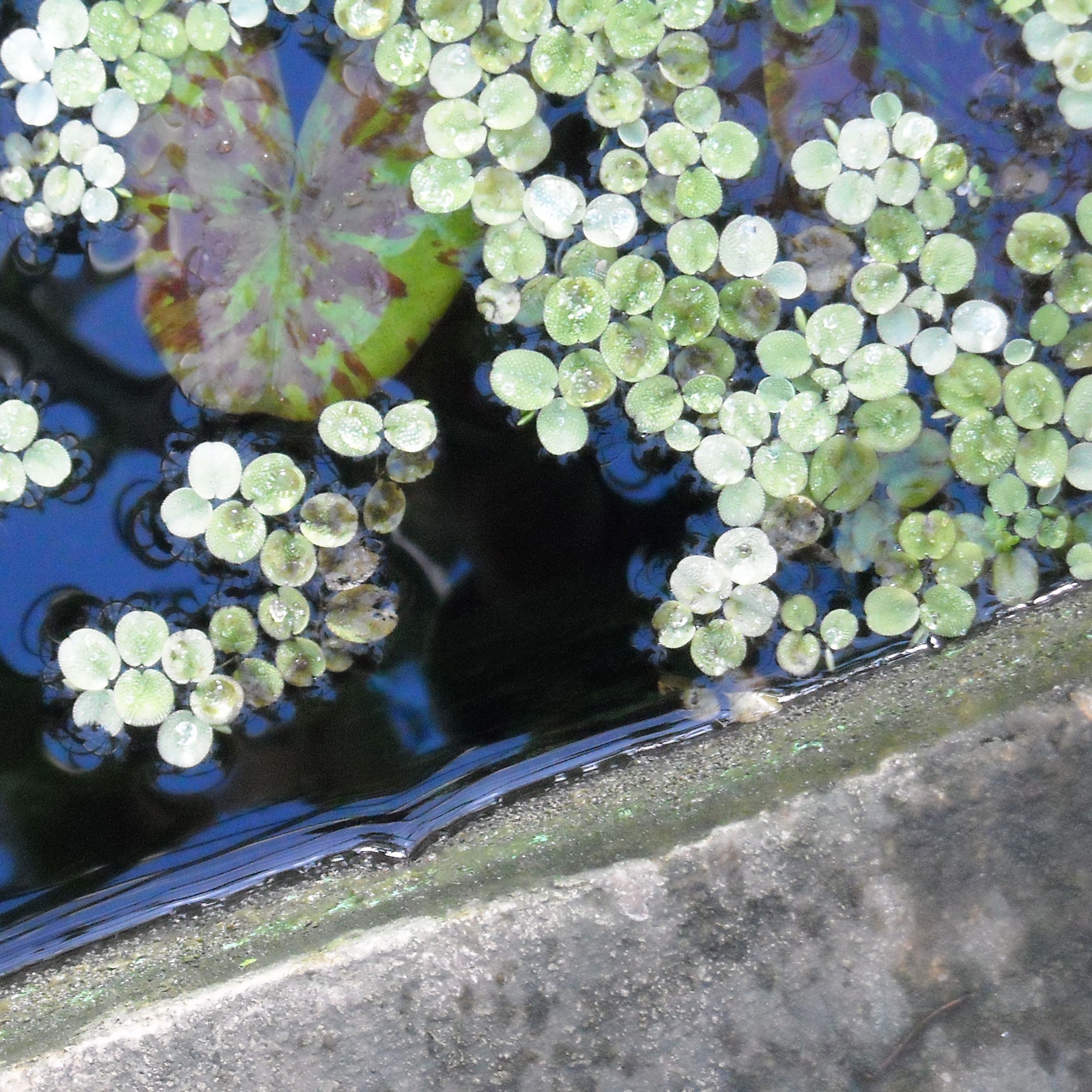
Image of water plants from a February 2009 trip to the Wellesley College Greenhouses. My spring break is coming up. Time for a return visit.