A is for awesome.

Lydia and I were talking about school, hers and mine. We considered motivation, and what fires people up to be and do the best  they can. She told me about her high school history teacher and an upcoming presentation assignment that Lydia wants to nail. In part, she is motivated by the teacher’s rubric:

A equals awesome.

B is not bad.

C is meh.

D is “Um…”

Lydia is aiming for “awesome.” I would go pretty far, too, for an authentic awesome. And if on the first draft I got a meh, I might laugh at the teacher’s humor, figure out what to do, and keep trying.
—–

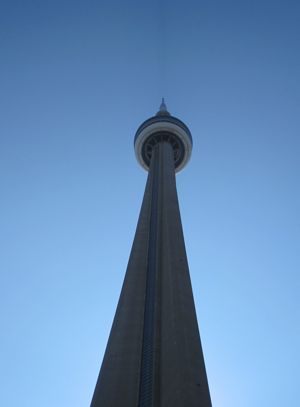
Photograph of the CN Tower, Toronto, August 2010.

The case for coffee

In 1992, during a hospital stay after my diagnosis with diabetes, I was faced for the first time with a meal that, at that time, was institutionally considered nutritious: undressed turkey, steamed vegetables, a boiled potato, diet Jello. No salt, no butter, no sweets. Worst of all: no caffeine in the coffee.

Feeling all hope bleed out of me, I implored the dietician, “Could I just have one cup of real coffee? One?” (Insulin, I could deal with. But a life with no coffee?)

“Honey, have as much coffee as you like,” she said, to my great relief. “Everyone needs a vice, and this is not such a bad one.”

That’s become almost a mantra for me, and I’ve embraced coffee like a maniac. Turns out, though, it may be less a vice than a health virtue*:

  • People who drink 1-2 cups of coffee a day had an elasticity of major blood vessels around 25% higher than those who drink little or no coffee
  • Compared to not drinking coffee, at least 2 cups daily can translate to a 25% reduced risk of colon cancer, an 80% drop in liver cirrhosis risk, and nearly half the risk of gallstones
  • At least six studies indicate that people who drink coffee on a regular basis are up to 80% less likely to develop Parkinson’s disease
  • A study published in the journal Circulation looked at data on more than 83,000 women older than 24. It showed that those who drank 2 to 3 cups of coffee/day had a 19% lower risk of stroke than those who drank almost none. A Finnish study found similar results for men
*Data are from GeekStats (search term: coffee).

So now I might be looking for a new vice, one that tastes as good.

—–
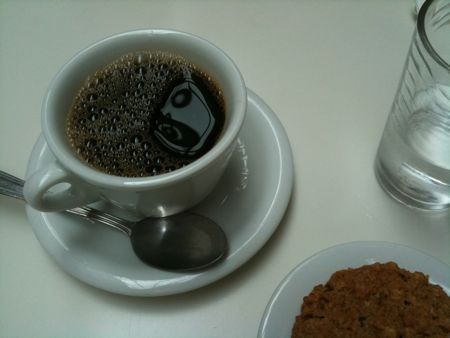
Picture-perfect coffee drunk by me at b espresso, Toronto, in August 2010.

Bits and pieces

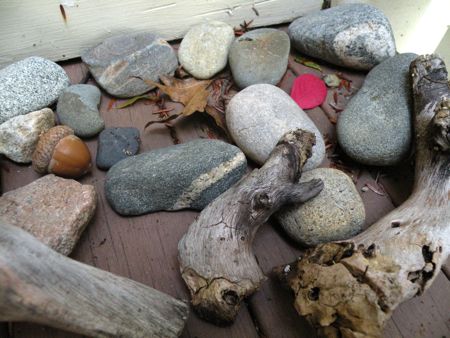
By the back door, on the way into our house, I empty my hand or pocket of whatever acorn or stone that has caught my eye as I rake, sweep, or beachcomb. Leaves occasionally fall there too and hang out for a while, until a wicked wind swirls them away. When I emptied the planters of their spent annuals yesterday, I set aside what I call the tree bones — small pieces of weather- or insect-rotted branches I collect on walks and then strew around the yard — and put them in the growing pile of finds.

I have no idea what I will do with this hoard, and yet it accumulates.

Writing can go like that sometimes.

A couple of weeks ago I was rummaging in my desk drawer for quarters. I needed two to get a cup of coffee from the office Keurig. Under the pencils, binder clips, box of tea, folded canvas bag, and loose band-aids, I saw a stapled document. I started reading the page I could see. It was not about science and therefore out of place; usually everything I read at work has to do with the technical. Whose is this? I wondered as I read about a dream of an unknown man, a car, and two people kissing. Who gave this to me? I was perplexed, almost disturbed. Continue reading

Backyard cat: stalker, or friend?

I look out the kitchen window several times a day and lock glances with its urine-gold eyes, which are pressed into a blank of black fur. I go out the porch door and down the steps, and there it stands, stock-still, defying me to shoo it. Not thinking of it, I head to the car in the driveway, and there the creature lurks, as though to say, “Wherever you go in this yard, there I will be.”
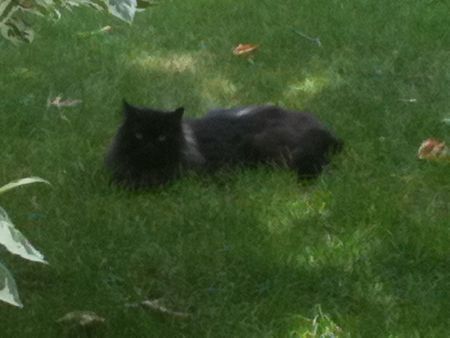
It’s my neighbor’s cat, and I think it’s haunting me.

Cats have never been fond of me. Growing up, we had one as a pet for a while. Named Saljami, short for Sally Jane Michael, she preferred my sister Sally over all of us. Saljami was sleek, gray, and striped, and she lived mostly in the yard and woods. One litter she gave birth to in my sister’s bed; I remember waking one night to see Sally sitting up in the other twin bed, with my parents around her and cat afterbirth on Sally’s nightgown. That’s how much the cat loved her. Not me.

In third grade, as a duet with Laura Farron, I sang “The Siamese Cat Song” on stage at Memorial School. Laura got scared in the first verse, and I ended up soloing. I wore a yellow dress that my mother had made, and one of the two pairs of cat glasses that our music teacher, Mrs. Holt, had supplied us with. My little disguise seemed to protect me from the audience, and I recall a feeling of elation as I belted out the verses.

In college, I babysat for a family that kept the food dishes of its two Siamese cats on the kitchen counter. This disgusted me, and when I cleaned up after dinner, I moved the cat dishes to the floor. The cats would jump up on the counter and stare me down. I always put the food dishes back in their places, and left the room.

When I first met Jimmy, whom I would later marry, and we visited his mother’s house, she still owned the family cat, Syd. I was indifferent to this old cat. In fact, as I sat in the den with my future relatives and had a conversation, totally ignoring Syd, of whom I was not afraid, Syd sometimes pounced on and scratched my leg. In retelling the story of how much the cat seemed to dislike me, I would remark that I couldn’t understand how I would provoke that much aggression in an animal toward which I felt neutral. I neither liked nor disliked Syd, or any cat. Jimmy would say, “Cats hate neutrality.” Continue reading

Green tomato moment

Time really does run out. And I’m not talking about mortality — we all know that. For some things we might do or experience in life, though, a moment passes, and it is gone. The gone moment must be acknowledged.

Often I hear people saying a sentence that begins, “I coulda been a [fill in the blank].” The first time I noticed this particular construction of sentence, I was only 25 years old, and the man who said it was perhaps 40 or so and someone I worked with. Apparently, he could have been an opera singer. But he was a university development officer. Alas, though, I think he wanted us to know, and he wanted to remind himself, that there was this germ of musical potential inside him. (Interestingly, he was doing nothing to propagate this germ.)

I’m human, and I can get stuck in this thought pattern, too. I don’t dwell on not becoming a pharmacist (yup, considered that), flautist, or Boston Globe reporter, or on not reprising the Francie Nolan story. It’s more like: I could have become the kind of person who would throw the plate, sob lavishly, shout “Pick me!”, or, in a manner of speaking, dance on the table. Honestly, I don’t even know how to turn on that impulsivity switch, and I am sincere when I say that — occasionally — I wish I had become the kind of person who could.

The gone moment must be not only acknowledged, it must be acted on. One must say, “This is what I am, what I have. What will I do with this?”

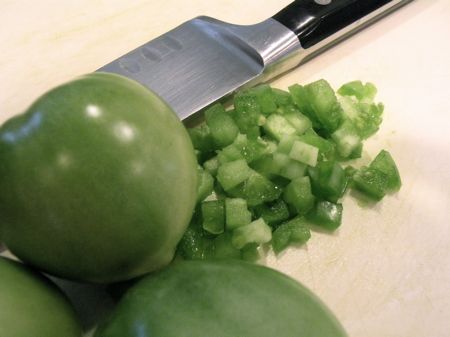
Which leads me to the actual topic of this post: green tomatoes. Let’s all confront what is our garden, or our neighbor’s garden. This summer seemed to be a poor one for tomatoes. Look around and see mostly hard and green ones still hanging on the vine, with the potential, but not likelihood, of ripening into juicy red ones.

It’s October 6th. It is time to recognize the green tomatoes, pick them, and eat. Here are recipes, personally tested by me and those around me, for Green Tomato Salsa and Fried Green Tomato BLTs. Perhaps, under different conditions, they coulda been red salsa or a more basic BLT, but I dare you to say that these are not absolutely, wonderfully edible.

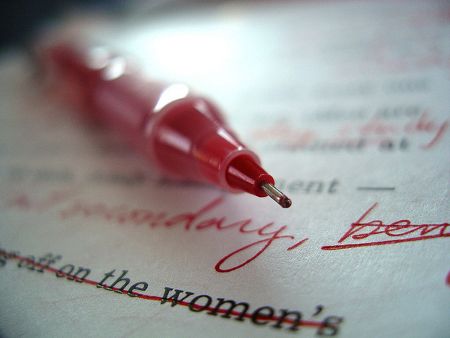
Rethinking the red pen

Grace promised to loan me a fine point pen with which to mark a stack of summaries. I opened her pencil case and found only a red one.

“I need a black one. All you have is red?”

“Yeah.” Grace, who sat across a table piled high with her homework and mine, looked at me quizzically.

“I can’t write on my students’ work with red ink.”

“Sure you can,” said Grace. “And, why not?”

“Well, because the red pen is perceived as… harsh, um, kind of censoring. A pencil, or even a green pen, seems kinder.”

Grace got that Mom, You’re a Lunatic look on her face. “I wouldn’t mind the red pen.”

“You wouldn’t?”

She sighed. “If I used perfect penmanship to write something, and then the teacher wrote on it with red pen and messy handwriting, that would be bad and probably hurt my feelings. But if the teacher has nice handwriting like you, Mom, and wrote carefully with a red pen on top of a student’s nice work, I wouldn’t mind.” Continue reading

Accidental vegetables

After I harvested the potatoes, we tilled up the patch and mixed in some lime for sweetness. While we were at it, we tilled up another troubled patch of grass and mixed in our first batch of compost. Would lime and compost yield the same results?

Grass is similarly sprouting in both the lime- and compost-treated areas. There is also, surprisingly, some additional species growth in the area with compost. Ah, vegetable seedlings to be exact.

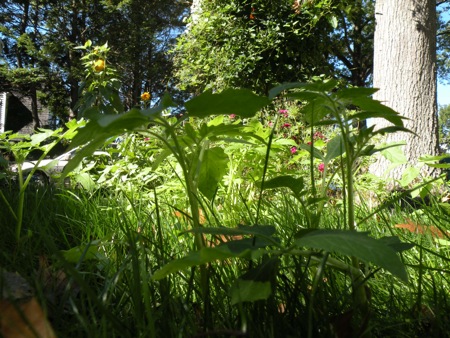
Tomato jungle towers above grass understory.

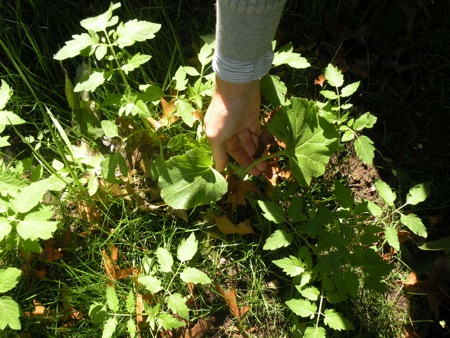
Leaves of a big-fruiting plant -- melon? squash?

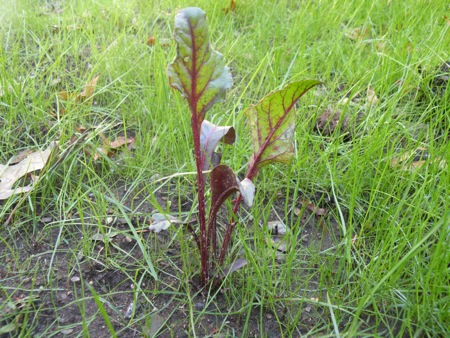
Ironicially, beets, which I wasn't able to grow successfully from seed this summer.

Plants do what plants do. We have decided to simply let this go — no mowing — until the first frost.

Desire and make

Desire is the spur for more than one kind of creation. In July I saw photographs of Margaret Oomen’s little urchins: crochet covered sea stones. I wanted them. Alas, her Etsy store was sold out.

So, I have been conducting a side project this summer. Based on instructions published by Oomen in the purl bee, I’ve been making some of my own, with stones picked on the shores of Cape Cod, Lake Ontario, and South Boston; a 1.40mm steel crochet hook; Valdani embroidery threads; and a darning needle. Voilà! the above stones.

On their bottoms I’ve been writing provenance, date, and sequence number:

What will I do with them? They’re like children — I made them, but I don’t have to cling to them. If I know you, and now you want one, please let me know. I’ll send you a surprise — a little piece of geologic history, and me.

Friend of the author

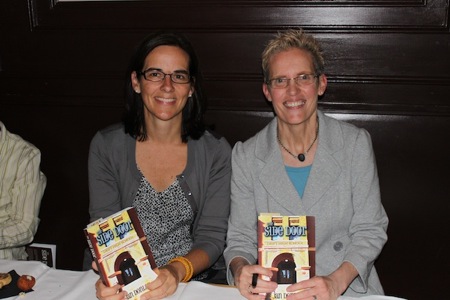
On Monday night, September 13, I was a guest and volunteer at my friend Jan Donley‘s book-signing event at Lineage.

Weeks ago on Facebook I posted this status message: “[Jane Kokernak] is not an event ‘mingler.’ Give her a job to do — coat check, for example — and she’ll knock your socks off.” The message captured my feeling after I attended an MIT event at which I had a job to do. I wasn’t hanging out, self-consciously chatting people up and trying to penetrate small-group conversations. Instead, I was there, by request, to examine student work and ask questions. At other events, I have distributed name badges, guarded doors, and cleared the dinner detritus. In each case, the assigned role made me comfortable enough to do well and have a great time.

Back to my status message. On it, Jan commented, “Hmmm… we might have a job for you at the book launch.” She and her spouse, Diane Felicio, invited me to handle proceeds at the book-signing table. “Of course!,” I practically bleated.

On Monday night, I showed up. I talked to my mysterious friend T. and others, drank wine, ate little crab cakes and figs with bleu cheese, listened to Jan read, saw Diane in her far out dress, clapped for Greater Boston PFLAG (the event’s beneficiary), and played cashier as the author signed books. Of course, I enjoyed it.

And a couple of weeks before, when I read The Side Door, Jan’s first novel, I thoroughly enjoyed that, too.

—–
Event photograph by Diane Hammer.

Wintry thoughts

Today in Boston it’s the same kind of beautiful weather we had 9 years ago, when we spent much of our day looking up at the sky, flooded by what we could not absorb or understand.

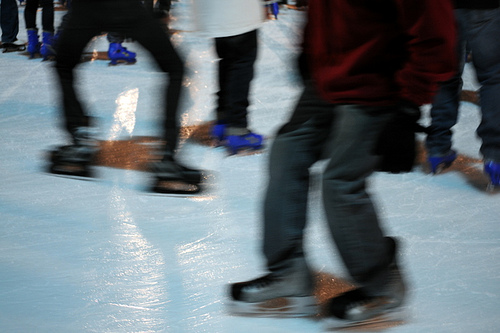
It was not a skating day. Still, a year later it was hope for winter weather that made me reflect on September 11, 2001 in my 650-word essay, “A Hunger for Ice.” Link.

—–
Photograph, “Ice Skating,” by prudencebrown121 on Flickr via creativecommons.org