I’ve been studying the fashionable subjects at Advanced Style for a few weeks.
Today, a vision in gray, my favorite color.
(Is gray a color?)
I’ve been studying the fashionable subjects at Advanced Style for a few weeks.
Today, a vision in gray, my favorite color.
(Is gray a color?)
Grace watched me get dressed. It was a skirt day, and I was yanking on some tights.
“I don’t understand why people like tights,” she said. “Uncomfortable.”
“They’re okay.” I shrugged.
Her face was scrunched with doubt.
“I could never be president,” Grace declared, almost as if someone had just that moment asked her to seek her party’s nomination.
“Uh, sure you could.”
“No, I couldn’t. Because I hate tights.”
I gave her my best what-are-you-talking-about look.
“And women presidents have to wear skirts,” she retorted.
I protested. “You could wear pants!”
Grace, only eight years old, had the last word: “No, only skirts.”
(Ah, the power of the image, and unwritten rules.)
—-
P.S. Go, Obama! You have my vote. Still, I miss you, Hillary. You would have worn pants, as Ms. President. I’m sure of it.
MIT, where I work, is a conglomerate of endless hallways. Buildings are attached to buildings; one segues into the next. Bulletin boards are everywhere, and, as I walk the long halls to my office in the morning and back to the car at night, I glance at a changing collection of flyers and posters pinned up by student groups and campus organizations. I read some as carefully as I read cereal boxes, in other words, pretty thoroughly.
This one, taped to the interior window of room filled with public computers, has been up all semester.
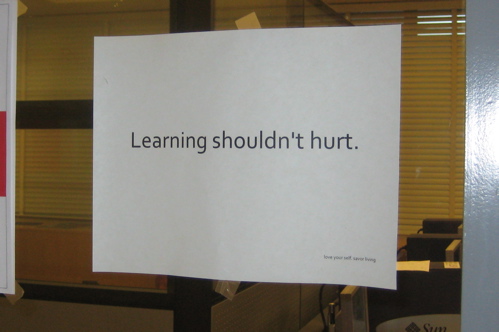
Who sponsors it, I don’t know. Perhaps its simple, subversive reminder is the humane work of underground activists.
In the bottom right corner, all it says is love your self. savor living.
—-
P.S. Here’s the video of an R.E.M. song that tugs at me, every time.
This morning at 8am I was stopped by a red light at the mouth of a side street that feeds into Commonwealth Avenue. A gas station on my right; a BU building across the street and train tracks. Me? Daydreaming, waiting. An MBTA bus, the 57, zoomed past, heading east into the city. People were packed inside, seated in rows, their many heads bowed over what they held in their laps — blots of white to me — opened books. And before my consciousness fully registered the scene, it seemed to me that people were praying, like supplicants in pews, staring down into hymnals, waiting for the priest to interrupt them from their reverie and say, “All rise.”
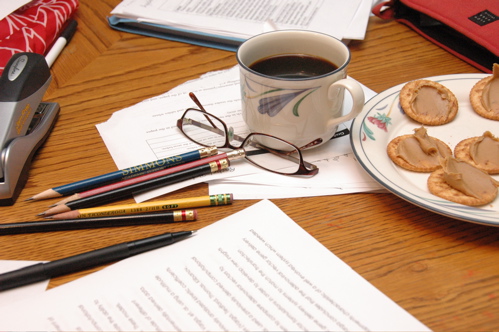
I’ve reached the semester’s choke point, and all I’m doing lately is commenting on draft after draft after draft. Welcome to my studio, a.k.a. the dining room table.
Does it mean your average Joe, carrying a six-pack of beer?
Or, does it mean your hyper-muscled Joe Gym, with a washboard abdomen?
Help me. Everyone’s saying it, and it’s shorthand that obviously refers to something about America and the election, but I don’t know what.
And whether it’s the beer guy, or the gym guy, or even some other guy, what does that even mean?
The knitters at Stitch for Senate are making helmet liners for every member of the U.S. senate in order to engage “with public officials about the war in Iraq.”
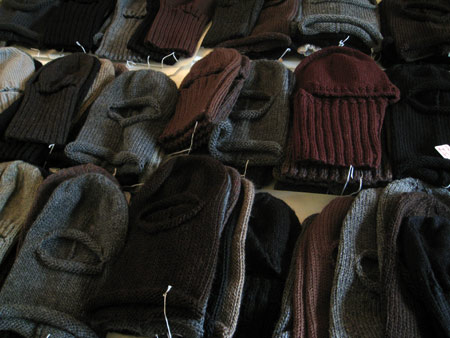
"Helmets, stacked," by Stitch for Senate
This puts me in mind of Eyes Wide Open, an exhibit of boots and shoes, representing military men and women killed in the Iraq War, that we stumbled across once when we were visiting my in-laws in New Jersey. We drove past a library and on its front lawn were rows of boots. Plain, magnetic.
When artists and activists use the everyday, intimate, and individual to make a statement about the enormous — war, power, death — that brings the enormous in close. I can imagine my head in the knit helmet, and my feet in the boots. And perhaps by imagining myself inside, I can start to imagine the other.
This sort of reminds me of the time that Sally and I, years ago, belted out “Shop Around” at the CambridgeSide Galleria. But that’s not on YouTube (although it is on tape).
Or something like it, in my size, in gray.
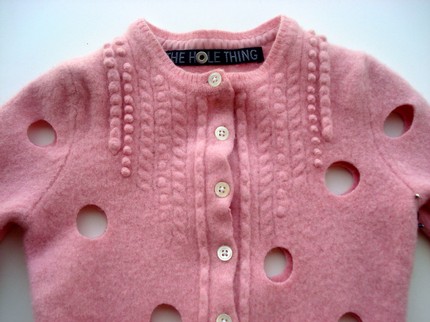
Swiss cheese sweater, by The Hole Thing
Felted, deliberately punctured, and made for a child, by The Hole Thing ®.
From the BBC’s “Science and Environment” section yesterday:
The global economy is losing more money from the disappearance of forests than through the current banking crisis, according to an EU-commissioned study.
It puts the annual cost of forest loss at between $2 trillion and $5 trillion.
The figure comes from adding the value of the various services that forests perform, such as providing clean water and absorbing carbon dioxide.
[…]
Key to understanding his conclusions is that as forests decline, nature stops providing services which it used to provide essentially for free.
So the human economy either has to provide them instead, perhaps through building reservoirs, building facilities to sequester carbon dioxide, or farming foods that were once naturally available.
Or we have to do without them.
 leaf stitch word