– Simple machine

When I threw away my old pruners — which had an irregular cutting edge and a safety catch that always stuck — I promised myself, when it was spring, I’d look for and buy the Mercedes of pruners: beautifully engineered, balanced, responsive. The price would be no issue. I use the tool all the time between April and November, and I even keep it within reach, on a nail I’ve banged into the wall near the garage door. Going out into the yard? Grab the pruners.

Spring weather and a free afternoon beckoned me out to the yard today. I put on my sturdy dirt shoes and raked up a carpet of wet leaves. I needed more! I wanted to cut something. Alas, I had no pruners and no desire to head to a specialty store to comparison shop for high-end ones.

I headed instead to the nearest hardware store, about two miles away in West Roxbury. First I grabbed some leaf bags. Then I asked the guy at the desk, as I made an odd, pincer-like gesture with my right hand, “Got any, uh, you know, clippers?” (Why the gesture? Why the vocabulary loss?) He pointed; I found the gardening aisle. My eyes scanned the price stickers first, looking for the most expensive pruners. They were ugly, and the handles were coated with that spongy foam I find so annoying. I looked again, searching for design features.
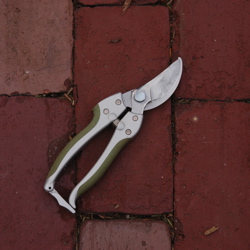
PrunersMy eyes landed on these, and lingered. I instantly liked them: clean, streamlined, unadorned. And yet… they were so cheap, only $7 or so in a long line of higher-priced choices. Would low price turn out to mean low quality?

Well, I took them home anyway, simply because I liked them so much. It turns out they are sharp, easy to handle, and effective. My favorite detail is the safety catch, which is the metal hinged piece at the bottom that opens and closes like a gate and latches ingeniously.

The manufacturer is True Value (item #680043): no snob appeal, just a well-made simple machine.
– Eyeglass repair

Eyeglass repair tools

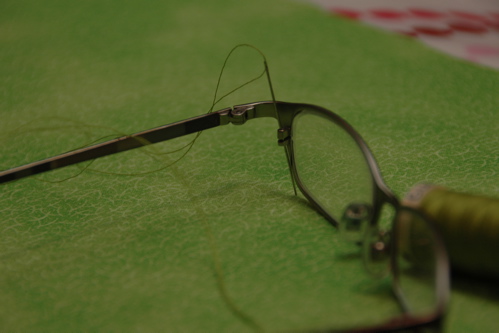
In a darkened room, I lost the micro-screw to the left lens of my metal eyeglass frames. The optical shop is closed today. I can’t find my spare pair of glasses, and I don’t own an eyeglass repair kit. A paper clip is too fat a replacement for the screw. A needle and thread, however, will do the trick.

As every Kokernak knows, if you don’t have the right tool for the job, make a tool, or re-purpose another.

– Teachers’ skulls

At the salon where I get my hair cut, every client gets a scalp massage from the shampooist after the final rinse. The sensation is bliss.

Today, Chris, a petite, instantly friendly young woman, took charge of my heavy head. She kneaded and kneaded. My whole body felt better. I was on a cloud…

Chris: Uh. (Knead, knead.) You have, like, the tightest skull.

Jane: Really?!

Chris: Yeah. What do you do?

(She doesn’t give me time to answer.)

Chris: A teacher?

Jane: Yes!

Chris: Teachers have the tightest skulls.

Jane: Really?

Chris: Wow, isn’t that weird, that I guessed what you do?

Jane: Yes.

Chris: (Knead, knead.)

Jane: What should I do?

Chris: I’m not really sure. I mean, I don’t know if I have a solution.

Jane: Oh.

Chris: (Knead, knead. Squeezes. Wraps towel.) I’ll tell you what I do for myself. And I’ve recommended this to some teachers. (She motions me out of the chair and walks me to the stylist’s chair.) There’s this hot tub place in Cambridge…

And she proceeded to tell me, in detail, about Inman Oasis, a place where, for $10, you can soak your bones (and skin, in a bathing suit) for an hour, and do nothing else.

Chris: I really think this is something teachers need to do. And you’re a teacher.

I am going to take her advice. It was so intently and kindly given.

– Stitched seaweed

Our house, which is currently undergoing dramatic structural changes, was built in 1938, according to our town’s property records. Nine years ago we bought and moved into it. We have learned much about it and previous owners since then.

At the closing, the lawyer for the bank remarked, as he studied the paperwork probably for the first time, “Oh, I know this house. It’s the bad luck house.” And he told us about financial reversals, domestics woes, and crimes committed in the house.

We learned more about the crimes, especially, a few months after we moved in, at a party that our new neighbors (and now friends), Rich and Julie Ross, threw. A woman was there who had, in high school, dated a boy in the family; she got caught up in an investigation as the local police and the FBI prepared to nab various family members for drug trafficking. They nabbed them.

When I dig in the yard and the shovel hits metal or unearths a buried strip of plastic, my first, impulsive thought is that I’ve come across a stash of money or a bundle of bones.

I haven’t, yet.

The garage walls are punctuated with covered cavities, and I wonder if little bags of cocaine were stored there.

I have found no supporting evidence.

Interior walls of the house were mirrored — beautifully and expensively, like a hotel lobby — when we moved in, and I wondered what was behind the mirrors.

It turns out (we’ve had them all removed, over time), nothing.

Once, as workers took out the old dishwasher and installed the new, we found a lost snapshot of a little girl and a fatherly man, standing together by a little swimming pool in the backyard. They looked happy. Carved into the paneled walls of the finished part of the basement are traces of people who have moved away: “Steve + Joan 70-71.”

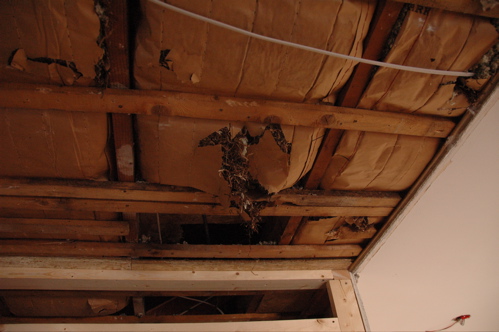
Over the years of our ownership, there have been lots of repairs and cosmetic projects in our house on Puddingstone Road, but nothing major until now. Builders are ripping down walls and reframing them into other room configurations. A bathroom floor and tub have made their way into the dumpster; I see grayed, creaky boards where they once sat. Old ceiling plaster has been pried and brushed loose. Shreds of insulation drift down, like ghosts released.

Here’s a picture of the insulation in the ceiling over what used to be Jimmy and my closet:

Cabot’s Quilt

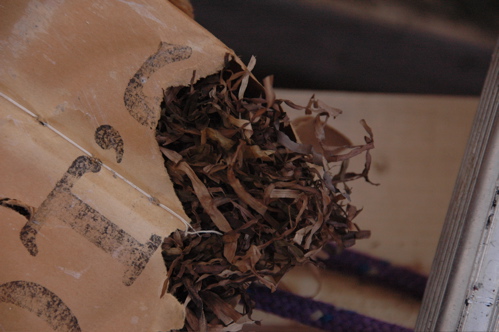
The stuffing, it turns out, is eelgrass, that profuse plant that washes up on ocean beaches all over the world. In 1893, Samuel Cabot, a chemist who graduated from MIT and Switzerland’s Zurich Polytechnicum, having learned that “early settlers had used eelgrass as a crude home insulation,” invented Cabot’s Quilt, clumps of the dried ocean plant stitched between brown paper. A six-inch layer of it is as effective as fiberglass, according to one source. There is a one-inch layer of it in our walls. Brrrr.

On the brown paper is stamped words: Samuel Cabot. Boston. One yard. Cabot’s. Those were the clues that helped me find the story (thank you, Google!) of this curious insulation, which went out of production in the 1940’s, although Samuel Cabot Inc. still exists.

When the foolish, unfiltered banker told us in 1999, at the signing of documents that made this house ours, that “bad luck” was associated with it, I retorted (politely), that it was up to us to “make it the good luck house.”

Although I think it is unfortunate that much of our house remains poorly and archaicly insulated, I am also pleased to discover that the walls around us are stuffed with a kind of leaf, stitched between paper that’s faintly printed with words.

Eelgrass from Cabot\'s Quilt

Is that karma or what?

– Making do

Are you curious about how people live when they’re undergoing renovations? Jimmy posts a picture today (March 28) of our living room doing double-duty as a dormitory for four people. Eli, whose bedroom is still intact, wistfully calls it “cozy.” He’s feeling left out of our nightly pajama party, and I have a feeling that pretty soon we’ll be making room for his bed among the other three. Hey, why not?

It’s not merry, but it’s manageable. We do get to wake up every morning to Junior Senior’s “Can I Get Get Get,” played by DJ Jimmy on his iPod speakers, also in the living, er, bunk room. Songs can make you happy.

– Signs of progress

Tending pachysandra, September 2007In September, I wrote (pridefully) of how I propagated and planted 100 pachysandra cuttings from my parents’ yard into mine. Within a couple of weeks, the cuttings had taken root and appeared sturdy. Over the winter, I checked on them from time to time, when they weren’t blanketed by snow. They drooped, yet remained green and leafy. I anticipated their spring return to robustness.

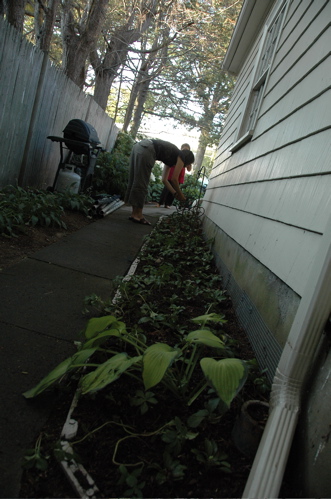
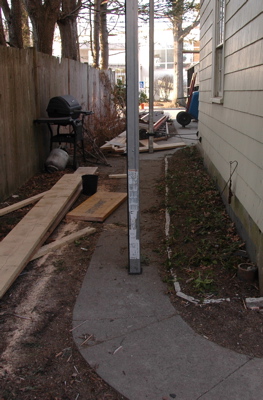
Flash forward to today: Now they’re trampled, knocked over, torn, dug up, and gone missing in places. Our house is undergoing what, for us, is a dramatic transformation — we’re adding a bedroom over the garage and redoing the rest of the second floor — and the builders and their staging are taking over the pachysandra’s territory.

Pachysandra, March

There’s also a pile of lumber on top of a more established hydrangea given to me by Leah B., a favorite former student and one I tutored frequently when I worked at Simmons. There are ruts in the lawn and broken branches on a holly. Around the foundation, where hostas and plumbago are soon to emerge, are scattered old nails and splinters of wood.

Do I feel sad? No, not that. Do I feel hopeful, that the return of a growing season will restore the trampled green things? Uh, no, because it’s also possible that the fragile pachysandra were too tender to survive boots, tools, and ladders. Yet I don’t exactly feel unhopeful.

I feel… like an accomplice. I set something into motion that’s directly competing with and possibly destroying some other process I set into motion. And all I can do is see it through, and do what I can to repair what’s been broken asunder.

The hydrangea will bounce back.  The broken holly will fill out again in a season or two.  Hostas are unstoppable and will find a way.  It’s the viability of the pachysandra I’m not sure about.

– Reciprocity

Sometimes a student enters the Writing Center in distress, having been told by a professor that his writing is so “unreadable” that the professor has not attempted, beyond the first paragraph, to read it.

These instances make me think again about the writer’s job, yet even more so about the reader’s. They each must try hard to reach the other. Writer, write hard. Reader, listen hard. Communication is a meeting in a middle place. Not a compromise, though. A meeting.

I like how Joseph M. Williams, the author of perhaps my favorite handbook on style, Style: Ten Lessons in Clarity and Grace 6e (Longman 2000), reflects on a writer’s role in this relationship:

We write and revise our earliest drafts to discover and express what we mean, but in the drafts thereafter, we write and revise to make it clear to our readers. At the heart of that process is a principle whose model you probably recall: Write for others as you would have others write for you. (220)

He says much more about the golden rule and a writer’s obligation, and I wholeheartedly recommend the chapter “Ethics of Prose.” In it, Williams also says this, about the golden rule and readers:

Some readers read less well than others, and some expect more from a writer than their meager investment of time and effort earns them. In fact, just as writers have an obligation to readers, so do we as readers have an obligation to writers: If we assume that writers work hard to say something important to us, we should read thoughtfully and generously, at least until we decide they have given us good reason to stop. (221-222)

Reading and listening — paying attention — to the words of another require generosity: a gift, a gesture. It takes effort to look beyond the lack of clarity in a student’s writing, but if we believe that they are making an attempt to say something important to us (it’s our assignment, after all!), then we should reciprocate. Williams calls such an exchange “fair” (222).

A penciled notation on the inside page reminds me that I paid $6.50 at Brookline Booksmith Annex for a used copy of Style. The latest edition, the 9th, is much more. Still, it’s worth it.

– Typewritten wish

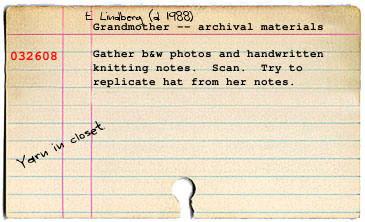
Card on E. Lindberg’s archives

The Catalog Card Generator is fun to play with, and the card you make might lend some concreteness to any project that right now seems a wish.

I want to knit a hat from some rather minimalist notes that my late grandmother wrote on the back of a birthday card, and which I recently rediscovered as I thumbed through a box of old knitting patterns and magazines she collected and I added to. And then I want to do something with that experience. (Oh, write about it maybe?) Wanting to do it, however, hasn’t gotten me any closer to actually doing it. I have the yarn and tools. What’s required is making that first move.

Well, I made this card, kind of like a “will do” note to myself. And now I’ve “put it out there in the universe,” as H., a woman I worked with many years ago, recommended that we do with our wishes and intentions.

– “It counts.”

Yesterday, after meeting with a small group of students, I set myself up in an empty lounge with a cup of coffee and a stack of Materials and Methods sections from my students’ scientific reports.

Before digging in, I sent an e-mail to a friend, another writer who tutors and teaches at a college in Pennsylvania, and said, “I’m not working on my writing right now, but my iBook is open and I’m about to write some comments on student drafts, if that counts.”

He wrote back instantly: “It counts. Oh yeah, it counts.”

– Boundary issues

When you let other people, especially underage ones, use your iBook, you have to let go of some amount of privacy and control.

Lydia parks herself daily in front of my screen, doing schoolwork, playing Scrabulous, and blogging. Once she hunted through folders and read the draft of an essay I was writing and had vaguely described to her. She wished she hadn’t. “It was disturbing,” she told me.

In iPhoto, I occasionally discover photographs I didn’t snap, like this one:

Pool party with dolls

Who are these people, and what are they doing in my Tupperware container, on my kitchen counter? And who let them use the camera?

Grace! Or was it you, Eli?