Well-made path to nowhere

We’ve lived in our house since June 1999. In the backyard, under a huge Japanese maple, is a dry, packed-dirt patch that has defied the planting of grass and flowers. Because it’s a long and narrow strip that follows the length of my neighbor’s fence, it has always seemed to be a natural location for a stone path.

But paths should lead you to a spectacle or stopping place, and one planted there would only lead you to my neighbor’s gate, which is never used. These neighbors are homebodies — the indoor kind — and we never stand in our backyards talking or offering pies to each other or doing whatever friendly people divided by fences do.

The path idea, though, had planted itself in my mind. Several weeks ago I picked a Saturday and wrote on my calendar: rent roto tiller! With that, a project was set in motion.

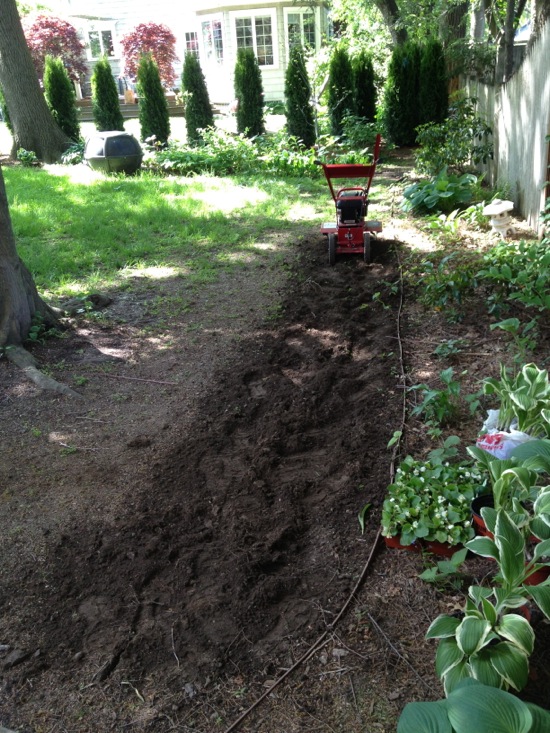
It takes longer than a morning to make a path. The labor happened over a few weekends; as of yesterday afternoon (Sunday June 2nd), it’s done. Here is how it unfolded in 10 illustrations: nine photos and one movie.

1. Tilling begins.

1 Path

2. Tiller does its thing; man follows. (Note: this is 7-sec movie.)

Continue reading

Paddle out, paddle out

At some point, the ideas become too many, and the pressure to write them becomes too great. The documentation of real life has its limits. Fiction seems roomier, or at least different.

So I begin. I start in a place I know, the setting for the story I have imagined. I writer, stop, write. The story starts traveling far away from the point I imagined the protagonist would travel to. I don’t know where she is heading anymore.

summer 2012

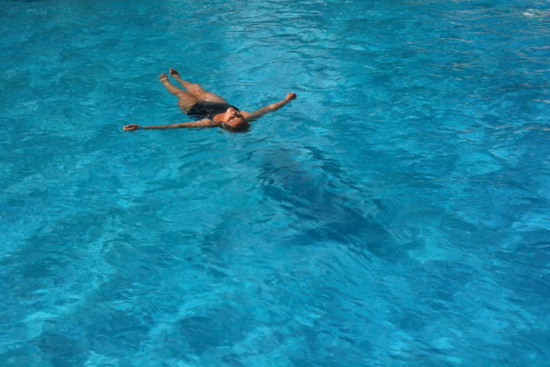
summer 2012, south boston swimming pool

I tell James, during our weekly hangout, “It’s like I’m swimming out, past the lifeguard buoys, and I keep going.” I wonder if I should turn back — to try forcefully to get back to the place the story began for me. But it’s going somewhere else.

James says, “It’s okay if you keep swimming out. That’s the good thing about metaphors.”

It’s true. I won’t drown.

What may be happening, he explains, is that in fiction we are writing a bunch of things at once, and wanting to deal with them all at the same time. “All these things come into the mind all at once” — and this is motivating, it keeps us going — but we have to deal with them separately, one or two at a time to give them the depth that the story wants.

And this going out, farther and farther, this might change the story.

Paddle out.

“Anxiety is based on the assumption that there is this perfect version of the story waiting to be unveiled,” he adds. “But there is not only one way; there’s a bunch of ways.”

Paddle out.

“Because it’s writing, you can stay out for weeks at a time. You’re not going to starve. You’re not gonna die of dehydration.” He pauses and laughs at his own joke in advance: “And maybe you’re a whale.”

I laugh, too, picturing myself.

That means I can dive under deep.

“But all the possibility is out there, so why would we tether ourselves to the land?”

I do not know where the story will go. I write, the narrative meanders, and I have to adjust my vision of it. And then I go farther, the story changes, and the vision is adjusted again. The story feels as though it is a few inches in front of my understanding, and I take a stroke, float closer, and it floats a few inches away again.

So I paddle towards it. I wonder if finishing will feel like getting back to shore, or reaching an island.

Return of the sunflower folly, with modifications

homemade seed marker

homemade seed marker

In the spring of 2009, I planted a sunflower folly in half of the front yard: link. It was a dramatic success. For me, it had been an experiment as well as a therapeutic act after I had experienced a major disappointment. In September, the growing season done, I was content with the results of my folly, documented them, and set the idea aside.

A month ago, as she watched me start the spring clean up, Lydia asked, “Can you do the sunflowers again? I loved that.” So here I go again, although on a smaller scale.

This time, instead of planting half the front lawn, we tilled up the barren strips that lie between the road and the town sidewalk. Sunflowers can grow anywhere, and the poor quality of this soil will not deter them. The flowers’ appearance will also delight passers-by and provide us with a visual screen.

Mail-order seed packets

Mail-order seed packets

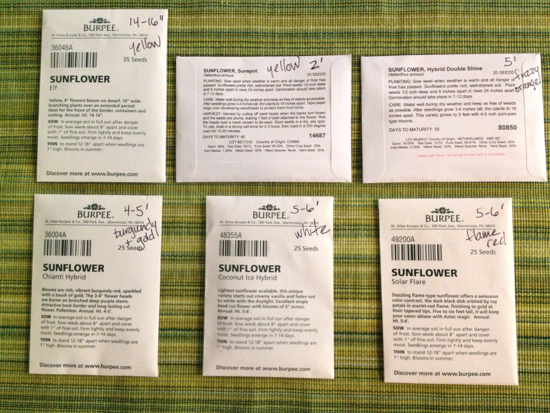
Seeds were purchased from Burpee and Gurney’s. Because the planted area would be smaller, I only ordered six packages total, in a variety of colors and heights:

  • Elf: yellow, 14″ to 16″ stems (Burpee)
  • Sunspot: yellow, 2′ stems (Gurney’s)
  • Chianti Hybrid: burgundy with gold, 4′ to 5′ stems (Burpee)
  • Hybrid Double Shine: fuzzy orange, not many seeds, 5′ stemps (Gurney’s)
  • Coconut Ice Hybrid: white, 5′ to 6′ stems (Burpee)
  • Solar Flare: flame red, 5′ to 6′ stems (Burpee)

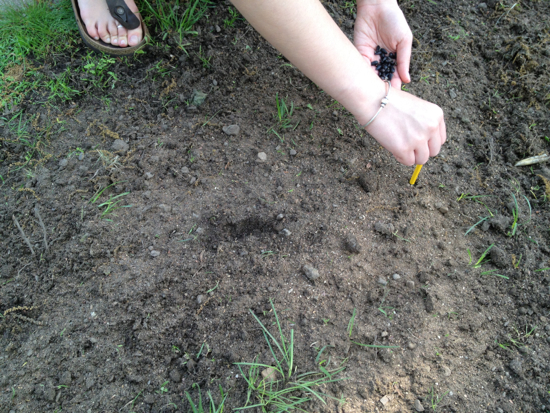
After tilling (thank you, Jimmy), Lydia raked and smoothed the dirt. I sprinkled on some foul-smelling fertilizer, and we used the eraser ends of pencils to make 1″ holes for planting the seeds.

Lydia plants her batch

Lydia plants her batch

Lydia came up with the planting scheme: tallest flowers in the sight line from our front windows, with shorter ones surrounding them. Her first proposal was that we “throw them down and let nature take its course,” but that was not enough of a scheme for me.

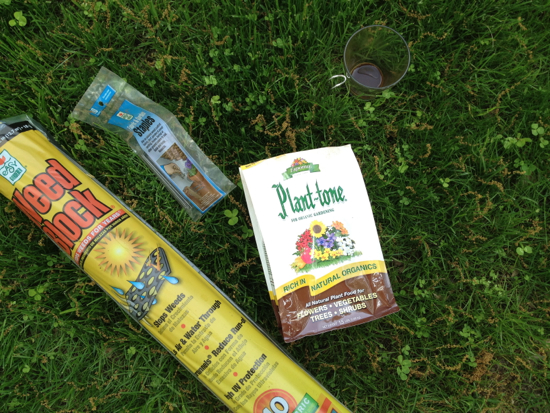
supplies: landscaper's cloth, staples, fertilizer, and espresso

supplies: landscaper’s cloth, staples, fertilizer, and espresso

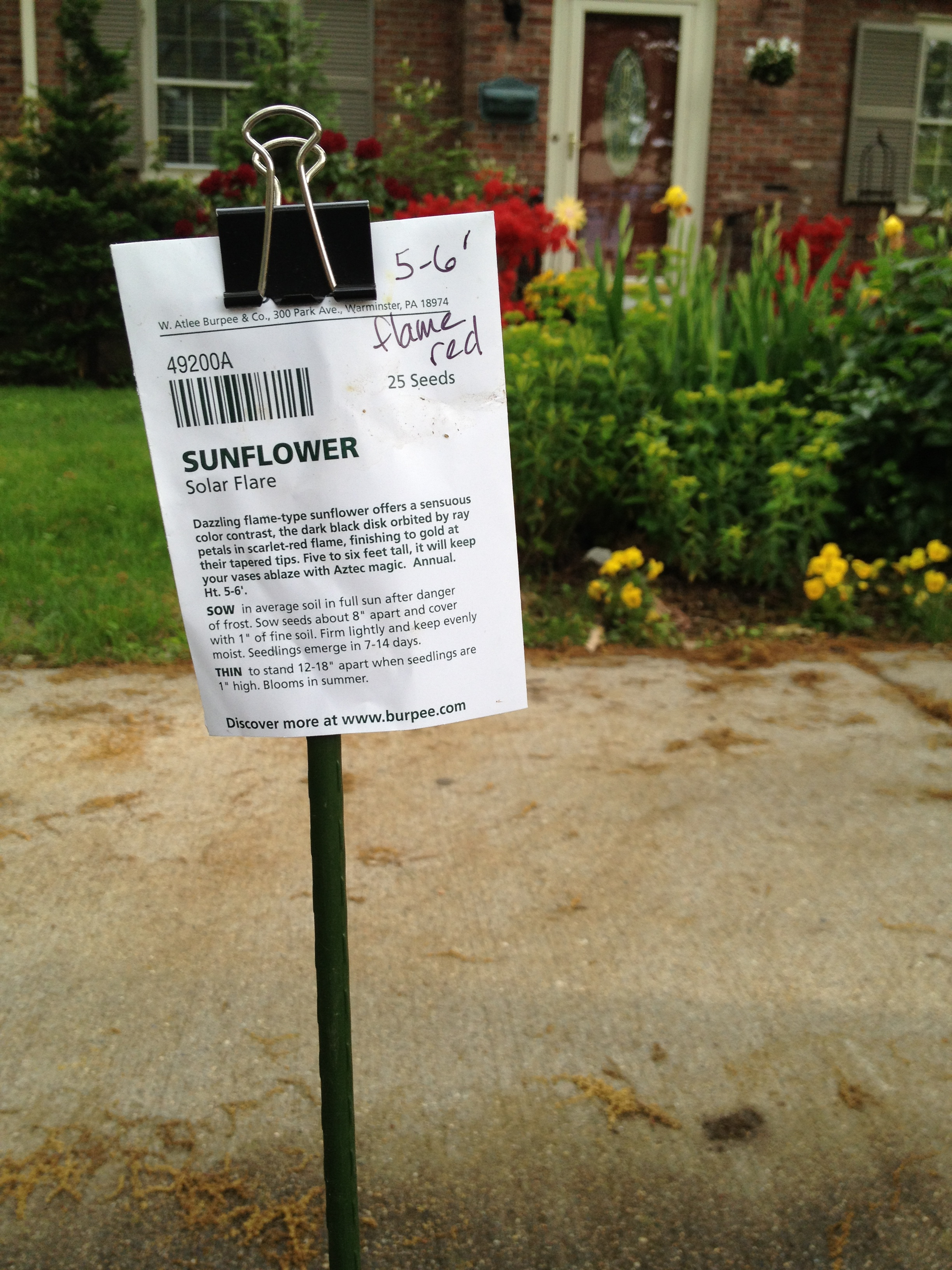
This was quick work. After planting, I watered the dirt lightly, put down some landscaper’s cloth with big staples (I used black cloth this time because I could grab it at Home Depot, but wish I had the white that I mail-ordered and used for my first folly). I made some improvisatory seed markers with the seed envelopes, some gardening sticks, and binder clips. See above.

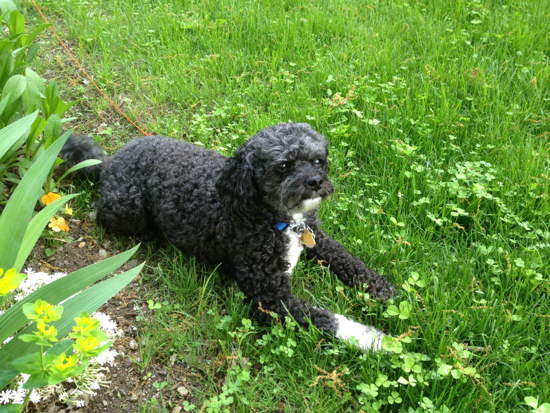
I drank espresso. Winston kept us company.

Winston, good company for gardeners

Winston, good company for gardeners

Official planting date: Monday, May 20. Stay tuned for progress reports.

—–

Previous posts on the Sunflower Folly of 2009, in chronological order:

  1. Sunflower folly: link (with full instructions)
  2. Sprouts: link (first sprouts, 13 days after planting seeds)
  3. First sunflower: link (first sunflower, 73 days after planting seeds)
  4. Habitat: link (folly as habitat for a wild rabbit)
  5. Harvest: link (sunflower harvest, four months after planting)

Blurt out, babble out the first draft (says John McPhee)

My favorite part of John McPhee’s recent essay in The New Yorker on first drafts and revision is the text of a letter he wrote to his daughter Jenny McPhee (now 51 and a novelist), when she was a senior at Princeton High School and frustrated by her inability to get things right the first time.

Dear Jenny:

The way to do a piece of writing is three or four times over, never once. For me, the hardest part comes first, getting something — anything — out in front of me. Sometimes in a nervous frenzy I just fling words as if I were flinging mud at a wall. Blurt out, heave out, babble out something — anything — as a first draft. With that, you have achieved a sort of nucleus. Then, as you work it over and alter it, you begin to shape sentences that score higher with the ear and eye. Edit it again — top to bottom. The chances are that about now you’ll be seeing something that you are sort of eager for others to see. And all that takes time.

What I have left out is the interstitial time. You finish that first awful blurting, and then you put the thing aside. You get in your car and drive home. On the way, your mind is still knitting at the words. You think of a better way to say something, a good phrase to correct a certain problem. Without the drafted version — if it did not exist — you obviously would not be thinking of things that would improve it. In short, you may be actually writing only two or three hours a day, but your mind, in one way or another, is working on it twenty-four hours a day — yes, while you sleep — but only if some sort of draft or earlier version already exists. Until it exists, writing has not really begun.

Entirely by John McPhee. A writer could go a long way on his advice and reassurance.

All the dead and ruined young lives

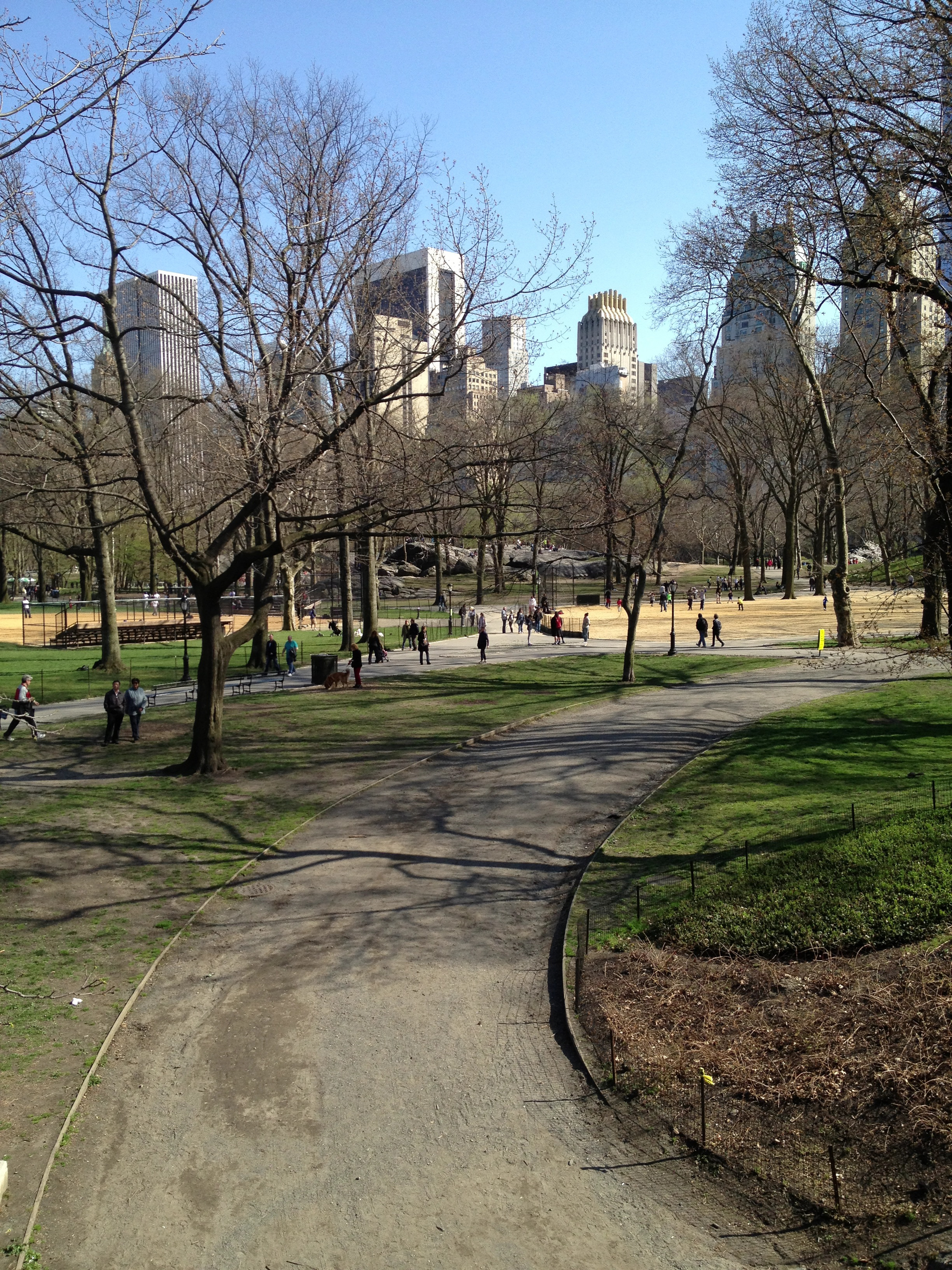
Central Park Running Path, 4.15.2013

Central Park Running Path, 4.15.2013

On Monday, April 15th in the afternoon, Lydia and I were walking through Central Park from the Guggenheim down to Columbus Circle. It was the end of a two-day trip to the city to see a college that Lydia is interested in applying to.

I kept looking at my phone because the walking paths curved here and there, and we followed them and yet still wanted to be headed generally in a diagonal across the park, so I needed the Google map. In the Ramble, I got a text from Jimmy:

There appear to have been explosions at the finish line of the marathon. We are at the arboretum, far away.

I did not know enough to worry, and I ignored the text. Maybe “explosion” meant firecrackers launched by naughty kids.

Lydia got a message from a friend about the explosions, and she followed up. Perhaps she is more easily alarmed than me, by personality or age. “Mom!” she said something like this, urgently, and conveyed the seriousness of what had happened.

Our walk to Columbus Circle — to go to Whole Foods to get something to eat on the train before we headed to my sister Emily’s office and then Penn Station —  lost its power. The beautiful spring day seemed to be happening to other people. Lydia even remarked, as we passed New Yorkers, that they probably didn’t know yet.

I did stop to take this photo (above) on a bridge that looked over a playing field and what is called Central Park Running Path, according to the geographic locator in Instagram. Lydia discouraged me from taking more, claiming that our moment for picture-taking was gone.

I didn’t know what I felt: distracted, there-but-not-there, worried about our travel plans.

When we got to my sister’s office near Penn Station, we heard more. We watched videos on our phones and my laptop. We discussed. The word “amputations,” more than any other detail, provoked whatever it is I felt, and those feelings I could not name.

Continue reading

Consider the hummingbird: a reading and writing exercise

Today I met with Karma, an MIT employee and adult student whom I tutor in English once a week through a pilot program. We have a grammar workbook that we are going through rather doggedly, and we like to break up the formal exercise with reading, writing, and speaking activities.

2483989061_536ffa3d77_z

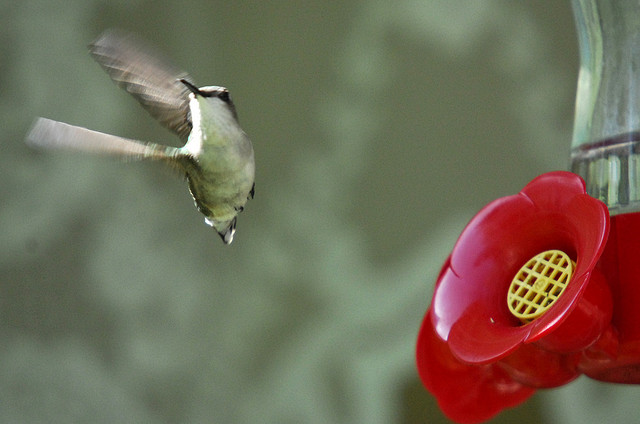
Last week we read out loud together one of my favorite short essays, “Joyas Volardores,” by Brian Doyle (The American Scholar, Autumn 2004). Read the full text here: link. It is about the hummingbird, and more. The essay is full of beautiful facts and therefore new vocabulary, so it is suitable for an ESL student. There is also a curious passage about the blue whale and a meditation on the human heart. There is much to puzzle over.

Today, we did some free writing based on the nature of the essay (i.e., facts lead you to ideas and even strong emotion) and its first sentence:

Consider the hummingbird for a long moment.

I proposed to Karma that we generate more concrete nouns, in place of “hummingbird,” for things we had knowledge about that could be described.

Consider the __________ for a long moment.

landscape
automobile
microwave oven
maple tree
Bobcat (small truck)
iPhone
computer
motorbike
kitchen
… and so on

I suggested that we each take the first sentence, put in a concrete noun of our own choosing, and free write from there, trying to emulate some of Doyle’s declarative style and building paragraphs on sentences with the simple subject/verb structure, which is used lavishly in the essay.

We wrote for 15 minutes. We read aloud to each other the first and last sentences of what we had written, to see how far our ideas had come. The noun Karma had chosen was “computer,” and the one I had chosen was “kitchen.”

I wrote a lot in 15 minutes, yet felt unhurried the entire time. (See below the jump for the full text of my free write.) I really was following my thoughts. Karma wrote less than me yet seemed contented also. This is a good way to get writers to excavate what they know from experience and observation; this exercise could be followed up with a research assignment to start to develop material from the free write into an essay.

I noticed, when Karma read it aloud, that his last sentence has the word “unimaginable” in it. A word in my last sentence is “unconscious.” We seemed both to have traveled from concreteness to the cerebral. To get to an idea is the goal.

What will we do with what we wrote? As we parted, I told Karma there is no real homework, but that I hoped he would think about his last sentence, and I will think about mine. We will start there next week.

Keep reading for my free writing…

Continue reading

Leaves of insight, before they disappear

6130889443_74c365a02b_b Here are three quotations from my reading over the past few weeks. Each has something to do with writing, even when it is not about writing.

1.
In this profile of Dr. Steven Zeitels (“Giving Voice,” John Calopinto, New Yorker, March 4), who is the surgeon who saved Adele’s voice, another patient, Scott Flaherty, “an operatic tenor… working as a teacher,” describes his motivation for undergoing risky surgery to restore his singing voice:

He explained [to Colapinto] why teaching was no longer satisfying. “I’ve grown tired of just talking about it,” he said. “I mean, when you sing you’re giving voice to your soul.”

Teaching singing to singing parallels the relationship of teaching writing to writing. It’s not enough to talk about or comment on. And yet that seems to be mostly what there is time for. This was my mournful state of mind in the weeks leading up to Spring Break.

2.
The playwright Annie Baker (“Just Saying,” Nathan Heller, New Yorker, February 25) also teaches in the graduate playwriting program at NYU. In his profile of her, Heller follows Baker and her playwriting students into the basement of a Washington Square bar, where they discuss the pressure to outline screenplays. Baker is wearied by them and negotiates her contracts to avoid outlining. She says

“I feel like it’s the most dangerous — I actually feel like Hollywood hurts itself when everybody outlines screenplays. And then it trickles down to grad writing programs. Like, I’m willing to sit around for hours to talk about what the screenplay’s going to be, and talk about ideas, and doodle diagrams on dry-erase boards, but I just won’t…. Because by the time I finish the outline, it’s dead.”

Talking and drawing can be explorative and generative when it comes to creative writing. But outlining: a killer. Too much left brain.

3.
Piano player Jason Moran (“Jazz Hands,” Alec Wilkinson, New Yorker, March 11) lives in New York but teaches once a month at the New Conservatory of Music in Boston. In tutoring Jiri Nedoma, who played his own composition once hesitantly and again with more sureness, Moran directed him to play it again, changing “the whole idea of the song”:

“Make it entirely different. Could you play it in stride piano?” […] Put different factors into the equation. Play it backward. Upside down. Your left hand might use something 1940 and your right hand is 2000, and what you find becomes part of your vocabulary.”

Nedoma played it again: “more delicate,” with richer chords. “He ended with a series of rising notes.”

Moran responded

“What you played at the every end, that’s where you should start… It’s almost like you played all that prelude just to find that little bit.”

Play, play, play. Mess it up. Experiment in unlikely ways. Often, you discover what you’re writing about at the very end — that’s what we tell students. It seems like this is true in other kinds of composition. What is found, at the end, becomes the new start. Not everyone, though, will have the perseverance to revisit one’s own work with the eyes of new discovery.

—–
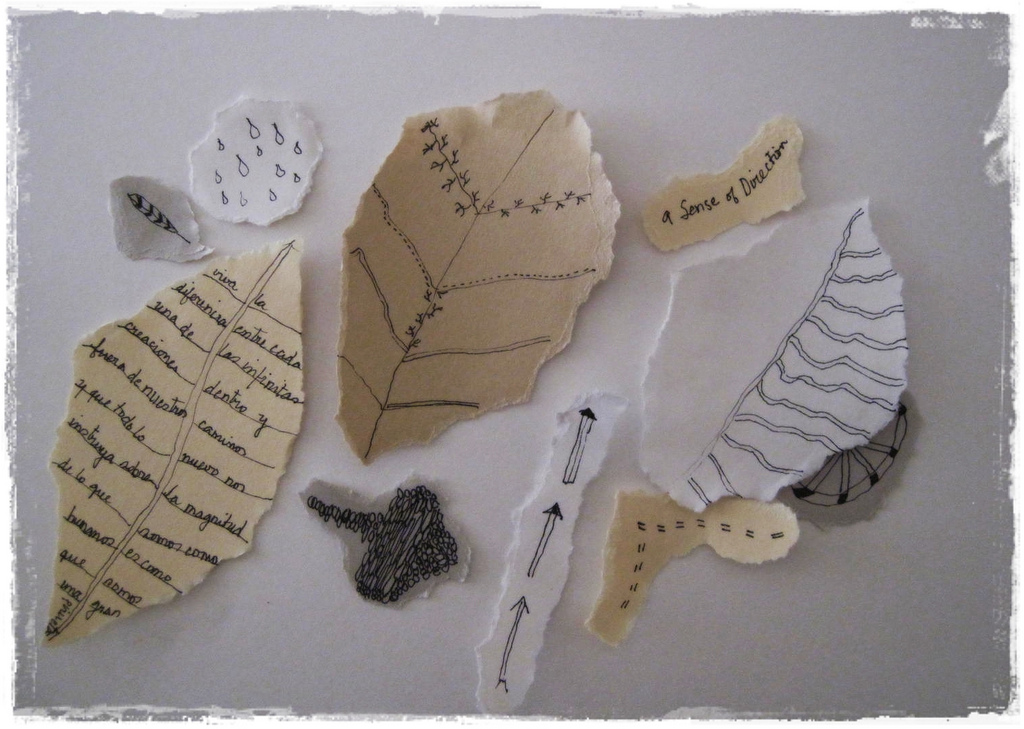
Image, “A Sense of Direction,” by Constanza on Flickr via a Creative Commons license

Cinderella goes to the ball

Cinderella is Grace, and the ball is a Bat Mitzvah.

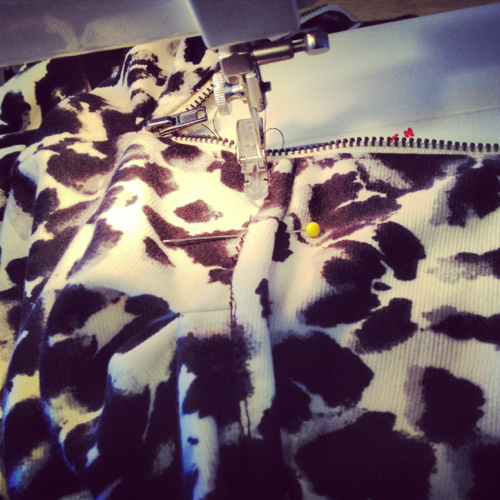
Today our house was a scene of cottage industry. I altered the dress I bought for Grace in the women’s department. The style and fabric were exactly what she wanted, but it was too drop-waisted, too long for a 5′ 1″ girl. Out came the sewing machine and ironing board.

sew dress 500

Meanwhile, Jimmy drove Cinderella to Target to buy some tights. He was shooed away by his daughter from the Intimates section of the store. I asked him where he lingered while waiting.  “Electronics,” he replied, with a tone that conveyed, “Where else?”

Later, I assisted with nail polish and jewelry selection and fastening. The black cardigan sweater, bunched up since the last occasion, needed some sprucing up with a damp cloth.

A check was written and greeting card found. Cinderella did her own makeup, and she is good at it.

wear dress 500

Purse, phone, hairbrush, and coat were gathered. Black slippers were slipped on.

I took some pictures.

Her carriage arrived. She went.

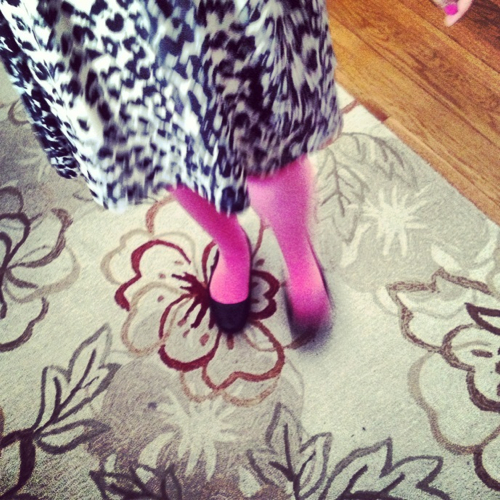
The ball, at a hotel in the adjacent town, ends at 11:30pm. Cinderella will be home around the stroke of midnight, in her customized dress, not-glass slippers, and pink tights from Target.

Precise, and soft at the edges

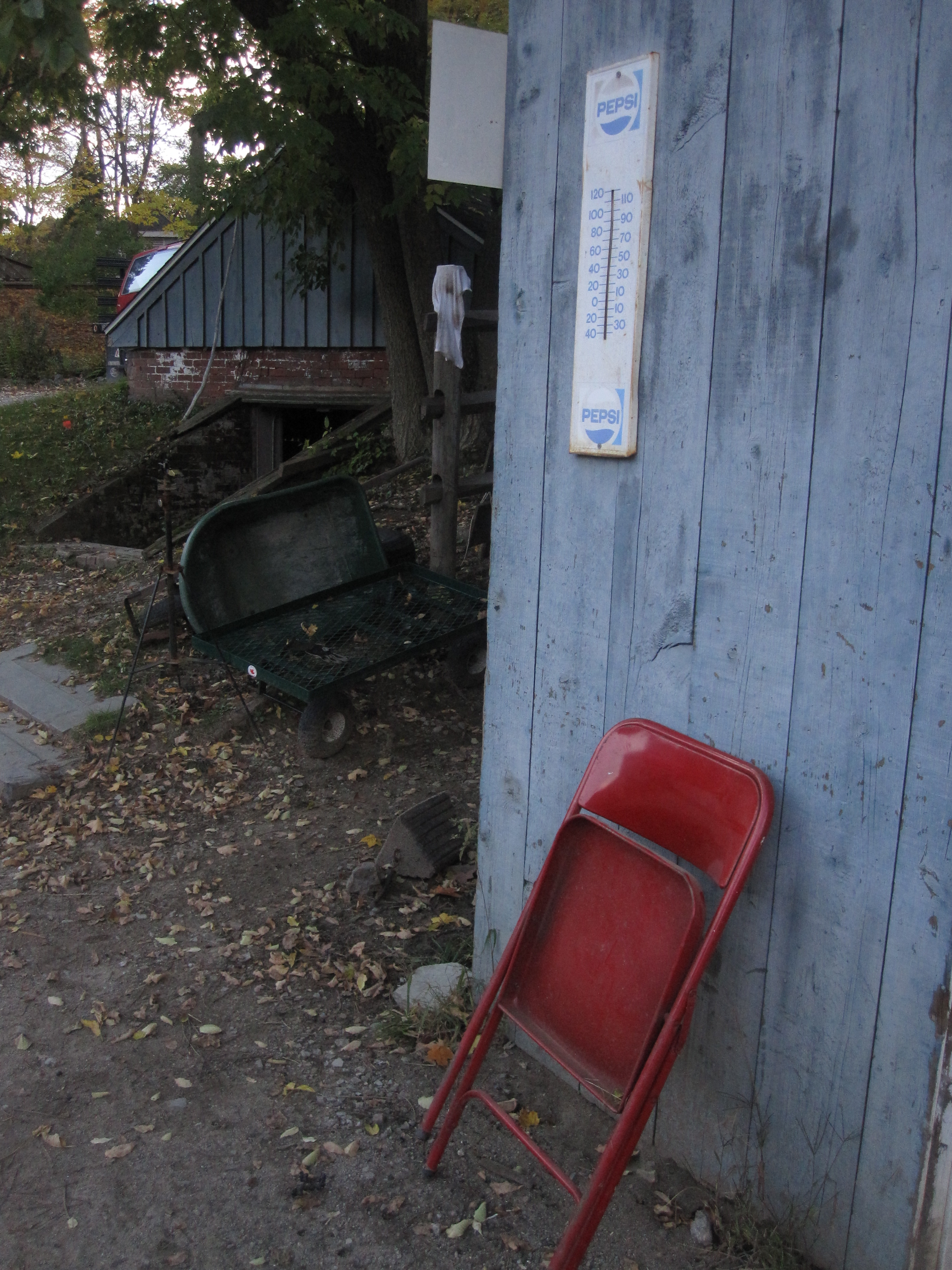
Red chairOverheard: A young instructor, after lab this week, to a another instructor, “My relationship to perfectionism has changed since I’ve become paralyzed.” She is in a wheelchair.

I hadn’t yet been part of this conversation. My ears perked up, I shuffled over, and I said to her, “You could write about that. I don’t think I’ve ever read anything with any personal insight into that topic from your point of view.”

We talked for a while about laundry folding and kitchen arrangement. Except for me, the group was made up of engineers, people whose work depends on attention to detail. When does attention to detail become perfectionism? I suspect there’s a continuum.

When I have been characterized as perfectionist, it feels like an accusation. The person saying it doesn’t admire the trait or its outcome (e.g., neatly folded sheets in the linen closet, a well-edited memo). Or it’s a way of distinguishing him or herself from me, as in, “You (Jane) are so uptight. I am easy-going.”

I don’t think of myself as desiring perfection, per se. Yet I do desire — and like, feel peaceful with — order, thoroughness, and the well-wrought detail.

Funny, I just had an impulse to make an annotated inventory of what parts of life or the physical world seem more pleasing to me if they are in line with my standards. It might start like this:

  • kitchen cabinets: stuff should be categorized, not stuffed-in randomly
  • closets and bureaus: neat, folded, unstuffed
  • desk: clear surface, things put away
  • yard: neat, trimmed, branches picked up — however, I don’t like a precise, manicured look — there has to be softness around the edges… and yet there are edges…
  • natural world: I like to see fallen branches, puddles, rusted cans among leaves, and yet I usually get to these places via a well-made path, which I like
  • writing: I prefer a fully-explored draft, even over-stuffed with ideas or information and long sentences, yet I want a finished piece to have shape, flow, grammar, and an absence of cliché, which to me is a kind of inexcusable clutter

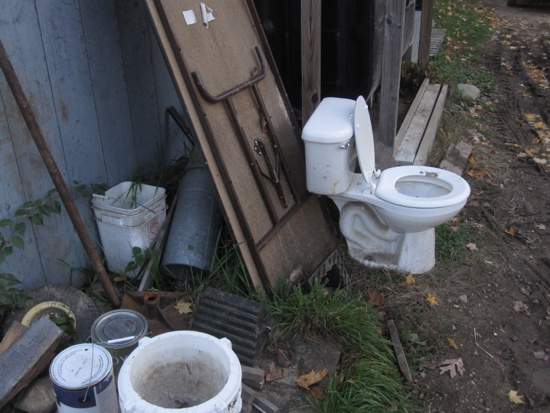
Toilet outdoorsAs time passes, and therefore there is less time in front of me, I let some perfectionist tendencies go. One does this also as a parent, as soon as you recognize that your infant is a wild thing. Students, too, have minds of their own.

But I hang on to others — performance at work and art and in the primary relationship(s) — and in some ways exacting standards are hampering.

To chew on some more.

—–
Photos taken October 21, 2012 at Allandale Farm by me.

I try and try to understand. I study you for clues.

Winston is two years old, a poodle Shih Tzu mix, and a stray. Two days ago we adopted him from the MSPCA shelter in nearby Jamaica Plain. Besides a few health observations made by the shelter volunteers and veterinarian, those are the only facts we know about Winston, who was once named Saint. This is our first dog.

Winston_Grace

Winston and Grace

We study him for clues, trying to discern his “personality,” his preferences and fears, and even the unknowable: his family history. When Grace, Lydia, and I met him for the first time at the shelter, he brought to the bars of his pen a soft calico bone-shaped toy. We took that as a signal to play, as when a dog drops a stick or ball at your feet.  The first toy we bought him, once he was ours, was a soft fleece bone-shaped toy. He holds it in his mouth, brings it to us, but not to play catch, we’ve discovered. He doesn’t let it go; he doesn’t want us to tug at it.

Here comes Winston

Here comes Winston

We’ve discussed at length what this sign might mean. Lydia has deduced the fleece bone is a comfort object, like a child’s pacifier, and says, “I want to know what his life was like. I wish we had more information.” Jimmy, who came with us for the formal adoption visit, has observed Winston at home, and concludes that he was once well-cared for. Winston has some nice habits and deliberate gestures. We don’t know what they all mean yet, but we suspect they are part of a communication system he had with other people.

He’s just a dog, I know. Still our urge to know him — not as a blank slate but as a creature with a history and with an inner, coherent life — is strong.  We desire very much to understand him: through observation, but beyond it too.

Winston_shelter

First meeting: we belong together

Meanwhile, this week I am reading Joan Acocella’s profile in the New Yorker of psychoanalytic writer Adam Phillips. He claims that our deepest urge is to be understood, and he finds this to be a fruitless urge and “our most violent form of nostalgia,” says Phillips. It is “a revival of our wish, as infants, to have our mother arrive the instant we cry out from pain or hunger,” explains Acocella.

I have wished to be known, to be deeply understood.  I am skeptical, however, about Phillips’s reasoning. It’s too Lacanian for my taste. Would we really spend our adult lives driven by desires established in infancy? That contradicts my common sense. (Or perhaps Lacan’s ideas confound my understanding. Also possible.)

My urge to be understood comes from my strong inclination and effort to understand others: Jimmy, my children, the members of my family of origin, my closest friends, and even the occasional colleague or student who intrigues me. This effort to understand — although conducted invisibly and silently — I give as a gift. I want the same one in return.

And maybe we are all doing this all the time: studying each other for clues. Or maybe this effort to understand others is gendered. Or maybe some people, like me, emphasize understanding in their relationships, and others emphasize problem-solving, favors, or action.

I do agree with Phillips that we would be better off in accepting our lives and stop always striving to fulfill its potential.  Good luck with that, though. I both aim for that and find it hard to do.

Winston faces the camera

Winston faces the camera

We do know we will never fully know Winston or get the facts on his family history. We are constructing a new narrative, and in doing so we are envisioning a previous one. We will assign logic and meaning to all the clues and believe at some point that we know our dog. But we will really only know the story we have made of him.

P.S. Yes, I know. He’s a dog. It’s my thoughts about him that interest me, which make me wonder about my thoughts about just about every person in my life.