There is beginner’s mind, and then there is beginner’s body.
*
 Around the time I turned 40, I got this idea that I wanted to become a good skater by the time I turned 50. The impulse hit me when I was at the rink in Brookline, skating with the kids, and I noticed a woman older than me who was powerful and fluid on the ice. I wanted to skate like her, and, even though her skating was more advanced, this suddenly seemed doable to me and desirable. Later, I found out she had started skating in her early 40s when her son was playing hockey, and she found herself looking at the ice and longing for it. So she began. At 60, when I met her, she was strong and graceful. This, by the way, is the first lesson in learning something new and hard: (1) Look for real-life models. Famous athletes may inspire us but, because their talents are stratospheric, can’t really convince us that we can do it.
I had been on the ice hundreds of times — if you grow up in Massachusetts, as I did, it’s almost a requirement that you get a new pair of cheap skates every year for Christmas and spend lots of time clumping around on frozen ponds or public ice rinks — but I couldn’t skate well. At age 40, I started taking group skating lessons for the first time. I learned a lot, starting with this basic fact that skates have edges (and if you have two feet, there are four edges altogether, or eight if you include forward and backward), and control of those is the foundation for everything. I also learned, from a teacher named Mark, that you can be afraid to do something and still make yourself do it. “You will fall,” Mark said. Being mindful of the possibility of injury makes it harder to try new things as an adult, and this fear must be managed in order to proceed. Which leads me to this: (2) Be afraid to fall, and skate anyway. I am, and I do.
You can only do beginner lessons so many times before you start to bump up against a ceiling. This winter, at age 45 and at my halfway point, I decided it might be time for private instruction. Happily, the teacher of the group lesson I was taking also teaches privately, and the transition was easy. I discovered, too, that the decision to do this was a signal to myself of the seriousness of my goal. You can’t hide in a 1:1 learning situation as you can hide in a group (and one can even hide, paradoxically, by excelling against other beginners). Another lesson: (3) When it starts to get easy, become more vulnerable to the task.
It’s a luxury to have the devoted instruction of an accomplished professional for one hour a week. (No wonder students like meeting with me alone for an hour to work on their writing.) There is an intensity to the learning experience that is different from a group experience that is a deep pleasure. The learner is also scarily exposed in a private lesson; there is no stepping to the side to let someone else skate ahead, and there is no half-assed trying just to get a little cheap credit for having gone through the motions. Continue reading


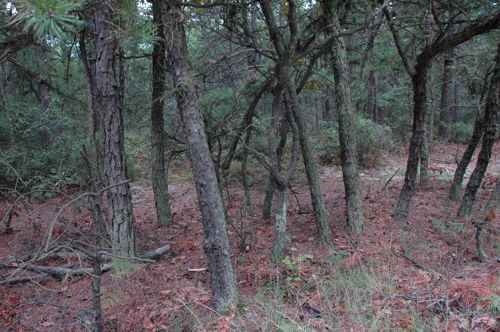 “What did you find out?” That was the question I was asked when Jimmy and I returned from our one-day field trip to the Pine Barrens of New Jersey, to find

 leaf stitch word