– Christmas ghosts

A couple of weeks ago I hurt my neck or my shoulder — “the C6 region,” according to the chiropractor whom I started seeing out of desperation yet now am quite attached to — and it’s been hard to get into the anticipatory rituals that make a holiday interesting and attractive. When I was a child, my mother would bake cookies for gifts, and this would start weeks in advance. The house always smelled like almonds and butter and oven heat. It was fun to try to guess where she hid the cookies, and a treat to be allotted a few.

I have done no baking, no Christmas cooking.

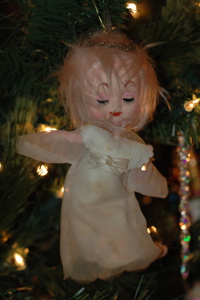
Ornament, c. 1965

Ornament, c. 1965

Tonight for our Christmas Eve dinner we had pizza rolls, noodle soup, and squash soup, plus glasses of milk. Deck the halls. I had said to Jimmy, when we went out earlier at 5pm for a last-minute errand, “I wonder what the Hales are doing tonight?” Those are my cousins, with whom I grew up, and, for perhaps the first 36 or 37 years of my life, we spent every Christmas Eve together. Whether we gathered at our cousins’ house across the street or at ours, the basic meal was always the same: deviled eggs with a bit of paprika, Swedish meatballs, scalloped potatoes, pickled herring for the old aunts, ham, Uncle Bob’s baked beans, green salad, and in the early days a gelatin salad. Some years a daring cook would experiment and bring a new vegetable dish; sometimes there was lasagna. There was always plenty; my mother and her cousin Joyce believed there had to be a lot, “because men like to eat.” While they were right, I noticed that the women liked to eat, too. Continue reading

– Thumb splits

Last week I was at the Chestnut Hill post office, and on the female clerk I noticed the tell-tale sign: colorful bandaids wrapped tightly around the tips of a few of her digits.

I winced in sympathy. “Oh, finger splits?” I asked.

“Yeah,” she said and seemed to groan. “They’re terrible. And always this time of year.”

“I know. They kill.”

“They really do,” she replied. “Especially the deep ones. They don’t seem big enough to cause that much pain, but they do.” Meanwhile, her hands kept moving, moving, moving. It’s the dryness of the winter air and the constant activity of our hands that do us in.

“Try Super Glue,” I said.

“Uh, I don’t know about that. A girlfriend said the same thing, but, uh, I dunno.” As she talked, she remained in motion: shifting packages, stamping them, sorting bills and coins.

skincrackcare“Well, there’s a skin glue that works, from 3M. It’s almost as strong as Super Glue. I’ve tried it.”

“Okay,” she said.  “Okay. Thanks!”

Behind the long counter, the clerk stood in her spot, her busy arms like the hands of a clock and she the center of a circle. Perhaps she is resolved to keep suffering, as we all are. I had a feeling, as I walked away, that she would stick with bandaids.

– Sunken treasure?

Where was the scrap of paper on which I had written down the date and time for a long overdue haircut? I remembered inserting that scrap between some others I’ve accumulated in my school bag.

I couldn’t find it.  I took my wallet, notebook, pencil case, and glucose monitor kit out of my bag, and I peered into the morass.  I stirred the papers and other items resting on the bottom. The scrap I had in mind did not float up.

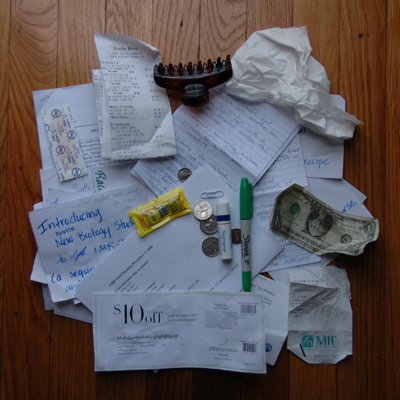
I dumped out the bag onto the floor in the hall. Although I didn’t find what I was looking for, I did find all this: the evidence of an autumn that has flown by.

the things she carried, 12.9.2008

the things she carried, 12.9.2008

Yes, I did style the pile a bit to make the contents distinctly visible and composed.

Here’s the list.  Make of it what you will.

  • notes for a handout on presentations for 2.009, a class
  • grocery store receipt, dated 11.19.08, amount due $149.36
  • hair clip (what Emily calls a “chip clip” for hair)
  • wrinkled, yet clean, tissue
  • dollar
  • coins
  • $10 off coupon to DSW, where I’ve gone twice to search for perfect black boots and failed
  • feedback from Grace’s fall parent/teacher conference, dated 11.12.08 (favorite phrase in it: “pours an abundance of energy”)
  • letter to me on Joslin Clinic stationery
  • receipt from ATM at MIT, dated 10.07.08, in amount of $50
  • green Sharpie
  • white-coated paperclip
  • bandaid (I usually carry enough to share.)
  • Neutrogena chapstick (“The best,” say I.)
  • mustard packet from the snack/sandwich bar at school (an extra from the occasional ham & Swiss sandwich I buy there)
  • scraps of paper, cut into approximate 4 x 6″ squares, on which I first storyboarded a conference presentation I made on 11.22.08
  • agenda of last week’s staff meeting for 2.009

Not junk, not junk at all. Really, artifacts.

And now I’m going to start something from this.  Let’s call it the School Bag Meme.  I tag my blogging and college teaching friends Alex, Dr. Poppy, James, Jan, and Rosemary.  What’s in yours, at this very moment? And how or why did it get there?

– Needles and activism

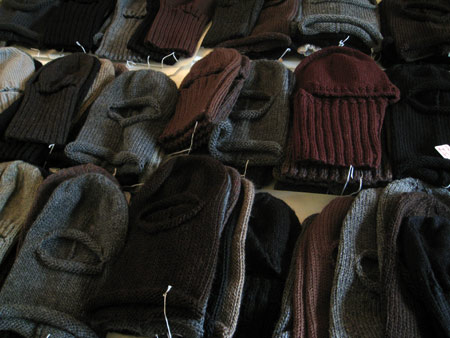
The knitters at Stitch for Senate are making helmet liners for every member of the U.S. senate in order to engage “with public officials about the war in Iraq.”

Helmets, stacked, by Stitch for Senate

"Helmets, stacked," by Stitch for Senate

This puts me in mind of Eyes Wide Open, an exhibit of boots and shoes, representing military men and women killed in the Iraq War, that we stumbled across once when we were visiting my in-laws in New Jersey.  We drove past a library and on its front lawn were rows of boots.  Plain, magnetic.

When artists and activists use the everyday, intimate, and individual to make a statement about the enormous — war, power, death — that brings the enormous in close.  I can imagine my head in the knit helmet, and my feet in the boots.  And perhaps by imagining myself inside, I can start to imagine the other.

– Bodies are weird

These few lines are from a conversation that Jimmy and I had in our upstairs hallway this morning.  It happened to be about menstruation, but it just as easily could have been about sex, psychopharmacology, or even double-jointedness.

Jimmy: Bodies are weird.

Jane: That may be because we think of them weirdly.

Jimmy: And that would be because of our bodies.

Touché.

And speaking of bodies…

“Tethered to the Body,” an essay on my adjustment to wearing an insulin pump and its affect on my sense of (sexual) self, appears in the fall 2008 issue of Bellevue Literary Review. The full version is not online.  You can get the journal at bookstores, or you can e-mail me and I’ll send you a PDF.  In the meantime, here’s the first paragraph:

A $6,000 insulin pump with an on-board computer chip is not alluring.  Neither is the white mesh adhesive patch on my naked abdomen or the length of nylon tubing that connects the patch to the pump.  There is only illness, and there is no way to make that sexy.  After several years as a medical device wearer, I know.

– Considering toast

Toast, from toastalicious.com

Toast, from toastalicious.com

I was thinking of a croissant with my coffee, but then I smelled toast. “Ah, toast.” This was as I got within 20 feet of the snack bar in my building at 9am this morning. I gave in to the toast impulse — I smelled it, I pictured it, I heard the sound of the word in my head — and it seemed foolish to get what I suddenly no longer wanted.

At my desk, I ate the toast. I drank water and sipped coffee but did not look at papers or compute while eating. I stared at the wall; I thought about toast.

Henry James said that “summer afternoon” are two of the most beautiful words in the English language. I cannot disagree. Yet, I’d like to add “toast” to a short list of beautiful, evocative words. Dr. Poppy, in her response to my post on snacks, reminded me of its sensuality and charm: “simple but… sustaining.”

And yet, I was thinking as I ate my toast, do writers always use toast as a detail to convey the same feeling? Is toast a cliché? Would it be possible to ruin toast for a reader, or at least subvert it?

Examples:

At the last minute, she put toast under the pillow. All night, her hand worried it and not the hardened blisters on her wrist.

Their naked bodies pressed together, only Donna’s toast came between them: scratchy, buttery, and smelling of last night’s onions.

Before he tucked the dead squirrel into the shoe box and interred it behind the dog house, Little Guy lay freshly made white toast in the box’s bottom. The toast’s firmness supported the stiff body; a smear of blood seeped into the surface crumbs.

The doctor recommended toast in the sneakers overnight, to deodorize them. “And soak those feet in vinegar, twice a day,” he added. Joe would try anything.

Would the reverse also work? Could you take a noun with negative associations attached to it — like pus or viscera — and make it lovely?

Hmm. It seems easier to try to ruin something than it is to repair or beautify something else.

– Last beach day

August 31, 2008.  Cold Storage Beach, East Dennis.

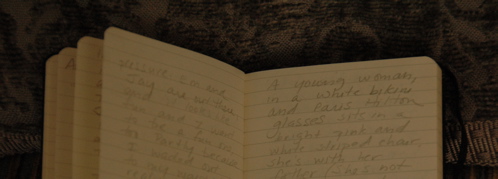
Pages from August 31st notes

Pages from August 31st notes

Verbatim:

“It’s Michael Krantz’s birthday,” Jimmy says when I ask him the date.

The family near us has a boy about Grace’s age with the same insulin pump as mine.  I talk to the mother.  Among many interesting things, she tells me about Cheating Destiny, and parts about history of insulin.  At some point we talk about my parents’ crying when my brother was diagnosed, and the boy says, “I have seen my mother cry four times.”  He grins and adds, “And it was because of me.”

Two families away there’s a guy my age who is fit, who knows it, who wears dark yellow trunks and, over his nape-length curly graying hair, a navy blue bandana tied pirate style.  He’s reading a hard-covered book called God of Sex, I think, although all I can see on the black cover are the big words “God” and “Sex” — I filled in the preposition — and he holds a fluorescent yellow highlighter.  His lady friend (no ring) is blond and wears a yellow bikini.  They are listening to Jack Johnson. It’s loud, which drew my attention to them.  That’s the point.

I am reading Stephen McCauley’s Alternatives to Sex.

In the channel out of the harbor, the lobster roll boat has struggled in the unusually choppy surf and turned around. $20 for a lobster roll and aborted boat ride.  Lazy American recreation.

We all talk about the Lobster Roll Boat.  “Think about boats,” Emily says: “what they mean to fishermen and what they mean to us.”  Yes, I have been on boats and not ever to fish.

I go in the water.  Partly out of guilt: my mother says, “Look at Lydia alone out there, she wants you with her.”  Partly out of peer presssure.  Em and Jay are out there, and it looks like fun and I want to be a fun one, too.  Partly because I waded out to my waist then realized it was not too cold to bear.  Out there, I lick my lips.  They’re salty.  I’m young again.

A young woman, brunette in a white bikini and Paris Hilton glasses sits in a bright pink and white striped chair.  She’s with her father.  (She’s not old enough to have such an older boyfriend.)  Out of their cooler she takes a bag of Dole lettuce mix and a plastic container.  She pours something from the sm. container into the Dole bag, then bunches closed the Dole bag and shakes.  Ah, salad in a bag.  Again and again she puts a fork into the bag, which she holds on her bare legs, and spears some salad.  She eats and eats, the whole thing.  Perhaps because she is so beachy glamorous, she makes this efficient eating, well, charming.  No, cute.

Jason left and came back w/ Nutter Butters and Heineken.  I haven’t had a drink on the beach since I was 15 or 16 and went to Maine w/ Heidi C. and her mother brought a pitcher of gin + tonic along w/ the picnic basket.  I tell my mother this.  She’s alarmed, too late.  “Sandy let you drink?!”  She shakes her head.

At 3:30 it feels like 5:30 did two months ago.

God/Sex pirate and his sexy wife (can’t be girlfriend) have three sexy teenage children.  It’s not only that they’re all good-looking.  They’re supple, and sit in poses. Louche.

Later, Grace walks out to end of jetty and Jimmy follows.  Our caravan gradually leaves.  My father and I still sit in canvas chairs.  He remembers carrying Eli, as a toddler, out to the end of some jetty.  He remembers carrying a little Eli from Boston Public Garden all the way back to Brookline.  He and my mother — always walking.  There are no more babies to carry; the grandchildren are all school age.  I realize that a person only gets, at most, two turns at babies in his/her life: as parent and grandparent.  My parents have had their two.
– On head lice

Over the summer, I finished writing a personal essay on my experiences with head lice. As part of that process, I researched and read way too much about Pediculus humanus capitis, a parasite that feasts on human blood and causes incessant itching. I also wrote about times, which I thought were past, when lice descended on our house.

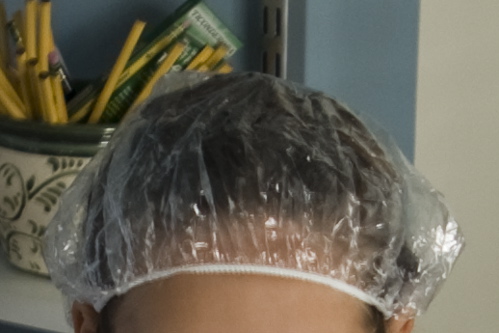
Grace undergoes a Licefreee! treatment

Grace undergoes a Licefreee! treatment

Well, the past has become present, and I’ve had to confront some fresh cases of infestation. This time, though, I feel no panic, because I see lice and I know what it takes to get rid of them. I’d like to share what I’ve learned with readers who may be confronting head lice on their children’s heads for the first time. Continue reading

– Hesitation

I went out to do errands. I brought Jimmy’s Nikon (very sharp, with a telephoto lens), because there’s a store sign I pass all the time that’s awkward in a provocative way. I meant to take a picture of the words; I forgot.

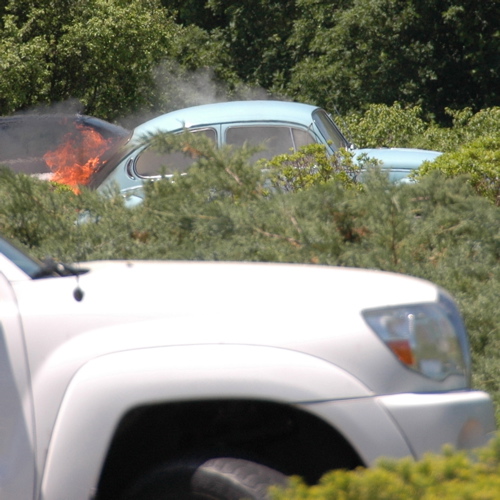
I did, however, see something else amazing: a blue VW bug on fire. It was directly across from me at the intersection of Rt. 1 and the entrance to the Dedham Mall. I was stopped at the red light; the burning, smoking car was in my sight line; and I remembered I had a camera. Opportunity!

I paused. The camera remained momentarily on the seat beside me. I mulled over my situation, step by step. This is what went through my mind:

  1. There’s a burning car. I should take a picture of it. I, for once, have a camera with me.
  2. If I roll down the window, and lean out with the camera, the car might choose that instant — with my luck — to explode, and spray burning gasoline and shrapnel in my direction.
  3. I could get burned, badly.
  4. Could the spraying flames from the exploding VW ignite the fuel in my car? Could I blow up?
  5. How terrible that would be, to be either horribly injured or die, in the act of taking a completely unnecessary picture of a stunning event.
  6. Perhaps I should turn into the parking lot and consider my options.

The light changed. And I turned into the parking lot. Then I took, with me sitting in the open window of the car to get some height and the lens zoomed to the max, this picture:

VW Fire, Rt. 1, June 12, from Uno\'s parking lot

The shot I missed was better: Herbie the Love Bug, looking me in the eye, with flames coming out of his rear end and smoke rising in billows over his roof. I guess I could never be a photo journalist (although I don’t recall ever having wanted to be one). I don’t act fast enough. Even a few seconds of hesitation, which is about what it took to go through that series of thoughts, adds up to a lost chance.

This tendency could explain my not being good at fast-moving multi-player sports.

This habit of pausing to gather my thoughts, however, which drives my kids nuts, could also account for my being pretty helpful in emergencies, as I think Julie, for example, could attest. If you’re with me, and you have a wound that’s dripping blood, I’m not leaping to the mental conclusion that you’re about to bleed out and die. I’m wondering where, exactly, did I stash the car’s first aid kit, and where on your body should I place some gentle pressure to get that blood to stop, and what should I say to you so you won’t worry.

– Hazards of reading

This is an approximation of a conversation I had with Grace recently. While I did not invent her remarks, I did cut out some of the repetition. There also were a lot of thoughtful pauses I have eliminated.

Grace: How old do you think you’ll be when you die?

Jane: Old, I hope.

Grace: Who do you think will die first, me or you?

Jane: Me.

Grace: Who do you think will die first out of me and Eli and Lydia?

Jane: I don’t think about that. You all will live a long, long time.

Grace: Why do people have to die?

Jane: Because their cells wear out and they can’t last forever.

Grace: Why can’t we live always?

Jane: I’m so sorry. I know. I promise, though, you will live a long, long time and life will feel long enough.

Grace: How long?

Jane: Grace! Could we talk about something else? How about… what are we going to do tomorrow?

Grace: I can’t help it. I just keep thinking about this.

Jane: Why do you think that is?

Grace: Because I’ve been reading biographies.

Jane: Oh?

Grace: Yeah. And I’ve noticed — people are always dying in them.