– Opposable thumbs

The tips of the nails on my thumbs are always notched, never rounded. The padding around the nails is usually cracked and, in the winter when it’s dry, split and bleeding. Every day these useful digits are under pressure.

My thumbs

With them, I peel stickers off apples; hold tiny bits, like garlic cloves and jalapeños, as I mince them; scrape dried paint drops off the floor; pry open the tightly sealed container of a glucose test strips bottle, six times a day; dislodge nits from children’s scalps and hair and pinch them off; peel up the ends of tape from the roll; snip withered leaves and blooms off plants as I walk by them; puncture plastic bags of mulch or frozen french fries; press a rubber eraser down on the page; pick snarls out of thread; unknot shoelaces; unbutton and button my pants; buckle belts and Mary Jane shoe straps; unscrew the empty reservoir from my insulin pump; fish coins out of my wallet; adjust a slipped bra or camisole strap; floss; and more.

When I, occasionally, use my teeth as tools — to open something stuck, or to bite open a knot — I hear my mother’s voice in my head: “You’re going to crack a tooth!” No one, however, objects when I maltreat my thumbs. They’re designed for many tasks, for any task.

Emily, my sister, broke both her thumbs when she landed and keeled backwards after completing a running long jump during Field Day activities in 8th grade. I was in college at the time, and I remember that sinking feeling of sympathy when my mother called me and told me about Em’s accident, and that her hands would be casted for six weeks.

Imagine six weeks without the use of your thumbs.

Photograph by Jimmy.

– The long bones

Bones

A student in the college’s funeral service program brought into the Writing Center her paper on organ and tissue donation. Before I read it, I asked her about the assignment, and I also asked if there was anything in particular she’d like me to read for. The assignment, she told me, required her to cover all aspects of the subject — religious, legal, ethical, and technical — in about five pages. When I raised my eyebrows at this, she remarked, “Yeah, it’s a lot to cover in a short space.” And she asked me to read “to see if it’s all right.”

Her writing was all right: clear, grammatical, good paragraphing. As reader, though, I found myself most fascinated by the one or two page technical section, which described how enbalmers remove organs and tissues and then prepare bodies after that, and especially by a paragraph or two on the long bones: the ones in arms and legs (and later I found out, in fingers). Not only did I not have any previous knowledge that these could be donated and transplanted, I loved the sound of the phrase “the long bones.”

I thought of telling her how all the action in the paper was in my favorite section and presenting the possibility of revising around that section. I stopped myself. She didn’t ask me how to write an exciting paper; her feedback request was more practical. In the end, I gave her a compliment about how well she described the hands-on work of her intended profession, and I raised a few questions to get her to sharpen a couple of meandering paragraphs.

Later, on my own and with friend and colleague Jan Donley, I reflected on myself as a demanding reader. How does that affect the way I respond to student writing? To friends’ writing? I hope I have the self-restraint to allow their work to be about what it’s about for them. Do I only exhibit that, however, when the writer is a pretty good one? I fear that, with student writers I consider lesser, I step in and give stronger, more shaping (and possibly diverting) feedback.

As a hungry reader, I am foraging constantly for something good in everything I read, whether it be a bit or the whole thing. I can’t stop thinking of the long bones. The phrase has been ringing in my imaginative ears. I drive around from place to place, and look down at my legs, at the span of my arm from shoulder to wheel, at my fingers. The long bones, the long bones, the long bones.

—-

Drawing by Nadav. Found on Flickr.

– Teachers’ skulls

At the salon where I get my hair cut, every client gets a scalp massage from the shampooist after the final rinse. The sensation is bliss.

Today, Chris, a petite, instantly friendly young woman, took charge of my heavy head. She kneaded and kneaded. My whole body felt better. I was on a cloud…

Chris: Uh. (Knead, knead.) You have, like, the tightest skull.

Jane: Really?!

Chris: Yeah. What do you do?

(She doesn’t give me time to answer.)

Chris: A teacher?

Jane: Yes!

Chris: Teachers have the tightest skulls.

Jane: Really?

Chris: Wow, isn’t that weird, that I guessed what you do?

Jane: Yes.

Chris: (Knead, knead.)

Jane: What should I do?

Chris: I’m not really sure. I mean, I don’t know if I have a solution.

Jane: Oh.

Chris: (Knead, knead. Squeezes. Wraps towel.) I’ll tell you what I do for myself. And I’ve recommended this to some teachers. (She motions me out of the chair and walks me to the stylist’s chair.) There’s this hot tub place in Cambridge…

And she proceeded to tell me, in detail, about Inman Oasis, a place where, for $10, you can soak your bones (and skin, in a bathing suit) for an hour, and do nothing else.

Chris: I really think this is something teachers need to do. And you’re a teacher.

I am going to take her advice. It was so intently and kindly given.

– Membrane

At the dining room table, I comment on and grade papers. I start early, before breakfast. Then breakfast goes by. I am still grading papers. I am still in my pajamas.

Grace wants to get dressed and start the day and do something. She can’t. “Mama, put your clothes on. I don’t feel comfortable when I’m dressed and you’re not.”

<Sigh> “Okay,” I say and get up and change into pants and a t-shirt. I go back to the dining room table and the papers. Grace gets dressed.

Jimmy asks, “What’s that about?”

I answer, “Oh, she’s so permeable.”

He says, “You mean co-dependent?”

“I’m sticking with permeable,” I say and smile.

– Row after row

There’s a kind of making that’s really just manufacturing. There are no choices or problems to confront. No risk. No surprise.

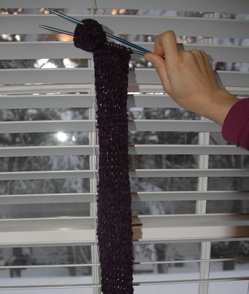
Purple skinny scarfI’m manufacturing a scarf as I sit on the sidelines and wait for Grace to finish her swim practice. Oh, early on I had to make one or two decisions — which of my surplus yarns should I use? how many stitches do I cast on? — but now all I have to do is pick up the needles and start moving my hands to operate the tools in a way I’ve done a thousand times before. As Lydia remarked a few weeks ago about this kind of knitting, it is calming, and it is productive. Row after row after row, the inches add up. I could almost knit this in my sleep. I want the scarf, which is intended for me, yet I feel no urgency about it.

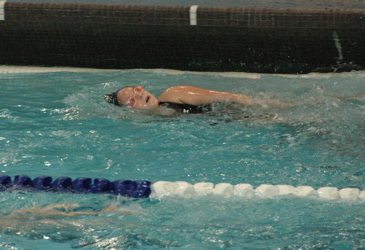
On Monday afternoon, Grace interrupted her swimming of laps, hauled herself out of the pool, and walked over to where I was perched, knitting and waiting for her. Practice was only half done. She looked spent.

“I’m tired. I don’t want to keep swimming today,” she moaned as she leaned against my leg. A conversation determined that her complaint was nothing diagnosable.

“It’s a tough practice,” I replied. “They’re not always fun.” I tried, as I always do when her confidence wavers, to be an external ballast: “You’re halfway there. You look strong.” Inside, I asked myself, Why not just go home? She’s only seven.

“But, Mom!”

With my hand resting lightly on her wet back, I murmured with firmness, “Grace, I know you can do it. Plus, we’re here.” At an education conference in the fall, I learned that children become self-reliant in their interactions with trusted others. It’s our job to coax them, paradoxically, to become more independent. Is this what that speaker meant? I wondered.

Unhappily, she walked back to her lane and slipped into the water. She looked to the coach for direction, and then she bent her knees, pressed her feet against the wall of the pool underwater, and pushed off. Stroke after stroke, Grace swam 25 meters, then 50, 75, and finally 100.

I looked down at the knitting in my lap and tried to compare my rows to hers. What’s different?

When I started teaching, my friend Lisette, a (former) serious college athlete who also became a teacher, asked me, “What are you going to do this semester to get out of your comfort zone?”

“Huh?” I responded.

“What are you going to do that’s hard for you, that you’re not sure you can do?” she elaborated.

I took her question seriously and thought about it for many days as I was planning the semester, and I built into my syllabus challenges not just for the students, but for me. With a silent nod across the miles to Lisette, I do that every semester.

When I do this kind of mindless knitting, however, there’s no risk for me and nothing of value at stake. Like eating ice cream, it’s soothing and filling in a pleasurable way. We all need those kinds of activities in our lives.

Grace’s rows in the pool, however, are different. She’s not always sure she’s up to it or that she can finish what she has signed on to do. There are tears sometimes, cold water, and nakedness in the locker room. There have been no measurable victories so far, although Grace keeps hoping for them, and hence no ribbons on a loop of thread to hang from her neck. And still, she must practice, practice, practice.

Grace swimming

—-

Picture of scarf in hand by Eli. Picture of Grace by Jimmy.

– Extremities

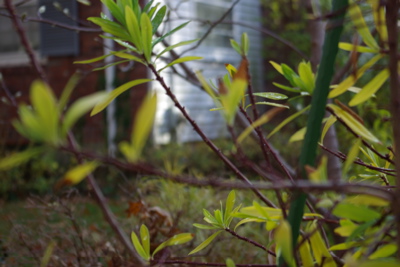
Although the frequency of my visits to the daphne that Jimmy and I transplanted in September have waned from daily to weekly, I keep monitoring her and doing the little I can to cultivate her return to vigor. Mostly, I have watered the ground inside the dripline, keeping it damp yet not flooded.

In October, her leaves stopped drooping: some fell off, and some sprung back. Her branches no longer looked like slumped shoulders; they regained their uprightness. Last Thursday, on our warm and breezy Thanksgiving Day, a few hours before heading downtown to my brother Michael’s new apartment, I poked around the yard. I pulled out and trashed the spent lantanas and then carefully assessed the daphne.

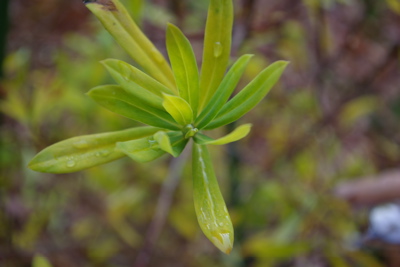
At the center of some remaining leaf clusters, there are tiny buds.

Bud inside leaf cluster

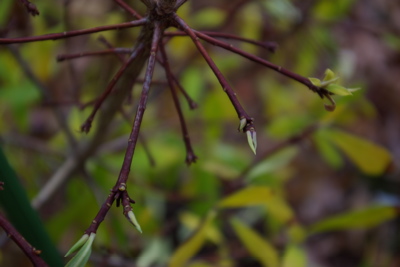
At the tips of leafless branches, more buds are starkly visible.
 

Buds at branch ends

Overall, her aspect is alert.

Alert branches

When I visit my endocrinologist for quarterly check-ups on my diabetes, he always checks for two pulses in each of my bare feet: one on the top of the foot, and one on the side, around the ankle. He also pricks the bottom of each foot with a microfilament and asks me if I notice the light touch. The health of the extremities — circulation and feeling in the hands and the feet — coincides with the health of my overall system. And so far, so good. There’s plenty of blood pumping unobstructed to the farthest reaches of me.

I’ll take the buds at the tips of the daphne’s branches as signs that she’s taking up water and nutrients from the roots and compensating for the ones we severed when we transplanted her. Something good that I can’t see is happening underground and inside the vascular tissues.

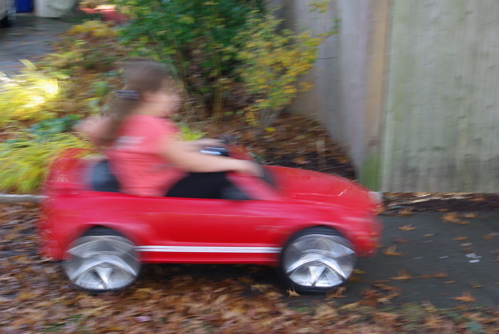
What I’m worried about now is this: two underage drivers (Grace and George) in a powerful, undersized electric car.

Underage drivers in red convertible

Their roadway, the sidewalk, skirts the daphne’s location. The branches tremble as the two whiz by.

——

Pictures by Eli Guterman, who recently said to me, “I’ve looked at your blog, Mom, and you make some awkward cropping decisions with the photos I take for you.” I present these, therefore, uncropped.

– Hanging drop

Until I looked at Laura Splan’s watercolors in blood, I hadn’t thought of my own blood as paint or ink. Yet, it is. Many times a day I prick my finger, squeeze a drop of blood from it, and touch the drop to a test strip inserted into a glucose meter. After I’m done with the procedure, my fingertip often keeps bleeding, even though I’ve stopped being aware of it. So, as I put my hand on the mail, or a page of my glucose record log, or the Times, my blood smears and makes it mark. On paper, blood is permanent.
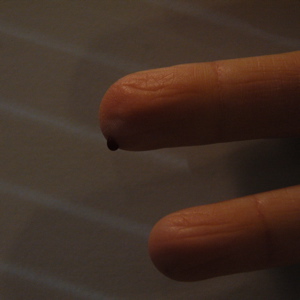
Hanging drop of my blood

Before I drive or teach — two activities during which I don’t want my glucose level to drop precipitously — I check my blood sugar. Once without my noticing it I left a smudged arc across the front page of a student’s paper. As I handed it back to her in class, she noticed it, and she visibly recoiled. “Ach, what’s this?!” Oh, shit, I thought. “I’m sorry, that’s my blood. From my finger. I’m so sorry.” I knew her as a fragile person, intensely worried about her own symptoms. Damn, why couldn’t I have smudged my blood across the paper of one of the nursing students?

Clearly, the traces of my blood on paper are not intentional or artful. Still, Laura Splan’s work put me in mind of them, and I started wondering about what I could do with all those smears. At the same time, I’ve been reading this sparkling, ruminative book, I Am a Strange Loop by Douglas Hofstadter (Brian, you would like this), which has a long section on math theorums and proofs, and I’ve been thinking about how much I loved geometry and calculus in high school and college. But, I didn’t go down the math path when I could have, and that knowledge is rusty and faded.

I’m in a predicament. I can’t draw, but I want to use my blood as ink. And I can’t, really, do math, but I want to use math in some way.

Ah ha! (When I was on staff at Simmons College, I was in a cross-disciplinary workshop on teaching writing in which the participants shared a lot of cool assignments they give to students. Donna Beers, a math professor, would sometimes get her mathematics education students to write what she called a numerical autobiography. At the time, I tried writing mine, but it quickly bored me: age, weight, street addresses, telephone numbers, age of first period, age of first kiss, number of children, favorite number, et cetera. No focus, no shape.) New, better idea — I could attempt to compose a numerical memoir piece, based on my life with diabetes, and I might get Eli, one of our in-house artists, to collaborate and contribute photographs that illustrate measurable moments! (He agreed.)

I even have the draft of a beginning, which is something I cut from another piece I wrote. Its working title, which came to me as I was driving around thinking about this, refers to the many times in a day or week I have to puncture myself. I’d like it to catch the reader’s eye.

—-

Number of Pricks

For several days in the fourth week of February, 1992, I was in the hospital. I was 26 years old and eight weeks pregnant with my first child. I had learned, the morning of the day I was admitted to Brigham & Women’s, that my blood glucose was high, around 300, and that I had diabetes.

By the end of day one I started injecting myself. The nurse offered to do it, but I said, “I might as well start.” She demonstrated on an orange; I jabbed the syringe filled with insulin into the flesh at the back of my arm and plunged. Mechanically, it is not difficult.

That night, lying awake in my hospital bed, I estimated my life expectancy – I chose 76 because it was 50 years beyond my then age and 50 is an easy integer to work with — and I multiplied four injections per day by 365 days by 50 years.

Here’s the equation. Solve for X.

4 x 365 x 50 = X

My thoughts were so scattered that I couldn’t do the simple math in my head. The next day I called my father, the math teacher, who advised against calculations: Do one thing, he said, and then do the next. Don’t count beyond today, or backwards, just take the next injection. Sometimes that trite “one day at a time” advice works; what he said helped.

More than 15 years and 20,000 injections have passed since that first day. And although I have come to take the long view when it comes to diabetes and follow a regimen that I hope will get me to old age with my feet, eyes, gums, and kidneys intact, it is what I do and don’t do during any one day — the increments of insulin dosing, carbohydrate counting, blood glucose checking, aerobic exercising, and portion measuring — that adds up to a life with Type 1 diabetes.

[end of excerpt, beginning of experiment]

—–

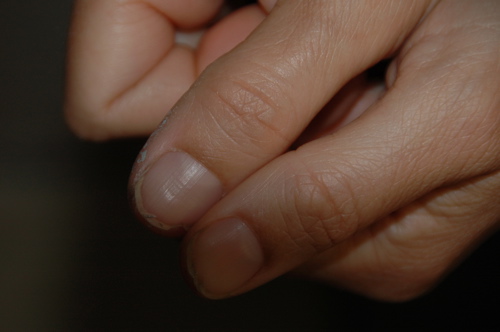
Picture of my November 14th fingertips by Eli Guterman
– Does she or doesn’t she?

Remember that Miss Clairol ad, from a time when stylists were still called hairdressers?

This is about my hair, and how I don’t color it, and how, in response to pressures from various factions, I’m considering it. Yeah, it’s a digression from my usual blog topics, but it’s also about making a decision.

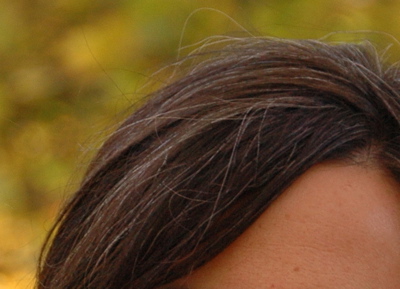
The first faction is myself as observer. Here’s what I see in the mirror every day, when my hair is dry. When it’s wet, it looks perfectly black and smooth.

Hair closeup

I actually kind of like it, except for the fly-aways (oh, what happened to the sleek, textureless hair of my 20s?), but I notice it. There’s no hiding it, even from myself.

The second faction is the woman who cuts my hair. The last time I got my haircut, she even… grimaced. “It’s time,” she said. I replied, trying to buy time: “Mmm, maybe next time.”

The third faction is made up of many people who, over the last few years, have said, every time they see me after a break of several weeks, “Wow, Jane, I’m just noticing that you’re getting a lot of grays.” Some have said, demurely, “silver.” Some, more truthfully, “white.”

A resistant faction, the practical me, doesn’t really want to start down that long, un-turn-backable path of coloring or foiling. If you have dark hair, that means maintenance visits every six to eight weeks to deal with the roots. Add the time for a haircut and blowdry, and that’s three hours at the salon! Not much of a self-pamperer, that makes me agitated just imagining it. There’s money on top of that.

Still, there is another faction — perhaps the über-faction — which is vanity, or audience internalized. Is my vanity in my hair remaining natural, or is my vanity in my person looking brighter or younger? I’m torn.

How do I proceed?

Step one, of a decision-making process, is, obviously, defining the problem or question, which I have done.

Step two is gathering information. Most of that information is in the hair photo, and what I know about the procedure and its costs.

Step three is seeking advice. I have turned directly to my reliable and thoughtful friends. Marcia appreciates the aesthetics of graying hair, but recommends her strategy, which is color now, and go gray at 50. Jan says she’s always liked dark hair with gray, but points out the annoying part of gray hair — the dry texture, its uncontrollability — and informs me that coloring takes care of that. Eli, although he is in the faction of people who have brought my gray hair to my attention — “Mom, your hair has a lot of white in it” — says, “Be your color.” From my friend James, with whom I talk about style of all kinds (writing, clothes, music, etc.), I received a measured response, full of examples, in which he recommends resisting pressure and doing what feels right, whatever that is: keep my gray hair if I like it or color it if that would be fun.

Those four answers contain factual and emotional information, but not a decision, which I guess is up to me. Damn.

Step four is taking more time to think about it. This isn’t surgery, so there’s no rush.

I could even put this one off forever.

—-

Digital hair closeup in daylight conditions — you can’t run, you can’t hide — by Eli.