– Freaks, inside or out

In The Family Stone, a movie that Jimmy and I saw together and (dis)liked differently, the Luke Wilson character exhorts the straight-laced Sarah Jessica Parker character to fly her “freak flag.” Yeah, I loved that. I also cried when the Diane Keaton character died.

In praise of freaks of all kinds (and aren’t you, whether secretly or openly, one too?), I offer a brief list of some 2008 favorites.

Book: No One Belongs Here More than You, Miranda July.

Musical artist: Ida Maria.

Essay: “Mine Is Longer than Yours,” Michael Kinsley, New Yorker, April 7, 2008.

Sitcom: The Office. (I almost picked 30 Rock, but there have been fewer surprises there this season.)

Blog written by someone I don’t know: David Byrne Journal.

Tears of joy and relief: Reading this transcript, while watching a video of the speech, on the morning after.

Clothing: Anthropologie.

Siblings: my four.  All strange, in their own ways.

That’ll have to do.

—-

p.s. Thanks to my always surprising friend James, who got me to do this.  And to Lydia, who heeded the call first and thereby inspired me.
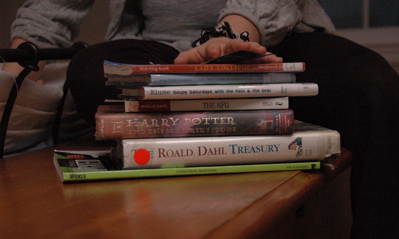
– Writing in bed

I am reclining with the heating pad under my shoulder. It’s only 7 o’clock in the evening. With me is also Everyman, which I am finishing, and my iBook.

Jimmy walks in and says to me, “You know, a lot of writers wrote in bed.”

“Really?” I ask, which does not express doubt, but is just the way I say: “Tell me more.”

He says that Proust did. Capote did.

“Why?” I wonder.

He tells me that Proust was sick. Capote just preferred it.

Not for me, I say, or something like that.  And, yet, here I am, writing in bed, and doubting that I will do it again.

– Big books

It’s a few minutes before the girls have to leave for school, and Grace is gathering her accoutrement: ponytail holder, socks, a tattered bag of yarn.  She also plunks down a pile of books.  I wonder how she’ll get all this into her pouch and up the hill to school.

big. books.

big. books.

I ask, “Why so many books? Is it library day?”

Without pausing (as though she has been waiting for this question), she tunefully replies, “Nope. I like big books and I cannot lie.”

Which seems to me a much better use of that song than the song itself.

—-

P.S. Dear Mom and Dad, you might not want to click through to the song video, in the line above. (Or now you might, because I’ve activated your curiosity.) The things your grandchildren are exposed to, on the tv and radio? Well, more than I was at their ages. Yes, times have changed.

– Inbound worshipers

This morning at 8am I was stopped by a red light at the mouth of a side street that feeds into Commonwealth Avenue.  A gas station on my right; a BU building across the street and train tracks.  Me? Daydreaming, waiting.  An MBTA bus, the 57, zoomed past, heading east into the city.  People were packed inside, seated in rows, their many heads bowed over what they held in their laps — blots of white to me — opened books.  And before my consciousness fully registered the scene, it seemed to me that people were praying, like supplicants in pews, staring down into hymnals, waiting for the priest to interrupt them from their reverie and say, “All rise.”

– I am Sarah Palin

When I was in college, at one of the Seven Sisters in the mid-1980s, meals were served in the dormitories by kitchen staff who were longtime employees of the college. This was before the big contractors, like Aramark, took over dining services everywhere. We knew our cook, Charlie his name was, and dinners were like dinner parties. We enjoyed what we ate, and we lingered over the table for hours. Sometimes I sat with a group, and sometimes I sat where there was an empty seat. It was easy to know everyone; there were maybe 150 residents in my dorm, Beebe Hall.

Because the nights were so similar to each other, they generally blur in my memory into one big mealtime. One night, though, when I was a freshman, I was sitting with Andrea, a junior from New Jersey. I don’t recall what I was telling her, but I was talking, and at the same time she was finishing dessert and licking her spoon: licking the bowl, licking the back, dipping it into the melted ice cream again, licking and licking.

She paused in her licking and listening and she interrupted me: “You know what’s a shame?”

“What?” I asked back.

“No matter that you’re here, no matter how smart you are, no matter how much education you get, people are always going to think you’re ignorant.”

What does one say in reply? I burned with sudden shame. “Um… why?” I stammered. Continue reading

– Images

I love the images in these two lines, from two different pieces:

All over the room, like boats softly tooting their horns in a harbor on a foggy night, men were weeping. (Nicholas Dawidoff, “The Man Who Wasn’t There,” New York Times, Sunday, June 15, 2008)

and

At times I was lonely, but it was a bearable loneliness, the way I imagined that a star, brilliant in a Milky Way of other stars, would be lonely. (Walter Dean Myers, “Poets and Plumbers,” What They Found, Wendy Lamb Books, 2007)

I tried to find more lovely sentences from my reading of the past week or so, enough to make a handful or a dozen, but these two kept pushing contenders aside.

The first is from a personal essay on his lost father, and other men without fathers, by a male author; he hears the weeping as he sits in a darkened movie theatre watching the last scene in Field of Dreams. The second represents a moment of self-reflection by Noee, the 17-year-old female protagonist in a short story, who feels distant from the boys and young men who try to attract her attention. Her father is dead, too.

The loneliness of the first-person narrators is made even more piercing, I think, by the beauty with which it is rendered by each writer. There’s something strangely comforting, too, in the idea of sadness shared, distantly, among other boats and other stars.

Is that ethical, to make sadness be beautiful? That’s a seduction. Should sadness be starker, plainer? It has one quality in art, and another in life.

Either, it is a feeling of force:

Sadness drives us to restore attachment and is from an evolutionary point of view an important adaptive emotion. The sadness caused by bereavement is the cost of having been attached, and it may also act as a social signal that is a plea for sympathy.

In these lines, who makes the plea: narrator, or author?  Does it matter? As a reader, I do feel as though someone in these words is reaching out to me.

– Rocks

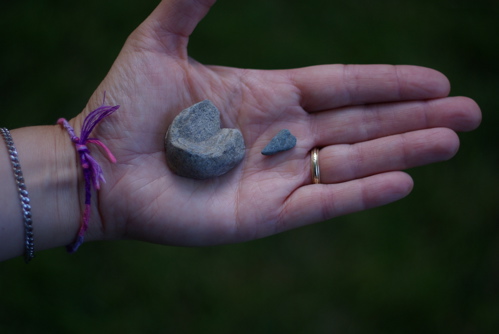
Grace came home with these the other day; she calls them heart rocks.

Heart rocks

Like me, she keeps her head down sometimes, looking for rocks. What, exactly, are we looking for in a rock? There are millions on the beach. Still, a few seem to call out to us: “Pick me, pick me!” We pick them. I look for color, and she, shape.

I live on a street named for the Massachusetts official rock, Roxbury puddingstone.

I grew up in a house across the street from a lot made unbuildable by the presence of a huge, rocky boulder. We called it The Big Rock. It was better than a playground. There were crevices in the rock to hide in, or pretend they were escalators. In neighborhood wars, one party or another claimed the rock. Daring kids, like Sally and Michael, did bike tricks around the rock and tree roots.

Surrounding our neighborhood, which was a figure-eight shaped development built in the early 1960s, was what we called The Woods. In it were acres of trees, streams, and swampy areas that made skating surfaces in the winter. There was The Old Lady who lived in a shack (really); she had a gun. There were stone walls that had tumbled down.

Sermons in Stone is one of my favorite nonfiction books. About the history of stone walls in New England, it’s riveting — history that moves a reader like a poem. I learned why there were so many stone walls in the woods of my childhood (those woods were once farmlands). I learned, too, the measure that makes a city block, and about the Ice Age and the force of glaciers.

In a writer’s workshop, another writer who read my work for the first time pointed out to me that there are a lot of stones in my work, actual and metaphorical. It was not a deliberate effect, and I had not noticed it. It’s funny what happens when someone observes something in your work: You start thinking, “That’s my thing.” And then you write more of it. And then you try not to, so as not to be obvious. And then you give up and go back to it, perhaps with more thoughtfulness.

___

Photograph by Eli, who has new work here. Friendship bracelet by Lydia.

– Trees

This link takes you to a moving short piece on NPR by Julie Zickafoose, called “The First Cut Is the Deepest,” about her response when a neighbor decides to cut down a big, sheltering tulip tree that provides privacy between her land and his. My sister Emily, who wrote to me today about her idiosyncratic love of gravel (ok, Em) and who might consider starting a blog of her own, recommended this story to me a while ago. It’s surprising — you think you know how it’ll end, and then it doesn’t.

This picture is the view out the window that’s over the window seat and between two closets in our new bedroom. From anywhere in the room — standing near the door, sitting on the bed, hovering near the window — a person can see the beautiful, mature Japanese maple that our friend Rich estimates is older than the house.

Window seat, maple tree

Looking out, I feel like Heidi from the Johanna Spyri novel for children, which I recall loving as much as this blogger did. This is the same version I read as a child. It seems to me we owned this book, and that it wasn’t borrowed only once from the library, and I read parts of it over and over. Why was I so attracted to stories about orphaned or independent girls who lived in some sort of extreme circumstances that they eventually tamed or softened? (Other examples are Jane Eyre, Little Princess, Secret Garden, Mrs. Mike, the Little House series, all of Nancy Drew, and Tree Grows in Brooklyn.) Perhaps these are the girl versions of the same forces at work in Moby Dick, although, as I told Grace last night after she strangely asked me about the whale, the captain dies chasing his blank nemesis. Heidi, Jane, Laura, and all the rest — they live to tell about it.

– Hazards of reading

This is an approximation of a conversation I had with Grace recently. While I did not invent her remarks, I did cut out some of the repetition. There also were a lot of thoughtful pauses I have eliminated.

Grace: How old do you think you’ll be when you die?

Jane: Old, I hope.

Grace: Who do you think will die first, me or you?

Jane: Me.

Grace: Who do you think will die first out of me and Eli and Lydia?

Jane: I don’t think about that. You all will live a long, long time.

Grace: Why do people have to die?

Jane: Because their cells wear out and they can’t last forever.

Grace: Why can’t we live always?

Jane: I’m so sorry. I know. I promise, though, you will live a long, long time and life will feel long enough.

Grace: How long?

Jane: Grace! Could we talk about something else? How about… what are we going to do tomorrow?

Grace: I can’t help it. I just keep thinking about this.

Jane: Why do you think that is?

Grace: Because I’ve been reading biographies.

Jane: Oh?

Grace: Yeah. And I’ve noticed — people are always dying in them.

– Reciprocity

Sometimes a student enters the Writing Center in distress, having been told by a professor that his writing is so “unreadable” that the professor has not attempted, beyond the first paragraph, to read it.

These instances make me think again about the writer’s job, yet even more so about the reader’s. They each must try hard to reach the other. Writer, write hard. Reader, listen hard. Communication is a meeting in a middle place. Not a compromise, though. A meeting.

I like how Joseph M. Williams, the author of perhaps my favorite handbook on style, Style: Ten Lessons in Clarity and Grace 6e (Longman 2000), reflects on a writer’s role in this relationship:

We write and revise our earliest drafts to discover and express what we mean, but in the drafts thereafter, we write and revise to make it clear to our readers. At the heart of that process is a principle whose model you probably recall: Write for others as you would have others write for you. (220)

He says much more about the golden rule and a writer’s obligation, and I wholeheartedly recommend the chapter “Ethics of Prose.” In it, Williams also says this, about the golden rule and readers:

Some readers read less well than others, and some expect more from a writer than their meager investment of time and effort earns them. In fact, just as writers have an obligation to readers, so do we as readers have an obligation to writers: If we assume that writers work hard to say something important to us, we should read thoughtfully and generously, at least until we decide they have given us good reason to stop. (221-222)

Reading and listening — paying attention — to the words of another require generosity: a gift, a gesture. It takes effort to look beyond the lack of clarity in a student’s writing, but if we believe that they are making an attempt to say something important to us (it’s our assignment, after all!), then we should reciprocate. Williams calls such an exchange “fair” (222).

A penciled notation on the inside page reminds me that I paid $6.50 at Brookline Booksmith Annex for a used copy of Style. The latest edition, the 9th, is much more. Still, it’s worth it.