– What death tastes like

I’m upstairs, in the bathroom, about to hop in the shower (as my mother would say. One can’t actually step into the shower, or take a shower. Hop, we must.).

Suddenly, from downstairs I hear running feet, the slam of a door, adult gagging sounds, and child screeching ones. I go to the top of the stairs. Through my mind runs all the first aid procedures I’ve learned related to choking and heart attacks.

“What’s happening?!”

I hear Grace, off stage, yell: “Dad’s gagging.”

I yell back: “What’s wrong?”

Jimmy walks, coughing, to the bottom of the steps. “Oh, my god, it’s the DayQuil. It’s horrible.” He drinks water from a cup.

Lydia joins me on the upstairs landing. Like Jimmy, she’s suffering from a sore throat, and she was the first one today to sample the orange liquid cold medicine.

“It can’t be that bad,” I say to both of them.

Lydia rolls her eyes at me. “Mom, it literally tastes like drinking death.” (Note: emphasis Lydia’s.)

And now I know.

– Draw a picture. Make a sandwich. Teach writing.

Grace comes to work with Jane and finds the art supplies.

Grace comes to work with Jane and finds the art supplies.

During a scheduled hour to discuss their upcoming proposal drafts, I asked a group of 10 chemical engineering students to explain to each other their research projects, the rationale, the experimental design, and prior research. They talked productively for a half-hour and listened to each other with curiosity and asked relevant questions. All good. Certainly, we could have filled the rest of the hour with more talk.

I looked at the classroom’s two white boards and one easel pad and clutch of dry erase markers and Sharpies. I invited them, instead, to draw.

In small groups, they drew branching diagrams of their proposed experiments and explained their plans — and, even more importantly, gaps in their plans — to their peers. I walked around. They asked questions about how they might frame their experimental design in their drafts.

My friend and colleague Lisa had the classroom reserved after me, and she came in five minutes before we finished. Later, on the way to the copy machine, I saw Lisa’s students (in a different section of the same class) sprawled on the floor with big pieces of white paper and clustered around the white boards, drawing and gesturing with hands and markers. Continue reading

– Lover of carrots

In my house, I have frequently been called “Lover of Carrots,” or “LoC” for short. Honestly.

And I do love carrots. I eat them raw every day. (My limit is a half-bag of those baby ones.) They taste good; they’re a habit; and — I also realized on Monday, when I felt overwhelmed by every work, house, and family task on my list — the chewing is a release of tension. Mouth exercise?

Perhaps it is not so illogical, then, that I thoroughly loved my raw food/vegan meal at Grezzo Restaurant in Boston, even though I am not currently a vegetarian. And that I had such wonderful company in my friend, and movie partner-in-crime, Betsy Boyle, helped.

– Heart breaker, list maker

GROUND BF 4, RIBS 2

Leanne told me that she and her spouse have become one of those families with an extra freezer in the basement.

Then she told me the part that made my heart beat faster and gave me goosebumps: Mark keeps a notebook on top of the freezer, with a running list of the items and quantities inside. Leanne, what a catch! I love that about him.

I have often joked that, when looking for a romantic partner, it would be helpful to identify someone who can both dance and cook. These qualities might sustain your life with both joy and food.

I’d like to add a third quality to that list, and suggest that someone — like Mark Mason — who can make and keep a good list is a rare and wonderful find: a sustainer of order. Ah.

—–

P.S. Thanks to Leanne for the photo, and the introduction to MM.

– Cupcakes and life

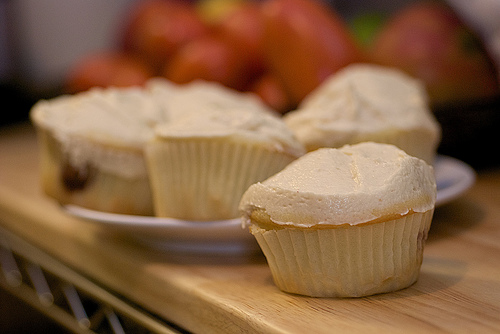
CupcakesAt 9:40pm, Jimmy is folding laundry and playing dj. It’s Prince: “I Would Die 4 U,” “Raspberry Beret,” and “When Doves Cry.” Eli is out. I am putting away my sorted clothes, and Lydia and Grace are hanging out with us. As usual, the children introduce conversational threads out of nowhere.

Lydia:  When we go to New York, can we go to Magnolia Bakery?

Jane:  Why?

Lydia: Because they mention it in “Lazy Sunday,” and Andy Samberg loves their cupcakes.

Jane: Lydia, it’s only a cupcake.

Lydia: Mom, life is short —

Grace: — in a long way.

*

—–

Cupcakes image is from B Tal’s photostream on Flickr. I worked with B Tal, that is, Brian Talbot, at Simmons College, and I once had the opportunity to have one of his peanut butter and jelly cupcakes. They were so great I had to get the recipe, and I have made them for the kids, who have dubbed these THE BEST CUPCAKES EVER. (Who cares about Magnolia?) You can make them, too, by following the recipe that appears under the photo on his Flickr page. Two tips from me — use only 1/3 or so cup of milk in the frosting recipe, and either make a double batch of the cupcakes or a half batch of the frosting, because the frosting recipe, as is, makes too much for the 12 cupcakes indicated. And refrigerate them: like a lot of cake and frosting combos, they are delicious cold.

– Words that cannot be said

PagesWhen I was a child, there were words forbidden in our household.

The following were the big three. Really, these are the words I recall my mother itemizing, after she announced: “There are three words I don’t want to hear.”

I am about to write them, which is a kind of saying.

Stupid

Hate

Kill

My parents had five children. While that made for a lot of fun, it made for friction, too. The forbidden words were ones that are most often useful in situations involving conflict. Say my sister Sally and I were playing the card game Spit. I’m older, but she was faster. In the heat of the game, when I suspected she was on the verge of winning, it would have been normal for me to growl at her and bark, “You’re so stupid and I hate you. I’m gonna kill you!”

But, I didn’t, because the words were forbidden. And just now, typing them? I felt very uncomfortable and even queasy. Those are not my words.

In the house I grew up in, we sat down together every night and ate a meal that my mother, usually, prepared. (Once in a while my father cooked.) It must have been hard to create a menu that all seven of us would find pleasing, day after day. I remember liking almost everything, or at least being willing to eat almost everything put in front of me. Still, my brothers and sisters and I each had our own personal limit. Me? Creamed corn. My brother Michael? Deviled ham sandwiches. (Sally, Emily, Brian: What were your dislikes?) Nevertheless, we could not say, “I hate creamed corn.” Instead, my mother recommended we phrase our distaste this way: “I don’t care for creamed corn.” Wordy, indeed, yet tactful.

My parents also preferred real words for objects, and not slang, especially when it came to the body and its processes. Continue reading

– Dream of kahare

Purple shellsI sit in a restaurant with two colleagues, a female one from my current job and a male one from a job I had 14 years ago. In my immediate view is what looks like an artichoke heart, but paler green. I hold it up to my mouth; I eat. I register “sweet, like fruit,” but my dream mouth doesn’t taste. Still, I sense that this is a discovery: a new fruit. It’s called a kahare, and I know this because I see the word on the menu in my dream. Kahare. Exotic — not from here — and delicious.

Waiting on my plate is something else, the color of black raspberry ice cream and the shape of a long, round-edged bar of soap and as smooth. It is intact; there are no bite marks. Continue reading

– Overheard and overbought

I heard this today, as I stood in the check-out line at my local grocery store. It’s a revision of a well-known saying, and another customer was sharing it with another clerk.

When you complain, you complain alone.
When you laugh, everyone laughs with you.

That seems good to remember.

And what was I buying at the grocery store? I’ll tell you, and I’ll also tell you that I noticed, as my 14 or so items were picked up one by one and scanned, that none were essentials.

  • 3 liters of Polar seltzer (for Grace’s 3rd grade party)
  • 2 half-gallons of Minutemaid lemonade (ditto)
  • 1 box of Cheez-It Party Mix (afternoon snack)
  • 1 jar of roasted sunflower seeds (the protein to go with the Cheez-Its)
  • 1 sandwich roll (okay, I need that for my lunch — I’m home today)
  • 1 single-serving sized bag of potato chips (ditto)
  • 1 hosta (to fill in a blank spot in a shady patch)
  • 2 six packs of those mini soda cans: Diet Pepsi and Diet A & W (because)
  • 1 bag of ice cubes (for Grace’s 3rd grade party)

Not only do we live in an age of complaint, we (still) live in an age of excess. I mean, none of those things are items I need. And yet I bought them, and will again.

– What are you letting go?

balloonOn Saturday night in Berkeley, after trying (without reservations) to eat at Chez Panisse (the upstairs, less expensive café part), Betsy and I walked along the block for a while before deciding on Café Gratitude, a raw food vegan restaurant that practices sacred commerce.

Our young server, Natalie, with her bangs and long black braid, bright eyes blackly lined, and pink glossed lips, gave us a tour of the menu and recited a bit of Gratitude’s history. Before she left us to ponder food choices, she asked us the question of the day: “What are you letting go?” Natalie opened her hands, palms up.

Betsy replied with her own question: “Do you want us to answer you… ?”

I interjected, “—or just think about it?”

Natalie seemed to take a step away. “Whatever you want,” she said and continued to smile. “I’ll be back.” As she walked off, I noticed she wore cool black boots with her black clothes. Continue reading

– A begat

This half-pound bag of Blue Bottle Coffee is a begat.

coffeebag2 According to my father-in-law Ed, who knows a bit of Yiddish, many things that are bought may fit into the category he calls “begat.” And even though “begat” begins its life as a verb — beget, which means to sire or cause to exist — here it’s used, in its past tense, as a noun. Most simply put, a begat is a purchase that begets another purchase. Like, the new couch that begets the purchase of a new area rug. (Indeed, according to Ed, a new couch is the classic begat.)

Sometimes, we make purchases so innocently: “Oh, all I need is a chair for this corner, and then the room will be complete.” A day after the chair arrives, we find ourselves pacing the aisles of Home Goods, looking for a few pillows that will “tie in” the new chair to the old furniture. The new pillows, in turn, may function as a begat and lead to a new lump of pottery on the table. Which could make us rethink the floor lamp in the corner. The new lamp is an opportunity to try the innovative, energy-saving compact fluorescent light bulbs. Why not buy a dozen? And so on and on and on.

Back to the meager bag of coffee. Continue reading