– Slivers

If a person gets the urge to grow something, she can do it anywhere there’s some light. A pot or a patch and time to tend it is enough. Last week boingboing linked to a post on Kirainet about gardens on little public corners in Tokyo. Here’s one:
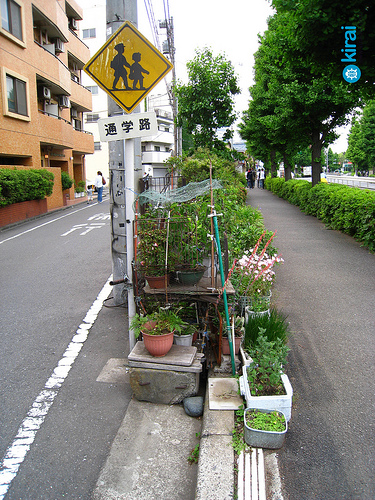
Sliver Garden in Tokyo

The anonymous gardener appropriated some unused public space — just a sliver — and made something both useful and beautiful in it. I probably should say that the gardener is making something there; gardens change every day and are never finished.

The sliver garden made me think about a story an old boss once told me about a friend of hers, who had a fantasy (if I remember this right) of buying and restoring a big, old waterfront home in Maine. This friend lived in some other, non-Maine non-old place, in a suburban development, not too far from her job, which she liked and which financially sustained her and her family. Yet, this fantasy kept pressing on her: an out-of-reach, vivid Someday Dream. So many aspects of it made it unattainable in the present: her like and need for the job, lack of money for a second home, lack of time and skills to do the fixing-up, a spouse’s lack of interest in the same project. The Someday Dream floated farther and farther from her reach.

Finally, someone asked this woman who was filled with longing, “What is the feeling under the fantasy?” The woman, at first, did not seem to understand the question, and she answered with a more specific description of the house she dreamed of and the place she pictured it in.

Her interlocutor explained that she wanted the woman to examine the more pure feeling underneath the specific details. This was (and is) a harder question. After a long pause, the woman finally said that she wanted to take something old, with a history, and make it livable. In answering the question, the woman herself realized that she didn’t have to live in an 11-room, white, black-shuttered Victorian in Kennebunkport to get close to that feeling.

It’s funny: I don’t remember the exact outcome of this story, but I do remember that, by figuring out the feeling underneath (and I love that the feeling is under the fantasy, supportive like a foundation, or hidden like a cellar), the woman made some change in her life that gave her access to the fantasy. Maybe she moved to an old house in her town. Maybe she bought old furniture — stuff with the history she was after — and restored it. What’s important is that she figured out a way to give shape and actuality to a dream of something longed for.

Last fall, on the afternoons that I dropped Lydia off at her chorus rehearsal, I regularly walked through the community gardens on East Berkeley Street in Boston. On a sliver of land between the street and a public alley behind townhouses, there’s a double row of fenced and gated outdoor rooms, each about 10 feet by 10 feet. There are a few double lots.

Many of the gardeners maximize their spaces, growing greens and vegetables in the ground, flowers in hanging pots, and squash vines on the fencing. Such parcels seemed like farms to me, and I’ll bet they are to the people who cultivate them.
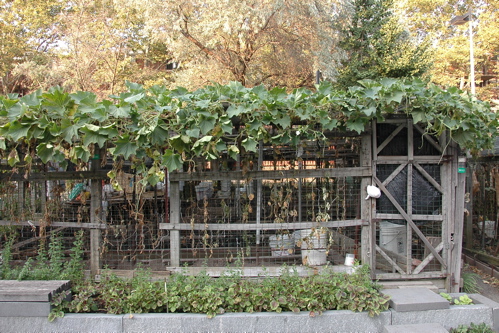
East Berkeley Street farm

Other gardeners trace paths inside the fencing and fill them with stone or broken pottery. I noticed ornaments and signage. Some gardeners post photographs, protected in acetate sleeves, featuring the same garden in another season, creating a weirdly fascinating, double view of the same location. A few gardeners have turned their allotments into sanctuaries with grasses, torches, wind chimes, and seating.

Whether farm- or patio-like, do such places give all their proprietors a feeling under what started as a more specific fantasy? I imagine the person or pair that arranged this tableau:
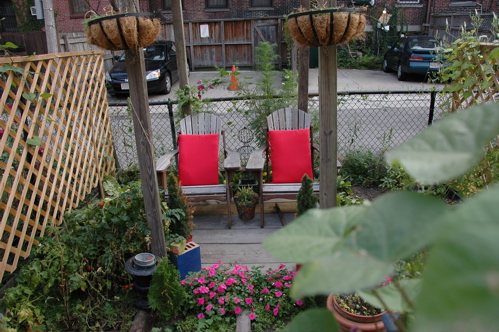
Red chairs on East Berkeley Street

This is what having some of what you want looks like. As I stood there, I felt it, too.

– Clouds

This is a cool way to kill, I mean spend, some time. Copy and paste the text of your c.v./resume into Wordle. The Wordle tag cloud might teach you something about yourself, or remind you of stuff you already know. Every word in my December ’07 resume makes the cloud below. (Collaborators, you’re in there, too!) Most repeated words are biggest.

And, what the heck, here’s Robin Behn’s “Gray Poem,” well loved by me:

From memory, I would have said that “whale” or “dive” would be among the prominent words in Behn’s poem. But, look at this: “turn” and “fathoms” and a few others are most recurring.

P.S. Thanks to Jimmy for the heads up.

– Rights

On a “Bill of Rights,” collaboratively written by elementary school students in our neighborhood afterschool program, I spotted this item, which is my favorite on the list:

We have a right to be helpful and be helped.

Imagine, the same person, child or adult, could be both helper and helpee. Maybe even on the same day. I like that.

– Hesitation

I went out to do errands. I brought Jimmy’s Nikon (very sharp, with a telephoto lens), because there’s a store sign I pass all the time that’s awkward in a provocative way. I meant to take a picture of the words; I forgot.

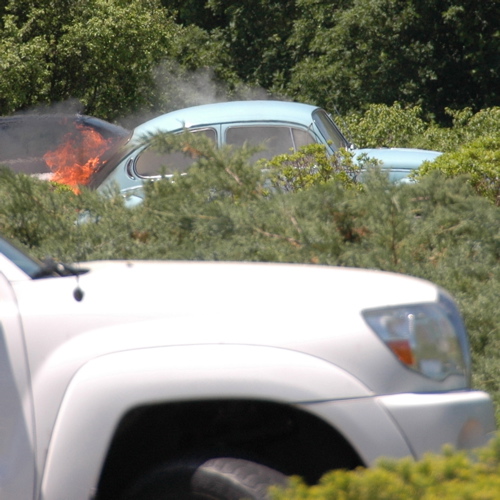
I did, however, see something else amazing: a blue VW bug on fire. It was directly across from me at the intersection of Rt. 1 and the entrance to the Dedham Mall. I was stopped at the red light; the burning, smoking car was in my sight line; and I remembered I had a camera. Opportunity!

I paused. The camera remained momentarily on the seat beside me. I mulled over my situation, step by step. This is what went through my mind:

  1. There’s a burning car. I should take a picture of it. I, for once, have a camera with me.
  2. If I roll down the window, and lean out with the camera, the car might choose that instant — with my luck — to explode, and spray burning gasoline and shrapnel in my direction.
  3. I could get burned, badly.
  4. Could the spraying flames from the exploding VW ignite the fuel in my car? Could I blow up?
  5. How terrible that would be, to be either horribly injured or die, in the act of taking a completely unnecessary picture of a stunning event.
  6. Perhaps I should turn into the parking lot and consider my options.

The light changed. And I turned into the parking lot. Then I took, with me sitting in the open window of the car to get some height and the lens zoomed to the max, this picture:

VW Fire, Rt. 1, June 12, from Uno\'s parking lot

The shot I missed was better: Herbie the Love Bug, looking me in the eye, with flames coming out of his rear end and smoke rising in billows over his roof. I guess I could never be a photo journalist (although I don’t recall ever having wanted to be one). I don’t act fast enough. Even a few seconds of hesitation, which is about what it took to go through that series of thoughts, adds up to a lost chance.

This tendency could explain my not being good at fast-moving multi-player sports.

This habit of pausing to gather my thoughts, however, which drives my kids nuts, could also account for my being pretty helpful in emergencies, as I think Julie, for example, could attest. If you’re with me, and you have a wound that’s dripping blood, I’m not leaping to the mental conclusion that you’re about to bleed out and die. I’m wondering where, exactly, did I stash the car’s first aid kit, and where on your body should I place some gentle pressure to get that blood to stop, and what should I say to you so you won’t worry.

– (Mis)reading

Glancing at the CNN headlines this morning, I saw one — “Clinton Crushes Obama” — and experienced this instant, non-processed thought: Oh, what a turn of events! Hillary is falling for Barack’s charm, too.

Perhaps I have been spending too much time in the company of teens and pre-teens, and reading their magazines and FB wall posts, a world in which everyone is crushing (on) someone. A couple of weeks ago, too, some tutor colleagues and I were talking about the phenomenon of the ephemeral tutoring crush, which seems to flare and die in an hour.

Well, at least my impulsive mind finds a sentimental, rather than a violent, meaning for the verb “crush.”

P.S. Go, Hillary!

– I spy

I look for and appreciate good signage, and I especially study signs on commercial vans, trucks, and cars.

This one turned my head today:

THIS OLD SPOUSE

Handyman

781-444-1###

Simple, clever, complete. Who are you, excellent sign writer?

– Stitched seaweed

Our house, which is currently undergoing dramatic structural changes, was built in 1938, according to our town’s property records. Nine years ago we bought and moved into it. We have learned much about it and previous owners since then.

At the closing, the lawyer for the bank remarked, as he studied the paperwork probably for the first time, “Oh, I know this house. It’s the bad luck house.” And he told us about financial reversals, domestics woes, and crimes committed in the house.

We learned more about the crimes, especially, a few months after we moved in, at a party that our new neighbors (and now friends), Rich and Julie Ross, threw. A woman was there who had, in high school, dated a boy in the family; she got caught up in an investigation as the local police and the FBI prepared to nab various family members for drug trafficking. They nabbed them.

When I dig in the yard and the shovel hits metal or unearths a buried strip of plastic, my first, impulsive thought is that I’ve come across a stash of money or a bundle of bones.

I haven’t, yet.

The garage walls are punctuated with covered cavities, and I wonder if little bags of cocaine were stored there.

I have found no supporting evidence.

Interior walls of the house were mirrored — beautifully and expensively, like a hotel lobby — when we moved in, and I wondered what was behind the mirrors.

It turns out (we’ve had them all removed, over time), nothing.

Once, as workers took out the old dishwasher and installed the new, we found a lost snapshot of a little girl and a fatherly man, standing together by a little swimming pool in the backyard. They looked happy. Carved into the paneled walls of the finished part of the basement are traces of people who have moved away: “Steve + Joan 70-71.”

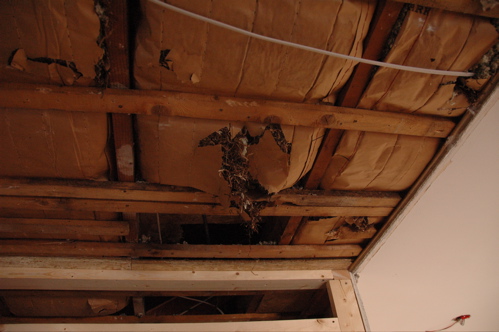
Over the years of our ownership, there have been lots of repairs and cosmetic projects in our house on Puddingstone Road, but nothing major until now. Builders are ripping down walls and reframing them into other room configurations. A bathroom floor and tub have made their way into the dumpster; I see grayed, creaky boards where they once sat. Old ceiling plaster has been pried and brushed loose. Shreds of insulation drift down, like ghosts released.

Here’s a picture of the insulation in the ceiling over what used to be Jimmy and my closet:

Cabot’s Quilt

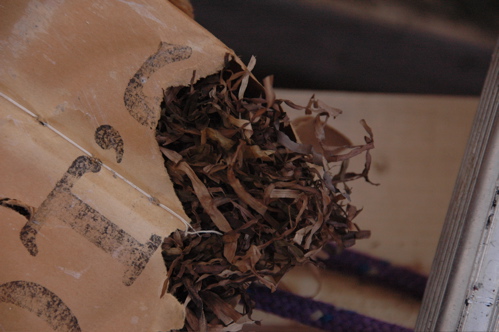
The stuffing, it turns out, is eelgrass, that profuse plant that washes up on ocean beaches all over the world. In 1893, Samuel Cabot, a chemist who graduated from MIT and Switzerland’s Zurich Polytechnicum, having learned that “early settlers had used eelgrass as a crude home insulation,” invented Cabot’s Quilt, clumps of the dried ocean plant stitched between brown paper. A six-inch layer of it is as effective as fiberglass, according to one source. There is a one-inch layer of it in our walls. Brrrr.

On the brown paper is stamped words: Samuel Cabot. Boston. One yard. Cabot’s. Those were the clues that helped me find the story (thank you, Google!) of this curious insulation, which went out of production in the 1940’s, although Samuel Cabot Inc. still exists.

When the foolish, unfiltered banker told us in 1999, at the signing of documents that made this house ours, that “bad luck” was associated with it, I retorted (politely), that it was up to us to “make it the good luck house.”

Although I think it is unfortunate that much of our house remains poorly and archaicly insulated, I am also pleased to discover that the walls around us are stuffed with a kind of leaf, stitched between paper that’s faintly printed with words.

Eelgrass from Cabot\'s Quilt

Is that karma or what?

– Boundary issues

When you let other people, especially underage ones, use your iBook, you have to let go of some amount of privacy and control.

Lydia parks herself daily in front of my screen, doing schoolwork, playing Scrabulous, and blogging. Once she hunted through folders and read the draft of an essay I was writing and had vaguely described to her. She wished she hadn’t. “It was disturbing,” she told me.

In iPhoto, I occasionally discover photographs I didn’t snap, like this one:

Pool party with dolls

Who are these people, and what are they doing in my Tupperware container, on my kitchen counter? And who let them use the camera?

Grace! Or was it you, Eli?

– Found: two-line dialogue

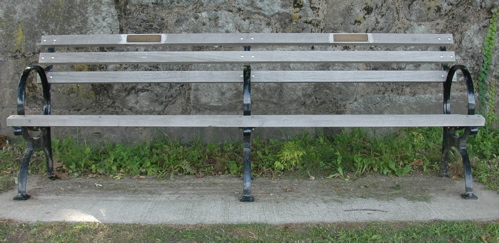
The Brookline Reservoir is ringed by a gravel path. Along the path are benches, on many of which are affixed small brass tribute plates, evidence of some past fundraiser, I guess. Most of the inscriptions are some version of this: In memory of Paul Smith. With love from Elaine, Mike, and Kim.

There are exceptions. One bench inscription says, “Don’t walk by.” That stopped me.

And then there’s the talking bench. Bench dialogueWell, it doesn’t actually burst into speech. However, one plaque has something to say to the other.

Read from the left…

“do you think they’ll sit down?” –Bobbi Davis

… to the right:

“yes, I hope so.” –Stan Davis

These few words, the punctuation, and the names suggest an entire relationship. I picture the ghost of Bobbi, the fun one, easily agitated, leaning forward and speaking emphatically to the ghost of Stan, mild, taking life as it comes, sitting back.

Think about how so many pairs of people you know — whether spouses, sisters, best friends, or characters in a favorite story — can be distilled into the particular lines that they play out over and over again. The cronies who made the gift to memorialize the Davises apparently knew these two well enough to choose and write down a couple of lines that could make strangers known to passers-by.