– I’ll take reality.

I have always preferred reality.

I was the child who read the Little House series, Nancy Drew, Tree Grows in Brooklyn, Jane Eyre, Secret Garden, Pig Man, and Anne of Green Gables.

And like my daughter Lydia, I have always liked facts. One spring, when I was about 16 years old, I took a stack of books out of the library’s nonfiction section on farming, gardening, and vegetables. (That summer I also attempted a 10 x 15′ garden on a clayey waste plot in my family’s back yard. What I recall is that lettuce grows quickly, and slugs like to make a home among lettuce leaves, which a person finds out when she holds that salad lettuce up to her mouth and sees a baby crawler on a leaf.) Another time I took out a less goal-oriented selection of books on the human body — a bunch of owner’s manuals. (I remember a set of photographs from a dermatology book on effects of aging, and how an older person could pinch skin on the back of her hand and it would stay in a little teepee shape for a second or two. I tried this on my own hand then and could not imagine a little skin teepee as a possibility.)

In my fiction reading, as much as I followed plot I liked learning how people did things with their hands: laundry in big tubs, food over an open fire, sleeping 3 or 4 to a bed, toys from sticks and rags, and treatments from poultices (ah, Kaiser Pease’s onion bath in Where the Lilies Bloom). When I picked up Mrs. Mike again, at least 30 years after I first read it, it was to find the description of an emergency amputation that has stayed with me:

I filled a kettle. I lifted it to the stove. The cries drew me back. His nails dug long furrows in the wood of the table. His dark eyes rolled back under his lids, leaving white, unseeing holes. The smooth muscles moved in Sarah’s arms. Back and forth, back and forth. The trap bumped and clanged against the table. Sarah’s strong man’s hand pressed the saw’s teeth deeper into the wound. It quivered, it quivered like jelly. A strange laughter stirred me. Mother and child, I thought. Mother and child. Then Sarah begin hacking. The bone chipped and splintered. I looked at her face, at the clamped lips! I looked at her hands. I thought, how can she do it! I looked again at her face, relentless and calm… His body lay under her hands, twisting, screaming, while she hacked at him calmly with a saw. I stared at a flap of hanging flesh.
Continue reading

– I am my own handyman.

The appliance store delivered the dishwasher; the plumber hooked up the water in and water out; and the electrician powered it. Yet, there it sat, half in and half out of its cubby, waiting for someone to ease it into place, adjust the feet and level the orientation, screw the brackets to the countertop, and install the plastic guard and metal toe kick.

Well, today that someone was me. How frustrating. How ultimately satisfying!

During all that time on the floor, I meditated again on the ratio of time spent mending things to time spent making things. Is this where my creative energy gets spent?  Hmmm.  I felt sorry for myself and all my quotidian concerns for a few moments and then answered my own question: “Not entirely.” This task is simply more finite and results observable than writing or research or teaching. And immediately useful! Finally, a working dishwasher.

—–

P.S. The title of the post is an homage to a wonderful one-actor play, I Am My Own Wife, performed by Philip Leal, which I saw with James Black in Houston in 2007. If I recall, we were the best audience members that night: engrossed, moved. The Houston crowd seemed polite, yet perplexed.

– Harvest

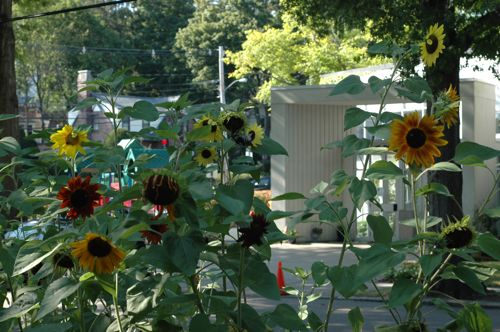
Rich, my neighbor — husband of Julie, father of Georgie, and looker-alike of this guy — walked by and asked me if the sunflowers were ready to be harvested for seed.

Yes.

Harvest_profusion2

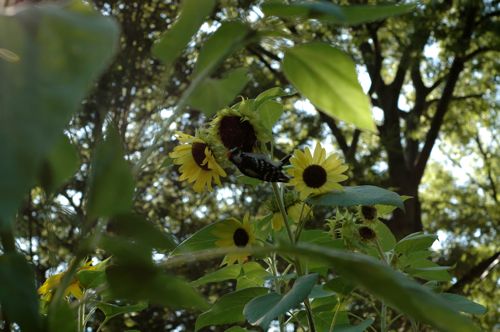
However… “I decided not to harvest them,” I replied to Rich, “and that I’d leave them for the wildlife.” I told him about a Downy Woodpecker and other birds that were feeding obsessively on the seed heads.

Harvest_ sunflower gymnast

It also seemed that there was other local wildlife interested in harvesting those seeds: Grace and Georgie. Later, as I poked around in the yard, they asked me if they could cut some down and get the seeds. I said, “yeah, but you can’t eat them.” Their countenances suggested I had offended their intelligence: “We know.”

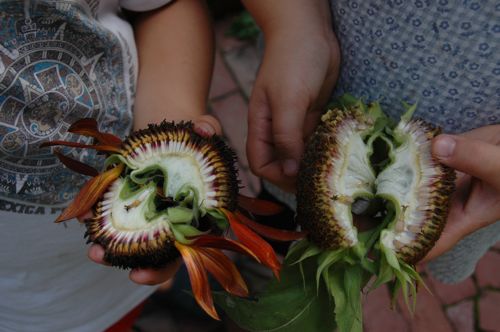
The two of them went to work, cutting down mostly spent sunflowers and cracking open the seed heads.

Harvest_heads in hand

Then they strafed them. Continue reading

– Mudroom thoughts

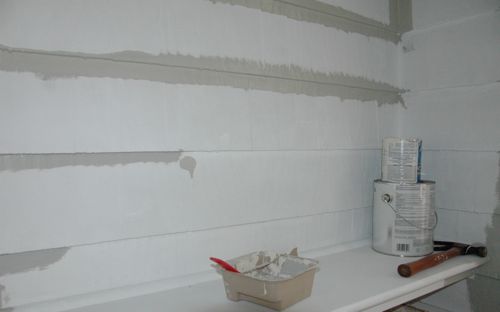
I am painting the mudroom in our house. It has seemed to me, as I’ve been sanding and priming and painting, that this is about as prudent as detailing the family minivan or polishing a car’s hubcaps. (Not very.)

Mudroom process

Still, I will finish it, and it will be good.

The experience — while longer than I budgeted — has yielded many long moments of my kind of meditation: an unhurried and unworried turning and turning over of thoughts. Here are a handful.

1. To be a professional ANYTHING takes more than talent, desire, and hard work. It takes a stomach for boredom. Don’t a lot of people think they can paint? I mean, hey, how hard can it be to lift the brush, stroke it back and forth, swipe at spills with an old rag? Not very. What’s hard, though, is to keep going through the boring times. This is true for every job and vocation and art: There are long patches of boredom. What makes someone a professional painter (or writer, teacher, accountant, mechanic, gardener, athlete, chef, whatever) is stick-to-it-iveness, not just in the face of challenge, but in that gaping yawn of same old, same old, end not in sight, still must go on. Continue reading

– Summer’s punch list

tool wall 500

"Tool wall," by Valerie Everett

Often, I think seriously about changing this blog’s tag line to this: “What goes into planting, fixing, and writing.” I rarely use my skills in handwork to do much else than repair or fix stuff up. This month, for example, I’m painting the mudroom, tinkering with the garage door, and changing the latch set on a storm door.

Last week I bent myself over the sewing machine to hem a few pairs of pants for Grace, and yes she did appreciate my labor. It is good to know how to do things: When you do it yourself, you save money, and you’re on your own schedule. I hemmed those pants the same day I bought them, and I draped them over the end of Grace’s bed as she slept, so she could see them when she awoke.

(My mother did that occasionally for us when we were children. She’d sew late into the night to finish pants or a little jacket, and arrange them on a clothes hanger and then our bedroom doorknob so that, when we awoke, there would be a new outfit in a place where before there was nothing, just a door. Perhaps that is why I love — and I really mean love, and never tire of — that scene in Disney’s Cinderella where all the birds and mice work together to fashion a dress for their poor but beautiful friend. You can see that scene and the animals’ industry in this YouTube short between the 3 and 5 minute marks. If you let it play another 30 seconds, you’ll see the stepsisters tear that dress to tatters, and that, for me, is more upsetting than the missed connection with the prince.)

But!, this isn’t about making dresses, it’s about mending them and lots of other stuff. Continue reading

– Sunflower folly

This is what hope looks like.

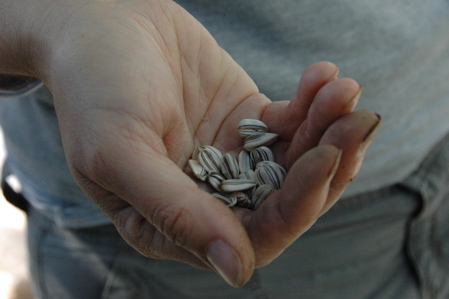
Seeds in hand
During a spring semester clouded by the recession and my own economic downturn, I forced myself to take on tasks that were both optimistic and doable. I tended to my students and their work; I cultivated ties to colleagues and friends; I hoed the already neat rows of my resume; and I scattered queries for teaching jobs.

And I planted sunflowers, a huge patch of them. A “folly,” it’s called. In the midst of the sober and the sensible, I had to do something dramatic, quirky, and above all possible. I mean, sunflowers I can grow. (So can you.)

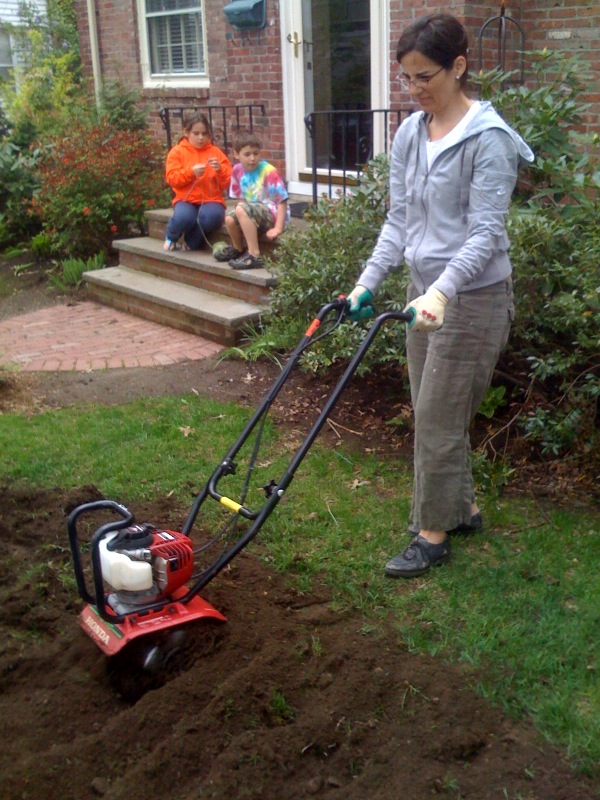
Along with my helpers Grace, Jimmy, and George, I stuck those seeds in the dirt only 10 days ago, on May 10th. It’s too soon to tell whether the folly will be a success. Amazingly, however, there has been an unexpected bounty on the teaching front: I’ve been rehired, as funding to the MIT writing program has been restored for the coming year.

And I am so… HAPPY! I feel the way I expect those sunflowers to make me feel when they bloom in August.

There’s still time for you to plant your own sunflower folly, according to the tutorial that starts below. The original concept can be found in Katherine Whiteside’s The Way We Garden Now (an excellent, unfussy, and imaginative garden project book, by the way). Variations are by me. Continue reading