Green tomato moment

Time really does run out. And I’m not talking about mortality — we all know that. For some things we might do or experience in life, though, a moment passes, and it is gone. The gone moment must be acknowledged.
Often I hear people saying a sentence that begins, “I coulda been a [fill in the blank].” The first time I noticed this particular construction of sentence, I was only 25 years old, and the man who said it was perhaps 40 or so and someone I worked with. Apparently, he could have been an opera singer. But he was a university development officer. Alas, though, I think he wanted us to know, and he wanted to remind himself, that there was this germ of musical potential inside him. (Interestingly, he was doing nothing to propagate this germ.)

I’m human, and I can get stuck in this thought pattern, too. I don’t dwell on not becoming a pharmacist (yup, considered that), flautist, or Boston Globe reporter, or on not reprising the Francie Nolan story. It’s more like: I could have become the kind of person who would throw the plate, sob lavishly, shout “Pick me!”, or, in a manner of speaking, dance on the table. Honestly, I don’t even know how to turn on that impulsivity switch, and I am sincere when I say that — occasionally — I wish I had become the kind of person who could.

The gone moment must be not only acknowledged, it must be acted on. One must say, “This is what I am, what I have. What will I do with this?”

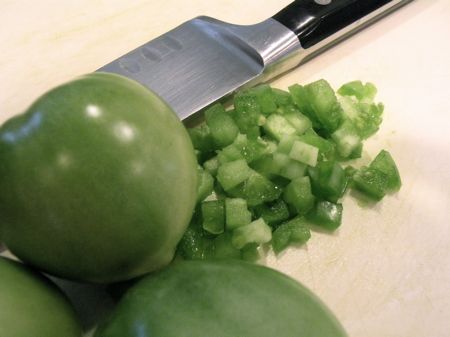
Which leads me to the actual topic of this post: green tomatoes. Let’s all confront what is our garden, or our neighbor’s garden. This summer seemed to be a poor one for tomatoes. Look around and see mostly hard and green ones still hanging on the vine, with the potential, but not likelihood, of ripening into juicy red ones.

It’s October 6th. It is time to recognize the green tomatoes, pick them, and eat. Here are recipes, personally tested by me and those around me, for Green Tomato Salsa and Fried Green Tomato BLTs. Perhaps, under different conditions, they coulda been red salsa or a more basic BLT, but I dare you to say that these are not absolutely, wonderfully edible.
Accidental vegetables

After I harvested the potatoes, we tilled up the patch and mixed in some lime for sweetness. While we were at it, we tilled up another troubled patch of grass and mixed in our first batch of compost. Would lime and compost yield the same results?

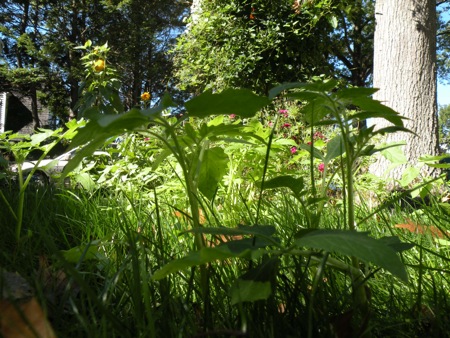
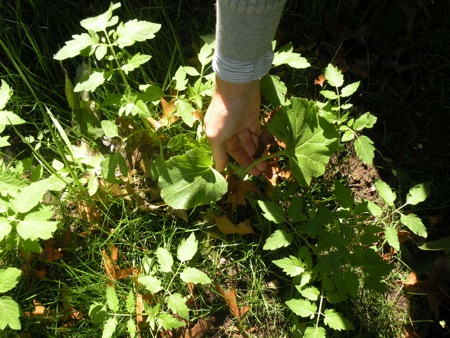
Grass is similarly sprouting in both the lime- and compost-treated areas. There is also, surprisingly, some additional species growth in the area with compost. Ah, vegetable seedlings to be exact.

Tomato jungle towers above grass understory.

Leaves of a big-fruiting plant -- melon? squash?

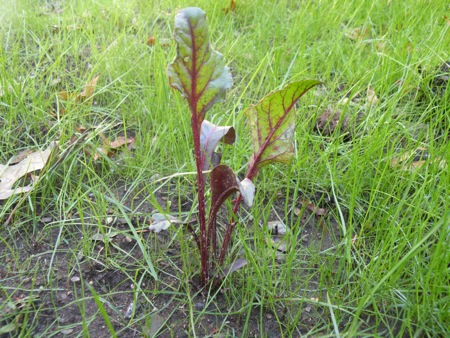
Ironicially, beets, which I wasn't able to grow successfully from seed this summer.

Plants do what plants do. We have decided to simply let this go — no mowing — until the first frost.

Unpretty potatoes and their lessons

There are beautiful ideas, and there is reality.

I learned this from a tutor I was training, several years ago, when I worked in the Simmons College writing program. Her name was Kristin, and she told our group about a time she absolutely could not write a paper, although she had “written it in her head,” and it was perfect. So she went to her professor, and she told him about this perfect, imagined paper and how she was unable to write it. He said to her, “All you have now is a beautiful idea. And beautiful ideas are not writing.” He handed her a lined, yellow pad of paper and looked at the clock. “I’ll be back in two hours. Write,” he said. Kristin sat at a desk in the hallway and wrote. And what she produced was less perfect than what she imagined producing, and yet it was real. The words existed in the world and did not merely float in her head. “There,” the professor said. And the paper turned out to be neither good nor bad, Kristin told us.

If a creative person has high hopes for her work, she must learn to tolerate the gap between the idea and its manifestation.

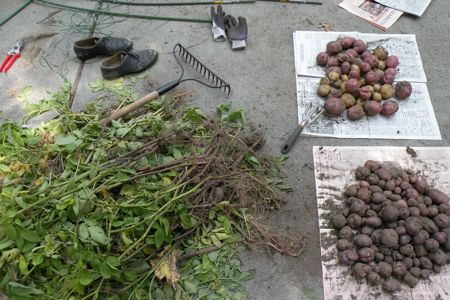
Harvest done. Things arranged.

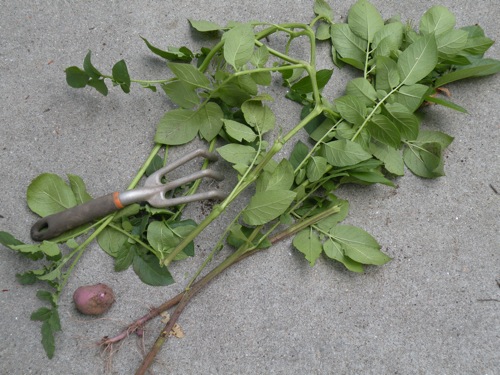
Yesterday I completely harvested my first crop of potatoes. I waited for the soil to dry from a previous rain, and then I clawed around each plant, exposing the stalks to the first potato. One at a time I grasped the plant down near the exposed soil line and pulled gently and with a little vibration, as though wiggling a tooth out. I piled up the stalks on the driveway. I piled up the potatoes — gold, red, and purple — on dry newspaper. My dark shirt absorbed the sun and my scapula were like hot wings. Continue reading

Potato’s first kicks

The potato plants are flourishing, and while I have wondered what’s going on underground, I would have been content to wait until the minimum growing period (70 days) had passed. But a member of my potato audience (i.e., a regular passer-by) suggested I have a look. “You might have some — whaddya call them? — new potatoes under there.” She claimed to have a farmer brother in Wisconsin and was therefore a bit of an authority on potato matters.

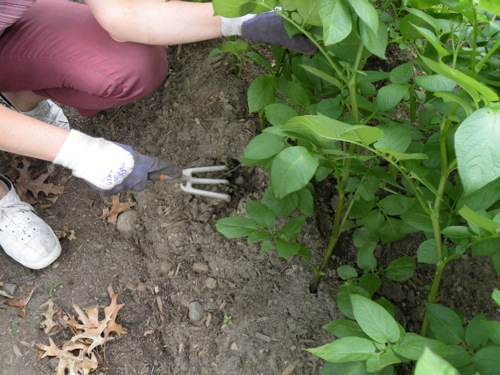
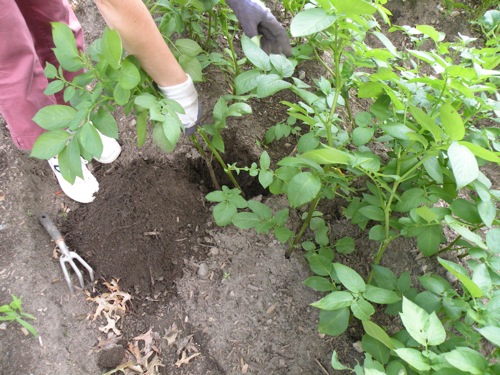
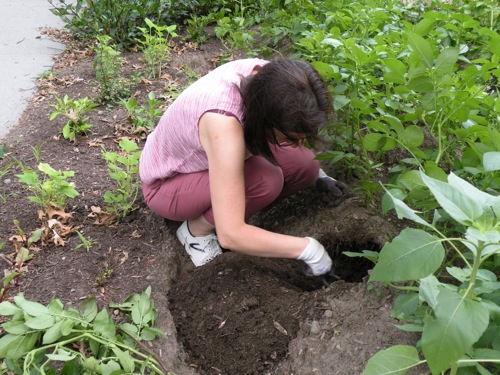
Persuaded, I enlisted the documentary skills of one of my staff photographers, put on some gloves, and grabbed the fork-like cultivator. Gingerly I began digging.

I clawed deeper. The only word for how I felt was expectant. Something, I hoped, had been growing invisibly for weeks, and I was eager for a sign, a fetal kick of sorts. Clump after clump of dirt rolled under the tines. All I saw was dirt and those thready roots.

No longer content to let sleeping potatoes lie, I tugged up the bushy plant itself, wondering if this would drop a little spud or two at my feet. Hmmm, no.

I went back in, like an archaeologist, easing the dirt out of the cavity, trying to feel for lumps I couldn’t see.

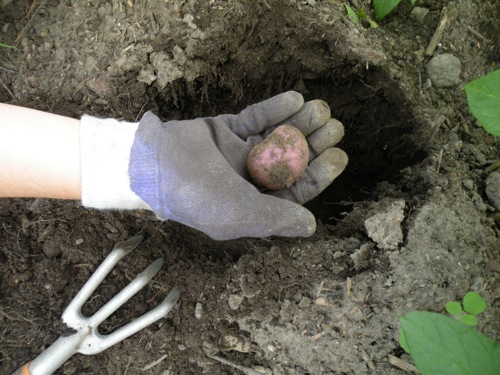
So suddenly that I caught my breath, a red potato rolled into view. Oh, the feeling! Here was evidence. Potato plants really do yield potatoes, and I had arranged the conditions (soil, water, sunny spot, fish meal) under which food — life sustainer! — could grow. A little sign of more to come.

I only dug the one, and then I cleaned, boiled, and ate it — floury, delicious, and mine.

—–

Photographer: Lydia Guterman


Tree in a bag

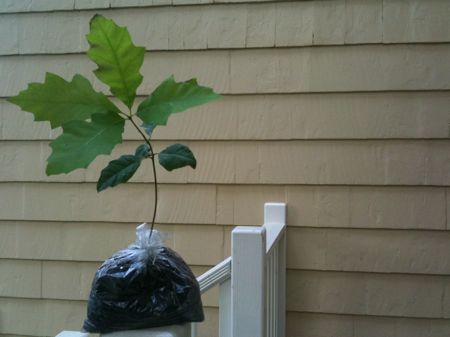
In April, digging around in the yard, I slipped a sprouted acorn out of the ground, put it in a plastic sandwich bag with some damp soil and mulch, and sealed it with a twist. My intention was to mail it to a friend’s child, as a surprise. I forgot. And yet it has been doing well on its own, sitting on the shelf attached to the gas grill, waiting for me to make up my mind what I’ll do with it, and growing.

You will be mine; you will be mine, all mine.

Those lyrics from this song went through my head as I put this little guy in his place. And then I remembered how much we loved this song in 1980, perhaps because it’s so mimickable. We sang it to each other a lot. I watch the video now, and the song seems to draaaaaaag along. Well, we were 15 that year and had all the time in the world, and we minded not the draggy songs.

I turned on the hose in the back and went to the front yard, where the potatoes are thriving. In only 4 weeks, some of the plants are already 12″ tall, so I hilled them. The UPS guy, in brown shorts that show off the fascinating tattoo running up the meat of his calf, stopped to ask, “What are you growing?” He seemed astonished when I told him, and had been walking toward me but took a step back, and then he said, “Hey, any fruits and vegetables are good, right? Well, except asparagus.” (I happen to agree that asparagus, which I will eat, is over-rated unless garlicked, roasted, and salted.) I confessed my worry that so far the results of my farming experiment are exceeding my hopes: “I might end up with one hundred pounds of potatoes, even more. How will we eat so many potatoes?” He responded by rattling off a list of all the ways potatoes can be prepared, ending with “leftover potatoes, hash browned.”

Even though we Americans normally plant our vegetables in a back garden, the good thing about gardening in the front is that people stop to talk. A woman in a nice black car parked along the curb to go to the temple across the street. I don’t know her, but I recognized her as my friend/neighbor Julie’s friend. She was as interested in my experiment as the UPS guy was, and remarked how satisfying it is when something grows. I said, “It’s amazing,” and then I checked myself: “Well, perhaps it is not amazing.” Lovely and well-groomed, she surprised me when she forcefully replied, “It is amazing. I mean, I’ve grown things myself. Tomatoes, cantaloupes…” In the air and with her hands she held the shape and weight of a cantaloupe, as if she was remembering the growing and picking of it.

While it is wonderful to grow anything ornamental — daisies, hydrangea, impatiens, and sunflowers — there really is something different, and I can’t quite yet put my finger on it, about growing food.

Potato farmer’s progress

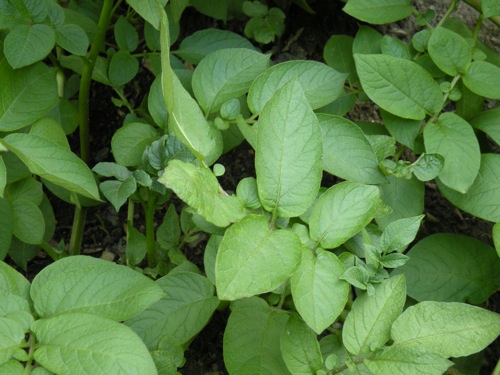
new potato plant, June 11

I have been wanting to report on the progress of my first attempt at potato growing, and I have been wanting to try Vuvox, a multi-media slide and collage making tool on the web. Two-for-one: I composed a story, with pictures and video, of the first weeks with my potato patch.

Note: My potatoes and Vuvox are still in beta. If you go to the Vuvox potato show, click on the play arrow and let it run through. (If you hold the cursor arrow in the collage field, you can control the speed and direction of the show, but the slide bar is clunky and to be avoided.) When you see the arrow for the video of rototilling, you can click on that, too. It all won’t take very long: 1 minute or so.

Where did I get the instructions for how to grow potatoes? The Maine Potato Lady, of course. Go to her site, and click on “Growing Potatoes Successfully” for a one-page PDF. And because she was out of seed potatoes by the time I was ready to order them, I got them instead from the Gerritsens of Wood Prairie Farm in Maine.