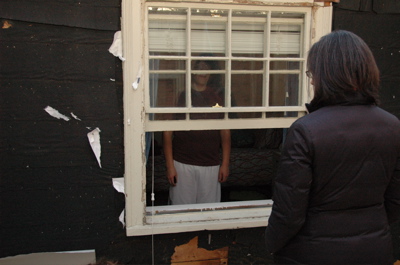
– Walk into the dark

This excerpt is from a ruminative and sparkling post by writer and teacher Alexander Chee on today’s Koreanish:

Part of what is interesting to me about writing is how writing is a social act—a performance for others, a way to connect that has not one guarantee to it. You write and you don’t know that anyone will ever read it or care. You have to proceed in line after line, like someone descending a stairway towards an unknown space below and past an unknown number of stairs also. It may even be an eternal descent until death. You don’t know how much you’ll have to write before you begin to connect to others—that is the crisis of the student writer, for example, but all writers, I think, recognize that crisis as simply a student writer’s introduction to the idea that they could write for their whole lives and never succeed, and they won’t know, even if they write.

You are basically asking them to walk into the dark and trust that they’ll meet someone there. Someone to whom they’ll entrust all of this work. Most of the time you never say this to them because it is a terrible thing to encounter and everyone makes their own peace with it.

– Good question

In an essay on memoirs in the September 2008 Harper’s Magazine, Francine Prose writes:

On nearly every occasion when I’ve been invited to speak about both fiction and nonfiction writing, someone has asked my opinion of the scandalous disclosure that James Frey had fabricated sections of his memoir, A Million Little Pieces. I reply that I’m puzzled that people seem more upset by a lie about how long a writer spent in rehab than a lie about whether Saddam Hussein had access to weapons of mass destruction. Inevitably, nervous laughter ripples through the room.

In fact, I couldn’t be more serious. Each time, I find myself wondering: Why isn’t the audience talking to one another, and to me, about how, for the past eight years, our government has deceived us about matters of huge consequence–the war in Iraq, the economy, the environment, Abu Ghraib and Guantánamo, real estate foreclosures, poverty, unemployment, the handling of the Hurricane Katrina tragedy?

(Incidentally, her essay is not at all a defense of Frey or Seltzer’s contraptions, which she finds “B-list” at best.)

– Advice

From Sara, Grace’s reading teacher who is tutoring her over the summer:

Read one book at a time.

From Hal Blythe and Charlie Sweet, who published a fascinating and enjoyable article, “The Writing Community: A New Model for the Creative Writing Classroom,” in the Spring 2008 issue of Pedagogy:

… To write like a professional, the writer will craft two works simultaneously (319).

These practices are an inversion of what I normally do: read two or three books at a time, and write one piece at a time.

Interestingly, I am having an easier time sticking to Blythe and Sweet’s advice than I am to Sara’s. I agree with Grace: it’s hard to finish one book when you’re dying to read another.

– Images

I love the images in these two lines, from two different pieces:

All over the room, like boats softly tooting their horns in a harbor on a foggy night, men were weeping. (Nicholas Dawidoff, “The Man Who Wasn’t There,” New York Times, Sunday, June 15, 2008)

and

At times I was lonely, but it was a bearable loneliness, the way I imagined that a star, brilliant in a Milky Way of other stars, would be lonely. (Walter Dean Myers, “Poets and Plumbers,” What They Found, Wendy Lamb Books, 2007)

I tried to find more lovely sentences from my reading of the past week or so, enough to make a handful or a dozen, but these two kept pushing contenders aside.

The first is from a personal essay on his lost father, and other men without fathers, by a male author; he hears the weeping as he sits in a darkened movie theatre watching the last scene in Field of Dreams. The second represents a moment of self-reflection by Noee, the 17-year-old female protagonist in a short story, who feels distant from the boys and young men who try to attract her attention. Her father is dead, too.

The loneliness of the first-person narrators is made even more piercing, I think, by the beauty with which it is rendered by each writer. There’s something strangely comforting, too, in the idea of sadness shared, distantly, among other boats and other stars.

Is that ethical, to make sadness be beautiful? That’s a seduction. Should sadness be starker, plainer? It has one quality in art, and another in life.

Either, it is a feeling of force:

Sadness drives us to restore attachment and is from an evolutionary point of view an important adaptive emotion. The sadness caused by bereavement is the cost of having been attached, and it may also act as a social signal that is a plea for sympathy.

In these lines, who makes the plea: narrator, or author?  Does it matter? As a reader, I do feel as though someone in these words is reaching out to me.

– Opinions

As dinner ended, Lydia, Eli, and I discussed our summer trip. (Grace had wandered off to the television; Jimmy is at a dinner meeting.) Eli is impatient for us to nail down the date and destination. The children have opinions, which enrich but complicate the process.

Lydia (suddenly): I know! Let’s rent one of those coach buses for a few days. What do you think it would cost? It would be, like, a great family vacation. All the Kokernaks could go to New York for the weekend.

Eli (loudly): Lydia! That’s like communism — it sounds like a good idea, but it isn’t.

Back to the drawing board.

– What you remember

Sunday. The water was 52° F. today; the air was 68°. Grace, Elena, and Sarah went into the water the moment we got to Cold Storage Beach; my father stood there, knee-deep, for a few minutes and then dove in. Later, I went in all the way, as promised. I lasted about 10 seconds. Lydia and Karalyn had a swim after they came back from the jetty.

Last year’s Memorial Day weekend was also sunny and warm, “75-80 degrees,” according to my mother’s 2007 datebook. The 2006 holiday weekend was glorious, too, and we went swimming to get a jump on summer. Three times: I’d call that a tradition.

This morning before the beach, and then later at dinner, I surveyed my siblings, their spouses and friends, and my parents, “What do you remember about Memorial Day from when you were a child?” Flags. A commemoration at school. Cemetery visits. Going to the parade. Being a Girl Scout and walking in the parade. An annual get-together with family friends.

Those memories of Memorial Day are like mine. I also remember the first few lines of one of the few poems I ever had to memorize in school, and I recall reciting it, with my classmates, in the paved playground of Leicester Center School, when I was in 4th or 5th grade, during a ceremony in which the flag was unfolded from its formal triangle, then raised to the top of the flag pole, then lowered half-way.

In Flanders Fields (1915)

In Flanders fields the poppies blow
Between the crosses, row on row,
That mark our place; and in the sky
The larks, still bravely singing, fly
Scarce heard amid the guns below.

We are the Dead. Short days ago
We lived, felt dawn, saw sunset glow,
Loved, and were loved, and now we lie
In Flanders fields.

Take up our quarrel with the foe:
To you from failing hands we throw
The torch; be yours to hold it high.
If ye break faith with us who die
We shall not sleep, though poppies grow
In Flanders fields.

John McCrae

I do not remember learning about World War I in school around this time, but we did learn about poppy fields, and veterans’ cemeteries, and flags. We must have recited the poem in sing-songy, childish voices, caught up in the rhythm. I doubt we stopped in the middle of the first line of the second stanza, as a reader should. I read that line now, as an adult, for the first time in more than 30 years, and I wonder, how can you not stop after such a line, “We are the Dead.” That stanza is something, isn’t it?, with all the thudding “d” sounds, starting with that doubled one: dead.

It seemed beautiful to me then, as a child, that image of an endless field of orange poppy heads waving in the sun, a makeshift burial ground transformed. Somber and bright at once. I don’t think I thought of sleepless soldiers under the poppies, or who the speaker of the poem might be or, rather, had been.

– Just to say

First of all, this is just to say that the following poem is one by William Carlos Williams that I’ve never really liked. I knew in high school I was supposed to like it, for its straightforwardness maybe, its use of the word “delicious,” but I don’t think I ever did. I do like the sound of “icebox,” yet I don’t like the sound of the word “breakfast” (a stack of consonants and blends!), even though I do like to eat it.

Yet, the title, This Is Just to Say, has been speaking itself to weary me as I stand in front of the sink and look out on ladders in the back yard and see paint splashes in the sink or sit at the kitchen table and hear the builders thumping and singing upstairs, as if our house is their house. This is also just to say I want my house back.

Back in March, on the verge of construction moving from the outside to the inside

You can read the WCW poem and see if you like it. Then you can read my words crammed into his structure. I know white space is important in his work, but there is no space in my life right now and so no extra space between the lines of my attempt.

This Is Just To Say

I have eaten

the plums

that were in

the icebox

*

and which

you were probably

saving

for breakfast

*

Forgive me

they were delicious

so sweet

and so cold

*

–William Carlos Williams

*

This Is Just to Say

We have endured
the guys
who are in
our bedrooms

and whom
you were possibly
going
to hire

Pity us
they are industrious
yet such bulls
and so loud

–Jane Elizabeth Kokernak

—-

Picture taken by Jimmy on March 11, 2008.

– Sentence love

Every night Dusty and Honey lie in their twin beds and talk before they fall asleep.

I didn’t write that sentence.  I heard it today, in the middle of a broadcast essay by Hillary Frank on This American Life.  The story is about two sisters in their 70’s who are not twins but who have lived their entire lives together, buying matching clothes, eating matching foods and snacks, and making a matching life.  It’s called “Matching Outfits Not Included,” and you should listen to it.  The author/producer gently raises with the sisters the urgent questions of selfhood that gnaw at many of us, and the sisters gently push back.  Love, not the self, is their currency.

And I love the sentence.  Hearing it, I instantly pictured the sisters, like old girls, in their beds on their backs with blankets up to their chins.  I superimposed on their faces the faces of my grandmother and her older sister, Mae, who lived together in later life: bickering, sharing, knitting.  As I wrote down the sentence on a pink Post-it note, a beat after it was spoken, I admired the author for saving it until the middle of the piece.  It would have been easy to use it as a first sentence — what great names! — like a good pick-up line.  But Frank holds onto it, until the moment after she establishes the sisters’ genuine intimacy.  And then the sentence brings us, the audience, in closer.

– Reciprocity

Sometimes a student enters the Writing Center in distress, having been told by a professor that his writing is so “unreadable” that the professor has not attempted, beyond the first paragraph, to read it.

These instances make me think again about the writer’s job, yet even more so about the reader’s. They each must try hard to reach the other. Writer, write hard. Reader, listen hard. Communication is a meeting in a middle place. Not a compromise, though. A meeting.

I like how Joseph M. Williams, the author of perhaps my favorite handbook on style, Style: Ten Lessons in Clarity and Grace 6e (Longman 2000), reflects on a writer’s role in this relationship:

We write and revise our earliest drafts to discover and express what we mean, but in the drafts thereafter, we write and revise to make it clear to our readers. At the heart of that process is a principle whose model you probably recall: Write for others as you would have others write for you. (220)

He says much more about the golden rule and a writer’s obligation, and I wholeheartedly recommend the chapter “Ethics of Prose.” In it, Williams also says this, about the golden rule and readers:

Some readers read less well than others, and some expect more from a writer than their meager investment of time and effort earns them. In fact, just as writers have an obligation to readers, so do we as readers have an obligation to writers: If we assume that writers work hard to say something important to us, we should read thoughtfully and generously, at least until we decide they have given us good reason to stop. (221-222)

Reading and listening — paying attention — to the words of another require generosity: a gift, a gesture. It takes effort to look beyond the lack of clarity in a student’s writing, but if we believe that they are making an attempt to say something important to us (it’s our assignment, after all!), then we should reciprocate. Williams calls such an exchange “fair” (222).

A penciled notation on the inside page reminds me that I paid $6.50 at Brookline Booksmith Annex for a used copy of Style. The latest edition, the 9th, is much more. Still, it’s worth it.

– Convergence

Last week we saw Ratatouille (Pixar 2007) for the first time. Remy is a French rat who loves fine food; his ambition to become a chef is stoked by imaginative visitations from the late Auguste Gusteau, a once-renowned restaurateur who wrote a book titled

Anyone Can Cook.

Yesterday I was sorting through a pile of non-urgent papers that I’ve been hiding, even from myself, in my top desk drawer at home. I came across a document, “NCTE Beliefs about the Teaching of Writing,” that a colleague asked me to read months ago. My eyes fell on the first belief, in bold type:

Everyone has the capacity to write.

These are beliefs. Like the jolly Gusteau, a person can choose to believe that each individual has the capacity to cook (not to become a great chef, but to cook). Like the Writing Study Group of the NCTE, a teacher can choose to believe that each student can write.

What if, however, a chef or a teacher held a similar belief, and yet also maintained an attitude inconsistent with that belief?

How many times have I heard someone grumble about students (especially incoming ones): “They can’t write”? I don’t think that a teacher, whose work is essentially optimistic, believes that college students do not have the capacity to write. What such a teacher is really saying is that her students’ writing does not meet her expectations, or college expectations, and she is daunted by that, and it brings her down. And yet, I wonder, what power does that attitude (“They can’t write”) have on one’s beliefs about one’s own students and, more so, one’s own teaching?

Once in a while I meet a new student in the Writing Center, and, as I read her writing for the first time, I see that it lacks so much in the way of clarity and sense that I do a quick, internal inventory for any teaching skills I might have to offer her as a writer and I come up almost empty. In such an instance, I do feel daunted — it’s like a stone in my chest — and I even set my sights low, not for the student but for the paper at hand. “Jane, just be an attentive audience. Give the student that.” So, I read and I get her to tell me about it. I don’t always understand her reply entirely, but I usually understand enough of it to have a conversation with her about her personal narrative, or reading of a novel, or thoughts about a historical event. I don’t correct or suggest. I listen, ask, nod, smile.

I have been tutoring S., who is such a writing-challenged student, for more than a year. She continues to make sentences that seem more spoken than written, and her grasp of American English idiom is based on what she hears, not what she reads. (For example, in a paper about a high school teacher, she described that person as being “inch arch” of a learning center. She and I figured out that the teacher was “in charge” of a learning center.) Encouragingly, I also see that her sentences are longer and more flowing and that her papers are more fully developed with detail and discussion. She sustains. And that’s a powerful sign of her growth as a writer, but it might be hard to recognize it if I were ticking off her many errors. And there are many; I do see them (and we are just beginning to work on some).

When another teacher, in genuine moments of fatigue or frustration, says to me, “My students can’t write,” I offer, gently, “They’ll get there.” I do not know what my tutee, S., will do in her writing, in school, and in her life beyond my time with her, but I do believe she will get there.