– Crow season

Jan sent me a link announcing new work by Vermont artist Carol MacDonald, in which she “examines the tradition of knitting through a variety of print-making techniques.”  I love it, especially that the featured image is “Red Skein I.”  (What is it about red yarn?)

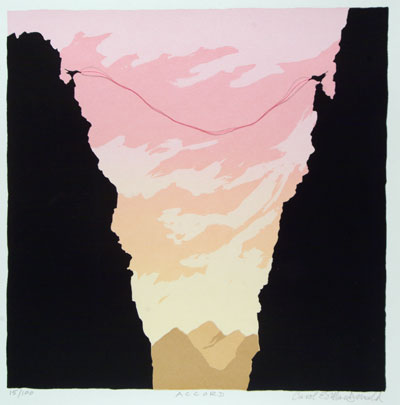
I looked deeper into MacDonald’s portfolio and found even more that I liked, especially her paintings and prints with crows as their subjects.  Her works have titles like “Convergence,” “Bearing Arms,” and “Resolve,” and they are more than portraits of crows.  There occasionally seems to be a bit of string in them, too:

"Accord," Carol MacDonald, silkscreen/thread

"Accord," Carol MacDonald, silkscreen/thread

It’s crow season again.  Yesterday and today, in the mild, fall weather, the crows are landing and taking off in the yard, again and again.  Continue reading

– Mending (a life)

Hem pants. Replace buttons. Re-hang shelves and pictures. Fix holes in screens. Weed garden. (Ignore crabgrass.) Deadhead annuals. Scrub enamel sink. Re-plant pachysandra bed. Adjust bike seats. Touch up dinged paint in hall. Oil squeaking hinge. Darn moth holes in favorite sweater, black. Launder curtains, and vacuum louvered blinds. Prune files. Treat stains.  Find missing pieces. Sweep up glass, and — band-aid solution — cover broken pane with a cardboard rectangle. Proofread the syllabus, the assignment, the handout. Adjust temperature. Change sheets. Plane doors. Bring broken chairs to Manny; wait two weeks; pick up chairs from Manny. Glue tiny porcelain arm to tiny porcelain shoulder.

Take old desk and make it new.

Take old desk and make it new.

So much of time seems filled with repairing, maintaining, and renewing what’s already been done.  The moments of decision and creation — when life is composed — are few.

– Midnight costumer

An eight-year-old child comes home from her arts camp on the second-to-last day and says to her mother, “Peggy says I need to wear jeans tomorrow.”

The mother, who knows that (a) the girl has no jeans and (b) the girl doesn’t like jeans, asks, “Why?”

The girl says, “Because I need them for my costume.”

Ah, yes, the last day of camp is filled with the performances and art shows the children have been preparing in the intense five-week session.

The mother offers to alter her own jeans skirt.

The girl refuses it. “Mama, my character is a man. So I can’t wear a skirt.”

The jeans make sense; now the mother remembers that the girl plays Frank, whoever he is, in Annie Get Your Gun.

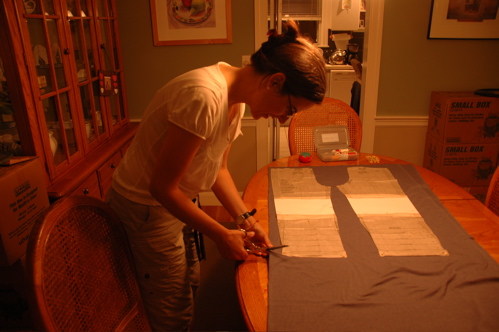
So, mother and daughter head to the fabric store and buy stretchy, denim-like fabric (that’s not denim!), a “quick sew” pattern, and notions. We come home, eat dinner, and get through the evening activities, including girl’s bedtime.

And here’s a picture of the mother, at 10:30pm, about 12 hours before the curtain goes up.

Jane cutting fabric for Grace's faux jeans

Costume Department

Photograph is by girl’s father.

– Retreat day two

The draft of “The Work Hands Do” grew by 1,716 words today. I feel like I’m coming to the end of it, like maybe tomorrow I could verify some facts and finish this version, of which this section is part:

There’s a stigma to lice, and I’m not sure what’s at the root of it. After all, the head lice epidemic largely affects school age children, six to twelve million a year, according to a recent report by the Centers for Disease Control. We’re not, as a culture, afraid to discuss other school age illnesses, like asthma and food allergies, so why head lice? Head lice are not sexually transmitted, although pubic lice are, and perhaps the two conflate in the public’s imagination. Body lice are prevalent among the homeless, so head lice, too, may be associated with poverty and poor hygiene.

Maybe that’s it: lice are dirty, whether you’re talking about grime or sleaziness. If contagions are preventable – haven’t we all increased our attention to hand-washing in the last several years? – then a head full of lice is an outward sign of poor fastidiousness and moral failure.

I had lice at least once, during one of the several times my children seemed to be farming them on their heads. At first, the itching seemed sympathetic. I’d comb squirming lice from hair for hours, absorbed in my task and mesmerized by scurrying creatures, and later as I lay in bed and tried to go to sleep, my head felt as though its surface was crawling with microscopic feet.

One day, though, after I finished spitting out toothpaste water into the bathroom sink, I raised my head, glanced at myself in the mirror, and caught a glimpse of a louse skating along one of the hair strands that brush across my forehead. I leaned closer and saw it dip down into the hair, out of sight. Visual confirmation of what I had suspected made me relieved and squeamish at once.

It was late, so I went to work, where I did not tell my officemate about the louse sighting. I decided, simply and inconsiderately, that I did not want to deal with unanticipated consequences. Are omissions lies? Not always, but, in this case, yes.

During a break, I went into Metaphor Yarns in nearby Shelburne Falls, because I had to. I met the proprietor, Meta (pronounced Meetah) Nisbet, who told me about a wonderful series of books by Sally Melville and then realized she was out of the very one I wanted. I mentioned that I had stumbled across Shelburne Falls years ago, when we were driving back from MASS MoCA with the kids and simply had to stop somewhere, and we discovered her town and the magical Bridge of Flowers. She asked if we had caught The Knitting Machine when it was at the museum, and I said no, so she told me about cranes, giant knitting needles, and a giant flag.

What could I do, but go to YouTube and look for it? “The Knitting Machine,” by artist David Cole, is straightforward yet weirdly phallic, and I think it’s meant to be. See what you think:

– Eyeglass repair

Eyeglass repair tools

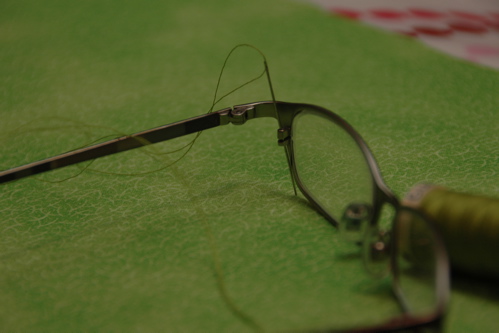
In a darkened room, I lost the micro-screw to the left lens of my metal eyeglass frames. The optical shop is closed today. I can’t find my spare pair of glasses, and I don’t own an eyeglass repair kit. A paper clip is too fat a replacement for the screw. A needle and thread, however, will do the trick.

As every Kokernak knows, if you don’t have the right tool for the job, make a tool, or re-purpose another.

– Stitched seaweed

Our house, which is currently undergoing dramatic structural changes, was built in 1938, according to our town’s property records. Nine years ago we bought and moved into it. We have learned much about it and previous owners since then.

At the closing, the lawyer for the bank remarked, as he studied the paperwork probably for the first time, “Oh, I know this house. It’s the bad luck house.” And he told us about financial reversals, domestics woes, and crimes committed in the house.

We learned more about the crimes, especially, a few months after we moved in, at a party that our new neighbors (and now friends), Rich and Julie Ross, threw. A woman was there who had, in high school, dated a boy in the family; she got caught up in an investigation as the local police and the FBI prepared to nab various family members for drug trafficking. They nabbed them.

When I dig in the yard and the shovel hits metal or unearths a buried strip of plastic, my first, impulsive thought is that I’ve come across a stash of money or a bundle of bones.

I haven’t, yet.

The garage walls are punctuated with covered cavities, and I wonder if little bags of cocaine were stored there.

I have found no supporting evidence.

Interior walls of the house were mirrored — beautifully and expensively, like a hotel lobby — when we moved in, and I wondered what was behind the mirrors.

It turns out (we’ve had them all removed, over time), nothing.

Once, as workers took out the old dishwasher and installed the new, we found a lost snapshot of a little girl and a fatherly man, standing together by a little swimming pool in the backyard. They looked happy. Carved into the paneled walls of the finished part of the basement are traces of people who have moved away: “Steve + Joan 70-71.”

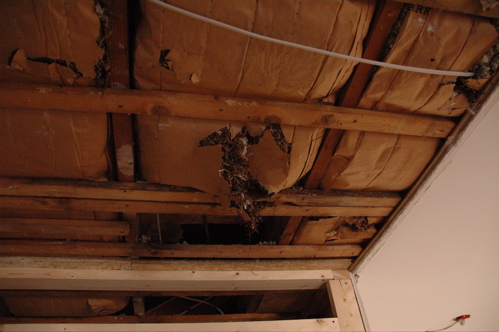
Over the years of our ownership, there have been lots of repairs and cosmetic projects in our house on Puddingstone Road, but nothing major until now. Builders are ripping down walls and reframing them into other room configurations. A bathroom floor and tub have made their way into the dumpster; I see grayed, creaky boards where they once sat. Old ceiling plaster has been pried and brushed loose. Shreds of insulation drift down, like ghosts released.

Here’s a picture of the insulation in the ceiling over what used to be Jimmy and my closet:
Cabot’s Quilt

The stuffing, it turns out, is eelgrass, that profuse plant that washes up on ocean beaches all over the world. In 1893, Samuel Cabot, a chemist who graduated from MIT and Switzerland’s Zurich Polytechnicum, having learned that “early settlers had used eelgrass as a crude home insulation,” invented Cabot’s Quilt, clumps of the dried ocean plant stitched between brown paper. A six-inch layer of it is as effective as fiberglass, according to one source. There is a one-inch layer of it in our walls. Brrrr.

On the brown paper is stamped words: Samuel Cabot. Boston. One yard. Cabot’s. Those were the clues that helped me find the story (thank you, Google!) of this curious insulation, which went out of production in the 1940’s, although Samuel Cabot Inc. still exists.

When the foolish, unfiltered banker told us in 1999, at the signing of documents that made this house ours, that “bad luck” was associated with it, I retorted (politely), that it was up to us to “make it the good luck house.”

Although I think it is unfortunate that much of our house remains poorly and archaicly insulated, I am also pleased to discover that the walls around us are stuffed with a kind of leaf, stitched between paper that’s faintly printed with words.
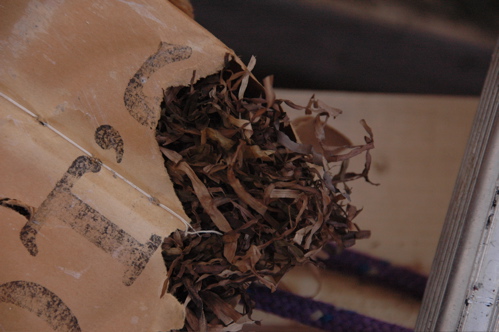
Eelgrass from Cabot\'s Quilt

Is that karma or what?

– Typewritten wish

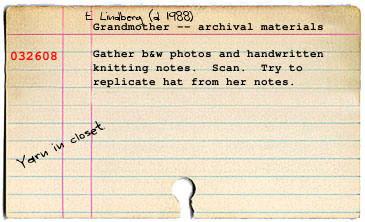
Card on E. Lindberg’s archives

The Catalog Card Generator is fun to play with, and the card you make might lend some concreteness to any project that right now seems a wish.

I want to knit a hat from some rather minimalist notes that my late grandmother wrote on the back of a birthday card, and which I recently rediscovered as I thumbed through a box of old knitting patterns and magazines she collected and I added to. And then I want to do something with that experience. (Oh, write about it maybe?) Wanting to do it, however, hasn’t gotten me any closer to actually doing it. I have the yarn and tools. What’s required is making that first move.

Well, I made this card, kind of like a “will do” note to myself. And now I’ve “put it out there in the universe,” as H., a woman I worked with many years ago, recommended that we do with our wishes and intentions.

– Row after row

There’s a kind of making that’s really just manufacturing. There are no choices or problems to confront. No risk. No surprise.

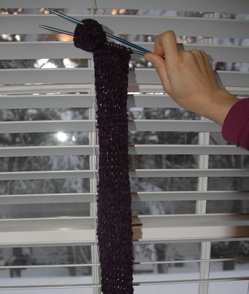
Purple skinny scarfI’m manufacturing a scarf as I sit on the sidelines and wait for Grace to finish her swim practice. Oh, early on I had to make one or two decisions — which of my surplus yarns should I use? how many stitches do I cast on? — but now all I have to do is pick up the needles and start moving my hands to operate the tools in a way I’ve done a thousand times before. As Lydia remarked a few weeks ago about this kind of knitting, it is calming, and it is productive. Row after row after row, the inches add up. I could almost knit this in my sleep. I want the scarf, which is intended for me, yet I feel no urgency about it.

On Monday afternoon, Grace interrupted her swimming of laps, hauled herself out of the pool, and walked over to where I was perched, knitting and waiting for her. Practice was only half done. She looked spent.

“I’m tired. I don’t want to keep swimming today,” she moaned as she leaned against my leg. A conversation determined that her complaint was nothing diagnosable.

“It’s a tough practice,” I replied. “They’re not always fun.” I tried, as I always do when her confidence wavers, to be an external ballast: “You’re halfway there. You look strong.” Inside, I asked myself, Why not just go home? She’s only seven.

“But, Mom!”

With my hand resting lightly on her wet back, I murmured with firmness, “Grace, I know you can do it. Plus, we’re here.” At an education conference in the fall, I learned that children become self-reliant in their interactions with trusted others. It’s our job to coax them, paradoxically, to become more independent. Is this what that speaker meant? I wondered.

Unhappily, she walked back to her lane and slipped into the water. She looked to the coach for direction, and then she bent her knees, pressed her feet against the wall of the pool underwater, and pushed off. Stroke after stroke, Grace swam 25 meters, then 50, 75, and finally 100.

I looked down at the knitting in my lap and tried to compare my rows to hers. What’s different?

When I started teaching, my friend Lisette, a (former) serious college athlete who also became a teacher, asked me, “What are you going to do this semester to get out of your comfort zone?”

“Huh?” I responded.

“What are you going to do that’s hard for you, that you’re not sure you can do?” she elaborated.

I took her question seriously and thought about it for many days as I was planning the semester, and I built into my syllabus challenges not just for the students, but for me. With a silent nod across the miles to Lisette, I do that every semester.

When I do this kind of mindless knitting, however, there’s no risk for me and nothing of value at stake. Like eating ice cream, it’s soothing and filling in a pleasurable way. We all need those kinds of activities in our lives.

Grace’s rows in the pool, however, are different. She’s not always sure she’s up to it or that she can finish what she has signed on to do. There are tears sometimes, cold water, and nakedness in the locker room. There have been no measurable victories so far, although Grace keeps hoping for them, and hence no ribbons on a loop of thread to hang from her neck. And still, she must practice, practice, practice.

Grace swimming

—-

Picture of scarf in hand by Eli. Picture of Grace by Jimmy.