– Evidence

Last summer I started and made substantial progress on a draft of a memoir/essay about having a crush on one of my Wellesley College professors, *not* having an affair with him, and reading many years later of his death from prostate cancer. A first excerpt is here, and another one is here. (There’s also a reflection on writing the essay here.)

Then, I put the essay aside for the winter and did other things and wrote other pieces as well as lots of comments on student work.
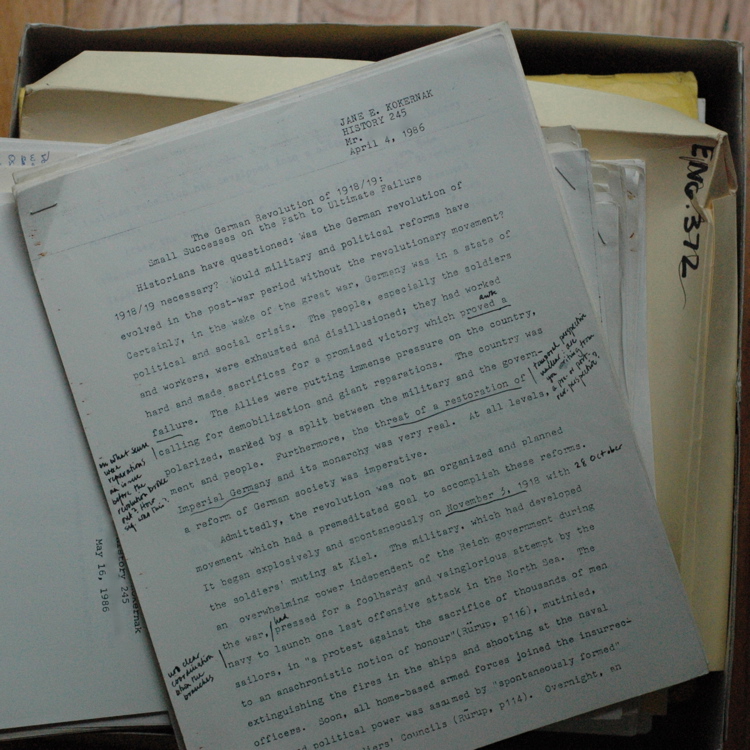
Archives750RetouchedResolved to finish the draft, I picked it up again a couple of weeks ago. I hit a snag when I felt I had exhausted my memory of that time in college. Searching for something concrete, I opened up my college archives (a green cardboard box) and found three papers I wrote for that professor.

Ah, evidence. It helps. In writing about those papers and his comments, I found my way back into the essay and finished the draft. It’s funny how artifacts function, however. While they are more lasting and stable than memory, our interpretation of them is often — usually — slippery.

Excerpt #3, “Dead and Gone (draft)”:

All that I have left from Mr. K’s class (History 245) are three papers I wrote, typed, handed in, and got back with his handwritten feedback and grade. These are my only concrete artifacts of my time in that course. Who knows, though? Maybe in the College Archives, or in his own papers, there are records of that course from that semester: a syllabus, a grade book, his own notes if he kept them. (All teachers must keep some sort of notes.) But this is all I have and all I’m willing to put my hands on. Continue reading
– Accentuate the positive

This week at MIT could be called “Presentations Galore.” In many classrooms, lecture halls, and meeting spaces, day and night, students are making formal presentations to their peers, profs, and even parents, if they want to invite them. My colleagues and I who are communications lecturers have been overseeing a lot of the behind-the-scenes rehearsals and being first audiences for draft presentations. We reserve practice rooms, lug laptops and projectors, cue students, ask questions, offer feedback, articulate our puzzlement, troubleshoot PowerPoint, watch the clock, talk through nerves, and inspire confidence.

And on the big day, the best thing we can do, besides be attentive members of the audience, is root for them, like devoted sports fans. Students do better when they sense our belief in them. They can borrow our positive energy.

So, I sent my presenters an e-mail yesterday morning, just a few hours before showtime. I wanted the message to be practical, positive, and sincere:

Dear [student names]:

I really enjoyed working with you on your draft presentations. I have
learned soooo much from your teams this semester, and I look forward to today’s showcase of your work.

Here is some preparation advice that is most relevant on the day of:

–Drink water. (If your mouth and voice are comfortable, you will feel more comfortable *and* confident.) Bring some with you, so you can keep sipping up until your showtime.

–Breathe. (Some deliberate breathing, in the five minutes before you go on, really helps with gaining your poise.)

–Pick a personally relevant, positive message. (Like, “I will reach my
audience,” or “I will enjoy this,” or, like an athlete, “I’m winning this
thing.” Once, before a good presentation, I said this to myself: “I own this stage.” This seems corny, but, honestly, it WORKS.)

And remember… your audience is interested in your project, and your friends and peers are rooting for you!

All good thoughts,

Jane

Thanks to my friend, Jan, who sometimes signs her notes, “All good thoughts,” which makes me, the recipient, feel as though she’s sending some good vibes my way. And if you want to hear Bing Crosby and the Andrews Sisters sing “Accentuate the Positive” (1944), you could watch this scene from The Singing Detective on YouTube.

– What they teach us

On Wednesday afternoon, I went to capstone presentations by students graduating from Mount Ida College, where I used to teach and run the writing center. Events like these seem more a measure of educational outcomes than any standardized test or GPA could ever be. The students were poised, engaged, knowledgeable, professional, and comfortable discussing both theory and its application to experience. Wow.

I really, really went to see Sarah Elliott, who worked with me in the writing center. In her capstone poster and remarks, Sarah described her year-long practicum at the Italian Home for Children in Jamaica Plain, working 1:1 with traumatized children, one in particular.

At some point, someone in the audience asked Sarah and her peers, “What did you learn about yourself through your work with your clients?”

I loved Sarah’s answer, and I wrote it down on the spot:

What they teach you is so much more important than what you already know.

In the auditorium, I was sitting in the dark next to Alan Whitcomb, a math professor and first year program director there who’s on my A-list of good teachers. I leaned over and said to him, “That’s what I think makes a good teacher.” He agreed, and added, “And it’s harder to teach that way.”

Interesting, that. To be a learning kind of teacher may be harder than being an expert kind of teacher.

Yet, it’s such a useful and optimistic stance as a teacher and tutor, or social worker, doctor, advocate, therapist. Open to students, open to keeping one’s own work alive.

(Go, Sarah!)

– Reading comprehension: the joy and the pain

It’s MCAS season, and all three of our children — a 3rd grader, a 7th grader, and a high school sophomore — are taking them. They seem unbothered by a few days of testing: Lydia announced, “They don’t matter,” and Grace said, “No homework this week!” Eli is his usual cool and collected self and has altered his behavior only a little, to get the recommended good night’s sleep.

This morning Grace emptied out her school bag from Friday, and after they all left the house — I’m grading papers at home today — I looked at the worksheets from last week. There must have been 25 of them. (I would say that the idea of a Paperless Classroom has been about as successful as the idea of the Paperless Office.) I was completely riveted — and I am not kidding — by one of the reading comprehension worksheets from the MCAS review curriculum.

It’s a social history piece, written by children’s book author Lucille Recht Penner and called “Don’t Throw Your Bones on the Floor,” on the Pilgrims and their manners. Here are some good (wonderfully disgusting) facts, verbatim: Continue reading

– Page length

pages500A recent post in Tomorrow’s Professor treats the forces converging on that often irritating but essentially benign student question: “How many pages?”  Here’s the lead:

He said, “How many pages does that paper have to be?”

She said, “As many as it takes to make your case.”

This exchange is pretty common, and annoying. The student is trying to set the boundaries of the assignment and is probably annoyed with the vague response he got from the instructor. The instructor wants the student to learn how to make a good argument, and is probably annoyed that the student seems to be focusing on quantity rather than quality. But there’s a motivational theory that might help each party understand the other.

Teachers, read the full post for insight into students’ impulses for this question, and your own motives for deflecting this question, if you do indeed deflect it. Continue reading

– Dear Ms. Morin

Jan Morin
Leicester High School (1979-1983)
Winslow Ave.
Leicester, MA 01524

Dear Ms. Morin,

My friend Rosemary, writing about her relationship to exercise over her lifetime, looks back on high school gym classes, where “being active meant being an athlete.” It made me think of high school gym class, and that made me think of you.

Ms. Morin, I was never a hardcore athlete and I liked gym class, and I liked it whistle1because you were a great gym teacher. I don’t know if I was aware of your greatness when I was in high school, or if this is only a realization I’ve had since becoming a writing teacher five years ago, but I always had fun in class and enjoyed talking to you. Teachers bring energy to their students, whether positive or negative, and yours was buoyant, humorous, and tough. I can still see your off-kilter smile; I remember your laugh, a whooping cackle.

Gym was one of those classes, as it is today, that was a requirement. We couldn’t get out of high school until we had taken so many P.E. hours.  That means that, unlike on sports teams, where everyone has volunteered to participate, all the students in gym were there to some degree against their own choosing.  Continue reading

– Two hours and five minutes

That’s how long it took me to make an MLA style list of works cited for an essay I am submitting to journals.

There are only nine sources on this list.

Why did it take so long? After all, I kept detailed research notes.  And, I tried EasyBib, which automates citation creation.

It took so long because, like the dashboard design that is unique to every car model, how each publication, whether print or electronic, catalogs its content is idiosyncratic.  Sometimes the author’s name and date are right there, at the top of the page.  Sometimes the name of the newspaper is the same as the owner (New York Times, for example). Sometimes URLs remain stable over time. And sometimes — most of the time — not.

Teachers, don’t we wonder why our students fail, almost every time, to adequately document their research in their papers? What’s wrong with those damn students? (Yes, I am shouting in my stage voice. You know I love them, and I suspect that you do, too.) Let me tell you something:

Continue reading

– Body’s report card

It’s on the kitchen counter, having arrived in the mail a day or two ago: a letter from the Joslin Diabetes Center with a full, quantitative report on what’s going on in my blood cells and, by extension, me.  I’m not ready to open it.

report2

Last week I saw my diabetes specialist. At one time, when I was new to diabetes and full of zeal, my performance — at monitoring, eating, record-keeping, sweets-avoiding, exercising, and controlling — was excellent. Sometimes, when Dr. A. introduced me to a med student on rotation, he would say, “This is my best patient.” Or even, “Here’s my A student.” In my late 20s at the time, that always struck me as paternalistic, if not affectionate, but still flattering. In the last couple of years, however, my body’s quarterly report card shows a more erratic performance. Occasionally, those numbers look great. More often than not, they look… merely adequate. Last week, as we looked over the records that I keep daily on my blood sugar, Dr. A. raised his eyes over the top of the paper and  asked me, in so many words, why I couldn’t do better. When I shrugged and smiled weakly, he caught my glance and then tapped the side of his head (home of the brain) as if to say, “You can do it. And because you’re not doing it, it must be your attitude.” Continue reading

– The party’s over

The semester has ended.

Well, almost.

The part of the semester that involves students has ended. I’m still sitting at my desk, calculating grades. The tally must be done — it’s part of the job — but this task is pretty dry.

There’s always a letdown at this point, when the real reasons for late nights, bags stuffed with paper, sharpened pencils, furrowed brows, last-minute prep, beautiful handouts, and teacher’s sighs pack up and go home.

Students.  I miss them when they go, even just for winter break.

In the past few days, since a culminating evening of student presentations in one course I teach in, I find myself wanting to turn to my colleagues (other staff on the same course) and sing to them a random song that my sister Sally and I used to sing to each other on occasion and at random.  Here’s how I (mis)recall the lyrics, and what I would sing: “The party’s over… take off your makeup… wake up, my friend…” The sound and the words linger on what has passed and will never happen, in just this way, again.

It’s a Nat King Cole song, yet Sally and I probably listened to the Johnny Mathis version on our parents’ phonograph player.

I can’t find a video of a live performance by either NKC or JM, but there’s a good one by Shirley Bassey.  Check out the arm flutters when she sings, “The candles flicker and dim.”

– Three new knitters

Yesterday, before a late afternoon dinner at my sister’s house, I taught my two nieces, Elena and Sara, and my oldest child, Eli, how to knit. (My two younger children, Lydia and Grace, are already in the club.)

The three of them picked it up quickly: naturals. It must be in their blood. Eli and Sara even invented their own way of handling the yarn-over step.  I tried a couple of times to guide them in the conventional way, but, when I could see that their idiosyncratic styles were nevertheless effective, I let it be. Continue reading