– An audience’s task

My colleagues and I teach undergraduates the fine arts of writing, speaking, and presenting. In this work, we talk explicitly to students about readers and audiences. Much of our work, in fact, involves making students aware of those people to whom they “transmit” their messages, reports, essays, and research. I doubt, however, that I’ve ever taught my students how to be good readers and audiences themselves, even though I hope I model the habits of a good reader and listener.

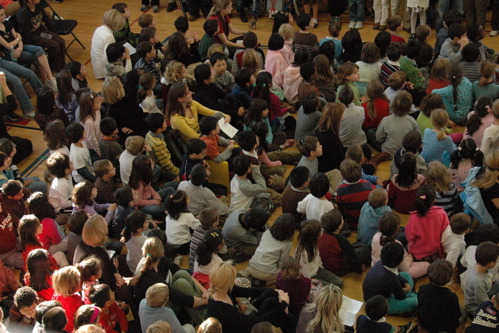
Today, at our neighborhood school, 670 students gathered in the big gym for the annual Thanksgiving assembly. Mr. Cavanagh, the principal and master of ceremonies, communicated a simple message to this young audience: “Be silent and attentive, and if you can’t be silent and attentive, at least be silent.”

School-age audience, 11.26.2008

School-age audience, 11.26.2008

Not in fear, but out of respect for Mr. Cavanagh’s words, they did sit still, and most were attentive. Some children were as young as 5 and some as old as 14. (It’s a K-8 school.) No blurting, no elbowing, no yanking at teachers’ sleeves.

After an hour, Mr. Cavanagh — an experienced educator who probably realized the energy that goes into being a good audience — called for a “one minute wiggle break.” Everyone stood up, stretched, turned to friends and talked, shifted in their places, and sat down again at the signal. The musical and theatrical numbers continued for another 30 minutes or so. The singers and players were wonderful; the audience performed beautifully, too.

– The knitting student

Today Grace, George, and I had an impromptu and inaugural meeting of Jane’s Knitting Club.  All are welcome.

Because the two of them are a mere 8 and 6 years old, a lot has to happen before knitting begins. Bickering. Bathroom trips. Yogurt. And the unknotting of yarn and the finding of needles.

I smoothed out some mistakes in Grace’s swatch, and I cast on 35 stitches for George’s scarf.  He wanted “a hundred” stitches; I recommended 30 or 40.

They set to work, sitting in chairs in the dining room.  I sat in the living room, where I could only eavesdrop and not observe.  From the frequent scolding of George by Grace, it sounded as though our friend was occasionally sitting on the table, or knitting while pacing. I did not intervene.

After a few minutes, George slid on stocking feet into the living room.  “Jane, will you fix this?” Continue reading

– Everybody hurts.

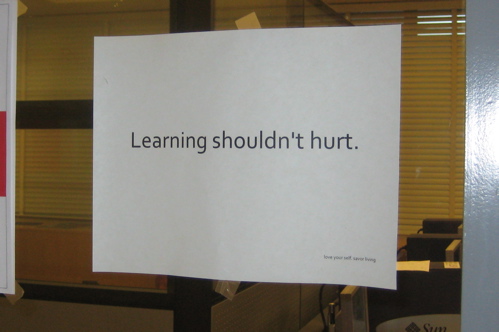
MIT, where I work, is a conglomerate of endless hallways.  Buildings are attached to buildings; one segues into the next.  Bulletin boards are everywhere, and, as I walk the long halls to my office in the morning and back to the car at night, I glance at a changing collection of flyers and posters pinned up by student groups and campus organizations.  I read some as carefully as I read cereal boxes, in other words, pretty thoroughly.

This one, taped to the interior window of room filled with public computers, has been up all semester.

Who sponsors it, I don’t know. Perhaps its simple, subversive reminder is the humane work of underground activists.

In the bottom right corner, all it says is love your self. savor living.

—-

P.S. Here’s the video of an R.E.M. song that tugs at me, every time.

– Japanese paper diet

In class, giving my students some advice on adding context to their scientific reports on Pfu DNA polymerase, I suggested that they return to their course texts.  “Make sure you digest the lab manual.”

I heard myself and smiled.  I looked around the table; some of them were smiling, too.

“I mean,” I said, “Make sure you read the lab manual carefully and digest the information in it. Please don’t actually eat it.”

The mind works associatively.  My verb/object error opened an unlikely file drawer in my head, one that contains moments from NBC’s 30 Rock.  Deciding to digress — and I rarely exploit my students as audience, but this time I did — I told them where my internal attention had landed.

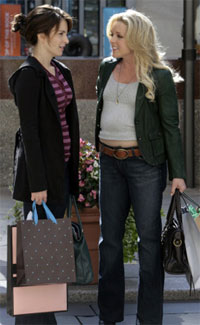
Liz and Jenna

30 Rock: Liz and Jenna

“Did anyone see that 30 Rock episode where Jenna is on the Japanese paper diet?”

I looked around.  They waited; they smiled; no one said anything.  I continued.

“Jenna is one of the stars of a television comedy show, and she’s trying to lose weight.  All she eats is paper.  In the show it’s called the Japanese paper diet.” I paused.  “And so, after I told you to eat the lab manual, I pictured you all eating paper and thought of this.”

Students laughed.  It was so nice of them.

Later, in the van with Jimmy and the two girls, I share the classroom anecdote.  From the way back, Lydia hoots.  “Mom, it’s not called the Japanese paper diet!  It’s called the Japanese porn star diet!” Lydia, who also watches the show, is correct.

Oh, god.  I always meddle, unconsciously, with gags, stories, and jokes, and get them wrong.  My own twists make sense to me, but not usually to anyone else.

In this case, however, I’m so glad I misremembered the diet’s name (although I did remember the gist of the joke: Jenna was eating all the paper she wanted).  There are some things you can say to your students, and some you cannot.  To mention a porn star diet in a science writing class, in any class??  Totally inappropriate.  A paper diet, though?  Just quirky, I hope.

– 100% me

Sunday night dinner. We’re all home. Chicken, salad, corn on the cob.

Jane: Who has homework?

Lydia: I have to write a poem.

Jane: About what?

Eli: It’s not about “anything.” That’s what all the seventh grade poems are about.

Lydia: It’s a one hundred percent me poem.

Jane: You’re a good poet.

Dinner ends; an hour passes. I return to the kitchen, and I see Lydia’s homework stack on the table. On the top, a poem.

100% Me Poem

I pick it up. Lydia’s there and lets me read it: part of her is this, part of her is that, and so on adding up to 100 percent. Under the poem, I see another piece of paper, a form that looks very teacherly, and which Lydia has thoroughly filled out.

100% Me Poem Rubric

Is it possible to score poorly on the 100% Me Poem, and get a… 60% ? Then, would a 12-year-old writer think that her self, and not her poem, was only a portion of what she thought was entire?

I like Lydia’s poem. I don’t love the rubric.

– Walk into the dark

This excerpt is from a ruminative and sparkling post by writer and teacher Alexander Chee on today’s Koreanish:

Part of what is interesting to me about writing is how writing is a social act—a performance for others, a way to connect that has not one guarantee to it. You write and you don’t know that anyone will ever read it or care. You have to proceed in line after line, like someone descending a stairway towards an unknown space below and past an unknown number of stairs also. It may even be an eternal descent until death. You don’t know how much you’ll have to write before you begin to connect to others—that is the crisis of the student writer, for example, but all writers, I think, recognize that crisis as simply a student writer’s introduction to the idea that they could write for their whole lives and never succeed, and they won’t know, even if they write.

You are basically asking them to walk into the dark and trust that they’ll meet someone there. Someone to whom they’ll entrust all of this work. Most of the time you never say this to them because it is a terrible thing to encounter and everyone makes their own peace with it.

– Future professor

I offered to drop Eli off at school on my way into Cambridge this morning. As we got closer to the high school, right around the time of the first bell, activity intensified: cars, bikes, crossing guards, pedestrians, teens, teachers. As we were stopped at an intersection, a student crossed it diagonally. Tall, slight, curly-haired, and hunched under the weight of his pack, he continuously blinked, grimaced, and adjusted his head on his neck as he made his way across, as though the sun and the concrete world were just too much for him and intruded on his private musings.

“Look at that funny kid,” I said to Eli, and I pointed.

“Yeah, I noticed him,” he replied.

“Someday he’s going to be one of those absent-minded professors,” I said.

Eli paused. He smiled. “And yet, his students won’t not like him.”

I knew what he meant. “He’ll be both. You’re right.”

And on my way to work, alone in the car, I thought about being a student and, along with my friends, loving our funny, weird, and quirky teachers and, as a way to show how much we had studied the objects of our affection, performing for each other our elaborate impersonations of the well-loved teachers’ mannerisms. We would laugh, and the laughter was never mean-spirited. It was gleeful, buoyant, and conveyed recognition. And I dare say the impersonations and laughter knit us together, too.

– Rights

On a “Bill of Rights,” collaboratively written by elementary school students in our neighborhood afterschool program, I spotted this item, which is my favorite on the list:

We have a right to be helpful and be helped.

Imagine, the same person, child or adult, could be both helper and helpee. Maybe even on the same day. I like that.

– Number one fear?

For weeks, Grace has been preparing for her animal research project, which is the culmination of the second grade curriculum. Out in the garage, with the door open, she constructed over many days a diorama that featured the elephant seals’ habitat. In the basement, on the kids’ computer, she searched Google for “elephant seals” to find what she called “quick facts.” (They are carnivores and eat skates, small sharks, and other fish, by the way.) She talked about an upcoming “oral presentation,” yet the design and rehearsal of that happened entirely at school.

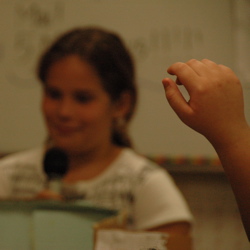
Raised handOn Friday, we went to school, sat in the back of the classroom, and watched Grace and her classmates, one by one, give their presentations. The room was arranged like an auditorium, with a table as podium at the front and the desk chairs arranged in rows. There was a microphone, into which each child spoke as s/he read aloud her prepared remarks. After the formal presentation, each speaker asked, “Any questions or comments?,” and then called on raised hands. Remarkably, what happened during the Q&A is what happens during the Q&A of presentations made by many adults: The speaker relaxed, smiled, and seemed more natural and engaged.

Children have less polish and guile than we do, so there’s something very raw about the behavioral “data” they present for our scrutiny. In this instance, the eight-year-old presenters gave me an opportunity to wonder this: Why does even a practiced, rehearsed professional speaker seem stiffer, less natural, than the same person during the Q&A?

I have always been skeptical of that claim that Americans fear public speaking more than any other fear, even fear of death. This source points to a 1973 survey by the Sunday Times of London that initiated that now wildly-held belief. Of 3,000 respondents, 41% listed public speaking as their number one fear. Hmm. About 1,200 Americans — many of whom might be dead by now — have got a lock on our fears. I, for one, do not fear public speaking over fear of death, or the death of anyone I love, or my fear of woodchippers. Let’s put this survey, and its outdated data, aside and actually examine this fear. Whether it ranks first or tenth, it’s still real. Continue reading

– Devil inside

Every teacher has their “duh” moments, and probably at least one per semester. You say something to your class, and it’s immediately apparent by the looks on their faces that you’re so wrong, or uncouth, or just not with it. By being wrong or simply inexperienced, however, you sometimes learn the coolest things.

Like this semester, in my section of the writing component of an introductory genetics course (which was hard for me to teach, as a newcomer to MIT, and hard for the students to get), I had this brilliant idea to make, with the class, a glossary of sorts for the scientific report that each student was writing on a very similar set of experiments. I had noticed, as I was reading their drafts of the report’s introduction, that the student writers varied dramatically in their use of a technical vocabulary. So I stood near the white board, marker in hand, and asked them, “What are the terms and concepts you think you should cover in this report?”

It was a way of them teaching each other — and me, too — the material, and it worked. As I wrote on the board each term they offered, I asked the speaker to say something about the term, “polymerase,” for example. That student might say, “It’s an enzyme in DNA.” And then another student might add, “It’s what causes amplification.” And then I might ask, “What’s amplification?” And so on. Everyone took notes!, without prompting.

I had a question, too, about this one term that cropped up in almost every one of their drafts: “wild type.” Hmm, what’s this? I immediately associated it with other terms I know, like wild card, wild thing, and wild horses. Crazy, out of control, the outlier. I said, “Someone explain to me this term: wild type.”

There was silence. Smiles. Looks around the room. A few giggles.

“Uh, wild type is just basically the version of a gene as it occurs in nature,” explained one student. She was hesitant, not in her knowledge, but as a way to show tact. Another student added, “It’s a gene that’s not mutated.” This is, I gathered, common knowledge (although not, then, to me).

I laughed out loud at myself. Then they laughed. It was a “duh” moment, but it turned out to be a good one, too.

I remembered this today as I was driving home along a winding back road and occasionally checking my speedometer to make sure I was adhering to the limit. And then I was thinking of (a few) people I know who try to respect posted speed limits. And I broadened that category to people I know who honor common courtesies, follow procedures, recognize the importance of Scrabble rules, and so on. Sometimes it can feel like a burden to always remain within bounds. It’s a weird comfort, though, to realize that even though you may not be a wild thing, you’re always the wild type, through and through.

—–

P.S. Does anyone remember “Devil Inside” by INXS? I was a fan of that band in the 1980s, and Jimmy and I went to Great Woods to see them when I was in my mid-20s. Even then, I somehow felt too old to be in that crowd.