– What you remember

Sunday. The water was 52° F. today; the air was 68°. Grace, Elena, and Sarah went into the water the moment we got to Cold Storage Beach; my father stood there, knee-deep, for a few minutes and then dove in. Later, I went in all the way, as promised. I lasted about 10 seconds. Lydia and Karalyn had a swim after they came back from the jetty.

Last year’s Memorial Day weekend was also sunny and warm, “75-80 degrees,” according to my mother’s 2007 datebook. The 2006 holiday weekend was glorious, too, and we went swimming to get a jump on summer. Three times: I’d call that a tradition.

This morning before the beach, and then later at dinner, I surveyed my siblings, their spouses and friends, and my parents, “What do you remember about Memorial Day from when you were a child?” Flags. A commemoration at school. Cemetery visits. Going to the parade. Being a Girl Scout and walking in the parade. An annual get-together with family friends.

Those memories of Memorial Day are like mine. I also remember the first few lines of one of the few poems I ever had to memorize in school, and I recall reciting it, with my classmates, in the paved playground of Leicester Center School, when I was in 4th or 5th grade, during a ceremony in which the flag was unfolded from its formal triangle, then raised to the top of the flag pole, then lowered half-way.

In Flanders Fields (1915)

In Flanders fields the poppies blow
Between the crosses, row on row,
That mark our place; and in the sky
The larks, still bravely singing, fly
Scarce heard amid the guns below.

We are the Dead. Short days ago
We lived, felt dawn, saw sunset glow,
Loved, and were loved, and now we lie
In Flanders fields.

Take up our quarrel with the foe:
To you from failing hands we throw
The torch; be yours to hold it high.
If ye break faith with us who die
We shall not sleep, though poppies grow
In Flanders fields.

John McCrae

I do not remember learning about World War I in school around this time, but we did learn about poppy fields, and veterans’ cemeteries, and flags. We must have recited the poem in sing-songy, childish voices, caught up in the rhythm. I doubt we stopped in the middle of the first line of the second stanza, as a reader should. I read that line now, as an adult, for the first time in more than 30 years, and I wonder, how can you not stop after such a line, “We are the Dead.” That stanza is something, isn’t it?, with all the thudding “d” sounds, starting with that doubled one: dead.

It seemed beautiful to me then, as a child, that image of an endless field of orange poppy heads waving in the sun, a makeshift burial ground transformed. Somber and bright at once. I don’t think I thought of sleepless soldiers under the poppies, or who the speaker of the poem might be or, rather, had been.
– Four characters

Months ago, I asked a favor of Y., a student I have known for two years. She is a regular in the writing center, and she was in my composition class last spring. All teachers secretly root for and are attracted to certain kinds of students, and this is something you start to know about yourself, as a teacher, as semesters roll by. A colleague of mine, a steadily productive one, admitted to relishing her work with the “out there,” unpredictable students. And me? This student, Y., is of the kind I have my eye on: hard-working, quiet, smart without fanfare.

I asked Y. to translate for me the scroll that the Chinese father of X., another (former) student, made for me a few years ago, when X. was graduating from her Master’s program. The parents were visiting the United States for the first time, and the daughter asked her father, apparently a skilled calligrapher, to make a scroll each for a few teachers and bring them along as gifts; I was a lucky one. Although fluent in Mandarin, her native language, X. was as unable as I to read the scroll. She explained: “It’s traditional.”

Y., current student (and, yes, her name begins with the letter Y and the former student’s name begins with the letter X), took this on as a project. Once in a while, since I have asked her, she has popped in to the writing center to update me on her progress, to give me a clue or two about the meaning she was finding.

Yesterday she stopped by and asked to meet formally. Y. had heard it was my last day in the writing center, not just for the semester, but for always. We sat down together, and she translated, at length and with plenty of her own commentary on Chinese poetry, the scroll. In four lines, the poem is about what we might, in English, call melancholy. Set at the end of spring, a time of year that intensifies such feelings, it uses the imagery of the garden, grass, and water to evoke an older person’s recollections of “people who are missing” — people who have gone before, grown children who have moved away. “It’s metaphor,” said Y.

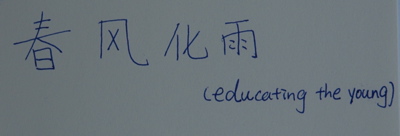
There was more for Y. to teach me. She gave me an envelope and said it was okay for me to open it. In her longish farewell note to me, written in careful English and careful Chinese, there were these four characters:

Excerpt from Y\'s note

The four characters represent these words: SPRING ** WIND ** TRANSFORM ** RAIN

Y.’s note offered an English translation — “educating the young” is what a teacher does — but her longer commentary on the characters, which she spoke aloud and illustrated on scrap paper, was richer. Let’s see if I can do Y. justice. Here goes:

SPRING seems to be a time of year that suggests both beginnings and the end of beginnings. This is the moment in which a teacher meets her student. The teacher is WIND, which, by its gentle force, TRANSFORMS and disperses the RAIN, which is knowledge. By transforming the rain into droplets that are not too small and not too large, and by dispersing them to the grass (grass, which stands for students, is implied), a teacher teaches.

I am so taken by this, these qualities of teaching and knowledge being powerful and yet ephemeral. I like, too, how the teacher is unbundled from knowledge; there is wind and there is rain; and neither contains the other, although they mingle. Y. shared a new metaphor with me that seemed instantly right.

It’s mid spring in New England. I’m moving on and might never see Y. again, although I don’t know. To each other, we may become, over time, people who are missing. Not gone, not dead: missed.

– The long bones

Bones

A student in the college’s funeral service program brought into the Writing Center her paper on organ and tissue donation. Before I read it, I asked her about the assignment, and I also asked if there was anything in particular she’d like me to read for. The assignment, she told me, required her to cover all aspects of the subject — religious, legal, ethical, and technical — in about five pages. When I raised my eyebrows at this, she remarked, “Yeah, it’s a lot to cover in a short space.” And she asked me to read “to see if it’s all right.”

Her writing was all right: clear, grammatical, good paragraphing. As reader, though, I found myself most fascinated by the one or two page technical section, which described how enbalmers remove organs and tissues and then prepare bodies after that, and especially by a paragraph or two on the long bones: the ones in arms and legs (and later I found out, in fingers). Not only did I not have any previous knowledge that these could be donated and transplanted, I loved the sound of the phrase “the long bones.”

I thought of telling her how all the action in the paper was in my favorite section and presenting the possibility of revising around that section. I stopped myself. She didn’t ask me how to write an exciting paper; her feedback request was more practical. In the end, I gave her a compliment about how well she described the hands-on work of her intended profession, and I raised a few questions to get her to sharpen a couple of meandering paragraphs.

Later, on my own and with friend and colleague Jan Donley, I reflected on myself as a demanding reader. How does that affect the way I respond to student writing? To friends’ writing? I hope I have the self-restraint to allow their work to be about what it’s about for them. Do I only exhibit that, however, when the writer is a pretty good one? I fear that, with student writers I consider lesser, I step in and give stronger, more shaping (and possibly diverting) feedback.

As a hungry reader, I am foraging constantly for something good in everything I read, whether it be a bit or the whole thing. I can’t stop thinking of the long bones. The phrase has been ringing in my imaginative ears. I drive around from place to place, and look down at my legs, at the span of my arm from shoulder to wheel, at my fingers. The long bones, the long bones, the long bones.

—-

Drawing by Nadav. Found on Flickr.

– Reciprocity

Sometimes a student enters the Writing Center in distress, having been told by a professor that his writing is so “unreadable” that the professor has not attempted, beyond the first paragraph, to read it.

These instances make me think again about the writer’s job, yet even more so about the reader’s. They each must try hard to reach the other. Writer, write hard. Reader, listen hard. Communication is a meeting in a middle place. Not a compromise, though. A meeting.

I like how Joseph M. Williams, the author of perhaps my favorite handbook on style, Style: Ten Lessons in Clarity and Grace 6e (Longman 2000), reflects on a writer’s role in this relationship:

We write and revise our earliest drafts to discover and express what we mean, but in the drafts thereafter, we write and revise to make it clear to our readers. At the heart of that process is a principle whose model you probably recall: Write for others as you would have others write for you. (220)

He says much more about the golden rule and a writer’s obligation, and I wholeheartedly recommend the chapter “Ethics of Prose.” In it, Williams also says this, about the golden rule and readers:

Some readers read less well than others, and some expect more from a writer than their meager investment of time and effort earns them. In fact, just as writers have an obligation to readers, so do we as readers have an obligation to writers: If we assume that writers work hard to say something important to us, we should read thoughtfully and generously, at least until we decide they have given us good reason to stop. (221-222)

Reading and listening — paying attention — to the words of another require generosity: a gift, a gesture. It takes effort to look beyond the lack of clarity in a student’s writing, but if we believe that they are making an attempt to say something important to us (it’s our assignment, after all!), then we should reciprocate. Williams calls such an exchange “fair” (222).

A penciled notation on the inside page reminds me that I paid $6.50 at Brookline Booksmith Annex for a used copy of Style. The latest edition, the 9th, is much more. Still, it’s worth it.

– Walk 500 miles

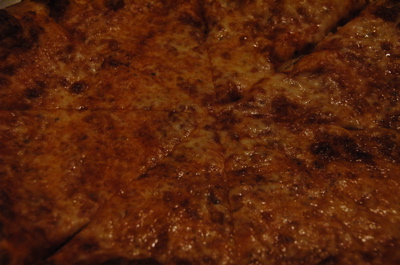
Does this look good to you?

Pizza slice

What would you do to get some? Walk 500 miles? Pass up tickets to the World Series? Give up your spring break?

If not those, then could the promise of pizza get you to show up at a meeting?

Not me. I’ve noticed, however, that this is a lure for students. A huge one. Right now I’m dividing my time between two different colleges, which are so different that I’d think the students at them would be motivated by different rewards, yet I notice a striking prevalence of the words FREE PIZZA on posters and chalkboards announcing club meetings, grammar workshops, and support groups.

Does it work? If you offer a snack to someone to get them to ingest, oh, comma rules, will he stick around long enough to learn how to fix his comma splices?

I’m skeptical.

Around the time I turned 40, I said to my children, as they waited impatiently for the usual Friday night delivery: “I’m so done with pizza.” Really, I’ve had enough. Because I’m not into pizza, if I offered it to students, there would be something condescending in that. I like comma rules, but I doubt that they do, so the pizza would be a cheap trick. A manipulation.

So what if I tempted them with something that tempts me too? Good olives. A roasted potato. Grilled flank steak from a recipe my friend Marcia gave me years ago. Walnuts. Almonds.

(Picture that poster. FREE ALMONDS.)

I’m interested in these questions of motivation. It takes empathy and creativity to persuade people to do what they don’t actually want to do. Yet, we keep relying on the same tired old tricks.

The blog Motivation Matters at Education Week has been covering the cash incentives that schools offer K-12 students to apply themselves to various tasks: reading, enrolling in AP courses, completing homework. Recently, Ken Bushwiller reported that panelists at the American Economic Association’s annual meeting demonstrated that “giving students incentives was not very effective.”

Alex Kjerjulf, a self-identified Chief Happiness Officer, considers the contemporary workplace and claims, “Many people don’t feel motivated at work, and there’s a very simple explanation for this: The motivational techniques used by most managers don’t work.” His blog post, which includes a vivid illustration, is titled, “Why Motivation by Pizza Doesn’t Work.”

Kjerjulf discusses extrinsic and intrinsic rewards and comes down firmly on the side of helping people find their own internal motivation. What is it that employees deeply want to do? (Hint:”eat pizza” is not the answer.)

What is it, I wonder, that students deeply want to do at school? More specifically, what is it that they want to do in my writing class?

Steven Reiss, a professor of psychology at Ohio State University, argues that there are more than the two kinds of motivation: “It’s all a matter of individual differences. Different people are motivated in different ways.” His research has theorized 16 basic desires.

This is news to me. Reiss’s findings seem sound. When I think about motivating students to undertake the assignments in my course, however, I could become overwhelmed trying to design incentives for all their human differences. This one might be motivated by pizza, that one by cash, he by the stuff itself, and she by acclaim.

Just as one person cannot be all things to all people, one teacher cannot design all rewards for all students.

Does that leave me back at square one? Hmm, maybe. How about this, though? I’ll offer them free almonds. Well, not really almonds. What if I offered them the promise of the same rewards that motivate me? A chance to talk about writing with other smart people. Good questions. Stuff worth reading. Moments of writing together. A little time, here and there, to get to know something about each other. Mutual support for the long haul and the steps we take alone.

Not everyone will bite, but some will. And there will be plenty for me.

—–

Thank you, Eli Guterman, for putting aside your dinner for five minutes to take the pizza picture. And thanks to a YouTube member for the clip of The Proclaimers doing an acoustic version of “I’m Gonna Be,” which includes the unforgettable line: “I would walk 500 miles and I would walk 500 more.” I love it.

– Convergence

Last week we saw Ratatouille (Pixar 2007) for the first time. Remy is a French rat who loves fine food; his ambition to become a chef is stoked by imaginative visitations from the late Auguste Gusteau, a once-renowned restaurateur who wrote a book titled

Anyone Can Cook.

Yesterday I was sorting through a pile of non-urgent papers that I’ve been hiding, even from myself, in my top desk drawer at home. I came across a document, “NCTE Beliefs about the Teaching of Writing,” that a colleague asked me to read months ago. My eyes fell on the first belief, in bold type:

Everyone has the capacity to write.

These are beliefs. Like the jolly Gusteau, a person can choose to believe that each individual has the capacity to cook (not to become a great chef, but to cook). Like the Writing Study Group of the NCTE, a teacher can choose to believe that each student can write.

What if, however, a chef or a teacher held a similar belief, and yet also maintained an attitude inconsistent with that belief?

How many times have I heard someone grumble about students (especially incoming ones): “They can’t write”? I don’t think that a teacher, whose work is essentially optimistic, believes that college students do not have the capacity to write. What such a teacher is really saying is that her students’ writing does not meet her expectations, or college expectations, and she is daunted by that, and it brings her down. And yet, I wonder, what power does that attitude (“They can’t write”) have on one’s beliefs about one’s own students and, more so, one’s own teaching?

Once in a while I meet a new student in the Writing Center, and, as I read her writing for the first time, I see that it lacks so much in the way of clarity and sense that I do a quick, internal inventory for any teaching skills I might have to offer her as a writer and I come up almost empty. In such an instance, I do feel daunted — it’s like a stone in my chest — and I even set my sights low, not for the student but for the paper at hand. “Jane, just be an attentive audience. Give the student that.” So, I read and I get her to tell me about it. I don’t always understand her reply entirely, but I usually understand enough of it to have a conversation with her about her personal narrative, or reading of a novel, or thoughts about a historical event. I don’t correct or suggest. I listen, ask, nod, smile.

I have been tutoring S., who is such a writing-challenged student, for more than a year. She continues to make sentences that seem more spoken than written, and her grasp of American English idiom is based on what she hears, not what she reads. (For example, in a paper about a high school teacher, she described that person as being “inch arch” of a learning center. She and I figured out that the teacher was “in charge” of a learning center.) Encouragingly, I also see that her sentences are longer and more flowing and that her papers are more fully developed with detail and discussion. She sustains. And that’s a powerful sign of her growth as a writer, but it might be hard to recognize it if I were ticking off her many errors. And there are many; I do see them (and we are just beginning to work on some).

When another teacher, in genuine moments of fatigue or frustration, says to me, “My students can’t write,” I offer, gently, “They’ll get there.” I do not know what my tutee, S., will do in her writing, in school, and in her life beyond my time with her, but I do believe she will get there.

– Longer

Scene: Writing Center. Student and tutor looking together at a paper.

Student: Why did you circle this… and this?

Jane: In a few places you use long phrases, and I’ll bet you could find a way to say it more directly.

Student: Oh, I know. But I sometimes add more words on purpose, so it will make it longer. You know, so it seems like a paper.

Jane: Academic?

Student: Yeah. Teachers seem to like that.

Jane: Hmm.

– Tutor as tailor

My writing center colleague, Jane Hirschhorn, published her article, ESL and LD Students: Diverse Populations, Common Concerns,” in the fall issue of Praxis. Grounding her discussion in research and personal experience, Jane describes writing challenges shared by diverse students, and she offers tutoring strategies, with examples, that effectively serve them.

Her key metaphor, incidentally, is tutor as tailor, which reminds the reader that tutoring involves the art of seeing and serving each person uniquely.

– Master/Novice

Since writing the “Wide eyed” post on novices, I’ve been seeing references to newness everywhere.  (Is my unconscious attention looking for them?)

Shirin Neshat, a “visual artist who works primarily in video,” has produced a body of work — Passage (2001), for example — that has garnered prizes and earned permanent placement in the collections of the Guggenheim, the Whitney, and the British Museum (Collins 86).  Although such a project has risks, she’s at work on her first film-length project, an adaptation of a novel by Iranian writer Shahmush Parsipur.  Neshat tells interviewer Lauren Collins that she felt “compelled to make Women Without Men“:

“It got to a point that it was a biennial here, a biennial there,” she said… “I started to get really tired of it. I needed a project that would let me be alone, let me be a beginner again.  I wanted to hide from the art world.  There was a danger that I would lose persepective–the integrity, honesty, and naïveté being washed away.” She pounded her fist against her palm to illustrate a wave eroding the shore. (90)

Historian and cultural critic Jacques Barzun is about to turn 100.  His former student, Arthur Krystal, “first encountered” Barzun in 1970, when Krystal was 22 and a graduate student at Columbia where Barzun, then 62, was University Professor of History; in spite of many differences, the two “hit if off” (Krystal 100).  Remarking on Barzun’s reputation and many accomplishments, Krystal points out a quality in his now friend that differentiates his work, and his stance, from others’:

Barzun regards himself in many respects as an “amateur” (the Latin root, amator, means “lover”), someone who takes genuine pleasure in what he learns about.  More than any other historian of the past four generations, Barzun has stood for the seemingly contradictory ideas of scholarly rigor and unaffected enthusiasm. (94)

I see that my friend and colleague Jan Donley, a writer and teacher, has altered the title of her website’s page on teaching to call it “Learning.”  One of my favorite running conversations with Jan has been on the seeming contradiction of being inside and outside an experience at once.  We’ve talked, for example, about being present in a classroom moment while stepping outside it, so that one can deeply participate and get some perspective, simultaneously.  A kind of duality.  It’s hard, requiring a person to let go and remain steady at the same time.  Now I’m mulling over Jan’s suggestion that, to be a teacher (and a writer), one must be a learner, too.

Which reminds me of a conversation I had last Easter with my father, Stephen Kokernak, about students.  (He was a teacher, a more than good one, of high school math for almost four decades.)  I was venting to him and my sister Sally about how some of my freshman students were not stepping up to the plate: not doing the reading, not bringing the book or homework to class.  My father commiserated as a teacher, and also talked about his own habits in college.  Then he said (something like this): “You know, I think it wasn’t until I became teacher that I finally figured out how to be a student, when I had to learn how to learn.”

To be a master and a novice at once seems key for being a teacher, writer, filmmaker.  Does the inverse work?  To be a student — a learner — must there be opportunities for teaching?

—-

Sources:
Collins, Lauren.  “Voice of the Veil” (Shirin Neshat).  New Yorker, Oct. 22, 2007.  86-92.
Krystal, Arthur.  “Age of Reason” (Jacques Barzun).  New Yorker, Oct. 22, 2007. 94-103.